Editorial review: October 31, 2026. Announcement date: October 28, 2026. This is not an October 31 product launch.
Verified news, narrowly stated
TikTok's October 28 newsroom announcement introduced a Brand Safety Center, a Brand Protection Playbook, and AI Safety Essentials at its APAC Responsible Media Forum in Singapore. The AI advertising guide was developed with Responsible Marketing Advisory. These are company announcements, not an independent assessment of campaign safety. Primary announcement.
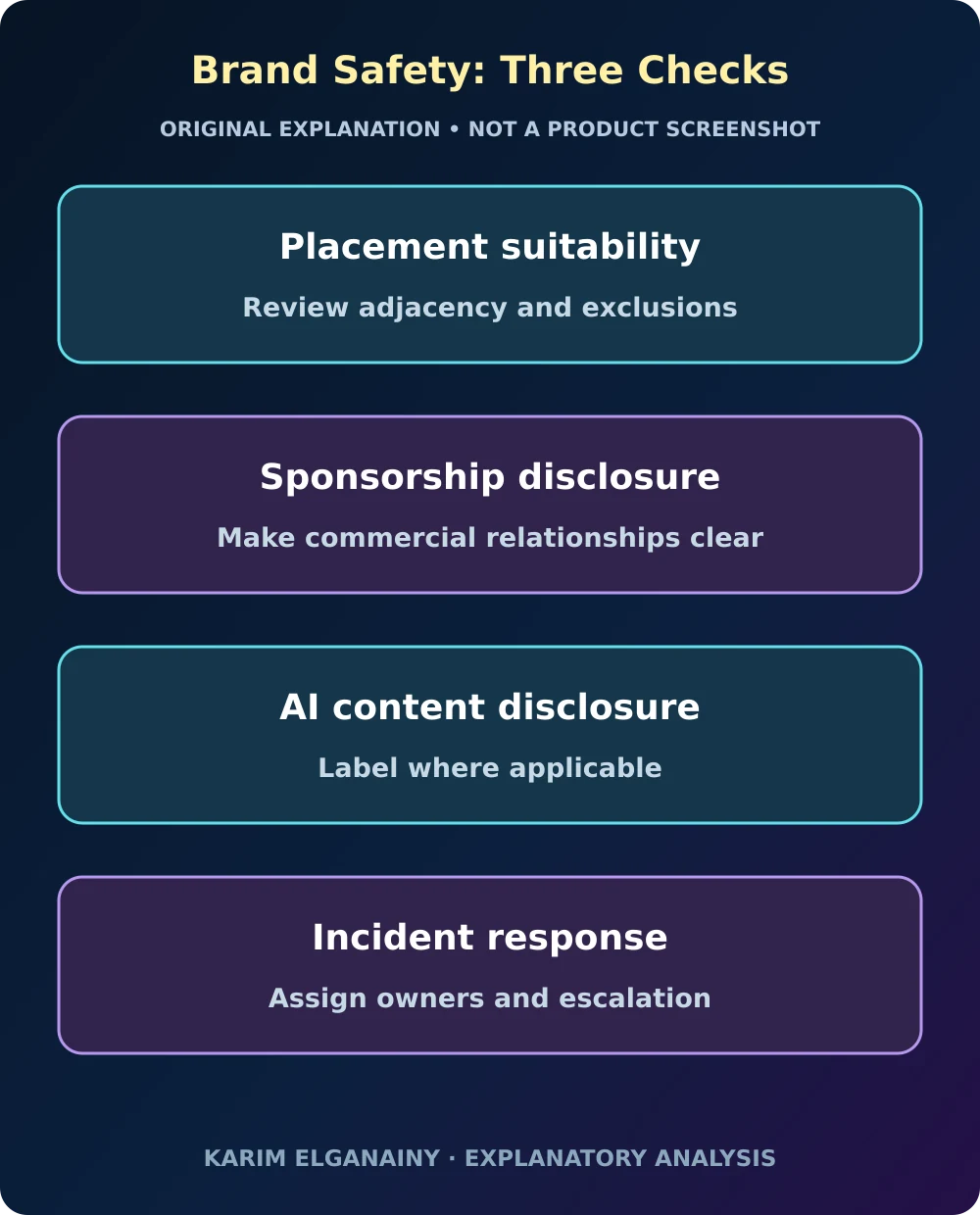
Original editorial framework; not a product screenshot or proof of campaign results.
Editorial application: turn resources into operating decisions
The following framework is original practical analysis, not a description of newly confirmed product functionality. Its purpose is to help a marketing team decide what to verify, who should approve a campaign, and what evidence should survive after launch. A resource library can improve access to information; it cannot decide which risks a particular organization should accept. That decision depends on the campaign, the audience, the creative execution, and the consequences of getting something wrong.
Start with a distinction between an uncomfortable conversation and an unacceptable exposure. A critical product review may be relevant customer feedback. An advertisement implying a claim the business cannot support is a different problem. Treating both as a generic reputation issue can produce the wrong response: suppressing useful criticism while leaving the advertiser's own misleading message untouched. A useful operating system separates media context, creative accuracy, audience suitability, and response readiness before assigning controls.
1. Write the risk statement before choosing settings
For each campaign, complete this sentence: “We would pause this activity if the following observable condition occurred.” Avoid expressions such as “bad sentiment” without a threshold or example. A more useful condition might be a verified mismatch between the offer shown in the advertisement and the offer available on the destination page. Another might be a creative execution that appears to present a fictional person as a real customer without adequate explanation.
Record why the condition matters, how the team could detect it, and who can decide whether it has occurred. The person monitoring comments should not have to invent company policy during a fast-moving incident. At the same time, a pause rule should not punish every ambiguous complaint. Add an intermediate review state for reports that deserve investigation but have not been confirmed. This creates a proportionate response instead of a choice between doing nothing and stopping everything.
2. Separate campaign scope from platform scope
Build a one-page campaign inventory containing the account, market, language, objective, destination, creative versions, responsible agency, and intended audience. Add any dependencies that must be checked inside the actual account, including access to reporting or verification services. A global announcement does not establish that every account has identical options. Confirm availability before incorporating a tool into a launch checklist, and retain the date of that check.
This inventory is particularly useful when one creative concept becomes several local campaigns. The broad idea may be shared, but the delivery settings and customer experience may differ. An Arabic advertisement leading to an English-only checkout introduces a problem that no media-context setting can solve. Similarly, a campaign may use a locally appropriate message while its customer support operates in a different time zone. These are operational gaps, not reasons to assume the platform failed.
3. Give each control a job and an owner
Do not evaluate a control by its name alone. Ask what failure it is intended to prevent, which campaign elements it covers, and what remains outside that coverage. Write a short control record: risk addressed, setting or process, owner, evidence, review date, and unresolved limitation. Where a setting is unavailable, document the substitute process or decide that the campaign should not proceed. “Not checked” should remain visibly different from “not applicable.”
An agency might configure media settings while the brand approves creative claims and the customer-care team handles complaints. That division can work only if the handoffs are explicit. Require the agency to provide confirmation of the configured campaign, not merely a general policy document. Require the brand reviewer to identify the approved creative version. Require the response owner to confirm that the destination and escalation contact are current. Small records make responsibilities testable.
4. Review synthetic creative at the level of the claim
An internal AI review should ask what the audience is likely to believe, not simply whether a production tool was used. A synthetic background, a translated voice, and a fabricated customer testimonial create different questions. For each asset, note what was generated or materially altered, whether a real person's identity is involved, what permissions have been obtained, and whether the result changes the apparent evidence supporting the advertisement.
Consider a hypothetical home-appliance campaign that shows a digitally constructed demonstration. The review should check whether the animation could be mistaken for a documented performance test. If the intended message depends on a result the business has not established, adding a general production note may not resolve the underlying issue. The safer creative route may be to illustrate the mechanism without presenting an invented outcome. This is editorial workflow advice, not a statement of a specific platform rule or legal requirement.
5. Test language, context, and comprehension separately
For bilingual campaigns, conduct a meaning review rather than relying only on sentence-level translation. Ask a reviewer to explain the offer in their own words after watching the advertisement once. Then compare that explanation with the approved claim and destination page. A literal translation can preserve vocabulary while changing urgency, certainty, or the impression of who is speaking. Those differences matter when the video is short and the viewer has little time to inspect qualifications.
Include on-screen text, captions, voice-over, disclosure placement, and the first destination screen in the same review. An otherwise clear explanation can become unreadable when a subtitle overlaps a label. Test the smallest intended display size, realistic sound-off viewing, and the actual language mix. Do not assume all Arabic-speaking audiences interpret dialect, humor, or examples identically. Select reviewers who understand the intended audience, and record disagreements instead of smoothing them into a vague approval.
6. Keep criticism separate from suspected infringement
Create separate intake paths for customer dissatisfaction, impersonation concerns, suspected misuse of brand assets, and media-context complaints. Each requires different evidence and a different owner. A dissatisfied customer's account of their experience should not automatically become an intellectual-property complaint. Conversely, a suspected fake storefront should not sit in a general sentiment report while customers continue receiving confusing messages. Classification helps the team respond to the actual problem.
The intake form should request a link, capture time, description of the concern, campaign relationship if known, and the minimum supporting evidence needed for review. Avoid collecting unnecessary personal information or circulating screenshots more broadly than required. Have an authorized reviewer decide which platform reporting route or internal team is appropriate. This article does not establish rights ownership or provide a legal conclusion; contested rights questions need qualified review before an accusation is made.
7. Design an incident exercise before a real incident
Run a short tabletop exercise using a fictional example. Suppose a viewer says an advertisement misrepresents a product demonstration. Ask who receives the report, who verifies the asset, who checks the supporting material, and who can pause delivery if necessary. Then test the path when the primary owner is unavailable. A contact list that works only during one person's office hours is not a resilient process.
The exercise should produce a decision log rather than theatrical urgency. Record the evidence available at each stage, the action taken, and what additional fact would change that action. Distinguish pausing an advertisement from deleting the evidence needed to understand it. Preserve the approved version and relevant configuration record in a restricted workspace. Once the issue is resolved, define who authorizes a restart and how the team will confirm that the corrected version, rather than the earlier asset, is active.
8. Measure process quality without promising safety
Useful internal measures can include the proportion of active campaigns with documented owners, the share of creative versions with completed review, the time needed to route a verified concern, and the number of unresolved configuration checks. These are process indicators, not proof that an environment is risk-free. A lower incident count can reflect improvement, lower exposure, weaker detection, or a change in what gets reported. Interpret the denominator and detection method before celebrating.
Keep safety review and commercial evaluation connected but distinct. A campaign can meet the organization's controls and still produce poor business results. It can also perform commercially while creating an unacceptable creative or reputational problem. Review both dimensions in the same meeting without collapsing them into a single score that hides trade-offs. When a decision is uncertain, record the uncertainty and the next evidence needed rather than manufacturing a precise-looking number.
9. Build a practical first-week sequence
On the first working day, choose one active campaign and map its assets, owners, destination pages, and open questions. Next, inspect the actual account with the authorized operator and record the relevant settings and access limitations. Review one English and one Arabic execution with a reader who was not involved in production. Use their explanation of the offer to identify ambiguity before rewriting every asset at once.
Then run the fictional incident exercise and close the most consequential handoff gap. At the end of the week, decide whether the process is ready to extend to other campaigns. The output should be a small reusable packet: campaign inventory, risk statement, control record, approved creative references, and escalation path. Keep the packet light enough that people maintain it. A large policy folder that nobody updates provides less practical clarity than a concise record tied to the live campaign.
A decision standard, not a reassurance slogan
The useful response to a new industry resource is neither automatic confidence nor automatic rejection. Ask whether it helps the team make a decision more clearly, verify an assumption, or shorten a preventable handoff failure. If it does, incorporate that improvement into the working process and name an owner. If it does not answer an important question, keep the question open rather than treating the announcement itself as evidence.
For the next campaign approval, require three explanations in plain language: what the audience is being asked to believe, what the organization has actually checked, and what would trigger review after launch. Those explanations will not guarantee performance or eliminate every risk. They do make the campaign easier to audit, correct, and discuss honestly. That is a more defensible operational objective than trying to turn a platform announcement into a promise of universal protection.
Comments
No published comments yet.