Original disclosure date: November 5, 2026. Figures cover the third quarter and nine months ended September 30, 2026. Financial amounts below are in millions of Saudi riyals; comparisons are year-on-year against the equivalent 2025 period unless stated otherwise.
Revenue growth and lower earnings
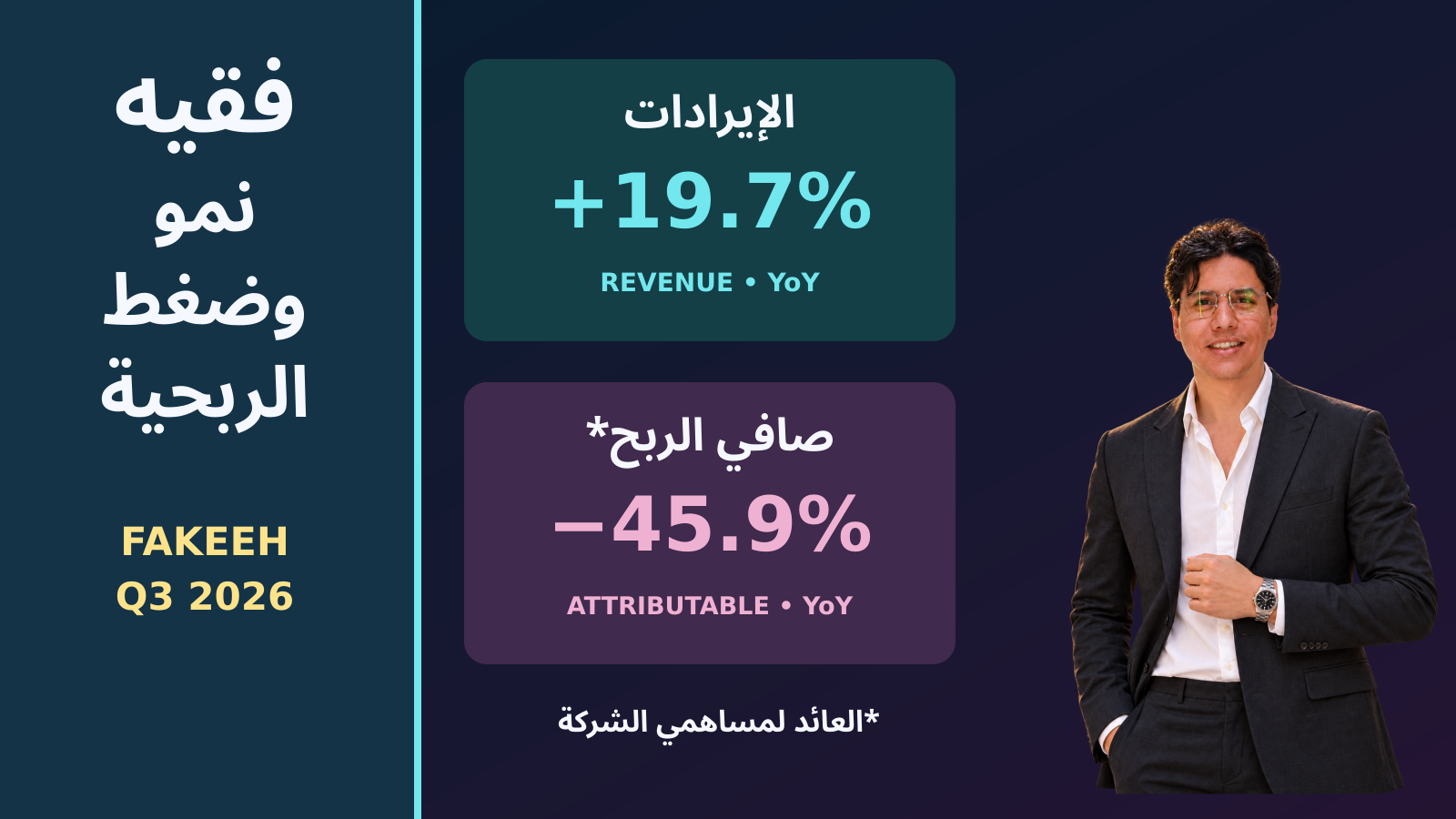
Dr. Soliman Abdel Kader Fakeeh Hospital Co. reported quarterly revenue of SAR 931.26 million versus 778.26 million, up 19.659%. Operating profit was 70.45 million versus 74.13 million, down 4.964%. Net profit attributable to the issuer's shareholders was 38.75 million versus 71.64 million, down 45.91%; this is not consolidated net income before allocation to minority interests. Readable disclosure #99009.
Nine-month revenue reached 2,454.32 million versus 2,291.12 million, while attributable net profit was 135.09 million versus 225.97 million. The company reports consolidation of Dr. Mohammed Al Fagih Hospital from July. Quarterly revenue excluding that acquisition grew 5%; acquisition-related depreciation and financing costs increased. Disclosure details.
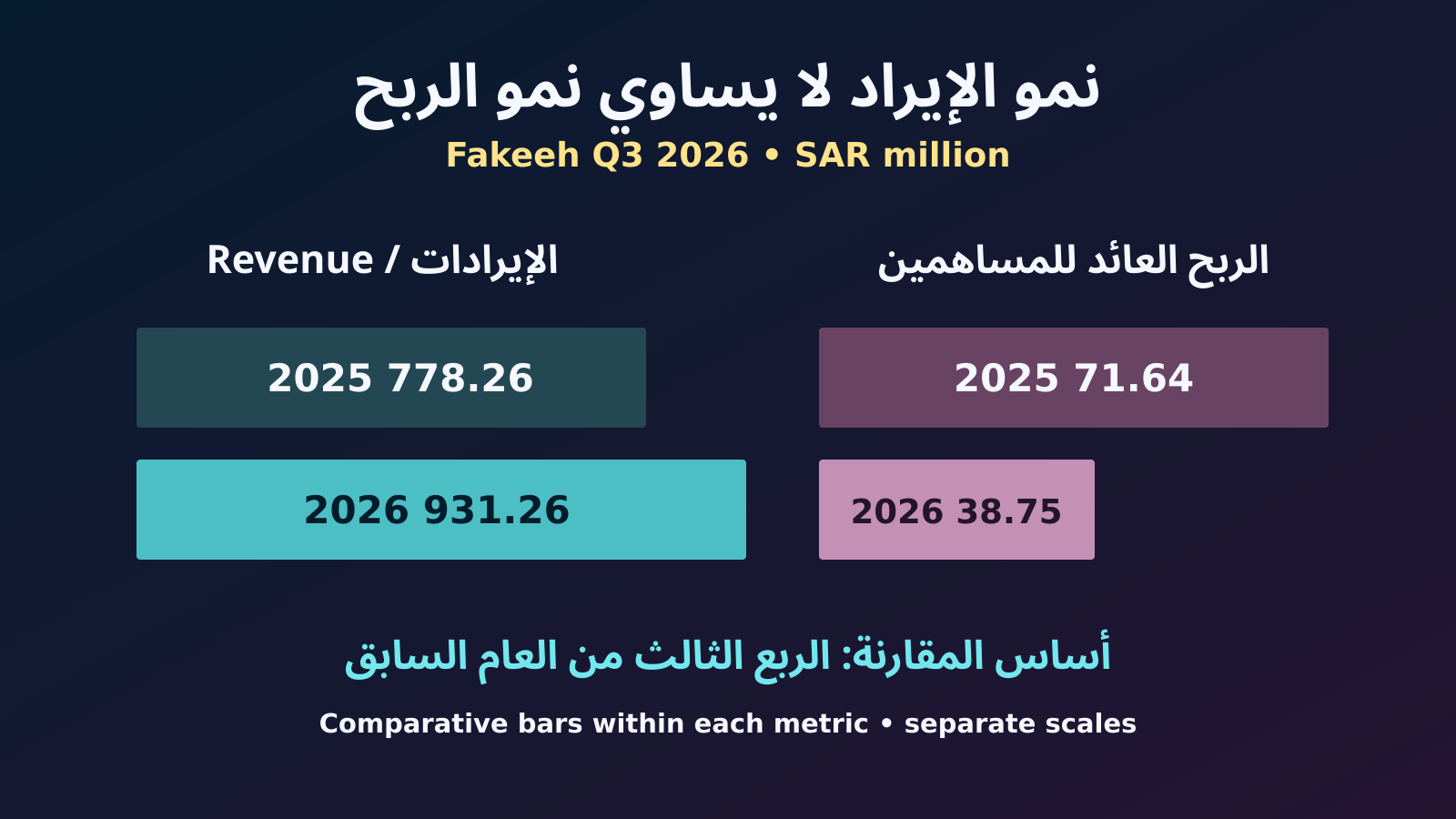
Original chart of disclosed financial data. Year-on-year comparison; SAR millions with separate scales for each metric. Source.
Analysis: reading the gap between growth and profitability
An expanded reporting perimeter changes the comparison. Bringing an additional hospital into consolidated accounts can lift revenue even when growth at existing facilities is more modest. Management therefore needs two views: the reported group result and an assessment of comparable activity. Revenue alone can overstate the contribution of better marketing or stronger demand at established facilities.
Different profit measures also answer different questions. Operating profit helps illuminate activity and operating costs. Net profit is affected by additional items, including financing costs. An advertising campaign cannot reasonably be expected to solve an acquisition-financing expense, and patient demand alone cannot explain every movement in net earnings.
This distinction gives marketing a more useful mandate. Its role includes reaching appropriate demand, explaining services clearly and improving the path from an enquiry to an appointment in coordination with available capacity. Clinical quality, suitable care and patient safety remain essential conditions, rather than variables to be traded away for a financial target.
Three practical priorities for healthcare growth teams
Map capacity against demand. Before increasing media spending, establish appointment availability by specialty, location and clinician. One service may face a long wait while another has unused capacity. Broad promotion of a hospital may not address that imbalance. Better service discovery or a simpler booking path may be more useful than indiscriminate reach.
Keep the patient experience clear during expansion. As a group adds facilities, location details, service descriptions, contact routes and insurance information need to remain accurate. A mismatch between an advertisement and the booking team's explanation creates friction. Maintaining these details is practical growth work, even if it does not resemble a large creative campaign.
Measure conversion quality. Within appropriate privacy boundaries, distinguish qualified enquiries, booked appointments, attended appointments and cancellation reasons. A contact request is not equivalent to a completed service. Examining the gaps between stages helps identify whether an obstacle concerns advertising, response time, availability or unclear procedures.
None of these measures alone establishes the profitability of a clinical service. Finance and operations teams need to interpret cost and revenue information using consistent definitions. Marketing should contribute evidence about demand and access without claiming credit for the entire group result.
A hypothetical management example
Suppose a newly opened branch receives a reasonable number of enquiries but attendance remains weak. Immediately buying more traffic could amplify the same problem. A useful first review might examine response times, map accuracy, rescheduling options and whether patients understand insurance arrangements before arriving.
Once a specific obstacle is identified, management can test a limited correction and compare it with a reasonably similar prior period. The test should record operational changes that might affect the result. Otherwise, a change in staffing or appointment availability could be mistaken for an advertising effect.
This example does not describe an established problem at Fakeeh. It illustrates how a financial observation can generate testable operating questions without diagnosing an organization from a single metric.
What should be watched next?
Future disclosures can help clarify growth excluding acquisitions, operating-profit trends, financing costs and reported operating indicators. One quarter is insufficient to determine whether integration has succeeded or whether the improvement at a newer facility will persist.
For marketing leaders, the practical conclusion is to connect demand measures with delivered services and distinguish consolidation effects from improvements in conversion. Assessing liquidity or investment value requires further evidence and analysis. This article is not a recommendation to buy or sell shares.
Turn financial disclosure into a usable operating dashboard
To avoid jumping from a financial number to a marketing verdict, build a dashboard with four layers. Start with reported figures, including period, unit and definition. Add changes that affect comparability, such as an additional facility or an altered business perimeter. Then examine service delivery: availability, booking, attendance and response. Finally, review marketing sources, messaging and spending.
The order matters. Starting with an advertising channel alone may assign credit for revenue that changed because another hospital entered the accounts. Looking only at financial statements may miss a simple booking obstacle that can be corrected quickly. The task is to connect the layers without mixing definitions or treating timing as sufficient evidence of causation.
Assign an owner to each measure. Finance should validate revenue, profit and cost definitions; operations should validate available capacity and service delivery; marketing should validate spending and enquiry sources. When figures disagree, reconcile definitions and periods before deciding to increase or reduce a budget.
Distinguish facilities at different stages
A new facility requires different questions from one that has operated for years. The former may need basic awareness, clear directions and appropriate referral pathways. An established facility may need to remove friction in an existing patient journey or correct outdated information. A single target and uniform spending rule can obscure those differences.
Review performance by location, specialty and operating stage, without turning that exercise into a simplistic comparison of clinicians or dissimilar medical cases. Service characteristics, case complexity and contracting arrangements affect results. Commercial indicators should not encourage inappropriate care or replace clinical judgment about a patient's needs.
This segmentation also improves communication. A familiar location may need to explain an additional service, while a new one may need to clarify access and booking. This is a general framework for evaluating healthcare expansion, not a claim about a specific deficiency at any Fakeeh facility.
Revenue, attendance and collection are different events
Marketing reports sometimes use bookings as the final measure of performance. But a booking is not a completed visit, and completion does not necessarily mean immediate cash collection. Accounting definitions and procedures vary by service and contract. Agree on the event being measured rather than comparing different stages under one convenient label.
For example, a contact system might record an enquiry, a booking employee might create an appointment, and the patient might later reschedule or cancel. Calling every stage a successful conversion inflates the report. Maintain separate indicators, and avoid sending private health information to advertising tools for matching or optimization.
Where management needs to relate commercial activity to financial results, use aggregated information and definitions reviewed by the relevant specialists. Better measurement does not mean collecting as much patient data as possible. It means using the minimum necessary information, controlling access and following applicable obligations and organizational policies.
A focused review before buying more traffic
Choose one service at one location and examine the journey from a mobile advertisement to an appointment confirmation. Test links, response hours, consistency of information and directions to the facility. The first review does not require a large analytics project. It requires organized observation and a clear record of what actually failed.
Prioritize issues by impact and the feasibility of correction. A broken link or incorrect opening time warrants prompt repair. A hypothesis about an unpersuasive message calls for a limited experiment. Avoid introducing many changes simultaneously if the objective is to learn which intervention made a difference.
Present the outcome with its limitations: observation period, number of cases and any changes in staffing, seasonality or spending. A positive result at one location is not a promise for every branch. A null result can eliminate a weak hypothesis; it should not be hidden by changing the objective after the test ends.
Read financial charts carefully
Revenue, operating profit and attributable net profit have very different magnitudes. A single shared chart can make earnings changes difficult to see. Separate panels or explicit labels can preserve clarity. State that the unit is SAR million and keep periods comparable. Avoid a truncated axis that exaggerates a difference without warning readers.
Label attributable net profit precisely. Replacing it with a generic label can confuse readers when another consolidated earnings measure appears in company materials. Likewise, a quarter should not be compared with a nine-month total without explanation. Good presentation reduces ambiguity rather than merely making the graphic look dramatic.
Keep incentives aligned with useful outcomes
The metric used to reward a team influences its behavior. A target based only on enquiry volume can encourage broad messaging that creates unnecessary work for booking staff. A target based only on attendance can hide important reasons for cancellation. Balance volume indicators with accurate information, ease of access and an appropriate service pathway.
Review a small sample of enquiries with personal details removed to identify questions that public information failed to answer. Repeated questions about location, opening hours or insurance procedures may justify a better service page before another campaign. This addresses an information problem without inferring someone's health status from browsing behavior.
Attribution also deserves restraint. Some enquiries may follow recommendations, clinician referrals or direct searches for the hospital. Assigning the whole outcome to the last advertising click can overstate a channel's contribution. Where causal evidence is unavailable, describe results as associated with the channel under the chosen attribution model.
Make trade-offs visible. Cheaper enquiries may increase contact-center workload, while more specific messaging may produce fewer, more relevant requests. Neither direction is automatically superior. Evaluate the full journey and operational capacity before selecting the next experiment.
Sources and method
- Original Saudi Exchange announcement #99009.
- Full readable disclosure reproduced by FinancialFilings.
- Official company reports page.
Disclosure data was checked against the complete reproduced filing and its Saudi Exchange reference. Practical sections are independent analysis, not an internal diagnosis or a claim that the author has worked with the company.
Comments
No published comments yet.