
Announcement date: November 5, 2026. Publication: November 6, 2026. This article covers SMC Healthcare's third quarter and nine months ended September 30, 2026. Financial amounts are in millions of Saudi riyals, with year-on-year comparisons against the same period in 2025 unless indicated otherwise. The cover is an original conceptual illustration, not a photograph of an SMC facility.
The news: more revenue, less attributable profit
SMC Healthcare reported Q3 revenue of SAR 401.087 million, up 4.819%, and net profit attributable to shareholders of SAR 41.899 million, down 36.751%. Nine-month revenue was SAR 1,183.089 million, up 4.618%, while attributable net profit was SAR 119.628 million, down 9.541%. These measures should not be confused with operating profit, EBITDA or cash generation. Full issuer-disclosure republication; Argaam results.
The Q3 explanation includes revenue costs increasing 9.7% and gross profit declining 8.5%. General and administrative expenses rose 44.4%, principally because of higher expected credit loss provisions. Other income fell 77.7%, while financing costs declined 13.9%. These are separate drivers, not one generic explanation of “weak demand.” The disclosure associates direct costs with ramping up Al Malqa and additional outpatient capacity. Disclosure details.
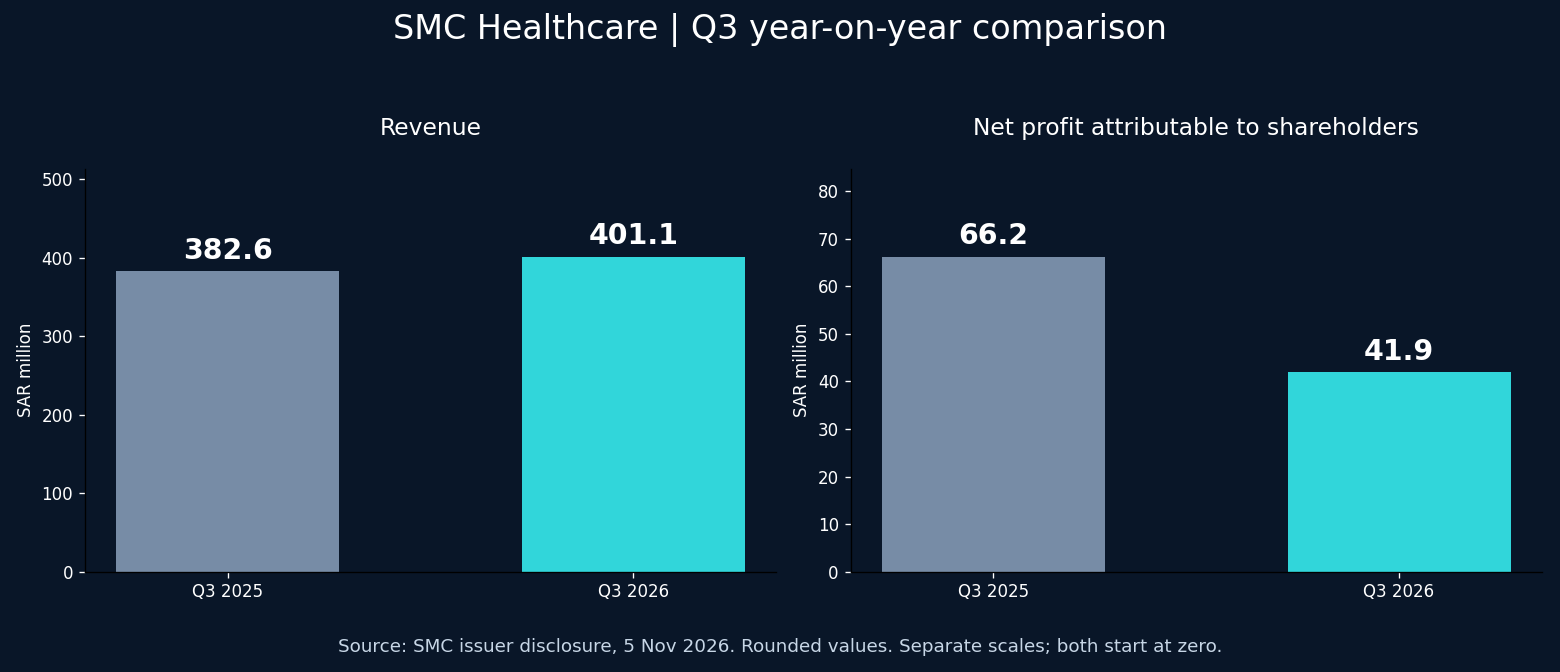
Original chart of rounded disclosed values. Left: revenue. Right: net profit attributable to shareholders. Each panel has its own zero-based scale; bar heights should not be compared between panels. Source.
What the operating figures add
The company-issued release reports outpatient visits rising from 353,018 to 376,108, or 6.5%, while outpatient clinics increased from 307 to 355, or 15.6%. Inpatient nights increased from 39,927 to 42,503, also 6.5%. These figures show expanding activity alongside expanding capacity. The release also describes higher operating and manpower costs, ramp-up expenditure and expected credit loss provisions. Company release.
The release's rounded Q3 EBITDA fell from SAR 104.6 million to 78.7 million, with margin declining from 27.3% to 19.6%. EBITDA is not net profit and is not operating cash flow. It is useful here only as another view of the earnings pressure described by the company. The article does not interpret it as a substitute for audited cash-flow analysis. Company release.
Analysis: capacity grows before it becomes productive
The remainder is independent business and healthcare-marketing analysis, not management guidance or a claim of access to SMC's internal records.
Opening consulting rooms is different from filling appropriate appointment slots. A clinic may be available physically before all specialties, clinician sessions, payer arrangements and booking information are fully established. For a growth team, the useful question is not simply whether there are more clinics. It is whether each service has a clear route from appropriate patient need to an available appointment and a completed visit.
The gap between clinic growth and visit growth is a reason to investigate, not proof that a specific facility is underperforming. The public figures do not disclose comparable clinic operating days, opening dates, staffed hours, specialty mix or utilization by location. Dividing quarterly visits by end-period clinic count would produce a crude ratio, not a reliable productivity KPI. It could penalize rooms opened near the end of the period and conceal differences between mature and new facilities.
A better internal view would separate cohorts by opening date and service. Management could compare attended appointments per staffed clinic hour, appointment lead times and unused bookable capacity. Those measures would distinguish a demand problem from a scheduling problem. The distinction matters because advertising more aggressively cannot create a clinician session that is not available.
Marketing decisions should start with service readiness
Consider a hypothetical medical center preparing to promote a new outpatient specialty. Before increasing spend, its team should verify the actual schedule, referral requirements, accepted payer arrangements, contact-center knowledge and the accuracy of the service page. This is an illustrative workflow, not an account of work performed for SMC.
If qualified callers repeatedly discover that the advertised clinician is unavailable, the next intervention is operational. If appointments exist but prospective patients cannot understand the service or locate it, clearer service information and a simpler booking path may help. If bookings occur but attendance is low, reminders and practical directions deserve attention before another acquisition campaign.
A useful campaign brief therefore names the service, location, available session capacity and intended action. It avoids unsupported clinical promises and unnecessary collection of health details. It should state how inquiries will be answered and who owns correction of misleading or outdated information. Healthcare growth depends on trust as well as conversion.
A practical measurement framework
Begin with one service and one location rather than a group-wide blended conversion rate. Track inquiries, qualified scheduling requests, confirmed appointments and attended appointments as separate stages. Define the observation window so that a patient booking this week for next month is not counted as a failure simply because the visit has not happened yet.
Use aggregate data and approved privacy controls. A marketing dashboard usually does not need diagnoses or clinical notes. Report acquisition costs alongside appointment availability and response times, then review the result with operations. Low cost per inquiry can be misleading when most inquiries cannot be served. Higher initial inquiry costs may still be sensible if the resulting attended appointments match available services and the total economics are sustainable.
Where feasible, test a specific change, such as a clearer location page or a shorter scheduling form, while keeping the service offer stable. Decide beforehand what improvement would justify retaining it. Watch operational safeguards such as waiting time, complaints and cancellations. A conversion increase that worsens service experience is not an unqualified success.
Credit loss provisions require a different response
Expected credit loss provisions concern the recoverability of receivables. They cannot be resolved simply by bringing more people into the booking funnel. The appropriate work may involve eligibility checks, authorization completeness, coding accuracy, claim submission, payer disputes and collection discipline. Public financial results alone do not identify which operational issue applies to this company.
The managerial lesson is to assign the right owner to each problem. Marketing can improve service clarity and appropriate demand. Revenue-cycle and finance teams investigate claims and collections. Operations manages capacity and delivery. A shared meeting can connect these perspectives without attributing every revenue movement or accounting charge to advertising performance.
The next review should ask better questions
An expanding network should be assessed over time, using comparable definitions. Are newer services moving toward sustainable appointment patterns? Are patients finding the correct facility and receiving timely responses? Is reported growth accompanied by suitable cash collection and manageable costs? Which parts of the change are recurring operating performance and which reflect other income or accounting estimates?
None of those questions can be answered conclusively from the headline alone. They form a disciplined agenda for the next review. The takeaway for healthcare growth teams is to connect promotion with actual capacity and the full service journey, while resisting the temptation to treat more traffic, more rooms or more revenue as interchangeable measures of success.
Sources and limitations
- Argaam financial results.
- Saudi Exchange announcement 99071, linked by public disclosure indexes.
- Full issuer disclosure republished by Mubasher.
- SMC company-issued release.
- Official investor-relations financial information.
The Saudi Exchange page returned an access error during verification. Its identifier and date were checked through disclosure indexes; amounts were cross-checked against the full republication, Argaam and the company-issued release. The official IR page had not yet exposed the Q3 document at the time of review. Rounded chart figures differ in precision, not meaning, from the exact disclosure values. This is business analysis, not personalized investment advice, a clinical recommendation or a claim of inside knowledge.
Comments
No published comments yet.