What the announcement establishes
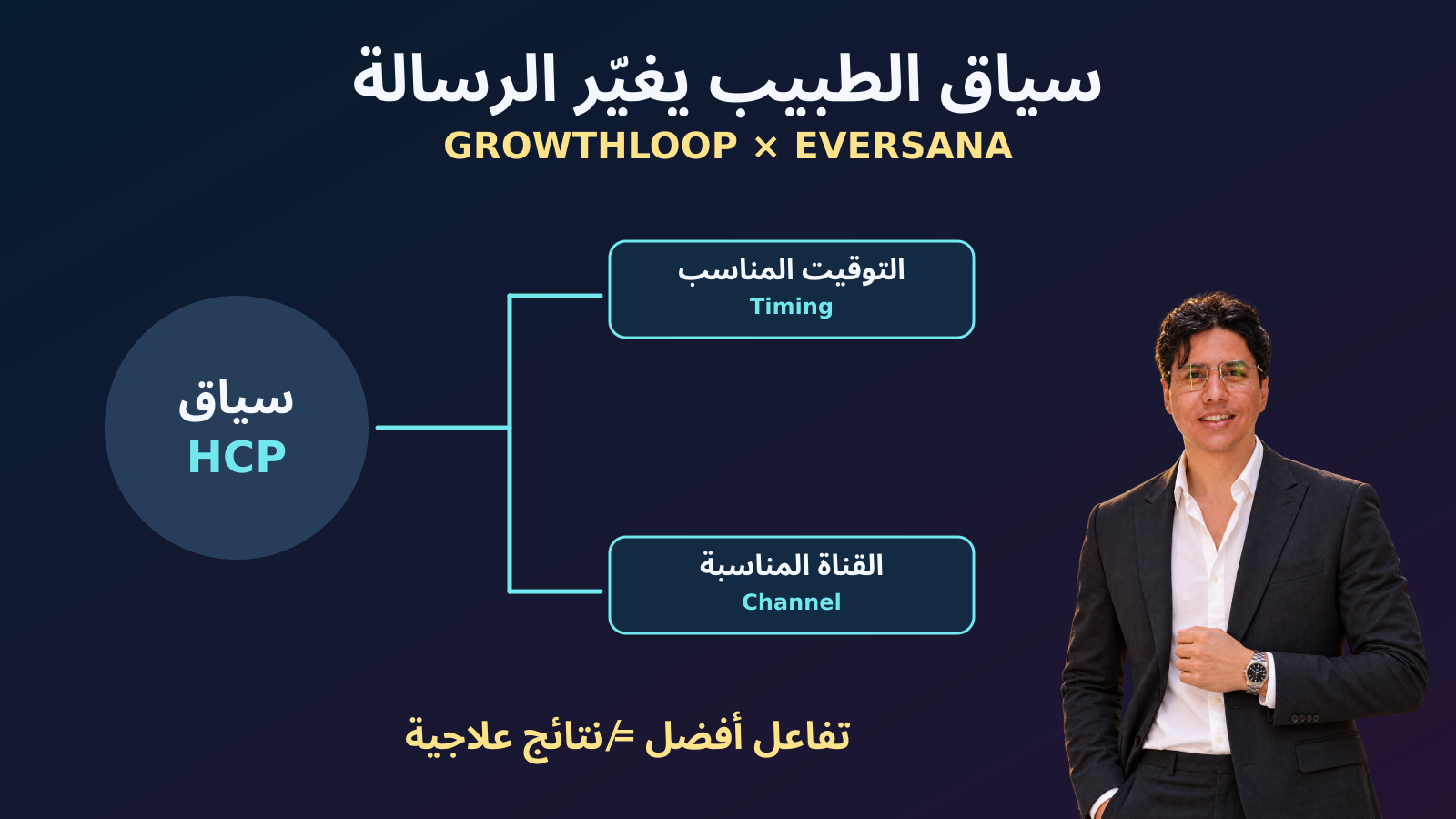
On November 4, 2026, GrowthLoop and EVERSANA announced AI decisioning for biopharmaceutical marketing. Their release describes one campaign: morning sends produced a 13% higher weighted composite engagement score than afternoon sends; display outperformed email by 52% per user only in a peer-to-peer-sourced audience. The score combines digital engagement and prescription activity. These are vendor-reported comparisons. Original announcement.
Analysis: read the outcome before reading the percentage
A percentage can travel much further than the definition underneath it. Someone may see a strong improvement and repeat it as evidence of higher sales, better treatment or a universally superior channel. Those conclusions require different evidence. A composite engagement score reflects a chosen combination of signals. To interpret it, a decision-maker needs to understand what entered the score, how each component was weighted and what the comparison actually measured. The analysis below proposes a way to evaluate such claims and design an appropriate local test. It does not independently validate the vendor's campaign or reproduce its methodology.
Start by writing the result in ordinary language without the headline percentage. Identify the population, intervention, comparator and outcome. Then ask what remains unknown: the observation period, number of participants, assignment method, uncertainty and operational conditions. Missing information does not automatically make a result worthless. It changes the kind of decision that result can support. A preliminary case study can justify further investigation or a carefully bounded pilot. It should carry less weight when someone proposes a major change across markets, products and audiences that were not represented in the original comparison.
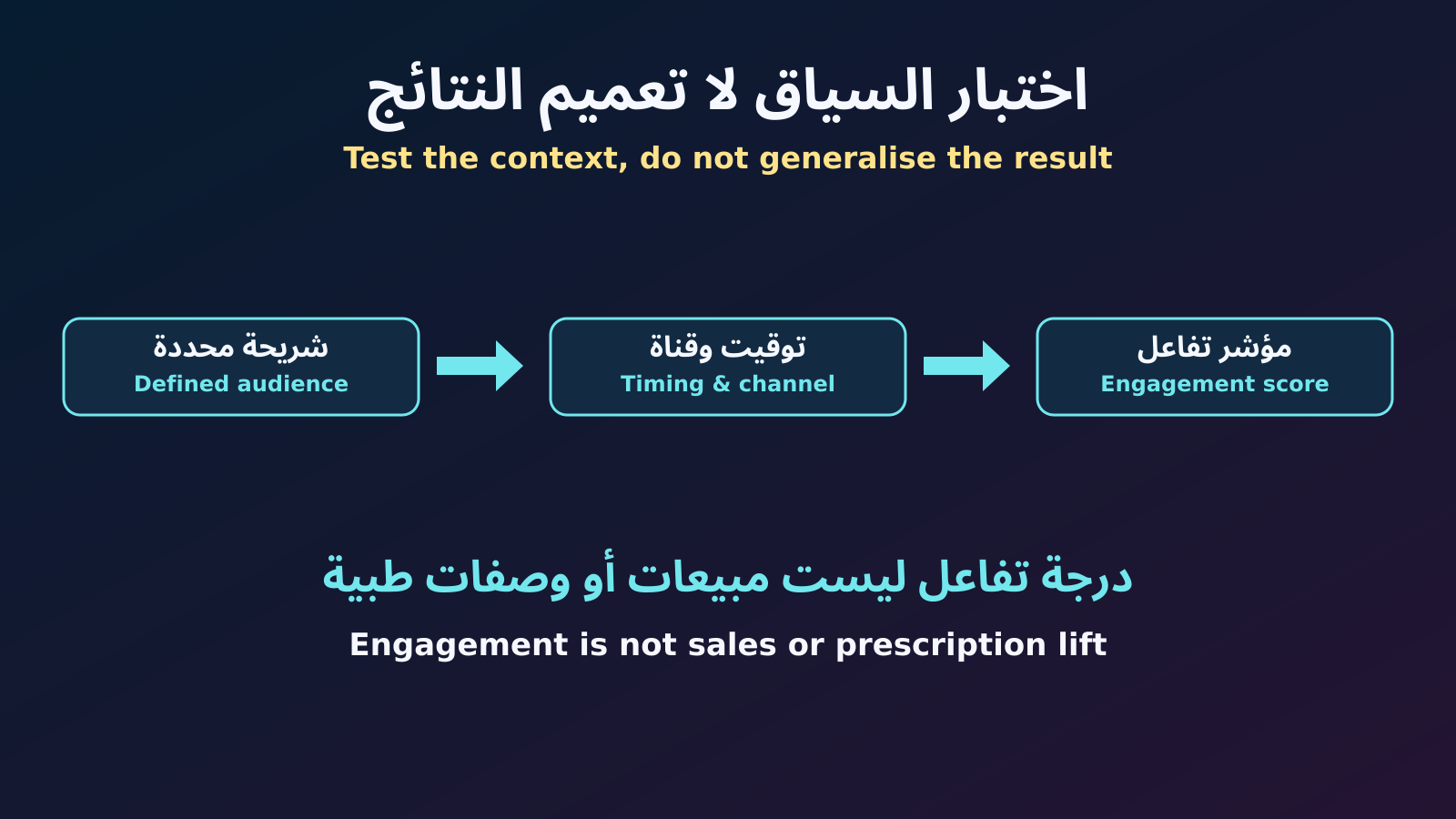
Original editorial illustration, not a product screenshot or evidence of campaign outcomes. Based on the source.
A composite score is a management choice
Imagine an illustrative score that combines opening educational material, engaging with its contents and completing a later business-relevant action. The organization assigns a different weight to each signal. If the score rises, several explanations are possible: more people may have performed the early action, a smaller group may have completed a heavily weighted action, or the balance between components may have shifted. Those patterns have different operational meanings. This example is a teaching device, not the supplier's actual formula. Its purpose is to show why the aggregate should be accompanied by the component measures.
Before adopting a composite measure, document the rationale for every component and weight. Explain who approved it and which decisions it is intended to inform. Examine whether a strong result in an easy-to-generate signal could hide weakness in a more important outcome. Keep a separate view of adverse signals such as opt-outs, complaints or excessive contact. An attractive overall score should not cancel those warnings. Where the outcome involves healthcare professionals, the evaluation must also respect professional independence and applicable communication rules. A marketing metric is not a measure of clinical appropriateness or patient benefit.
Ask whether the comparison can support a causal conclusion
A team that receives messages in the morning may differ from a team that receives them later for reasons unrelated to timing. Different professional roles, regions, workloads or prior relationships can affect response. A channel comparison can face similar problems if one channel reaches a different mix of people. The practical question is how the groups were formed and whether the intervention was the main systematic difference between them. Without that information, an observed difference should not be described as a proven effect that will recur whenever the same setting is selected.
For a local pilot, define the population before assigning treatments. Where appropriate and feasible, use random assignment and keep eligibility rules consistent. Consider whether people in the same organization could influence one another or receive overlapping communications. If that creates contamination, the experimental unit may need to be an organization or another meaningful group rather than an individual. A qualified analyst should review the design, including sample requirements and uncertainty. These are general research considerations. They do not imply that a particular design is legally or operationally suitable for every healthcare marketing program.
Preserve the audience boundary
Audience differences can be strategically useful because they discourage a blanket channel decision. If a result appears only in a defined segment, the next question is what distinguishes that segment and whether the difference is reproducible. A team should retain the original membership rule and avoid casually expanding it to everyone who looks similar. Document how the audience was obtained, whether the permitted purpose covers the proposed communication and what happens when someone withdraws consent or becomes ineligible. Those operational details influence both the quality and acceptability of a test.
An illustrative healthcare education program might separate professionals who requested follow-up from those who only attended a general event. The groups could have different expectations even if their job titles are identical. Sending them the same sequence could obscure that distinction. A useful experiment would respect their permissions and compare suitable options within each eligible group. It would not infer personal health conditions or use patient information to create a convenient targeting shortcut. The example is hypothetical; it describes how a marketer can reason about an audience without claiming access to any real professional or patient dataset.
Build the measurement plan around delays
Immediate engagement and longer-term outcomes operate on different clocks. A message can be opened today while a later outcome remains unobserved for some time. If a system updates its decisions using only the earliest signals, it may prefer content that attracts quick interaction over content that supports a more useful long-term objective. The answer is not to ignore early signals. It is to label their role clearly and avoid treating them as complete substitutes for delayed outcomes. Set an evaluation schedule that reflects how and when the relevant information becomes available.
Create a reporting view that distinguishes mature observations from incomplete ones. Record the latest date for which the longer-term outcome is sufficiently complete and show recent activity separately. If historical data are revised, preserve the revision history and explain how it affects the result. Teams should also decide when to freeze an analysis for a decision and when to reopen it. Otherwise, a constantly changing dashboard can produce repeated contradictory conclusions. A stable decision record allows people to see what was known at the time instead of judging every past choice using information that arrived later.
A practical pilot for a healthcare marketing team
Choose one approved communication objective and one eligible professional audience. Write a specific question, such as whether two appropriate delivery windows produce different engagement with an educational resource. Keep the resource, destination and contact limits consistent. Define the primary outcome before delivery and identify secondary measures that will help interpret it. Specify the review period, exclusions and stopping conditions. Confirm that the test does not interfere with mandatory information, safety communications or a professional's ability to access needed material. The pilot should improve understanding without making necessary communication contingent on an experiment.
Assign ownership across marketing, analytics, medical review and privacy or legal teams as appropriate. The marketing owner manages the operational plan. The analyst checks the comparison and uncertainty. Qualified reviewers assess content and permitted use. Agree on a procedure for handling complaints, data-quality problems and unexpected delivery. Test the tracking before launch using approved test records rather than real sensitive information. Keep a clear record of the final content and audience rules. These steps create a practical audit trail and make it easier to distinguish a weak idea from a sound idea undermined by execution errors.
Use a decision rule rather than chasing the best-looking cell
Before reviewing results, specify what evidence would justify keeping, changing or abandoning the tested approach. The rule should consider the size and reliability of the difference, the operational effort and any adverse signals. If several segments or outcomes are examined, distinguish planned comparisons from exploratory findings. A surprising pattern can generate a new hypothesis, but it should not be presented with the same confidence as a prespecified test. This prevents a dashboard full of possible comparisons from becoming a machine for discovering impressive but unstable percentages.
A sensible outcome may be to keep the existing approach while collecting more information. Another may be to adopt a change for a narrow group and continue monitoring it. Expansion should depend on comparable conditions, not enthusiasm alone. Check whether a different specialty, language or market changes the assumptions. For a Saudi or wider Gulf organization, local audience relevance, consent, approved content and operational capacity need their own assessment. A foreign case study provides a question worth asking; it does not establish local availability, regulatory suitability or expected performance for a new organization.
Make learning useful beyond the next campaign
Maintain a simple experiment register. For each test, record the question, eligible audience, intervention, comparison, measurement definitions, result and limitations. Add the final decision and the conditions under which it should be reconsidered. This makes unsuccessful or inconclusive tests useful rather than disposable. It also prevents a team from repeating the same experiment under a new name without realizing that the earlier result depended on a specific audience or period. The register should contain only necessary information, with appropriate access controls and retention arrangements for any personal data.
The strategic opportunity is a more disciplined connection between marketing action and evidence. That requires a willingness to question attractive results, preserve audience boundaries and report uncertainty. AI can help organize hypotheses and prepare analyses, but the organization must still decide which outcomes matter and which actions are appropriate. A strong healthcare marketing program learns without overstating what it has learned. Its next campaign should be easier to justify because the team understands the evidence, not merely because a model selected a setting or a case study supplied an impressive percentage.
Source and interpretation limits
GrowthLoop and EVERSANA company release, November 4, 2026. The reported campaign figures are company claims, not independently audited findings in this article. The frameworks and examples are original analysis. They are not clinical guidance, a recommendation to increase prescribing or proof of commercial or patient outcomes.
Comments
No published comments yet.