Editorial review: November 1, 2026. Announcement date: October 30, 2026. This article examines an earlier announcement, not an event announced today.
Verified announcement
DemandSense announced its integration with LinkedIn’s Company Intelligence API, bringing company-level paid and organic engagement into its attribution reporting. The company says the integration is available to its customers. DemandSense’s October 30 announcement.
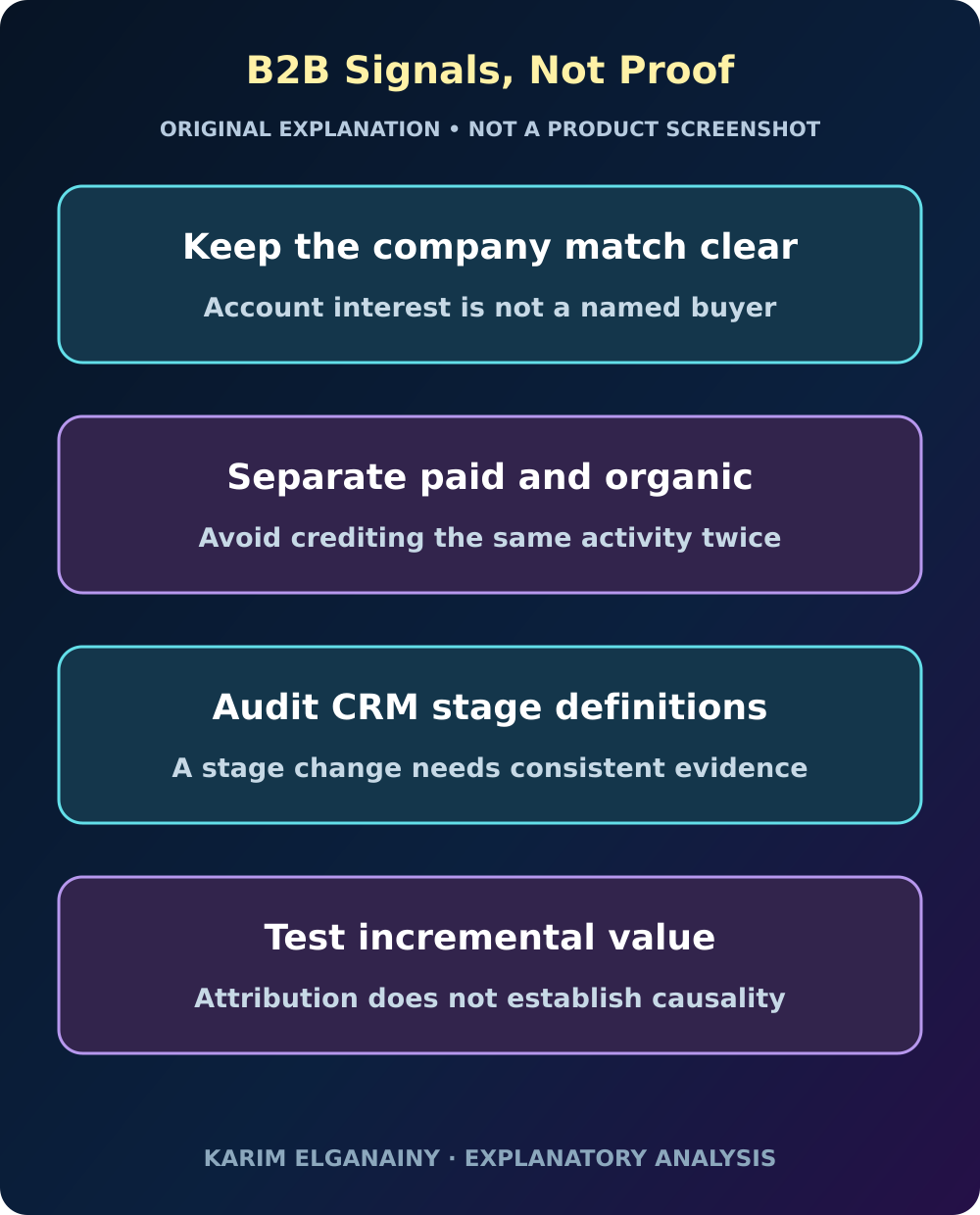
Original editorial framework; not a product screenshot or proof of campaign results.
Original analysis: a richer account history is not a causal verdict
For a B2B marketing team, the interesting opportunity is to reconstruct a buying account’s history more carefully. The operational challenge is to avoid mistaking a fuller history for proof that every recorded interaction created revenue. The framework below is independent editorial analysis, not a description of additional DemandSense features. Verify actual fields, permissions and reporting behaviour in your account before implementing any proposed workflow.
Imagine a software supplier selling to a regional manufacturing group. Several employees may encounter the brand, but only one eventually submits a request. The eventual opportunity may belong to a subsidiary while the first contact uses the parent company’s domain. A narrow contact record and a broad company history can tell different stories without either being fraudulent or useless. The task is to understand which organisation, interaction and commercial decision each record represents before drawing conclusions about marketing contribution.
Start with an account identity map
An account name is not necessarily a stable unit of analysis. Groups acquire businesses, subsidiaries operate independently, and employees change jobs. Write down which entity your team means by an account: the legal buyer, the parent group, a regional branch, or a sales territory. A campaign aimed at one subsidiary should not automatically receive credit for every contract signed anywhere within the group.
Build a small mapping table between the identifiers actually available in the marketing system and the corresponding CRM organisation. Include the reason for each match, the date reviewed and any unresolved ambiguity. Where the connection is uncertain, keep an unmatched category instead of forcing a convenient association. Shared domains and abbreviations are particularly worth reviewing. A cleaner-looking chart is not a good reason to hide unresolved entity boundaries.
Start with a sample of important opportunities rather than trying to perfect every historical account. Ask sales operations to review the mapping because they often know whether two similarly named records represent duplicate entries or genuinely distinct buyers. Retain the original identifiers so that a corrected mapping can be traced rather than silently rewriting the account’s history.
Build a timeline before calculating influence
For each sampled opportunity, arrange the relevant events chronologically: initial recorded engagement, known enquiry, opportunity creation, material stage changes and commercial outcome. Distinguish when an event happened from when it entered the reporting system. A late CRM import can otherwise make an older event look like a recent response to a campaign.
Create separate views for activity before and after opportunity creation. Earlier activity might inform an acquisition hypothesis; later activity could relate to evaluation, reassurance or ongoing account development. Neither category proves a causal role by itself. A prospect may already know the brand through relationships that are not recorded in either system. Do not fill those gaps with invented journeys simply because the dashboard invites a continuous narrative.
Record the earliest date for which the relevant data is reliably available. An account with no visible engagement before that date is not necessarily an untouched account. Label the observation boundary clearly, especially when comparing newly integrated reporting with older periods. Otherwise, a change in visibility can be mistaken for a change in customer behaviour.
Keep paid and organic histories distinguishable
A company may encounter a paid message and also interact with an employee’s post or a company page. For analysis, preserve the distinction between the types of activity actually supplied by the reporting system. Do not collapse everything into a single engagement score before understanding what the components mean. A score can be convenient for prioritisation while being a poor explanation of how a commercial relationship developed.
Write a plain-language definition for every category used in a management report. Describe the event, its unit and its limitations. If a field represents aggregated company activity, avoid presenting it as the behaviour of a named decision-maker. If a field is unavailable, mark it unavailable rather than treating the absence as zero. Those two states have different implications for both analysis and follow-up.
When sales asks which content persuaded an account, the honest answer may be that several interactions were observed but persuasion cannot be isolated. That answer still supports useful work: reviewing whether content covers the account’s likely evaluation questions, checking whether the next step is accessible, and improving coordination between marketing and sales. It does not justify pretending that every member of the buying group has been identified.
Define pipeline without changing its meaning mid-report
Pipeline can refer to an opportunity count, an unweighted value, a probability-weighted value or a subset judged commercially credible. Choose the definition appropriate to the question and keep it visible. A report that silently switches between them can suggest improvement where only the calculation changed.
For an opportunity-value comparison, record currency, expected contract period, and treatment of expansions or renewals. Avoid combining annual recurring value with a multi-year total as though they were equivalent. A single large opportunity can dominate an account-level result, so show both the number of opportunities and their value. Where appropriate, show the result with and without an unusually large deal to make concentration understandable, not to remove inconvenient evidence.
Agree with finance or revenue operations on the moment an opportunity becomes closed-won for reporting purposes. A signed agreement, a booked order and recognised revenue are distinct milestones. The marketing dashboard should not relabel one as another. If the business needs several views, provide them separately with explicit definitions rather than producing one impressive total that nobody can reconcile.
Use cohorts that respect the sales cycle
Group opportunities by a meaningful entry point, such as creation month, then compare their progress after similar elapsed time. A cohort created last month has not had the same chance to close as one created six months ago. Comparing their raw win rates can punish the newer campaign for a timing difference rather than a quality problem.
Track unresolved opportunities as unresolved. Do not quietly exclude them from one report while retaining them in another. State the review date and the amount of follow-up time each cohort has received. For long cycles, early indicators can help describe progress, but they should remain labelled as intermediate outcomes rather than substitutes for eventual commercial results.
Segment only where the sample supports a useful interpretation. Breaking a small cohort into many industries, territories and creative variants may produce attractive tables with almost no dependable signal. Begin with the few divisions that materially affect selling conditions. If enterprise contracts require procurement review while smaller purchases do not, that operational distinction may matter more than a decorative list of audience categories.
Reconcile overlapping credit before allocating budget
An opportunity may appear in reports from several channels, and each system may apply its own inclusion rules. Adding the attributed values together can therefore exceed the actual pipeline. That does not automatically mean an integration is malfunctioning; it means the totals answer overlapping questions.
Create a reconciliation view that separates total unique opportunities from channel-associated opportunities. Explain whether the purpose is to describe exposure, assign accounting credit, or estimate incremental effect. These are different analytical jobs. If management wants an allocation rule, agree the rule explicitly and label its output as an allocation, not as a discovered law of customer behaviour.
Use richer attribution to identify questions for controlled learning, not to skip the need for it. For example, a team might notice that accounts with several kinds of engagement progress more often. That pattern could reflect pre-existing interest or sales attention rather than marketing causation. A subsequent test should address a feasible intervention and a relevant comparison, with specialist help where the design requires it.
Connect the report to a useful sales conversation
Account-level signals should improve preparation, not create a pretext for intrusive outreach. A salesperson can review the organisation’s publicly stated priorities and prepare relevant questions without claiming to know which individual viewed a particular message. Avoid opening a conversation with an assertion that the available data cannot substantiate.
Create a short account briefing that distinguishes known commercial facts, observed aggregated activity and questions still to ask. Include the offer or resource that might be useful, not merely a list of interactions. A manufacturing account evaluating operational software may need implementation detail, integration constraints or a procurement-ready comparison. The briefing should make the next conversation better even if the marketing history later proves incomplete.
Agree how sales feedback returns to the analysis. A rejected lead may reflect timing, service fit, procurement restrictions or duplicate outreach. Capture a manageable set of reasons instead of a single unhelpful dismissal. Keep sensitive details out of general marketing notes and use existing authorised systems for any information that genuinely needs restricted handling.
Make the first management readout deliberately modest
A useful initial readout contains a verified account map, a few representative timelines, consistent pipeline definitions and an explanation of missing information. It should distinguish a reporting improvement from a commercial improvement. Discovering previously invisible engagement can change the account story without changing the underlying number of customers or contracts.
Compare the new reporting view with the previous view using the same opportunity population wherever practical. Explain which records became associated with marketing and why. Do not describe an increase in attributed pipeline as newly created pipeline unless separate evidence supports that statement. This distinction is especially important when management is considering budget shifts based on the first report after an integration change.
The durable outcome is a shared language for discussing company-level engagement and sales evidence. Marketing can explain what was observed, sales can explain the commercial context, and finance can reconcile the resulting totals. If the integration leaves important questions unanswered, retain those questions explicitly. Better measurement does not eliminate uncertainty; it makes the remaining uncertainty easier to locate and the next decision easier to defend.
Comments
No published comments yet.