Editorial review: November 1, 2026. Announcement date: October 29, 2026. This article examines an earlier announcement, not an event announced today.
Verified finding: intention is not deployment
DoubleVerify's October 29 release describes research drawing on a global survey of 2,020 marketers and additional company data. It reports that 97% of marketers plan to use AI in some aspects of media planning, buying, or optimization during 2026. Company release distributed by GlobeNewswire.
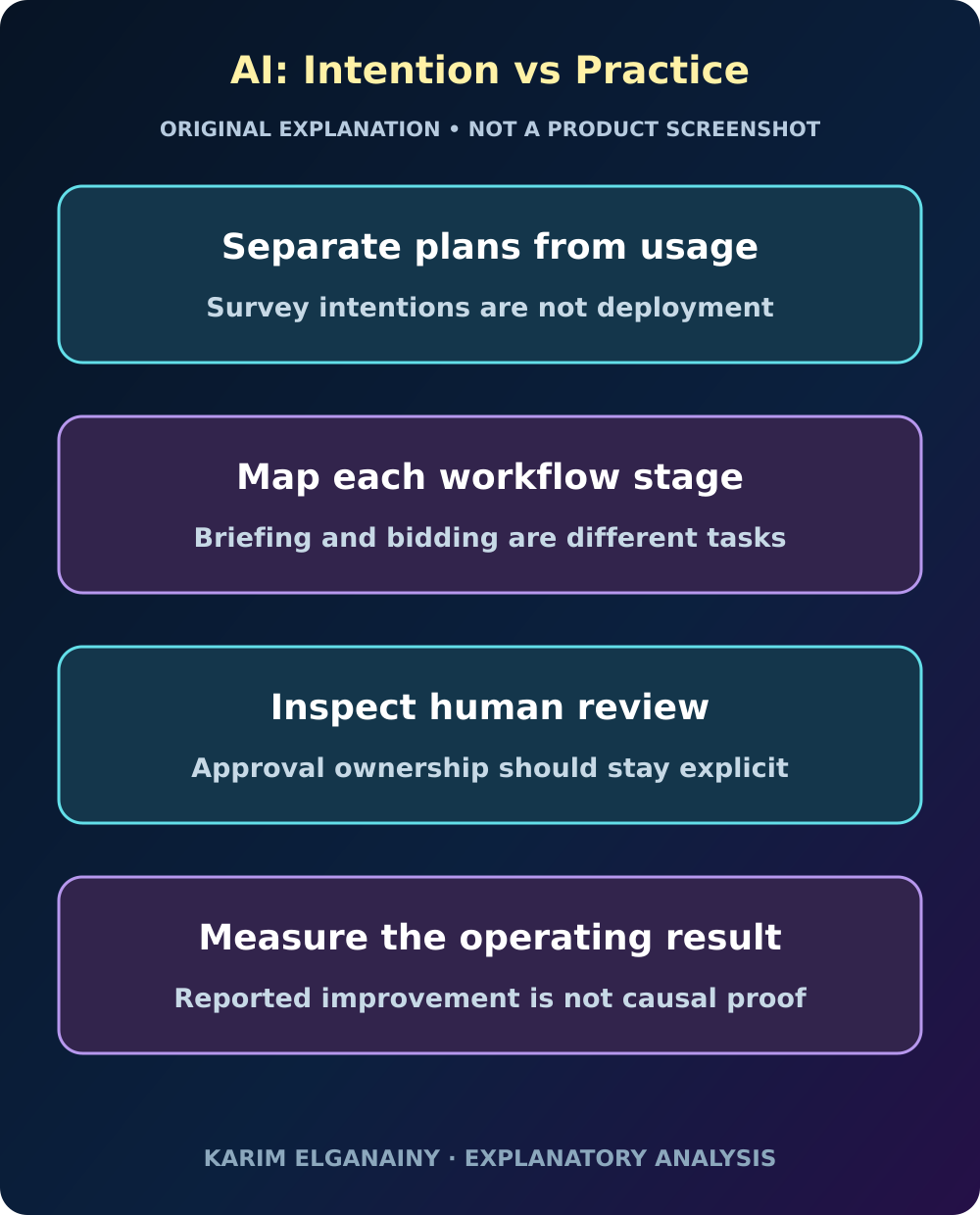
Original editorial framework; not a product screenshot or proof of campaign results.
Original analysis: inspect the work, not the adoption label
The remainder of this article is an original operational assessment framework, not additional findings from the survey. A team's answer to “Do we use AI?” is less informative than its answer to “Which decision changed, using which input, with what remaining work?” Drafting a summary and allowing software to alter bids are different interventions. Grouping them together hides the implementation problem and makes comparisons between organizations difficult to interpret.
Consider a fictional regional retailer preparing a seasonal campaign across two languages. Its agency already produces attractive machine-assisted presentation slides, yet its planner still spends hours reconciling product availability, budget assumptions, and conflicting campaign names. Calling the team an AI adopter says little about that bottleneck. A useful assessment follows one campaign through its actual work products and measures where information is lost, duplicated, or delayed. It starts with the unit of work rather than a software purchase.
1. Decompose the media brief into decisions
Take the latest approved brief and mark each sentence as a fact, constraint, preference, assumption, or unresolved question. A sales target is not an audience insight; a budget ceiling is not an allocation recommendation. Ask an assistant to organize those categories, then compare the output with the original. The useful question is whether a planner can see the unresolved choices sooner, not whether the generated summary sounds fluent.
For the fictional retailer, a phrase such as “prioritize high-value customers” needs an operational definition. Does value mean basket size, margin, repeat purchase, or another measure? If the system silently chooses one, the polished brief can move the team farther from agreement. Require unresolved terms to remain unresolved until the business supplies a definition. Measure how many clarification rounds the structured brief removes, while counting any important constraints it drops. That is a concrete workflow outcome rather than an adoption badge.
2. Make the available evidence usable
Before asking for a plan, assemble a compact evidence packet: the offer, eligible products, relevant historical campaign extracts, measurement definitions, and known operational restrictions. Use only information authorized for the chosen system. Remove identifiers and unnecessary customer details when aggregate information is sufficient. More input is not automatically better input; an old promotion can create a plausible but wrong recommendation if its validity period is missing.
Create a small manifest listing the origin, date range, currency, time zone, and purpose of each file. If one export counts orders and another counts order lines, state the difference instead of expecting a model to infer it. For our retailer, separate discontinued products from available inventory before asking for creative angles. The assessment should record how long evidence preparation takes. A tool that saves drafting time but creates a larger cleanup burden may not improve the complete workflow.
3. Convert channel suggestions into comparable options
A planning assistant can generate alternatives without possessing evidence that one will outperform the others. Ask it to produce three options using the same budget, period, audience definition, and success measure. Each option should state which assumptions it needs, what operational dependency it creates, and what observation would weaken its rationale. This makes the output useful for a planning discussion instead of allowing persuasive language to substitute for an argument.
For example, one option might emphasize an existing customer group, another a broader prospecting audience, and a third a smaller creative exploration. These are hypothetical planning alternatives, not channel recommendations. Compare what each option would teach as well as what it would cost to execute. If the assistant assigns projected returns without an agreed model and justified inputs, remove those projections. Unsupported precision is especially distracting when colleagues mistake a tidy table for a forecast grounded in evidence.
4. Treat activation as translation, not just copying
Campaign activation translates business intent into account fields, asset references, destinations, and delivery constraints. Inspect that translation separately from strategy. Build a plain-language specification containing the approved objective, market, dates, budget unit, naming convention, and creative-to-destination mapping. Then compare the proposed configuration against the specification before any authorized operator applies it. A correct sentence in a plan does not prove that a date, currency, or landing page was transferred correctly.
In the retailer example, two similar product names might lead to different stock pages in Arabic and English. A mapping table should make those relationships explicit. Check whether the workflow catches a swapped destination and a daily-versus-total-budget mismatch using invented test inputs. The point is not to claim that any particular product can perform these checks. It is to identify the exact translation errors the team wants assistance detecting, so a demonstration can be evaluated on realistic tasks.
5. Separate bid decisions from objective decisions
An automated bidding proposal needs a clear description of the outcome being rewarded. If the desired business result is profitable new demand but the available signal is any completed form, the system may optimize a convenient proxy. Improving the proxy does not necessarily improve the underlying business. Write the relationship between the signal and the desired outcome in plain language, including known gaps and delays.
Ask what happens when a form is duplicated, a purchase is cancelled, or a customer returns an item. These examples reveal whether the available feedback reflects value or merely activity. A planner should also distinguish a recommended bid change from a recommendation to change the objective itself. Those decisions operate at different levels. In a workflow assessment, examine whether the assistant notices missing feedback and identifies the uncertainty, rather than rewarding it for producing a confident action in every situation.
6. Give mid-flight analysis a timeline
A campaign report is a sequence of events, not simply a table of averages. Create a timeline of budget changes, creative replacements, offer changes, destination outages, and measurement updates. Ask an assistant to summarize the campaign against that timeline. A drop after a creative change is an observation; it is not, on its own, proof that the creative caused the drop. Several interventions may overlap, and some outcomes arrive later than the advertising interaction.
For the fictional retailer, a stock shortage could coincide with a media change. A useful analysis should consider both rather than blaming whichever variable appears in the advertising export. Have the assistant list competing explanations and the smallest additional information needed to distinguish them. The output might justify waiting for delayed data, checking product availability, or investigating tracking. Sometimes the most valuable recommendation is not to make another media adjustment until a separate operational issue is understood.
7. Assess the economics of assistance end to end
Record preparation time, machine processing time, human review, correction, and handoff effort for a complete task. Do not report the seconds required to generate a draft as the entire time saved. A shorter first pass can still produce a slower approval cycle if colleagues must check more ambiguous claims. Include software and integration costs where they are relevant, while keeping commercial estimates separate from observed labor time.
Use a fictional example: a report previously took three hours, while an assisted version takes one hour to prepare and two hours to verify. The arithmetic shows no labor saving, even if the output appeared instantly. It may still offer another benefit, such as better issue coverage, but that benefit must be stated and inspected separately. Conversely, a modest reduction in repeated manual reconciliation can matter more than impressive creative generation if reconciliation is the team's recurring constraint.
8. Read reported improvement as a question to investigate
When a study describes respondents reporting better performance, ask what they mean by performance, what comparison they used, and whether the period, spend, offer, and measurement stayed comparable. A person's positive assessment can be informative about experience without establishing the size or cause of a business effect. Intention to adopt, actual use, satisfaction, and incremental commercial value are four different categories. None should silently stand in for the next.
In an internal presentation, label evidence accordingly. A planned use belongs in the roadmap, a documented use belongs in the workflow inventory, a time study belongs in the operations assessment, and a causal claim requires an appropriate evaluation design. This article does not infer a causal lift from survey answers. If a team cannot yet estimate incremental value, it can still document what changed and what remains unknown. An honest uncertainty statement is more useful than borrowing confidence from a headline.
9. Build an assessment around one recurring artifact
Choose one artifact that the team produces repeatedly, such as a weekly pacing explanation, rather than trying to automate an entire department. Define the inputs it needs, the decisions it supports, and the reasons a reviewer would reject it. For a pacing explanation, rejection reasons might include mismatched dates, an incorrect budget denominator, ignored campaign pauses, or an action that conflicts with the approved objective. These make quality observable.
Compare assisted and existing versions on those criteria using a small set of representative historical cases, with confidential details handled appropriately. Include a quiet week, a disrupted week, and a week with incomplete information. The assessment is not complete when the assistant handles only the cleanest example. Record which cases require extensive intervention, and decide whether the tool is suitable for drafting, checking, or neither. Those are legitimate distinct outcomes, not stages that must all culminate in autonomous action.
From enthusiasm to a precise implementation choice
The final decision should name the task, the allowed inputs, the expected output, and the work humans still perform. “Use AI for media” is not a sufficient implementation specification. “Prepare a first-pass pacing explanation from these approved aggregate exports, flag missing information, and leave budget decisions to the planner” is narrower and easier to assess. A different team may identify activation mapping or brief clarification as its better starting point.
Return to the fictional retailer's original bottleneck. If the intervention reduces reconciliation errors and helps the planner resolve conflicting assumptions earlier, that is a defensible operational improvement to document. It is not a guarantee of higher sales or evidence that every advertising workflow should be automated. The practical value of adoption research is to sharpen the questions an organization asks about its own work. The answer must come from the work itself, not from the popularity of the label attached to it.
Comments
No published comments yet.