
Published October 29, 2026. Alphabet released its third-quarter results on October 28, covering the quarter ended September 30. Google advertising revenue increased from $74,182 million to $82,012 million. The component comparison below uses the release's reported figures; percentage changes are our calculations, not campaign-performance estimates. Primary earnings release.
For marketers, the useful task is to separate three questions: how the platform earns revenue, how people seek information, and whether an advertiser's own activity produces worthwhile outcomes. Those questions interact, but they are not interchangeable. This analysis connects the financial disclosure with the AI-search discussion while keeping the boundary between reported evidence and practical interpretation visible.
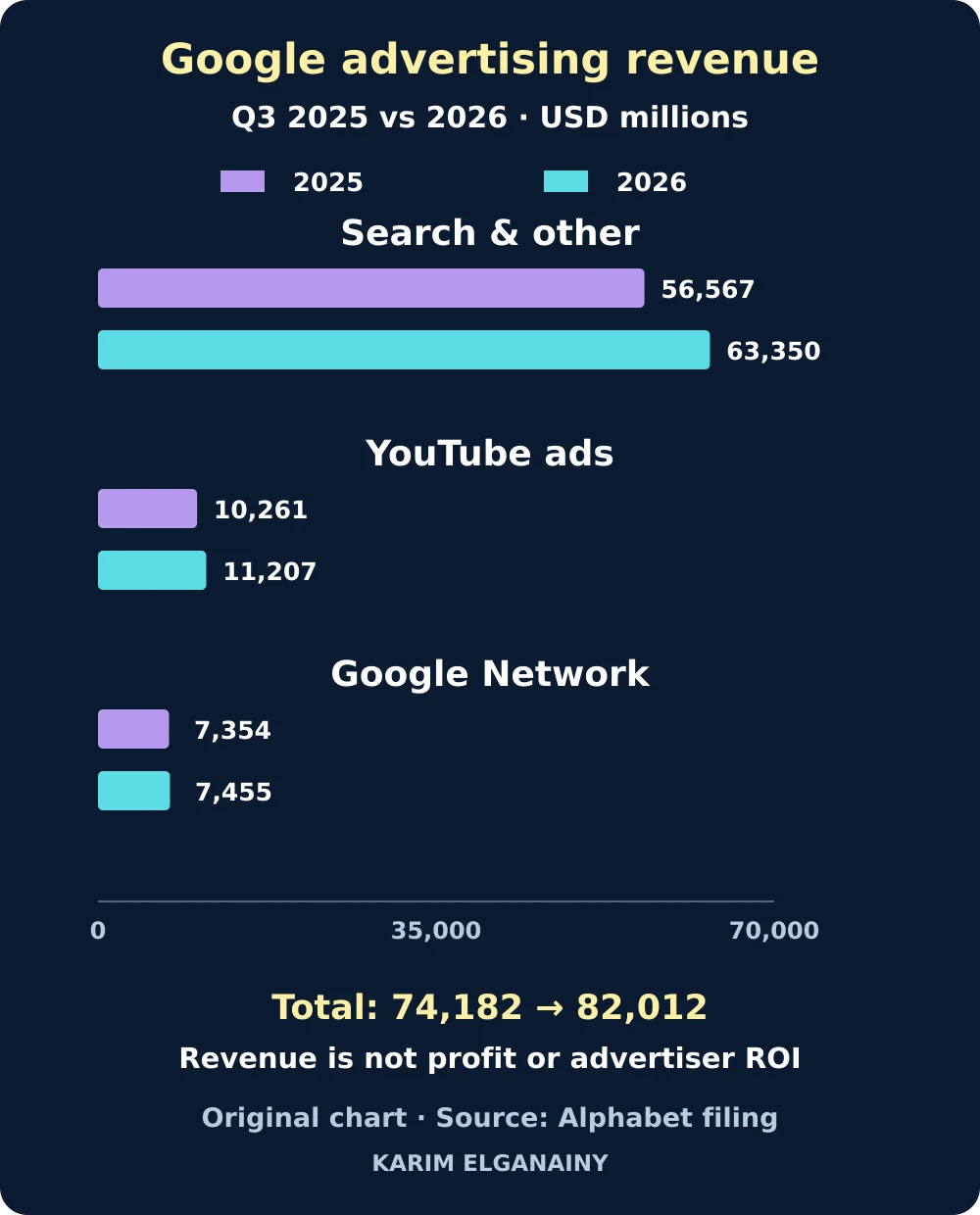
Original explanatory chart by Karim Elganainy. Reported Q3 2025 and Q3 2026 revenue from the Alphabet earnings release; comparison of reported business lines, not advertiser returns.
The reported advertising comparison
| USD millions | Q3 2025 | Q3 2026 | Calculated YoY |
|---|---|---|---|
| Search & other | 56,567 | 63,350 | 11.99% |
| YouTube ads | 10,261 | 11,207 | 9.22% |
| Google Network | 7,354 | 7,455 | 1.37% |
The calculation is current-period revenue divided by the corresponding prior-year figure, minus one. Using the same quarter avoids confusing an annual comparison with a sequential change. Keep the labels intact when sharing the chart: a business line is not a single campaign type, and its reported revenue should not be relabeled as a measurement of advertiser efficiency. Data source.
What the revenue table cannot tell a buyer
A platform's revenue is a supplier-side outcome. An advertiser's return concerns the value produced relative to that advertiser's costs. A larger supplier total does not tell a particular organization whether its next unit of spend will produce an additional qualified inquiry, purchase, or useful interaction. It also does not reveal the mix of customer objectives behind the revenue.
Treat the table as context for planning questions, not a percentage to copy into a budget. A buyer should still examine marginal results, operating capacity, and the evidence supporting each campaign's objective. The same platform-level headline can coexist with very different account-level situations, which is why a local decision requires local measurements.
Separate the AI narrative from a causal result
AI-search claims require their own evidence record. A statement about increasing activity does not isolate which feature caused that change, how many interactions created advertising opportunities, or whether the advertiser received more valuable visits. Even a genuine product improvement can affect different parts of the journey in different ways.
For planning, write the hypothesis in a form the team could disprove. For example: clearer information about service availability will reduce administrative confusion among relevant visitors. That is more testable than saying that AI growth will improve the whole funnel. The financial release can motivate investigation, but it does not supply the missing comparison needed to establish a campaign-level causal effect.
What Google disclosed about AI-search behavior
In its October 28 edited CEO remarks, Google said AI Mode queries average three times the length of traditional searches, one in five AI Mode searches globally uses voice, images, or documents, and monthly visual searches exceed 50 billion. These are company-reported usage disclosures, not a new launch announcement or a local advertising-availability notice. Official CEO remarks.
The practical interpretation is a research agenda: review whether customer-facing information can answer a question containing several constraints. That does not mean writing longer pages automatically. A concise page that states coverage, exclusions, and the next step can be more useful than a long page repeating a category name. Assess the completeness of the answer against a defined task, then check that the information is accurate and maintained.
Do not use the disclosed averages as targets for your own copy. An average query length says nothing about the optimal length of an advertisement or a service page. Nor does a multimodal usage share identify the audiences your organization can buy. Keep product-use context separate from campaign settings and independently confirm the options actually available to the account.
Test a constrained question rather than a broad topic
Consider a hypothetical service business whose customers ask whether a specific package is available in their area on a suitable date. A broad page may describe the category well while failing to answer those practical constraints. The team can create a task checklist covering location, inclusions, timing, and the appropriate contact step, with an owner responsible for verifying each item.
Then ask reviewers to complete the task using the published page without coaching. Record the information they find, what remains uncertain, and any incorrect inference. This is a small usability exercise, not a representative study or a guarantee of AI visibility. Its value is that it reveals a concrete information defect that the organization can correct and recheck.
If the problem is operational availability rather than wording, route it accordingly. A content team should not invent capacity to produce a more satisfying answer. The result might be a clearer limitation, an alternative administrative route, or a decision to stop advertising an unavailable option until the responsible team confirms the details.
Prepare visual information without promising discovery
The disclosure also gives teams a reason to inspect the usefulness of their own visual assets. Check whether an original product photograph, explanatory diagram, or location image communicates an accurate and necessary detail. Use appropriate rights, meaningful descriptions, and visible context rather than treating an image as decoration or implying that it documents something it does not.
For a hypothetical product page, the useful task could be distinguishing two variants without relying on an ambiguous filename. For a service page, a clear process diagram might explain administrative steps. These are proposed content improvements, not claims about a ranking mechanism or guaranteed traffic.
Keep an asset register linking the visual to its information owner, permission basis, and update trigger. If a product or process changes, the image and its caption need review together. That maintenance discipline makes the content more dependable for human readers regardless of whether a search platform chooses to surface it.
Audit information tasks before changing keywords
Choose a small set of tasks that potential customers need to complete. They might compare delivery coverage, understand what an offer includes, or determine the next step before contacting the organization. Examine whether the organization's approved information answers those questions consistently across its own pages.
This is a content audit rather than a promise of placement in an AI answer. Record the question, the evidence supporting the answer, the page responsible for it, and the owner who can keep it current. A narrowly scoped correction is easier to verify than a broad instruction to optimize everything for a changing search experience, and it gives the team an actionable starting point.
Distinguish visibility from a successful visit
A brand's presence in an observed answer and a useful visit to its website are different events. Keep any answer-monitoring exercise separate from website analytics unless a defensible connection exists. Document the conditions under which an answer was observed rather than presenting a handful of examples as complete market coverage.
For the website, define what a useful visit means for the specific page. A visitor may need an accurate answer without submitting a form. Another page may exist to support a clear administrative inquiry. Evaluating both solely through the same conversion counter risks rewarding unnecessary friction or mistaking a completed information task for a failure.
Give paid search its own decision rule
Before altering a campaign, document the intended outcome, the approved budget boundary, and the evidence needed for expansion. Separate a creative or landing-page correction from a change in distribution. When both change together, describe the intervention as a bundle instead of claiming to have isolated one factor.
Review the quality of the response as well as its volume. A campaign that attracts more inquiries may still need adjustment if the inquiries concern unavailable services or misunderstood conditions. The practical question is whether the next investment helps the organization serve appropriate demand, not whether it can mirror a platform's reported growth percentage in an internal presentation.
Keep video and publisher activity distinct
The separate lines in the comparison are a reminder to define different jobs for different media activity. A video intended to explain an unfamiliar service may require a different evaluation from a campaign intended to capture an immediate administrative question. Set the intended job before selecting a success measure.
Avoid pooling results just because the buying interfaces or organizational owners overlap. Record what each activity was supposed to accomplish and what evidence can reasonably assess that purpose. If the organization cannot observe the desired outcome directly, state that limitation and choose a proportionate test rather than substituting an easy-to-count metric and silently calling it business impact.
Localize the whole GCC information journey
For a GCC organization, evaluate Arabic and English independently and preserve market-specific differences in services, locations, and contact arrangements. A global earnings report does not establish local audience behavior or product availability. Confirm those matters separately before treating a new search experience as an immediate local buying opportunity.
Review more than translated headlines. Check whether the destination, form labels, acknowledgment, and administrative response support the intended language. An apparently weak campaign can conceal an avoidable handoff problem. Use qualified reviewers and concrete tasks, then document where users hesitate. This produces a practical improvement list without inventing a regional benchmark from company-wide figures.
Protect healthcare boundaries
Healthcare teams can focus this audit on approved administrative information: where a service operates, how to contact the organization, and what happens after an inquiry. Keep that work distinct from diagnosis, individualized treatment advice, and assumptions about a visitor's health. More detailed measurement is not automatically more useful or more appropriate.
Have the relevant internal specialists review proposed data collection and sharing. Marketing performance reports do not need to reproduce sensitive personal narratives to reveal a confusing contact process. The aim is to measure the approved operational question with proportionate information and access controls. This analysis makes no claim that a particular tracking setup satisfies medical, privacy, or legal requirements.
Build a review that can conclude no change
Use a short decision record with the observation, alternative explanation, proposed action, owner, and review condition. Include the option to leave a campaign unchanged. If every interpretation leads to more spend, the exercise is not testing the decision; it is finding language to justify it.
At review, distinguish a confirmed improvement from an encouraging but unresolved pattern. Record changes in staffing, availability, offers, or measurement that could affect the comparison. The strategic takeaway is to use Alphabet's disclosures to sharpen questions, then earn any account-level conclusion through relevant evidence. Platform growth is context. A defensible marketing decision still needs a clear objective, a bounded intervention, and a result the team can explain.
Comments
No published comments yet.