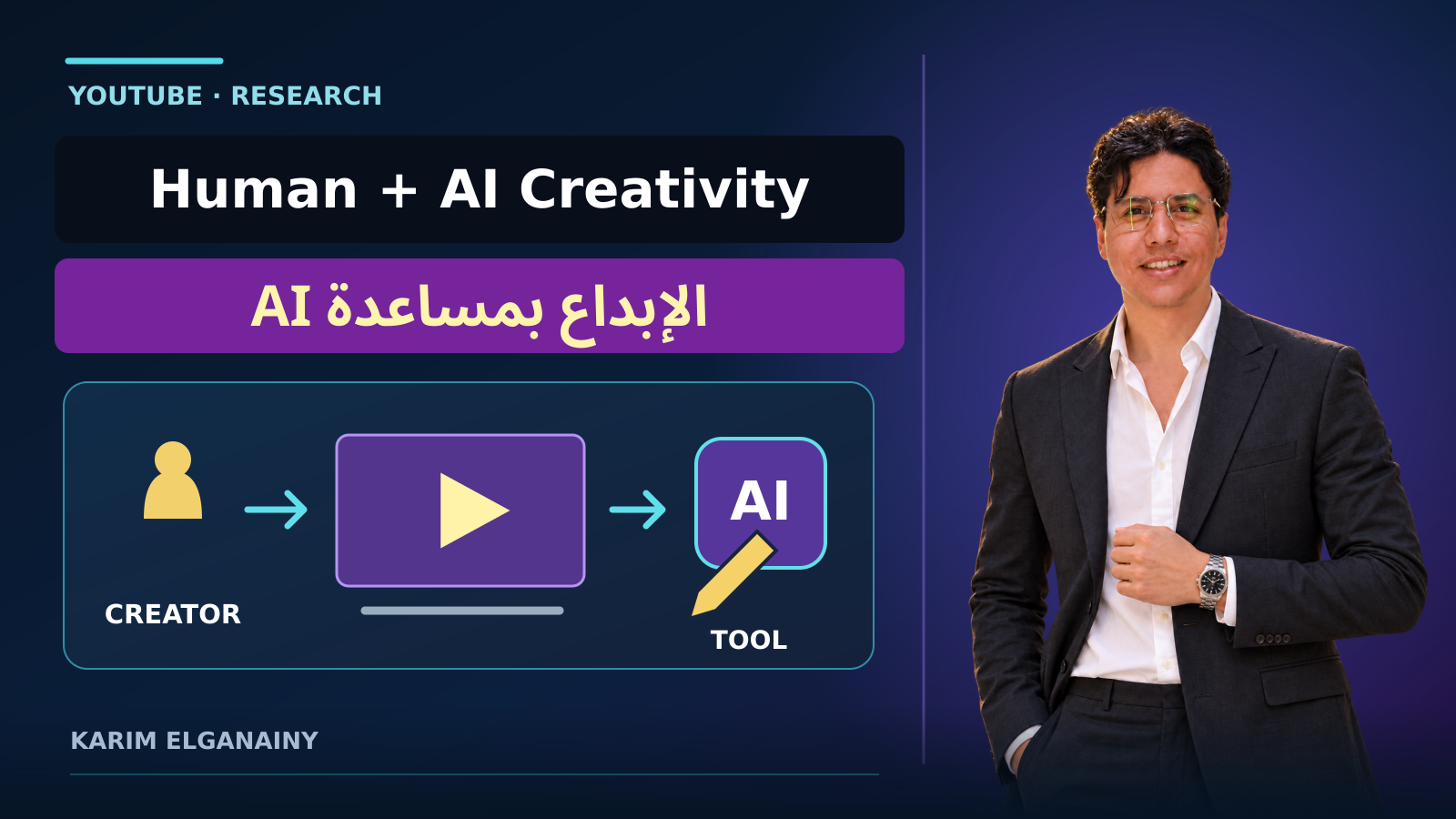
What YouTube’s new research actually tells marketers
On October 20, 2026, YouTube published research on personal creativity with generative video. Its cited US survey, conducted with NRG in April 2026, covered 694 online people aged 14–44. Among surveyed video posters, 72% reported using AI for images or video; 61% expressed interest in inserting themselves into AI content. These are self-reported behaviors and attitudes, not evidence of better campaign performance or a representative estimate for Saudi Arabia. Official research.
The useful marketing question is therefore not whether every brand should generate more video. It is which creative problem a team can solve more effectively, without weakening accuracy, distinctiveness or audience trust. Adoption statistics describe activity. A business still needs evidence that its chosen production method helps people understand an offer and take an appropriate next step.
The following operating framework is original analysis. It separates a research finding from a proposed experiment and from a commercial conclusion. Its purpose is to make AI-assisted production accountable, not to turn a broad technology trend into a mandatory content quota.
Start with the audience’s unfinished question
A creative brief should begin with a question the audience genuinely needs answered. A customer may struggle to visualize the size of a product, understand a service process, compare alternatives or imagine an unfamiliar setting. Each difficulty suggests a different visual treatment. Generating an impressive scene before identifying that difficulty reverses the order of useful work.
Write the intended change in understanding in plain language. Instead of asking for a futuristic advertisement, ask for a demonstration that makes the setup process understandable without specialist knowledge. Instead of requesting an emotional film, identify the specific uncertainty that should feel less intimidating after viewing. The resulting brief can be evaluated before anyone spends time producing assets.
Separate the information that must be literally accurate from elements that can be illustrative. Product dimensions, service availability and claimed results require evidence. A metaphor used to explain a complicated idea may allow greater creative freedom, provided the audience can recognize it as a metaphor rather than documentary proof.
Choose where assistance belongs in the production chain
AI assistance can be considered at several stages, but changing every stage simultaneously makes quality hard to diagnose. A team might first use it to explore storyboards, then retain its established filming and editing process. Another might test visual transitions while keeping the script, presenter and factual demonstrations unchanged. These are proposed workflows, not claims about a particular YouTube product.
The best starting point is a repeated bottleneck with clear acceptance criteria. If the delay is finding an understandable sequence of scenes, storyboard exploration may help. If the problem is an unclear proposition, faster rendering will merely produce more versions of the same weak idea. Diagnose the constraint before selecting the tool.
Document what remains human-owned. Somebody should approve the factual claims, visual meaning, brand fit and release decision. Saying that an output was generated does not explain who checked it. A named editor with a defined checklist is more useful than an informal expectation that everyone will notice mistakes.
Preserve a recognizable point of view
When production becomes easier, sameness becomes a strategic risk. A brand can publish more frequently while becoming less recognizable if every piece follows the same fashionable visual grammar. Distinctiveness comes from choices about what to explain, what evidence to present, what tone to use and which audience tensions deserve attention.
Build a small creative reference set around those choices. Include examples of acceptable explanations, misleading simplifications and visual treatments that belong to the brand. Explain why each example works. A folder of attractive images is not enough; the team needs shared reasoning that can be applied when an unfamiliar output appears.
Retain material that only the organization can credibly supply, such as an accurate explanation from a qualified specialist or a truthful demonstration of its actual service process. Generative decoration should support that substance. It should not imply access, expertise, facilities or outcomes the organization does not possess.
Design a comparison that answers one question
An illustrative pilot could compare two treatments of the same educational idea: an established production method and a carefully reviewed AI-assisted method. Keep the core proposition, intended audience and next step as comparable as practical. Record unavoidable differences so the final report does not pretend the test was cleaner than it was.
Choose the decision before choosing the dashboard. If the goal is clearer explanation, ask whether viewers can identify the essential point after viewing. If the goal is production efficiency, measure the complete workflow through approved output. If the goal is qualified interest, connect the content to a suitable downstream measure rather than celebrating viewing activity alone.
Set an observation window that respects the business process. A complex service may generate questions before bookings. An immediate sales judgment can undervalue useful educational content, while an unlimited waiting period can protect a weak experiment from scrutiny. Agree when the team will review early signals and when it can responsibly assess later outcomes.
Measure total production cost, not the first render
A useful efficiency calculation includes briefing, generation, selection, corrections, rights checks, translation, specialist review and final export. Count abandoned versions as work, not as invisible experimentation. A fast first draft can still be expensive if it creates extensive revision or requires another team to repair errors.
Track elapsed time separately from hands-on effort. An overnight render and an hour of concentrated editing create different operational constraints. Also record which roles are required. Saving a designer’s time while increasing a specialist’s review burden may or may not be worthwhile; the answer depends on the actual bottleneck.
Compare like with like. Do not compare a simple generated animation with a complex documentary production and attribute the entire cost difference to AI. Define the intended standard and usable deliverables in advance. The commercial question is the cost of an approved, effective asset, not the number of drafts the software can create.
Treat trust as a measurable quality constraint
A visually persuasive output can create a false impression even when its individual words are technically correct. Review the complete message. Would a reasonable viewer think this is a real customer, a real location, a recorded demonstration or a documented result? If that inference would be false, revise the presentation and make the illustrative nature clear.
Audience testing can help reveal ambiguity. Ask a small review group what they believe the scene shows before explaining how it was made. Their interpretation is more useful than a leading question about whether they liked the design. A misunderstanding discovered before publication is an inexpensive correction compared with a credibility problem discovered afterward.
Disclosures should be understandable where the potentially misleading impression occurs. A remote note that most viewers never encounter may not solve the communication problem. Review applicable platform and local requirements separately; this article proposes an editorial discipline, not a substitute for legal or policy advice.
Protect people whose likeness or information might appear
An organization should distinguish using its own authorized brand assets from using somebody’s face, voice or private history. Obtain appropriate permission and establish the intended scope before creating a recognizable depiction. Do not assume that a public photograph provides blanket authorization for every generated use.
Keep sensitive information out of routine creative experiments. A healthcare team can explain a general service journey with a clearly illustrative diagram rather than uploading patient records or constructing an apparently real testimonial. A business does not need an identifiable personal story simply because an image tool can make that story emotionally compelling.
Set a removal and correction process. If permission changes, a claim becomes outdated or a depiction causes confusion, know which published assets depend on it. Asset records should connect the source material, approval, final version and distribution locations. This is basic content governance made more important by the ease of producing variations.
Localize meaning rather than just captions
For a bilingual Saudi or GCC campaign, equivalent wording does not guarantee an equivalent viewing experience. Visual references, pacing, examples and the amount of explanation may need different treatment. Review whether the Arabic and English versions answer the same audience question without forcing them into identical sentence lengths or compositions.
Check small-screen readability early. A successful full-size preview can hide tiny labels, confusing motion or subtitles that compete with essential visual information. Inspect the actual delivery format and the first moments of the sequence, not only the polished final frame used in a presentation.
The destination must continue the explanation. If the video invites viewers to learn about a service, the linked page should provide the promised details in the same language. A sophisticated creative treatment followed by an unclear form or unsuitable support channel creates friction that the production method cannot repair.
Give healthcare content an additional evidence gate
Healthcare communication deserves a clear separation between general education, information about available services and individual clinical advice. A creative team should not treat a plausible-looking anatomical scene or simulated treatment sequence as medically accurate merely because it is visually convincing. Qualified review should assess the explanation itself.
Avoid invented before-and-after evidence, synthetic patient endorsements presented as genuine, or scenes that imply guaranteed outcomes. Even an illustrative example can become misleading when placed beside a booking call to action without sufficient context. The review must examine how the elements work together rather than approving each asset in isolation.
Marketing outcomes should also remain distinct from clinical outcomes. More views, inquiries or bookings do not demonstrate improved health. A responsible performance report can discuss service information, audience understanding and appropriate demand without claiming effects the campaign has not measured or expertise the author does not hold.
Make the final decision explicit
At the end of a pilot, classify the outcome: adopt the workflow for a defined use, revise it around a specific weakness, or stop using it for that purpose. Explain the evidence and remaining uncertainty. Avoid a vague conclusion that the technology has potential, because it gives the next project no usable guidance.
Retain the strongest learning even when the test underperforms. Perhaps the team discovered that its original script was unclear, that localization consumed more effort than expected, or that a simple real demonstration outperformed an elaborate illustration. Those findings improve future production decisions without requiring a positive story about the tool.
The strategic takeaway is to compete on judgment rather than generation volume. Faster production becomes valuable when it produces clearer, trustworthy communication at a sustainable total cost. The source finding invites experimentation; it does not remove the need for a disciplined brief, evidence review and an accountable release decision.
Source and evidence boundary
The opening research summary is source-based. The workflows, examples and evaluation criteria that follow are original recommendations, not reported results from YouTube or claims that the writer conducted these experiments.
Comments
No published comments yet.