A strong platform result is not your campaign forecast
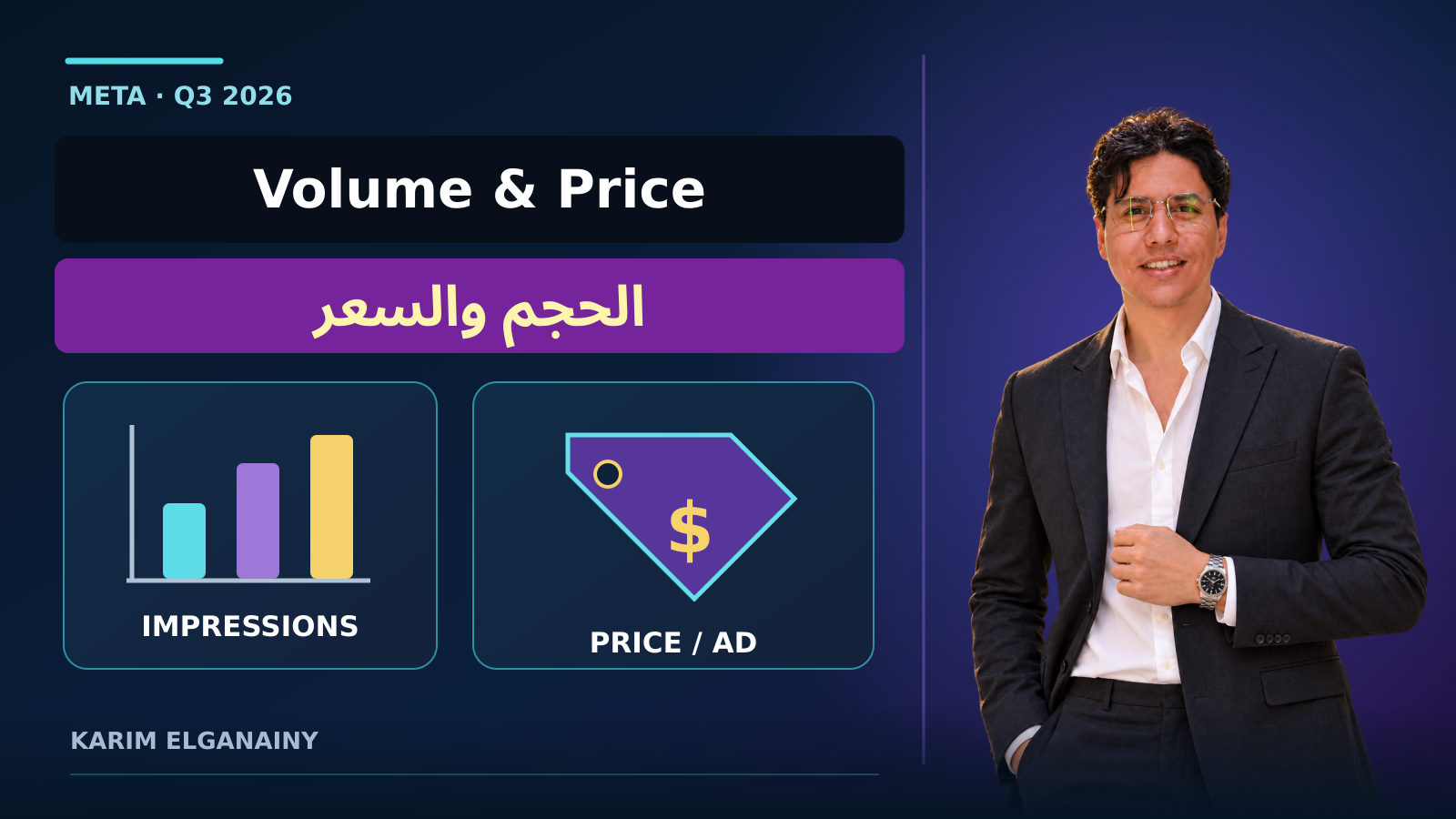
Meta published its results on 21 October 2026 for the quarter ended 30 September. Total revenue was USD 64.601 billion versus USD 51.242 billion a year earlier; advertising revenue was USD 63.061 billion. Net income, a different measure, was USD 9.860 billion. Across its Family of Apps, ad impressions rose 10% and average price per ad rose 14% year over year. These are company-wide reported figures, not Saudi account benchmarks. Meta's earnings release.
For a marketing director, the useful response is neither panic about prices nor automatic confidence in performance. A platform's aggregate result describes a marketplace containing different countries, objectives, placements, advertisers and customer journeys. The operating question is narrower: what happened to the cost of acquiring an appropriate customer for this business, and which part of the journey explains the change?
The framework below is original analysis, not additional guidance from Meta. It offers a way to investigate that question before changing budgets. It is not a prediction for an individual advertiser and does not provide a personal investment recommendation about the company.
Keep three scorecards separate
The first scorecard belongs to the platform: its corporate revenue, expenses and earnings. The second belongs to the advertising account: spending, delivery and attributed events. The third belongs to the business: suitable demand, fulfilled sales or services, and the economics of delivering them. Each can improve while another deteriorates. Combining them into a single story makes management conversations sound simpler but decisions less reliable.
Put the three scorecards on different pages or clearly separated sections. A platform announcement supplies context, not a target for the local account. Account attribution helps diagnose acquisition, but it should not silently replace the company's own record of completed business. Finance and operations should agree what counts as a fulfilled outcome before the media team evaluates its acquisition cost.
This distinction also prevents a common reporting error: using a growth percentage from a corporate announcement as the explanation for every local increase. A change in market mix, a new offer or weak follow-up might be more important to the account than a broad platform trend. Treat the headline as a reason to investigate, not the result of the investigation.
Rebuild the funnel before blaming the auction
Start with comparable periods and a stable definition of success. Record spend, impressions, clicks, valid inquiries, qualified inquiries and completed outcomes where these measures are available and appropriate. Specify the source of every stage. A platform click and a CRM contact are not interchangeable units, and a change in tracking can create an apparent business change that never occurred.
Then locate the first meaningful divergence. If impressions became more expensive but qualified demand improved, the business might still be healthier. If delivery costs stayed stable while completed outcomes fell, inspect landing-page usability, availability and follow-up. If all stages changed at once, check whether a campaign restructure or new measurement definition broke comparability.
Use the smallest useful breakdown rather than every possible filter. Geography, service line and language may reveal actionable differences, but tiny segments create unstable ratios. Begin with a view large enough to interpret, then investigate a specific hypothesis. Keep missing data visible instead of filling gaps with assumptions that make the funnel look complete.
Calculate the outcome that the business can afford
A lower acquisition cost is not automatically better when the acquired customers require different costs to serve. Define the relevant contribution measure with finance: the amount remaining after the variable costs included in the decision. Be explicit about which costs are excluded. This is an operating model for the business, not a substitute for its formal accounts.
For illustration only, suppose a campaign spends SAR 12,000 and generates 120 valid inquiries, of which 30 become completed purchases. Cost per inquiry is SAR 100, while acquisition spending per completed purchase is SAR 400. If another campaign generates more inexpensive inquiries but fewer completed purchases, its headline lead price can hide weaker economics. These figures are hypothetical, not a client case or a platform benchmark.
Carry the same distinction into the review meeting. Ask whether the campaign generated additional suitable business, whether the service could fulfil it and whether value remained after relevant costs. Avoid presenting gross sales as profit or appointments as recognized revenue. A useful dashboard makes these boundaries obvious even to a stakeholder who did not build it.
Inspect creative meaning, not just creative volume
When results weaken, producing more assets may help only if the new assets test a meaningful difference. A revised background or colour is not necessarily a new proposition. Build a short map of customer questions: what is offered, who it suits, why it is credible, what it costs or requires, and what happens after the next step.
Choose one unresolved question for each concept. A demonstration can reduce uncertainty about use; a clear comparison can explain a genuine trade-off; an honest description of the process can prevent unsuitable inquiries. The aim is not to make every asset persuasive to everyone. It is to help the appropriate audience understand the offer accurately enough to decide.
Review creative performance with downstream context. A sensational opening may attract clicks while creating expectations the business cannot meet. A more specific explanation may generate fewer responses but better-qualified demand. Track both the attention signal and the quality signal before deciding which concept deserves more investment.
Repair the handoff to the service team
Advertising is only one part of acquisition. A delayed response, unclear routing rule or unavailable product can erase the value of a strong campaign. Ask the people handling inquiries which misunderstandings recur and which operational obstacles prevent completion. Their observations can turn an apparently mysterious media problem into a concrete process repair.
Agree a small set of consistent outcome labels. Examples include outside service area, offer misunderstood, unavailable time, duplicate inquiry and no response after the agreed contact process. Use these categories to learn, not to blame individuals. A label should describe an observable condition rather than an unsupported judgment about the customer's motivation.
Choose the intervention that matches the evidence. Correct the advertisement when the promise is misunderstood; repair the landing page when important details are missing; fix routing when inquiries reach the wrong team. Changing bids for every problem treats the advertising account as a control panel for things it cannot actually control.
Test budget changes with an explicit stopping rule
Do not increase spending merely to compensate for a disappointing number. Write down what the additional budget is expected to reveal or achieve. State the constraint, the maximum acceptable exposure and the point at which the team will review mature outcomes. The review should reflect the real sales cycle rather than the convenience of a weekly slide deck.
Where a supported controlled test fits the question, use it. Otherwise, document the weaknesses of the comparison. Promotions, seasonal demand, staffing changes and creative fatigue can influence a before-and-after result. Acknowledge these factors instead of assigning the entire change to the budget decision simply because that was the action the media team took.
Protect a stable reference where practical. Changing the audience, offer, creative, landing page and attribution window together makes learning difficult. Some repairs cannot wait, but record them as interventions. The purpose of a test is to reduce uncertainty enough to make a better decision, not to manufacture a positive narrative.
Treat measurement repair as part of the work
Check whether events are duplicated, whether the selected event represents the intended business stage and whether internal tests contaminate the count. Confirm that consent choices and privacy requirements are respected. A technically functioning tag can still record the wrong action; a neatly populated report is not proof of a useful measurement design.
Reconcile a sample of account outcomes with the business's own records using appropriate access and minimal necessary data. Differences may arise from attribution rules, timing, cancellation or mismatched definitions. Document the reason before declaring one system correct and the other broken. Sometimes the systems answer different questions rather than disagree about the same fact.
For healthcare organisations, do not treat more detailed patient data as the default solution to uncertainty. Keep service marketing and clinical information appropriately separated. Have privacy and relevant subject-matter owners review any proposed data flow. Better measurement starts with clear purpose and definitions, not unrestricted collection.
Localise the decision for GCC operations
A regional campaign should be evaluated against its actual service geography, languages and delivery capacity. Arabic and English audiences may need different explanations and support journeys. Check the full experience in each language, including the form, confirmation message and follow-up. An advertisement can be properly localised while the next step remains confusing or unsuitable.
Keep location differences meaningful. A service that is available in one city but not another should not be judged through a blended conversion rate that hides the mismatch. Similarly, a campaign for immediate availability and a campaign for a waiting list are not producing identical outcomes. Define what each is meant to accomplish before comparing them.
In medical marketing, distinguish a suitable inquiry, a booked appointment, attendance and the financial outcome where it is appropriate to measure. None is evidence of a clinical benefit. Review claims with qualified professionals and avoid messages that imply knowledge of a person's private condition. Commercial clarity and respectful communication should reinforce each other.
Turn the review into a decision record
End the analysis with a short record: the question, the evidence, the main uncertainty, the chosen action and the owner of the next review. Include what would change the decision. This makes the team accountable without pretending that the available data can remove all uncertainty from a changing marketplace.
The strategic takeaway is to improve the business's ability to diagnose acquisition, not to copy a corporate growth narrative. Marketplace news becomes useful when it leads to a clearer funnel, a better proposition or a repaired handoff. If the only output is a chart repeating a platform headline, the operational opportunity has been missed.
Source and scope
The worked example and management framework are original illustrative analysis. They do not establish local advertising inflation, guaranteed performance improvements or investment suitability.
Comments
No published comments yet.