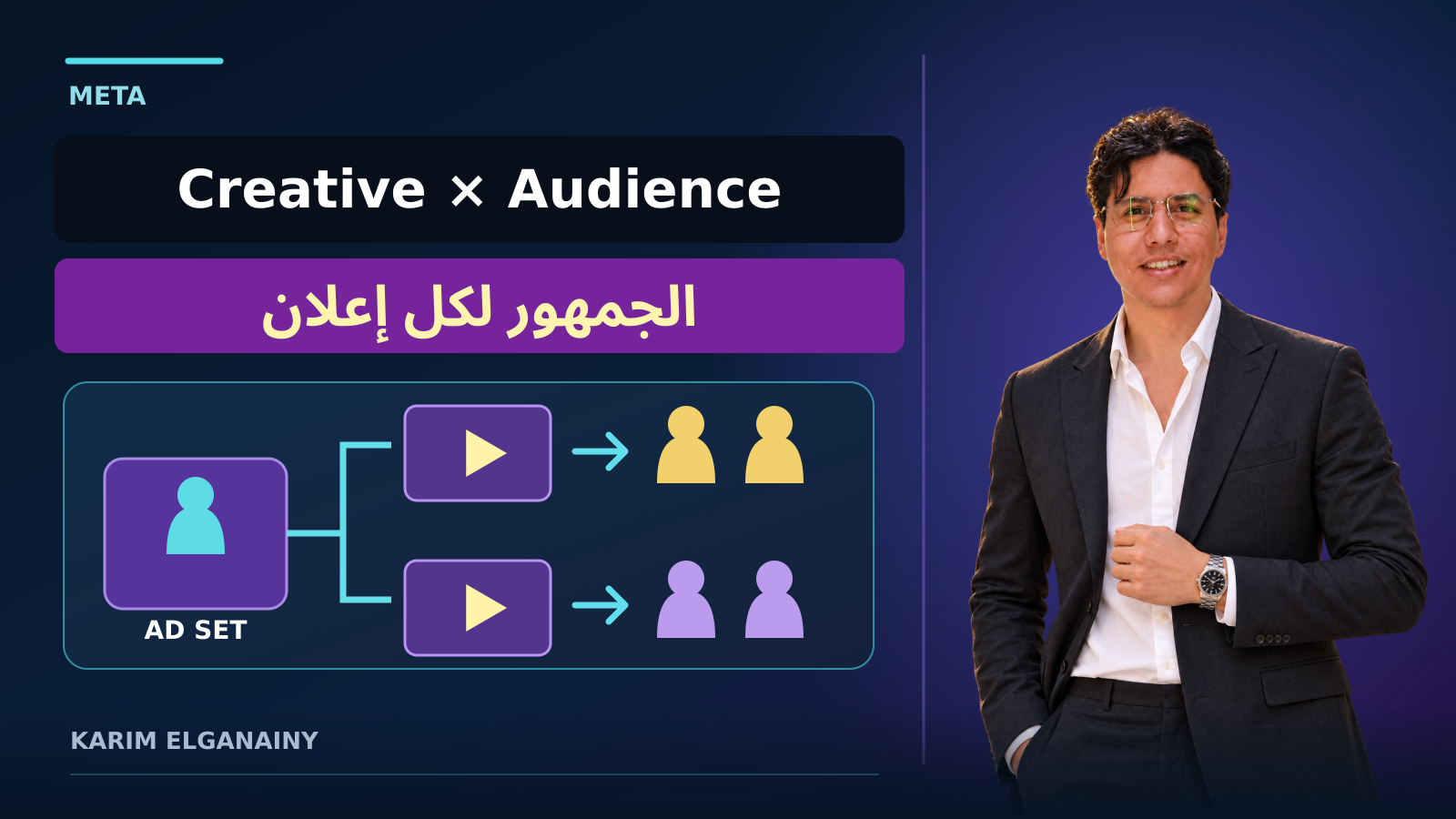
A new creative control, with an important qualification
In a firsthand walkthrough reviewed on 22 October 2026, advertising educator Jon Loomer examines Meta’s “Choose an audience for each ad creative” option. His interface inspection shows age and gender guidance attached to individual media, while the displayed explanation allows delivery beyond that audience. This is not evidence of a strict demographic fence or universal account availability. Firsthand walkthrough.
PPC Land separately reported a developer announcement dated 19 October. This article does not reproduce API parameters or present an implementation specification: Meta’s linked developer and help pages could not be independently retrieved during preparation. The practical discussion below is original analysis of how to evaluate creative-level guidance, not a claim that the feature is enabled in your account or proven to improve results. Launch reporting.
The important management question is not whether a new switch exists. It is whether a team has evidence that different messages serve different customer needs, and whether adding guidance makes those messages more useful without concealing a commercial trade-off. A more elaborate campaign structure is not automatically a more intelligent one. Neither is a simpler structure automatically better if it loses a distinction the business actually needs.
Separate a customer need from a demographic shortcut
A demographic label is an imperfect description of the job somebody wants done. Two people of the same age can have very different budgets, experience, purchase timing and concerns. Before assigning a creative to a group, write down the underlying reason for the difference. Is the message about ease of use, an unfamiliar category, a particular product configuration or a different stage of decision-making?
Then ask what evidence supports the proposed distinction. Customer interviews, consented feedback and aggregated sales questions can help identify real differences. A stereotype copied from a planning presentation is not enough. The team should be able to explain why the message is useful even when somebody outside its intended demographic sees it. That requirement is particularly important when the observed interface explicitly allows broader delivery.
Treat the audience definition as a hypothesis, not a diagnosis of the individual. A proposed message might help first-time buyers understand installation while another explains compatibility to experienced users. Age may correlate with experience in a particular dataset, but the relationship should not be assumed. If the creative solves a problem shared across groups, demographic guidance may add complexity without meaningful benefit.
Decide whether consolidation solves a real problem
The appeal of creative-level guidance is easy to understand: several messages can be managed without multiplying every supporting campaign element. But consolidation should address an identified cost. Examples include excessive manual reporting, duplicated quality checks or fragmented learning. Write down the current problem before changing the account so that the team can later assess whether the new arrangement actually reduced it.
Some distinctions deserve to remain separate. Different service regions, budgets controlled by different owners, incompatible commercial objectives or sharply different margins may require independent decisions. The existence of a creative option does not remove those organizational constraints. Ask whether consolidating would make it harder to stop a particular activity, explain spending to a stakeholder or ensure that the customer receives an available offer.
Map each proposed change to a business reason. If the only explanation is that a platform now offers a feature, keep the existing structure while preparing a bounded test. This avoids mistaking product discovery for an account-wide migration plan. It also protects teams from spending their limited review capacity on complexity that does not address the main performance bottleneck.
Build a message matrix before touching settings
Create a small working matrix with four columns: customer question, truthful proof, proposed creative and next step. For an illustrative household-product campaign, one question could concern storage space, another maintenance and another durability. The proof might be measured dimensions, a demonstrated cleaning process or documented material information. These are hypothetical examples, not reported outcomes from a client account.
The matrix should make weak messages visible. If the team cannot produce credible proof for a proposed claim, changing the audience will not fix the problem. If several creatives answer exactly the same question with different stock photographs, the experiment may test visual preference rather than a meaningful difference in customer need. That can still be useful, but it should be described honestly.
Review the next step as carefully as the advertisement. A detailed demonstration should not lead to a page that hides specifications. An explanation for a cautious first-time buyer should not end in an unexplained purchase form. Message continuity gives the experiment a fair chance: the customer encounters a coherent answer, and the team can interpret drop-off without blaming targeting for every weakness in the journey.
Define a controlled experiment and a stopping rule
Choose one commercial question and a limited test budget approved through the organization’s normal process. Keep the offer, destination, measurement definitions and service conditions as stable as practical. Record which creative guidance changed and which elements did not. If several settings must change together, acknowledge that the result will evaluate a package rather than isolate one feature’s effect.
Write the decision rule before launch. The relevant outcome might be qualified enquiries, completed purchases or attended consultations, depending on the business. Pair that outcome with a cost measure and a quality check. Do not set a universal percentage improvement simply because it looks persuasive. A useful threshold depends on baseline variability, economics, available volume and the cost of making a wrong decision.
Plan how to handle insufficient evidence. A small number of conversions can produce dramatic-looking differences by chance. If the test does not generate enough relevant outcomes, report it as inconclusive rather than manufacturing a winner. The operational benefit of simpler management can be measured separately, using documented preparation and review time, without pretending that saved minutes prove incremental revenue.
Measure the downstream result, not only response
A creative can attract attention while creating the wrong expectation. Review the path from exposure to click, enquiry, qualification and completed service where those stages are relevant and lawfully measurable. Keep the denominators visible. A better click-through rate among a smaller or different audience does not establish that the business acquired more valuable customers at an acceptable cost.
For a service business, distinguish a submitted form from a reachable lead, a suitable enquiry from a confirmed booking, and a booking from attendance. These stages answer different questions. If follow-up staffing changed during the test, note it rather than attributing all movement to the advertising feature. Marketing and operations must share enough context to separate a communication problem from a response-capacity problem.
Do not automatically upload sensitive downstream details to an advertising system. A measurement plan should specify purpose, lawful permissions, data minimization and responsible ownership. In healthcare especially, the desire for a richer optimization signal does not justify exposing a person’s condition or treatment history. Useful internal analysis can often begin with less data and clearer definitions.
Read distribution changes before declaring a winner
An aggregate improvement can conceal a change in the mix of people reached. Review available breakdowns cautiously and compare like with like where the data supports it. Ask whether one creative received substantially more delivery, whether a location changed in importance or whether the offer was more available during one period. These questions help identify explanations without claiming a causal answer from observational reporting alone.
Avoid a spreadsheet with so many tiny segments that every cell becomes noisy. Choose the breakdowns needed for the original decision and explain their limitations. If reporting cannot show the distribution required to validate a hypothesis, say so. A team can still make a bounded operational decision, but it should not present missing evidence as proof that the mechanism worked exactly as expected.
Keep results and interpretation in separate paragraphs. First report the observed counts, rates and costs. Then describe plausible explanations and competing factors. Finally recommend the next action. This ordering makes the report easier to challenge constructively and prevents a confident headline from becoming more durable than the evidence underneath it.
Apply extra care to healthcare communication
A healthcare creative should answer a legitimate service question without suggesting that the advertiser knows a viewer’s private medical circumstances. General educational explanations, appointment logistics and clearly described service scope are different from claims about an individual’s condition. Clinical assertions require appropriate professional review, and an advertising experiment is not evidence of treatment effectiveness.
Consider a hypothetical clinic explaining how to prepare for a first consultation. One version might emphasize the appointment process and another the documents to bring. The useful distinction is the information need, not an assumption that a demographic group has a disease. Review whether the message remains respectful and accurate when it reaches somebody outside the intended audience.
Confirm operational readiness before asking for more enquiries. The service must be available, the response team should understand the campaign and the landing page should state the relevant location and next step. If a campaign succeeds in generating attention but cannot deliver a reliable response, the business risks turning a creative test into a trust problem.
Give the experiment a clear owner
Assign one person to approve the creative hypothesis and another appropriate reviewer to validate the claims and measurement. The same small log should record changes, reasons, dates and the planned review. This is a lightweight control, not a demand for unnecessary paperwork. Its purpose is to prevent a second operator from changing the test halfway through without realizing why the original settings were chosen.
Document what can be reused after the test. A useful learning might concern a customer question, a proof point or a weak landing-page transition rather than the new feature itself. Preserve that insight in the next creative brief. Otherwise, a team can run many experiments while repeatedly rediscovering the same problem because only dashboard screenshots survive.
The strategic takeaway is to use additional controls only when they improve a decision the business can explain. Creative relevance comes from understanding the customer and presenting credible evidence. Platform guidance can support that work, but it cannot replace it. A cautious, well-documented test is more valuable than an account-wide change justified by novelty.
Sources and evidence boundaries
- Jon Loomer’s firsthand interface walkthrough, reviewed 22 October 2026.
- PPC Land reporting on the 19 October developer announcement.
- Meta’s linked help page, provided for direct reference; not independently retrievable in this review.
Published 22 October 2026. This article does not claim a new launch on the publication date, universal availability, a strict targeting restriction or demonstrated performance uplift. The experimental framework, commercial interpretation and hypothetical examples are original analysis. For the broader planning framework, see segmentation, targeting and positioning.
Comments
No published comments yet.