What X actually changed
X's November update makes it easier to produce vertical video without exporting from another editor. That is a workflow development, not a reason to expect every clip to earn more reach. The November 25 announcement from X Business, also covered by TechCrunch, describes a media editor with segmented recording, green-screen effects, reframing for vertical video, trimming, captions, text overlays and thumbnail controls. Availability can vary by market. A team should confirm the controls in the account and version it actually uses before promising production around them.
There are two related but distinct workflows. The editor helps turn your own recording or footage into a new publication. The clipping tool shares a portion of an eligible existing video as part of a post with commentary and a link to its source. X also described other creator tools around the same period, but their presence in the announcement does not mean they all first shipped on November 25. It also does not establish that organic publishing features are controls for paid advertising. The useful commercial question is whether editors can remove a step while keeping quality, access and provenance intact.
Calculate the clip boundary, not just the upper limit
X Help documents clipping in the iOS and Android apps, with availability varying by region and app version. The documented use is for eligible prerecorded videos at least two minutes long, not live broadcasts. A clip is between five and sixty seconds and cannot exceed 30% of the source length. Both maximums apply. A two-minute video is 120 seconds; 30% is 36 seconds, so the ceiling is 36 seconds. A four-minute video is 240 seconds; 30% is 72 seconds, so the ceiling is the other limit, 60 seconds. These are calculations from X's rules, not recommendations about ideal clip length.
The original creator is credited and the source link takes viewers to the clip's starting moment. That link is valuable when a viewer wants to hear the rest of the answer. It is not a replacement for the context needed before somebody shares or acts on an excerpt. X says earnings depend on enrollment in Original Content Rewards; a clipped post is not eligible for the Video Kickstart Bonus. Do not put income from a clipping program in the pilot budget unless eligibility, availability and outcomes are independently established for the account. Having a button is not the same thing as having all the permissions your organization needs to reuse another person's recording.
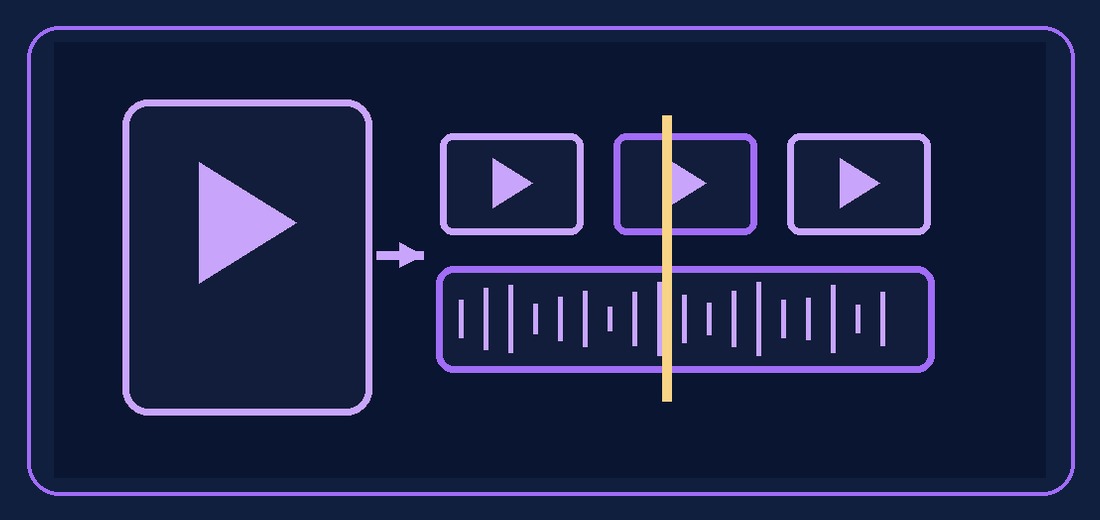
Editing timeline moving from recording to clipping and review
Protect meaning before optimizing the frame
Vertical reframing solves a geometric problem but can create an editorial one. A speaker can occupy the center of a widescreen interview while the object, comparison or slide referred to sits to one side. A crop following the face may drop the evidence the speaker is pointing to. Watch the result without the original beside it. If one cannot tell what the speaker means by “this” or “the second option,” use a different segment, include a clean supporting shot, or keep the full frame instead of squeezing a missing explanation into a caption. Test both a small phone and a larger display in the same aspect ratio; the smallest supported rendition is the stricter readability test.
For bilingual teams, auto-captioning is a first pass rather than an approval step. Compare the actual sound with the subtitle, especially names, loanwords, abbreviations, numbers and negation. A missed negative is a change of meaning, not a typography problem. In Arabic, review direction and punctuation where English initials or numerals interrupt a line. In any language, leave room for posted overlays and avoid hiding labels under captions. A custom thumbnail should promise what the excerpt actually answers. A good opening attracts the right viewer by naming a real question, not by withholding criteria that matter to the answer.
Build an organic pilot that can survive its own results
Start with four recordings your team is allowed to edit and publish. In a hypothetical pilot, a professional education account selects four interviews, each with two separate self-contained answers of similar complexity. For each interview, randomly assign one answer to native editing and the other to an external-editor workflow designed for X. Use comparable lengths and a consistent caption and review standard. Rotate time slots and which variant goes first across interviews. Do not post the identical clip twice to substantially the same audience as if those views were independent observations. Document the topic, date, access to features and accepted cut for each pair.
The small experiment does not isolate an editor's effect on ranking. Topics, opening shots, audiences, timing and ordinary distribution changes may still explain differences. Separate the production question from the audience question. For production, log active staff minutes: ingest, rough cut, framing, captions, review corrections, final approval and publishing. Keep waiting time separate from hands-on labor and carry over any approver's correction in both arms. For audience response, define which watch measures are available, compare like with like, and use the same observation period for all posts. Control the variables you reasonably can without pretending that an ordinary posting rotation creates a perfect randomized field trial.
Read time, attention and outcomes separately
Use three layers of measurement. First, compare active minutes per approved clip; the count of cuts rejected before approval is part of that labor. Second, use a viewing metric whose definition and denominator are known. A video start, a completed play and an impression are not interchangeable. If the account does not expose comparable retention, mark it as missing instead of substituting a ratio from a different surface. Third, log the intended next action, such as a professional profile visit, a qualified education-page visit or watching the linked source video, when the account can actually observe it.
Here is a fictitious calculation for the production layer. Native editing uses 80 active staff minutes to deliver four approved clips; external editing uses 120 minutes for four. That is 20 versus 30 minutes per approved clip, a ten-minute difference. If native edits later require 40 minutes of additional caption corrections across those four clips, add those minutes to the same observation window; the difference disappears. Note any accounts or clips missing comparable data before interpreting the result. Even if the native group produces more profile visits, those visits are not leads, booked appointments or proof of incremental business. Use a tagged educational link only where appropriate, keep the destination consistent across variants, and avoid placing personal details in tracking parameters.
A practical GCC use case, with a clear boundary
A Saudi or Gulf healthcare team could use an owned professional interview to explain an ordinary service process, such as how families locate published clinic hours or how to prepare nonclinical documents for registration. This is a hypothetical use of the format, not a claim about patient behavior on X or a recommendation to move acquisition budget there. A trained reviewer should check local terminology, any date and facility named, and whether an Arabic excerpt can stand without the English context that introduced it. A clean, access-approved source file and a separately approved publishing copy make it possible to correct captions or take a clip down without losing the record of what changed.
Keep patient material, private screens and responses to individual clinical questions out of this pilot. Use presenters and rights-cleared assets, not someone else's clip simply because a credit displays. When someone replies with a personal health question, route them to the ordinary approved channel rather than improvising in a public thread. The same restraint applies to professional services outside healthcare: an excerpt cannot carry every condition, so point to the complete educational explanation and check that the short opening does not imply a guarantee. Where the app lacks a needed control, use the external workflow rather than letting a distribution feature dictate the quality of the content.
Make the keep-or-drop decision in advance
Choose a meaningful time-saving threshold before work starts. For example, a team might require at least eight fewer active minutes per approved clip, while requiring every caption and every material claim to pass the same review in either arm. That is a proposed threshold, not a benchmark from X. Record how to handle missing data, rejected clips and work that takes place after publication. For a safety-critical error, the response should be to correct or remove the content, not to leave it public so the experiment has a complete set of observations.
If the native workflow saves labor and passes review, keep it for simple, self-contained clips. If it saves labor only on takes with clear speech but fails when Arabic terminology, multiple speakers or slides are involved, use it selectively and retain the external route. If attention looks better but the team cannot reproduce the improvement or understand which metric X reported, treat it as a signal for a larger test, not as a reason to change spending. Document the decision in a page that names which inputs, approvals and checks will carry forward. The durable improvement is not publishing all video through one app; it is knowing which footage can be turned into a responsible short piece without paying for the shortcut later.
A sensible next iteration changes one thing: the draft workflow, the caption review process or the opening shot. Keep the rest stable. Preserve one approved long-form source, timecode the point where the excerpt begins, and make a named editor accountable for the final rendering. This is useful even if a platform relocates a control or changes eligibility. The platform has made a cut easier to assemble. The team's job remains deciding whether that cut is accurate, comprehensible, and worth the audience's time.
Make the review auditable by recording next to each version why that excerpt was chosen, which idea stands on its own, and what was deliberately omitted and may need to appear in the post copy. The reviewer can then test the opening by itself before watching the whole clip. If the opening promises something the clip does not deliver, revise it before scheduling. This check takes a few minutes but avoids re-editing material that could have been corrected before anyone saw it.
Comments
No published comments yet.