What Meta actually announced in India
Meta’s November 27, 2026 announcement describes an expansion of Instagram for TV into India. The company said the app would become available within days on supported Apple TV, Fire TV and Google TV devices. That wording describes a rollout in progress, not simultaneous access for all Indian households, worldwide availability or a newly declared Saudi launch. Nor does the announcement give advertisers a new placement to buy. An app on a television and a bookable connected-TV campaign are two separate things.
The viewing surface is built around Reels and Stories. The company describes up to five accounts, horizontal Reels played in widescreen, channels grouping videos, a Friends tab, and remote-controlled playback. It also describes casting from a signed-in phone and TV on the same Wi-Fi network, with availability varying by device and rollout. These details matter because they tell us which experience is changing: people can browse short videos in a setting where a remote and a screen may be shared. They do not establish how many will watch together, how long they will stay, or what commercial effect creators should expect.
Why viewing distance changes a creative decision
A television is physically larger than a phone but often much farther from the viewer. A line that looks generous in the editor’s desktop preview can become hard to read from the sofa. A large title does not solve it if the disclaimer, office hours or instruction underneath is too small. Likewise, a clean subtitle can still be unusable if it changes before a viewer has read it. A screen-friendly cut must therefore make the central scene, words and audio clear at the intended viewing distance, not just technically fill the available pixels.
A second difference is who controls playback. A phone’s viewer can pause or replay at any moment without negotiating with anyone. On a shared screen someone else may hold the remote. A viewer who misses the opening may not want to interrupt the room to ask which service or location was meant. Marketers should make the subject and context recognizable early, then repeat only essential instructions in a natural way. For example, introduce the facility in the voice track and display the same short unit name when the booking step appears. Do not turn the opening into a long identity card just to accommodate late arrivals.
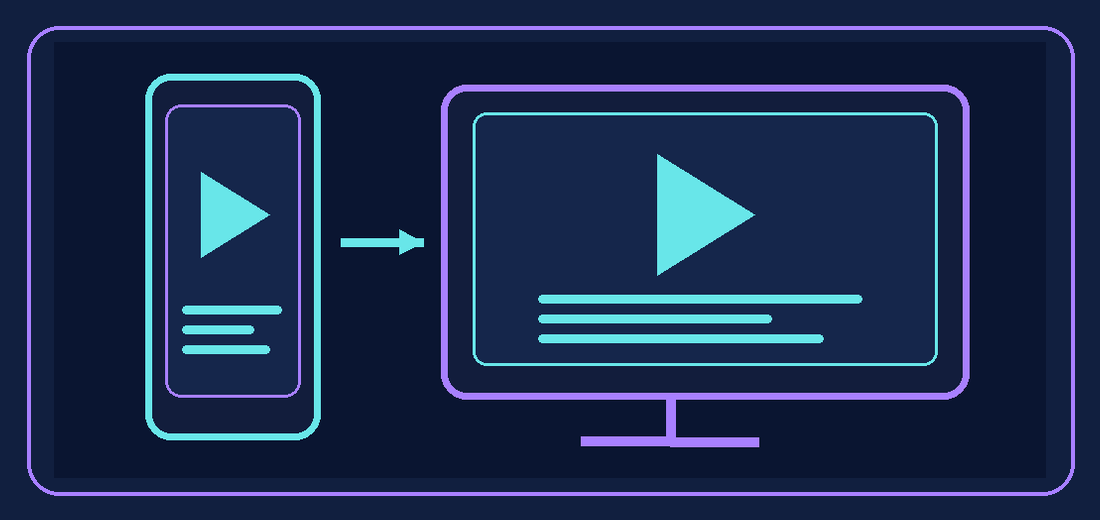
Phone and television framing the same scene differently
Keep one message, but cut for two frames
The cheapest option is not always to press an automatic crop button. A vertical close-up of a trainer’s hands opening a product case might work on a phone because the latch and safety label are close together. A widescreen crop can cut away the label or show a great deal of empty space. Reframing decisions should begin with what the audience must understand, not with who owns the crop tool. If the important visual cannot survive both frames, film a separate insert. A thoughtful shot list is less expensive than asking the editor to reconstruct an action that was never filmed.
Build the shot list around a master interview, a wide view that establishes the space, and a closer view of the action. Give the editor a clean version without baked-in captions and author captions again for each frame. Record the answer in full even if the Reel uses only a short passage, so that the team can confirm the edit has not changed the speaker’s meaning. On the mobile edit, preserve room for interface elements. On a television candidate, avoid pushing important content to the edges. These are production choices, not claims about any Instagram interface overlay or guaranteed presentation.
Design a Gulf pilot without buying inventory
Consider a hypothetical educational series for a Gulf outpatient clinic. Its aim is not to test individual diagnoses, sell a package, or claim access to the TV app in the region. It is to test whether people can explain how to prepare for a first visit using material the clinic already has permission to produce. The four episodes might cover finding the correct reception, what the clinic expects a visitor to bring, where to ask access questions, and how to locate the official booking page. A staff member and a staged room can demonstrate the steps without filming a patient or exposing a screen used for care.
Start with a current phone export and one deliberately reframed television candidate for two episodes. Put the other two into the sprint only if the initial comparison turns up a meaningful issue. Give both versions the same facts, narrator, and approved call to action. Invite volunteers rather than asking strangers for private medical information. Show the television export locally on a supported playback device as a simulation; call it a living-room test, not an Instagram for TV test in Saudi Arabia. The phone version can be assessed on a phone in the same session. Keep the draft links private until the content and rights are cleared.
Measure understanding, not just playing time
For each test episode, write a question before seeing any results. A useful question might ask where a visitor should go first, or how they can confirm the right location if the screen does not make it clear. An open-ended response is better for discovering misleading instructions than a leading multiple-choice item. Score answers as correct, incomplete or wrong using a brief rubric shared before testing, and record when the participant asked for a replay. Do not put private appointment or identity details in the question or the record.
To learn something about the edits instead of the order in which they were watched, split the volunteer sessions so one group starts on the phone and the other on television. Where possible, use a different episode on each screen for an initial pass so the test does not merely measure recall from seeing the same video twice. Note the viewing distance, sound setting and any practical constraints. If the sample is small, report the actual counts and specific failures rather than an impressive percentage. Decide in advance what would justify changing the template: recurring caption failures, an ambiguous booking instruction or a framing problem reproducible in more than one scene.
Keep attribution and cost in their own lanes
The pilot has an internal primary measure: whether people understood and could repeat an instruction without prompting. It has a production measure: the extra time and review required to deliver two usable files. It does not have a television reach measure. Before accepting two cuts as a default, record the edit hours, correction rounds and accessibility fixes per episode. If a typical title change forces a second caption check and a compliance review, include those costs rather than treating the widescreen version as a free extra. A team that cannot maintain two accurate cuts could preserve a clean master and convert selected episodes when there is an actual distribution reason.
If the clinic later posts the mobile version through an authorized organic channel, track viewing separately from website visits and confirmed bookings. A television viewer might use a phone later or ask another person to look up a page; an attributed click is not a census of everyone who watched. The opposite error is also easy: a search, QR scan, or booking after a release does not on its own prove the video caused it. Use distinct route tags where appropriate, limit data collection, and compare like periods, but keep unattributed activity explicit instead of forcing the numbers into a purchase funnel that the platform has not documented.
Accessibility and privacy are part of the edit
A larger screen often means someone besides the original viewer can see or hear the material. In healthcare education, avoid instructions that ask people to announce personal details, show test results or use public comments to provide a medical history. If a next step needs private information, direct people to an approved private channel. On-set footage and browser recordings deserve attention too: crop or reshoot a sequence if an employee name, patient name, visit row or personal notification appears. Do not count on the text being too small to notice when somebody pauses the frame.
As part of the pilot, have a person other than the editor check Arabic captions for timing, line breaks and readable numerals, and compare the spoken booking route with what is displayed. Try ordinary lighting with the television several steps away, not only a monitor in the edit suite. Run one pass muted to see whether captions still carry the core message. Run another without reading the captions to see whether the narration can stand alone. Not every viewer will use video the same way; making the essential action available through more than one cue reduces the chance that an otherwise polished clip fails the simplest comprehension check.
Give the file sign-off a field for the device and viewing distance and a checkbox for separate text and audio checks. If the call to action relies on a QR code, test whether the code is readable from the viewer’s normal seat, but do not make it the only route. Name the official channel aloud or show a short address viewers can type. On a shared screen, not everyone will have a phone in hand or want to use it in front of others. You do not need to make them take that step to assess whether the video communicates clearly.
A practical decision for the next content sprint
A Gulf content team does not need to redesign its whole calendar because of an India rollout. Pick a topic with a clear benefit from shared viewing, such as explaining a location or demonstrating a physical object, rather than forcing a panoramic crop onto a selfie-led response. Keep the version that performs well on the phone today, build one or two television candidates out of clean footage, and test in the setting where the differences actually matter. Keep a record of what changed and what the result can support.
The useful takeaway is a narrow one: if a second edit helps real test viewers understand the same message and time costs remain manageable, maintain an editorial option for television. If both cuts perform similarly or production effort regularly exceeds the benefit, retain the option without routinely delivering it. Before paying for any connected-TV tactic, verify local product availability, placement controls, reporting and costs as separate conditions. None is established by this announcement.
In a team with a limited budget, separate a request to change the script from a request to change the frame. If both versions confuse viewers about which branch the instructions refer to, change the words before spending another hour on the crop. If only the television version loses a legible label, fix the placement of the label or shoot a dedicated close-up. This distinction tells the producer who should act next and helps keep the pilot small enough to finish. Record the change before showing the revised version to anyone.
Comments
No published comments yet.