What Tom Health announced and what to take from it
Tom Health's November 16 announcement describes a Lumeris affiliate with its own brand and product strategy. The company says its product, Tom, is already involved in work with organizations across 14 US states, and identifies Ochsner Health's Mia as a patient-facing experience powered by Tom. The November 28 briefing is revisiting that launch, not announcing a new release or Gulf availability on November 28. It also does not establish regulatory clearance, service availability or a procurement recommendation in any particular market.
The interesting operational idea is that an appointment reminder is not the end of the job. A system that finds people due for an already agreed follow-up, handles routine replies and routes problems to the right waiting team could reduce the friction between a care plan and its execution. It can do that only when the underlying queue is accurate, the proposed appointment exists and someone owns the exceptions. A conversational layer cannot create clinic capacity or reconcile incompatible records by itself. That distinction matters much more to a hospital marketer or access team than whether the interface is described as an agent.
How orchestration differs from sending another reminder
The vendor's product description calls its prioritization system Best Next Action and describes bringing together data sources, identifying gaps and coordinating outreach and follow-up, including through voice and SMS in relevant workflows. It describes escalation to staff when a decision calls for clinical judgment or human support. That is the vendor's description of its product. The following operating model is an editorial illustration, not a description of Tom's exact configuration or an instruction to automate medical triage.
Imagine that the organization has a list of routine follow-ups already approved by staff. A reminder tool can take the list and send a message. An orchestration workflow must instead confirm the task is still open, choose an allowed contact channel, identify which team is accountable for the next action and recognize when the original case is no longer suitable for a routine message. If the patient already booked by phone, another reminder may be redundant. If someone says they need language assistance, sending them the same link again may make the process worse. In both cases the useful action depends on changing the case state, not generating more polished copy.
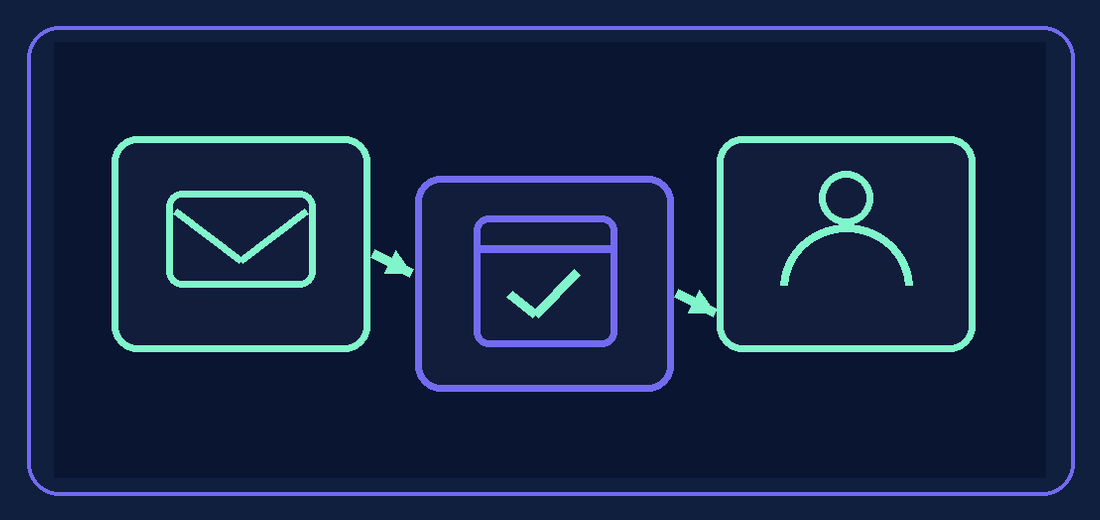
Follow-up workflow linking a reminder to booking and human handoff
Closing a case should require an event that the organization can actually verify, such as a matched booking in the scheduling system or attendance recorded by the clinic. A delivered text, a clicked link, a tentative slot and a confirmed appointment are different events. A person can complete the administrative step without clicking the original link. A person can also click more than once without making progress. Keeping these distinctions in the design protects patients from repeated outreach and protects the business from overstating performance.
What the performance figures do and do not show
The announcement reports engagement above 88% among patients aged 75 or older, 28% fewer emergency department visits, 94% medication adherence and a 56% increase in annual wellness visits. These are figures reported by the company. They describe different outcomes and should not be treated as interchangeable. The release does not offer the denominators, cohort construction, observation periods and comparison design needed to attribute the changes to Tom or to transfer them to another provider. It would be a mistake to use them as expected improvements for a local rollout.
For example, before interpreting fewer emergency visits, a team would need to know if visits were counted per person over equal periods, what events were visible outside the participating provider and whether baseline differences were handled. A change in what the organization can see in its data can change the count without changing care. An adherence percentage needs a defined measure and a population: a refill record, a patient report and a continuously measured behavior are not equivalent. An engagement percentage also needs a clear definition of who entered the denominator and which actions counted. An organization evaluating the product can ask for those definitions and an analysis plan, but the absence of details in a public announcement is not evidence that the reported outcomes are false.
Management should also ask about missing outcomes. Were unreachable people, wrong contact details or those preferring a staff member in the denominator? Did their observation end earlier or later than the reporting window? These questions do not imply that the result is positive or negative, but they determine whether a readily reachable sample can reasonably stand in for a broader population.
Design one administrative pilot instead of a general assistant
Consider a hypothetical outpatient service with an existing, staff-approved pathway for routine follow-up. Start with one clinic, an eligibility list prepared by the accountable team, and one verifiable objective: whether eligible people attend the planned follow-up within a predeclared period. Do not recruit from advertising audiences or infer eligibility from clicks. Staff need to set inclusion and exclusion criteria, check stale patient records and decide what happens if a patient asks a medical question. This is an operations pilot, not a recommendation about how often anyone should be seen or what care they should receive.
Before live use, test with synthetic records. Include a booked patient, a wrong number, an opt-out, a duplicate message, an unavailable slot and a response that requires a human. Give each administrative state an owner, a time limit and a fallback. If a contact fails, the record should say so without silently switching to an unapproved channel. If the person refuses contact, that is an opt-out, not a failed appointment. A supervisor should have a way to pause the workflow when the booking feed is unavailable, the queue is too long or a meaningful safety concern appears. Test the pause and recovery procedure before testing message wording.
A Saudi or Gulf provider should check its own requirements, agreements and policies before rollout, rather than transferring a US deployment design. In practice that means involving privacy, security, clinical governance, scheduling and patient access from the beginning. Confirm which contact channel is allowed, what information can appear on a shared phone, who can read the records and what happens when someone requests human help. A short generic first message can avoid disclosing the reason for contact before identity is appropriately verified. Keep access logs, limits on retention and the vendor's data handling in the review. Do not send health information to a marketing pixel or enrich an ad audience from a follow-up queue.
Do not start testing every channel and message at once. Choose a route the clinic can support during its coverage hours and tell the patient when a staff member will call back. A delay in assigning responsibility after a handoff can matter more than a delay in the first message. The coordinator should see only the operational context needed, and another member of the team should know how to take over if the original owner is unavailable.
Measure attendance, workload and trust separately
Freeze the eligible starting cohort, the start date, the follow-up window and the definitions before comparing the pilot with routine handling. Pair a fair comparison with a clear report on missing data and access barriers. Where feasible, and only with the necessary approvals, assign comparable eligible cases across the new and usual workflows. If the design uses two locations or a before-and-after comparison, record differences in availability, staffing and the composition of the cohorts. Report association rather than causation when the design cannot support a causal conclusion. Confirm who checked in with the clinic's authoritative attendance record and reconcile non-digital bookings using an approved internal process.
A hypothetical calculation illustrates the difference between funnel measures. Suppose 100 people are initially eligible in each group. In the new workflow, 72 are successfully reached, 40 book and 32 attend. In usual handling, 65 are reached, 38 book and 30 attend. The attendance rate among eligible people is 32% versus 30%, a difference of two percentage points. Among people who booked, the attendance rates are 80% versus about 79%. These small illustrative counts do not demonstrate causation, clinical benefit or a reliable financial return. They do show why a seven-point difference in successful contact must not be presented as a seven-point improvement in attendance.
The report should also show opt-out and no-answer separately, together with wrong contacts, duplicates, requests for human assistance and how quickly those requests were handled. Count staff time across preparing the list, reviewing replies, making callbacks, correcting records and handling exceptions, not just the minutes saved in composing reminders. A process that reduces outgoing calls but creates more correction work may increase the total burden. Review counts by approved operational slices, such as supported language or whether someone booked by phone, without exposing small groups or private identities. If data are insufficient to assess a slice safely, say so instead of hiding the uncertainty in an overall average.
Do not reduce cost to the licence fee. Compare weekly time across teams before and after, noting one-off training and continuing work separately. This can show whether pressure moved from scheduling staff to reply reviewers, not that each minute saved automatically becomes revenue. Ask the clinic manager whether service capacity could handle the possible increase in attendance in the first place.
Make the expansion decision before seeing the numbers
Set practical review rules before launch. A service manager could require a reliable booking feed, timely human responses during covered hours, and tolerable workloads before running even a small pilot. Review failures in early rounds rather than pushing for higher message volumes. Incorrect recipients, repeated contact after opt-out, inaccessible replies or unhandled clinical messages warrant a pause and investigation according to the organization's procedures. More attendance alone should not excuse those failures.
For an expansion review, show the eligible count, the result window, the comparable group if available, staffing effort and the safety findings together. Test a narrower change, such as clearer timing options or a better way to request a callback, if scenarios indicate administrative friction rather than a capacity constraint. If there are simply no usable appointments, redesign the access process before changing the messages. That is the useful takeaway from the launch for healthcare marketers: measure whether patients can actually take the next step, and never make a polished communication metric stand in for delivery of care.
Write the protocol so that another service manager can run it without inferring what a status means. For instance, specify whether a cancelled booking goes back into the queue or requires a human review, and who checks the history before a new attempt.
Comments
No published comments yet.