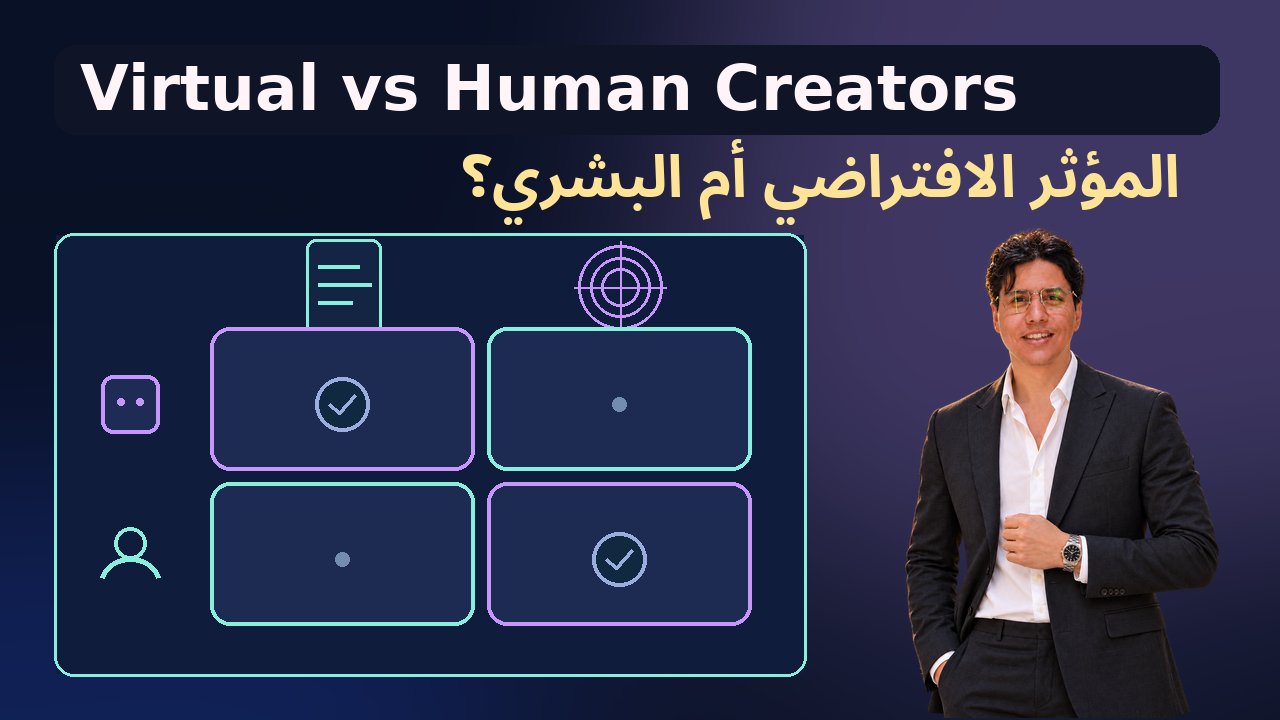
The finding: influencer fit depends on what customers need to learn
A virtual character can explain a product’s specifications without pretending to have used it. A human creator can show what happened when they actually tried a product. The question is not which creator looks better on camera. It’s which can provide the evidence a shopper needs to engage with the brand.
In a Journal of Consumer Behaviour article first published November 22, Bo Song, Haixiang Huang, Zixin Cai and Yingzhi Guo report three between-subjects experiments with 994 participants in total. The public abstract reports a matching pattern in intention to take part in creating value with a brand: virtual influencers had a relative advantage for search products; human influencers had a relative advantage for experience products. That does not mean either type always wins, and the measured outcome was not a completed contribution or a purchase.

Original conceptual illustration. The checks show the two pairings the finding suggests testing first; the four cells are experimental conditions, not effect sizes or sales results.
Primary source for this illustration
Search and experience describe the decision, not the marketing channel
A search product has important attributes a buyer can assess before purchase. A USB-C hub’s port count, dimensions and documented compatibility are examples. An experience product has important attributes that are harder to judge until someone actually uses it. The comfort of an office chair over an afternoon is one example. This distinction has roots in Phillip Nelson’s economics research. It is not a distinction between ads that run on a search engine and ads that run elsewhere.
Many real products straddle the boundary. A pair of headphones has published specifications and dimensions, but comfort depends on the wearer and the duration of use. Two videos about the same pair could serve different decisions: check compatibility or judge whether they feel comfortable. Decide which uncertainty the campaign should reduce before you choose a creator.
What the study can and cannot establish
The authors examined parasocial interaction, the audience’s sense of contact with a media figure who is not actually in a reciprocal relationship with them, and empathy, the ability to appreciate another person’s perspective or feelings. The abstract reports indirect patterns involving parasocial interaction alone and a sequence involving parasocial interaction followed by empathy. It says the indirect pattern through empathy alone favored human influencers only for experience products. These are reported analyses, not evidence that the sequence holds in every campaign or that manufacturing artificial intimacy will improve results.
This article draws on the public abstract, not a full review of the methods or study appendix. There is no basis here to quote effect sizes, local audience response, orders, return on ad spend, or a lift in actual participation. The experiments are useful for deciding what to test. A brand still has to verify that people do something valuable when asked, not simply tell a researcher they are willing to do it.
A hypothetical four-cell test for a home-office brand
Take a spec-led decision for a monitor arm, where shoppers check mounting compatibility and desk clearance, and an experience-led decision for a chair, where shoppers judge how the adjustment controls feel to use. For each product, make one version with a clearly disclosed virtual presenter and one with a human creator. Give each pair the same factual claims, landing page, participation prompt and placement mix; keep the commercial incentives and evaluation window comparable.
In the monitor-arm cell, ask viewers to submit the mounting or clearance question the setup guide does not answer. For the chair, ask existing users to suggest a clearer adjustment instruction, without submitting identifying footage. Use a real, documented demonstration if the human creator describes personal use. A virtual presenter can explain verified setup steps or reference someone else’s attributed test; it cannot truthfully claim to have sat in the chair. Label sponsorship and virtual identity where the audience can see those disclosures. Keep tests away from medical endorsements and other uses where a fictional first-person account could create undue trust.
Randomize audiences within each product rather than sending different creators to different cities or placements by default. Define what a valid contribution is before launch. If both examples start out with the same plausible assumptions but turn out to attract different types of participants, compare creator types within each product first. Look at the difference between those two comparisons rather than interpreting all four rates as though the products competed for the same audience.
Count useful contributions and the work it takes to review them
Make the primary outcome the share of assigned participants who submit at least one unique, relevant, actionable contribution in a fixed window. A blinded reviewer can categorize ideas as actionable, duplicate, off-topic, or inappropriate without knowing the creator condition. Report the share of responses that need moderation, creator and media cost, reviewer time, and cost per accepted contribution. Keep clicks, stated interest and completed transactions separate. Each answers a different question.
Suppose, purely for illustration, that 1,000 people are assigned to a virtual spec-led video and 1,000 to its human counterpart. The virtual version yields 30 accepted contributions versus 24 for the human version: 3.0% versus 2.4% of assigned viewers. If their total costs are 1,500 and 960 in the same currency, the costs per accepted contribution are 50 and 40, respectively. That small rate lead is not by itself persuasive evidence, and the more productive version is more expensive per useful idea. Decide what difference matters, collect enough observations to estimate uncertainty, and weigh the cost of acting on the contributions before scaling.
The decision rule
Select the creator whose evidence fits the decision and whose audience behavior warrants further investment. If verified contribution quality is similar, the lower production and moderation burden may decide it. If only views or survey intent improve, keep the result labeled as attention or intent. A creator strategy earns a bigger budget when it produces more usable participation at a cost the brand can justify, without making the source of the endorsement less clear.
Comments
No published comments yet.