The announcement and its limits
On 2 November 2026, T-Mobile named Anomaly its strategic brand transformation partner and Highdive its lead creative advertising agency, while expanding AI-enabled production within T-Studios. Its official announcement describes an ambition to extend the brand beyond wireless. It supplies no fees, staffing figures or achieved performance results.
The useful management question is how strategic authority, campaign development and repeatable production should work together. The following framework is original analysis for marketing leaders, not a description of unpublished arrangements between these companies. A new organization chart creates possibilities; the quality of its decisions and handoffs determines what those possibilities become.
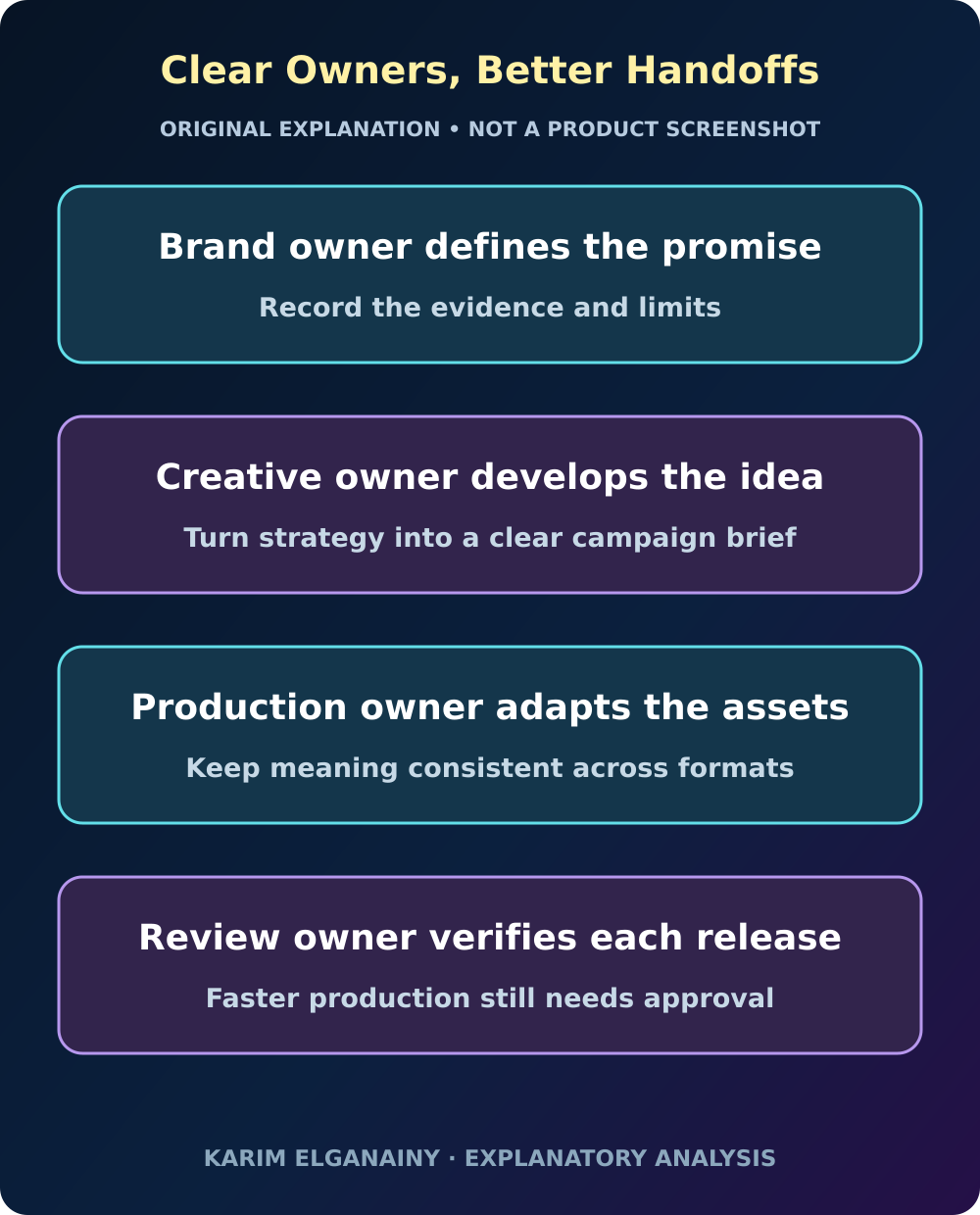
Original editorial framework; not a product screenshot or proof of campaign results.
Start with three decisions, not three suppliers
Separate the brand promise, the campaign idea and the production system. The brand promise defines the customer problem the organization can credibly address. The campaign idea gives that promise a memorable expression for a particular objective. The production system turns approved ideas into usable assets across placements, languages and moments.
Give each decision a named accountable owner inside the client organization, even where an external partner develops the work. Ownership means resolving trade-offs and accepting the consequences. It does not mean reviewing every file personally. A team can delegate execution while retaining authority over which promise the business is prepared to make.
Write the boundary questions. Who can change the audience? Who can change the offer? Who can approve a new interpretation of the brand? Who can adapt a layout without another meeting? If these questions remain unanswered, apparent collaboration can become repeated negotiation, with expensive specialists waiting for decisions nobody believes they own.
Make the strategy handoff usable
A strategy presentation becomes operational when another team can apply it to an unfamiliar brief. Create a short decision document containing the intended audience, customer tension, credible advantage, evidence, exclusions and examples of acceptable expression. Explain which elements are fixed and which require creative exploration. Avoid replacing judgment with a long list of adjectives.
Include a difficult example. Suppose a hypothetical subscription business wants to promise simplicity while selling a plan with several eligibility conditions. The strategy should explain how to present those conditions honestly without burying the main value. A statement that the brand should feel bold does not help a writer resolve that practical conflict.
Test the handoff by asking the creative team to explain the strategy in its own words and propose two contrasting routes. Differences expose ambiguity early. Record the decisions that follow, including what was rejected and why. The goal is a shared operating reference that survives personnel changes and does not depend on attendance at one workshop.
Preserve one customer story across the funnel
A campaign may appear in different formats and at different levels of customer readiness. Assign each asset a job. An introductory film might establish a problem; a product explanation might demonstrate a relevant feature; a conversion page might clarify price and eligibility. All three should remain compatible with the same underlying promise.
Review the journey as a sequence rather than approving isolated files. Ask whether the person who clicks the advertisement meets the offer they were led to expect. A polished landing page cannot repair an expectation that the campaign created inaccurately. The commercial cost of inconsistency can appear as wasted attention, avoidable enquiries or disappointed customers.
Use a simple continuity check during creative review: promise, proof, next action and destination. If an asset changes one of these, explain the reason. Different expressions are healthy when they serve different tasks. Contradictory offers or unsupported benefits are a governance problem, even when every individual execution looks visually consistent.
Build a claim record before increasing output
For each material claim, keep its approved wording, supporting evidence, scope, owner and review date. Include restrictions such as geography, product version or offer period where relevant. The record should help a producer distinguish a reusable fact from a statement that needs fresh approval. It should not become an archive of unsupported slogans.
Connect the record to the brief and asset register using a practical identifier. When a price or feature changes, the team should be able to identify affected materials. This is a design recommendation, not a claim that any named company has implemented such a system. Start with the claims that would create the greatest customer confusion if wrong.
Keep factual approval separate from stylistic preference. A subject expert checks whether the statement is supportable; a creative reviewer checks whether its expression serves the campaign. Mixing these reviews encourages late factual changes disguised as copy polishing. It also makes disagreements harder to resolve because nobody can tell which requirement is actually at stake.
Give production clear permission boundaries
Classify work by the degree of change it introduces. A mechanical resize that preserves meaning may follow a lighter review route than a new benefit claim. A new language version needs someone capable of checking its meaning, not merely a person who can confirm that the file contains the expected number of characters.
For AI-assisted work, specify permitted inputs, intended outputs, review responsibility and storage arrangements according to the organization's approved policies. Do not assume that permission to use a production tool permits every kind of customer information to enter it. The practical brief should describe the work clearly enough that the operator can recognize an exception.
Preserve a reviewed master and trace variants back to it. Record meaningful changes rather than every experiment. If a generated version introduces a feature, removes a qualification or changes the emotional meaning, route it back to the relevant owner. Faster variation is useful only when the organization can still tell what it has approved.
Measure the waiting as well as the making
Track the elapsed time from a complete brief to accepted delivery, then separate production from waiting for inputs or decisions. Otherwise, management may invest in faster production while the real constraint remains an unresolved offer. A useful report explains the delay and identifies an owner able to remove its cause.
Pair speed with acceptance quality. Count avoidable corrections, assets withdrawn after release and the effort required to maintain published material. Do not reward a team for generating more versions if reviewers cannot use them. Output volume can increase while useful capacity falls, especially when every extra variant creates another approval or updating obligation.
Keep these operating measures distinct from campaign outcomes. Better delivery might support better marketing, but it does not independently establish sales growth or causal brand effects. Evaluate commercial outcomes with a suitable comparison and the limitations stated. A production dashboard should not claim to answer a business question for which it has collected no evidence.
Test the model on a bounded campaign
Choose a campaign small enough to inspect end to end but complex enough to require genuine handoffs. Before starting, record the existing process, recurring defects and the change being tested. Keep unrelated changes limited where feasible, so the team can interpret whether the revised ownership structure helped rather than simply enjoying a quieter week.
Agree what will count as a useful result: fewer unresolved brief questions, less preventable rework, predictable acceptance and a consistent customer journey. Set targets from the organization's own baseline and risk tolerance. Arbitrary industry benchmarks would create false precision when the work, staffing and approval requirements are not comparable.
At review, examine both successful and stalled assets. Ask which decisions became clearer and where another handoff added friction. Retain the parts that improved the process, revise those that did not and document remaining uncertainty. A pilot earns expansion through evidence, rather than becoming a permanent operating model merely because launch materials described it confidently.
Make Arabic a decision layer, not an export
For a Gulf campaign, decide the audience, register and terminology before treating Arabic as the final production task. A formal institutional message and a conversational consumer offer may require different choices. Neither a literal translation nor a fashionable dialect automatically fits every market, service or customer relationship.
Give the Arabic reviewer authority to flag meaning changes, unsupported implications and awkward destination experiences. An advertisement can read naturally while its booking flow, product terms or service explanation remains inaccessible. Review the complete path with the language version's intended audience in mind, including practical information that helps someone decide whether to proceed.
Keep approved terminology and examples of difficult choices in the shared reference. Explain why a term was chosen rather than declaring every alternative wrong. This helps future writers preserve intent while adapting to context. It also reduces repeated debates that otherwise consume production time without improving the actual customer experience.
A hypothetical healthcare adaptation
Consider an imaginary clinic introducing an appointment service. Brand leadership defines the desired experience; the creative team develops a clear explanation; production prepares formats and language versions. Clinical accuracy remains a separate approval gate. The example illustrates workflow design and does not describe a real provider, patient population or proven campaign result.
The brief should distinguish operational statements from medical claims. Opening hours, booking steps and service availability require their appropriate business owners. Statements about treatment suitability or expected outcomes require qualified clinical review and applicable local requirements. Attractive creative treatment cannot supply evidence that a claim lacks, and an approval elsewhere in the workflow cannot replace clinical judgment.
Use simulated information to test the process without introducing patient data. Check whether an Arabic reader can understand the service, its limitations and the next step. Measure process clarity and completed appropriate enquiries where suitable, while avoiding claims that advertising alone explains patient outcomes. The objective is a reliable communication workflow, not a shortcut around professional review.
Plan how mistakes are corrected
Assign someone who can pause affected material when a claim becomes inaccurate or an offer changes. Keep a list of live destinations and versions so correction does not depend on memory. Decide how factual corrections reach the owners of creative, production and customer-facing information, including material maintained by different teams.
After an incident, distinguish an execution error from a missing decision or outdated reference. Each needs a different response. Retraining a designer will not repair a source document that still contains the wrong price. Adding approvals will not help if every reviewer assumes another person checked the disputed statement.
Karim's strategic takeaway
The transferable lesson is to design the decision system before expanding the asset factory. Start with one campaign, three clear ownership areas, a usable claim record and a review that separates operating quality from market impact. These are practical choices a smaller organization can test without copying a large advertiser's supplier roster.
The strongest arrangement is the one that keeps judgment visible as output grows. Leaders should be able to explain who made the promise, who shaped its expression, who approved the variation and what evidence would change the decision. That clarity is more useful than announcing a new structure and assuming the structure will produce the result.
Comments
No published comments yet.