Announcement dateline: November 3, 2026. Editorial analysis: November 4, 2026.
A phased announcement, not universal availability
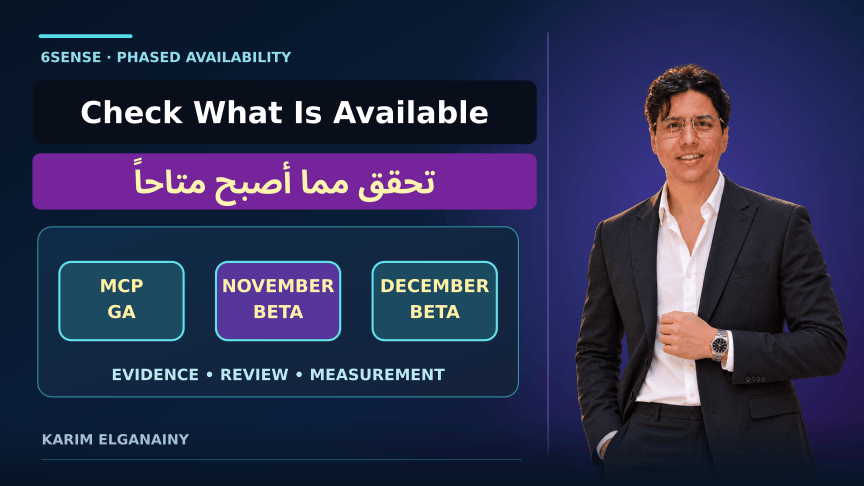
In its November 3 Breakthrough release, 6sense lists Sales Intelligence MCP as generally available; Explainability in RevvyAI/MCP as November open beta, with full surfaces planned by February 2027; and BDR Agent as November beta, with phone, social and sales-engagement support at general availability. AI Visibility beta is planned for December. 6sense release.
Source note: the page header says November 1, while the release dateline says November 3. This article follows the dateline.
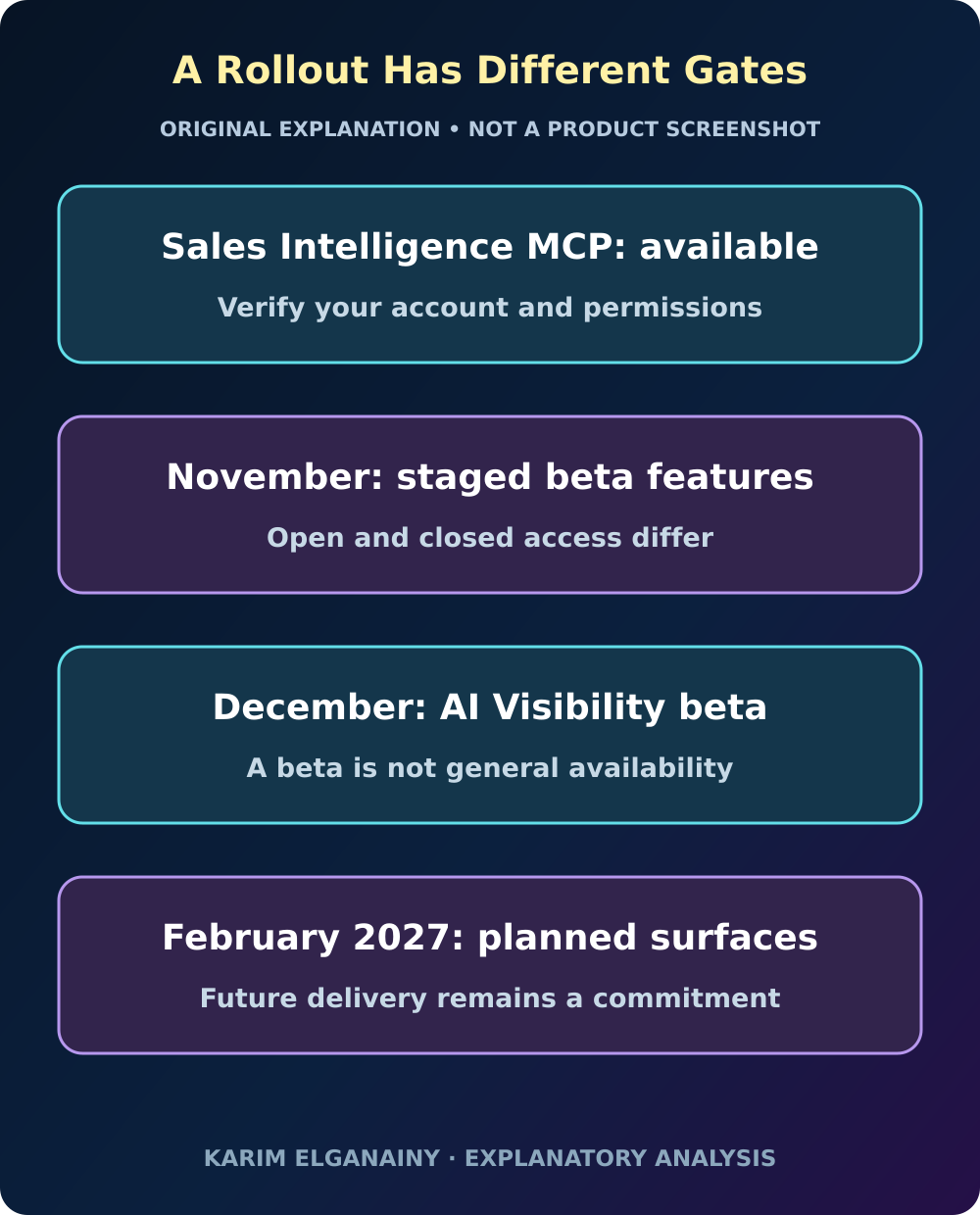
Original editorial framework; not a product screenshot or proof of campaign results.
Original analysis: buying an agent means defining its authority
The analysis below is independent editorial guidance. Proposed checks are buyer recommendations, not claims that every capability is already supported by 6sense. All examples are hypothetical. A team considering agent-assisted go-to-market work needs to distinguish the quality of a recommendation from the permission to act on it. Better context may make a recommendation easier to review, but it does not automatically authorize a message, a database change or a customer commitment.
Start with a concrete job rather than a broad ambition to automate revenue. Preparing an account research brief, suggesting a next step and sending an external communication are different jobs with different consequences. The first purchase decision is which job the organization is ready to delegate. The second is how it will determine whether the delegated work was useful, accurate and within the agreed limits.
Separate an account signal from a person’s situation
An account-level indicator should not be casually translated into a claim about a named individual. A company may contain several divisions, locations and buying teams. Research activity associated with that company may be relevant to the seller, yet still leave uncertainty about who is evaluating an offer or whether any particular employee wants contact.
A practical research brief should make that uncertainty visible. Ask what the signal describes, which entity it is associated with, when it was observed and what alternative explanations remain plausible. Avoid language that implies the seller knows a person’s private intention merely because an account was prioritized.
Account intent is not consent to contact an individual. Outreach permissions, existing preferences and the organization’s normal review requirements remain separate checks. A recommendation can lead to more research, a discussion with an existing account owner or a decision to wait. The ability to recommend action should include the ability to recommend no action when evidence is insufficient.
Require a trace that a reviewer can follow
A useful explanation should let a reviewer travel from the observed information to the proposed decision. It should identify the relevant source or source category, the timing, the account association, the inference and the action being suggested. The team should also be able to see which part is observed and which part is inferred.
A persuasive paragraph is not enough on its own. An explanation can sound coherent while relying on stale data, an incorrect company match or an unsupported leap. Ask reviewers to check a sample against the underlying material they are authorized to inspect. Record whether the explanation was accurate, incomplete, irrelevant or impossible to verify.
The point is not to make every salesperson reproduce a model’s calculations. It is to make important recommendations contestable. If a reviewer identifies an error, the workflow should provide a way to correct the record, prevent the same mistake from spreading and determine whether other recommendations depended on it. Ask the supplier which parts of that process are supported and which remain the buyer’s responsibility.
Test confidence against later outcomes
A confidence label is useful only if the team understands what it means. It may describe certainty about an entity match, a model prediction or the evidence available for a recommendation. Those are different claims. Ask for the intended interpretation and resist treating every high score as an equivalent probability of winning business.
For evaluation, preserve recommendations before their outcomes are known. Compare groups with similar stated confidence against later, consistently defined outcomes. Include cases that the system ranked low or chose not to advance. Looking only at successful high-ranked accounts creates an incomplete picture of how the system behaves.
Keep the evaluation proportionate to the available volume and business cycle. A long sales process may not provide enough closed outcomes for a quick verdict. Intermediate reviews can assess factual accuracy, relevance and operational usefulness while the commercial evidence matures. Label those results for what they establish rather than presenting an early quality check as proof of revenue impact.
Use an authority ladder, not a single automation switch
A buyer can define several levels of permitted work. At the lowest level, an agent gathers approved information and prepares an internal brief. A later level allows a proposed action for human review. Further levels may allow bounded internal updates or specifically authorized external activity. These are recommended operating categories, not a description of the vendor’s settings.
For each level, identify allowed data, destinations, actions and exceptions. Specify who approves a move to a higher level. An agent that can draft a message should not automatically gain permission to send it. Likewise, access to read customer information should not silently become permission to overwrite records or share them elsewhere.
Write a clear stop condition. Ambiguous account ownership, a restricted recipient, conflicting instructions or unsupported claims in a draft should lead to review rather than improvisation. The goal is to make the safe path straightforward, including when the agent is uncertain or the information it receives changes after an earlier approval.
Begin with a pilot that produces inspectable work
A sensible first pilot can focus on a task whose output is easy to review and reverse. Consider a hypothetical business software seller asking an agent to prepare account briefs for a limited set of existing prospects. Each brief would explain the evidence, identify open questions and suggest a next research step without contacting anyone automatically.
Reviewers could assess factual accuracy, relevance, missing context and time spent correcting the output. They should also inspect a sample of accounts the agent did not prioritize. The pilot would be valuable if it revealed where the process helps and where it fails, even before any claim about sales performance is possible.
Compare with the existing process using the same definition of a usable brief. Count correction time and failed attempts, not just the time required to generate text. A fast draft that creates substantial checking work may not save the team time. Conversely, a modest speed improvement may still be useful if the work becomes more consistent and easier to hand over.
Keep the customer record and the agent’s memory aligned
A recommendation can become outdated when an account owner has already spoken to the customer, a deal has changed stage or a contact has asked not to receive further messages. The pilot should establish which system is authoritative for each kind of information and how recent changes are reflected in the agent’s work.
Document what happens when records conflict. If a research tool suggests that an account needs outreach but the customer record indicates an ongoing sensitive discussion, the workflow should not resolve that disagreement by choosing whichever data arrived first. Define an escalation owner and an explicit precedence rule appropriate to the organization.
Also consider repeated actions. A workflow retried after a technical interruption should not send duplicate messages or create duplicate tasks. Ask how the implementation identifies an action that already completed and how an uncertain outcome is checked. These operational questions are essential for any agent workflow that moves beyond drafting, regardless of the intelligence provider.
Evaluate regional coverage before trusting a ranking
For Gulf B2B teams, an account can be complicated by local subsidiaries, regional headquarters, distributors and shared corporate names. A pilot should test whether the implementation associates evidence with the intended legal or operating entity. Do not assume that an international parent company and a local buying unit have the same needs, ownership or purchasing timetable.
Include Arabic and other relevant language contexts in the review where the team’s market requires them. Check the quality of the interpretation rather than assuming that a translated summary preserves the meaning of the original research. A relevant local product category may also be described differently across industries and markets.
Use the company’s own known accounts as a carefully selected evaluation set, within its existing data permissions. Record coverage gaps and uncertain matches. This is a regional diligence recommendation, not evidence that 6sense has inadequate or comprehensive Gulf coverage. The appropriate conclusion should follow the pilot’s observations, not a general impression about global product scale.
Treat access stages as commercial boundaries
A roadmap, a beta invitation and a production entitlement answer different questions. Procurement should record what the buyer can use at the start of the agreement, what requires an invitation, what is still planned and what may change. Ask for the relevant terms rather than inferring access from a broad product announcement.
For a beta, clarify support expectations, limits, data handling, export options and how the team exits if the experiment is unsuccessful. If a future capability is central to the business case, identify what happens if its timing or scope changes. Avoid presenting planned functionality as an existing dependency that the operations team can already rely on.
Keep those distinctions visible in the internal purchase recommendation. A feature matrix should state availability and conditions beside the use case, not bury them in a footnote. The financial and staffing plan should be based on the work the team can actually perform, with future possibilities treated as conditional rather than counted as realized benefits.
Make disagreement and failure part of acceptance testing
A good demonstration shows a successful workflow. Acceptance testing should also show what happens when the inputs are missing, contradictory or misleading. Give the implementation a clearly labeled test account with incomplete evidence, a stale record or a recommendation that conflicts with an established restriction. Observe whether it asks, stops, explains uncertainty or proceeds anyway.
The expected behavior should be agreed before the test. Otherwise a confident but unsuitable action may be rationalized after the fact. Record failures in terms of the business risk they create: wasted review time, incorrect account prioritization, an unauthorized change or an unsuitable communication.
Do not demand that the system never make an error. Demand a process that makes material errors detectable, limits their consequences and supports correction. An agent that reliably surfaces uncertainty may be more useful than one that always supplies an answer. This is especially important when several tools or agents pass recommendations between them.
Define a narrow decision after the pilot
The final review should separate three questions: whether the evidence was accurate, whether the workflow stayed within its authority and whether it improved the chosen operational or commercial outcome. Success on one question does not settle the others. A useful recommendation could be to retain internal research assistance while postponing external execution.
Document what the team learned, which accounts and tasks the evidence covers and which limitations remain. If the commercial outcome has not had time to mature, set an appropriate later review rather than declaring a result prematurely. Keep the next step proportional to the strength of the evidence.
Agentic go-to-market tools become easier to evaluate when the buyer stops treating autonomy as a single product feature. The practical purchase is a bounded workflow with reviewable evidence, explicit permissions, a reliable customer record and a way to stop. That is the standard against which a promising announcement should earn its place in daily revenue work.
Comments
No published comments yet.