Announcement: November 3, 2026. Editorial analysis: November 4, 2026.
What Teads announced
Teads says Adelaide AU measurement is available globally in Teads Ad Manager across web and CTV InStream. Its November 3 announcement adds live reporting and an Attention Threshold control for filtering inventory below a chosen AU floor. AU estimates a placement’s attention potential; the announcement does not establish an advertiser’s incremental sales. Teads announcement.
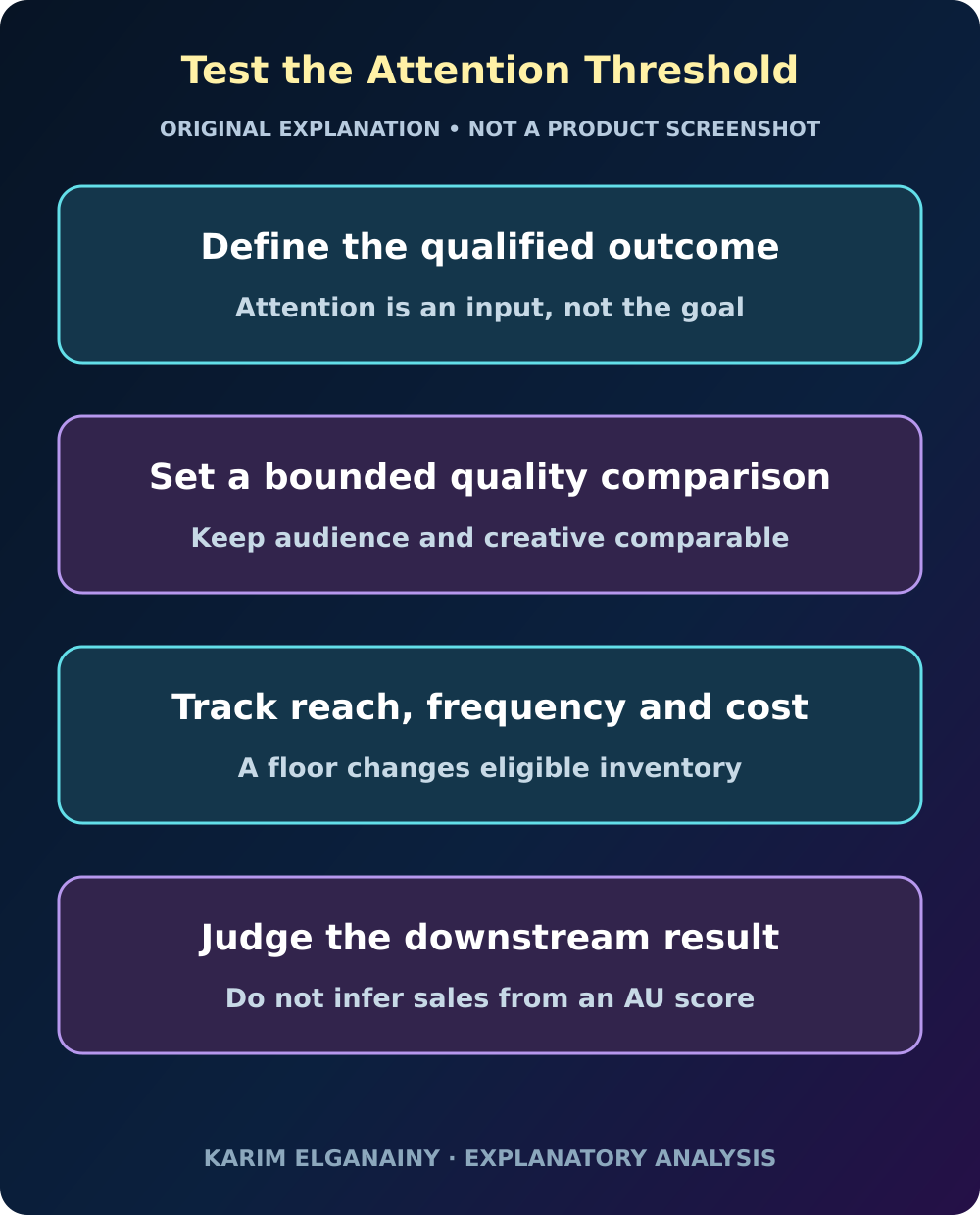
Original editorial framework; not a product screenshot or proof of campaign results.
Original analysis: turn a quality signal into a testable decision
The following assessment is independent editorial analysis. Its workflows are recommendations, not documented features or promised results. Examples are hypothetical. The useful question for a marketing director is how a new buying constraint changes the relationship between spending, suitable exposure and business outcomes. A score can help organize that investigation, but the commercial decision still needs a comparison and a clear account of what changed.
Begin with the decision the team expects to make after the trial. Perhaps it wants to retain a quality floor, change the floor, restrict its use to particular objectives or abandon it. Writing those options down makes the test more informative than a dashboard tour. A measurement project should produce an operating choice, including an honest decision to collect more evidence when the available results are inconclusive.
Choose the outcome before choosing the threshold
For a retailer, the meaningful outcome might be a fulfilled purchase with an acceptable contribution after discounts and returns. For a business service, it might be an enquiry that meets agreed eligibility criteria. For a brand campaign, a suitable research design might investigate awareness or consideration. These objectives have different time horizons and should not be collapsed into one universal definition of performance.
Define the primary outcome in advance, along with a small number of diagnostic measures. Exposure, delivery cost and destination engagement can explain what happened without becoming the final objective. If a team changes its success measure after seeing the results, it risks selecting whichever number happens to make the experiment look good. Record unavoidable revisions, explain why they were made and distinguish them from the original plan.
Also specify what would count as a commercially meaningful difference. Statistical uncertainty and business value are different questions. A tiny measurable improvement may not justify operational complexity, while a potentially useful change may remain too uncertain for a large commitment.
Understand the inventory that disappears
Any eligibility rule changes the opportunities available to a buyer. Before judging the final campaign average, examine the inventory excluded by the proposed rule. It could differ in price, audience composition, time of day, format or availability. This is not an argument against filtering. It is a reason to understand which trade-offs the organization is accepting.
Ask for an estimate or a controlled observation of delivery capacity under the intended constraint. Establish whether the campaign can still reach a useful audience within its budget and timing. A campaign that concentrates spending into fewer opportunities may encounter a different frequency pattern. A more selective purchase can be appropriate, but the buyer should know whether the selection has altered coverage of a strategically important group.
Keep a record of excluded and retained opportunity types at a level the available reporting supports. Do not infer people or motives from a placement label. Where the reporting cannot answer a question, mark it as unknown rather than converting a lack of visibility into a confident explanation.
Design a comparison that can survive scrutiny
A reasonable starting point is a bounded trial comparing the proposed buying rule with the existing approach. Keep the offer, creative, audience logic, dates and outcome definitions as stable as practical. Where a platform and the campaign design support valid random assignment, use it. Where they do not, explain that a comparison may be affected by differences between the groups or periods.
Avoid a simple before-and-after claim when other commercial conditions changed. A new promotion, payday, a product shortage or a repaired checkout could influence results independently of media selection. Keep an intervention log so that the final review can identify competing explanations. The log need not be elaborate: date, change, owner and likely affected part of the journey are usually enough to start.
Agree on the review window before launch. Very short windows can give unstable answers, particularly when the desired action happens long after exposure. Do not invent a universal sample size. The necessary volume depends on the outcome rate, variation, decision stakes and evaluation method.
Read prices together with qualified outcomes
A higher price per thousand impressions does not automatically make an advertising purchase worse, just as a lower price does not automatically make it efficient. The relevant question is what suitable exposure and useful outcomes the budget produces. Keep the purchase cost visible, then connect it to a consistently defined downstream measure.
Consider a hypothetical retailer comparing two buying approaches. One produces fewer visits and costs more per impression. It might still be attractive if the visits lead to enough fulfilled, profitable orders to justify the difference. It might also be unattractive if the apparent order advantage disappears after cancellations. No result should be assumed in advance, and this example is not a reported Teads campaign.
Calculate the same cost categories in each group. Include any material measurement, service or creative costs that the decision would add. A comparison that includes extra costs on one side and ignores them on the other will not support a fair budget decision. Ask procurement to confirm the actual commercial terms rather than assuming an integration is free.
Give creative its own place in the diagnosis
Media selection and creative communication solve related but different problems. A suitable opportunity cannot rescue an incomprehensible offer, and a strong message still needs a chance to be encountered. When both change together, a favorable result may be difficult to attribute to either intervention.
Start by checking that the creative communicates the intended proposition in the time and space available. The destination should deliver the same offer, price logic and next step. If the message promises an easy comparison but the page demands a long registration before showing any details, the journey may lose suitable visitors for reasons outside the inventory rule.
A later experiment can examine creative differences deliberately. For example, a hypothetical service advertiser could compare a short problem-led message with a demonstration-led message while holding the buying policy steady. Keep that as a distinct question. Separating experiments makes it easier to understand which change is worth retaining and avoids crediting an attention measure for every improvement in the journey.
Treat cross-screen comparisons carefully
The customer’s action and the screen on which an advertisement appears need not coincide. A person may encounter a message on one device and later investigate through another route. This creates a measurement question, not permission to assume that every later action was caused by the exposure.
Before combining reporting across screens, ask how exposure, identity, attribution windows and duplication are handled in the proposed evaluation. A household-level observation and a person-level conversion are not automatically interchangeable. If the necessary linkage is unavailable or uncertain, retain separate results and describe the limitation clearly.
For an upper-funnel campaign, a well-designed research study may be more appropriate than forcing the entire assessment into immediate clicks. For a direct-response campaign, destination and transaction quality remain essential. The objective should determine the evidence, rather than allowing whichever metric is easiest to retrieve to determine the objective. These are measurement recommendations, not claims about a specific vendor’s identification method.
Build a local evidence plan for Gulf markets
A Gulf advertiser should ask whether its own market, language and eligible supply are adequately represented in the proposed test. Global availability alone cannot answer whether a particular Arabic message, local publisher mix or delivery footprint will work for that advertiser. The appropriate response is a local evidence plan, not an automatic rejection or endorsement.
Review Arabic creative as communication, including meaning, readability and the relationship between the advertisement and destination. If the business also serves customers in other languages, define those audiences and journeys explicitly. Do not assume that translating a headline creates an equivalent offer or an equally usable checkout.
Check the operational boundary as well. Advertising should not generate demand for a product the company cannot deliver in the advertised area or by the promised date. Include local payment success, enquiry handling and fulfillment constraints in the review when they affect the intended outcome. These are independent regional applications, not regional findings reported by Teads or Adelaide.
Decide who may change the buying rule
Automation needs an operating owner. Name the person who can set the initial rule, authorize a material change and pause the trial. Record the reason for each change so that later reviewers can distinguish an intentional adjustment from an unnoticed configuration error.
Define alerts around the business risks that matter. A sharp delivery shortfall, unusual concentration, broken destination or unexplained reporting gap may warrant investigation. Avoid treating every movement in an intermediate score as an emergency. Constant reactive changes can make the final results difficult to interpret and distract the team from the agreed outcome.
Keep a simple fallback plan. If the new rule prevents necessary delivery or the reporting cannot be trusted, the team should know whether to revert to the prior setup, reduce spending or pause. A fallback is a control for uncertainty, not a prediction that the integration will fail. Test the process at a scale the organization can comfortably review.
Make the procurement conversation specific
Ask the provider to explain the score’s intended interpretation, measurement coverage, reporting limits and any circumstances in which data may be absent. Request the commercial terms for the proposed implementation, including measurement charges, service dependencies and cancellation conditions. The public announcement should not be treated as a complete order form.
Clarify which information the team can export or retain for its own review. An attractive live dashboard is useful, but a decision audit may require a stable record of the configuration and results. Check the permissions and retention arrangements for any campaign or customer data involved, using the organization’s normal privacy and security review.
Finally, ask what support is available when reported changes appear inconsistent with delivery or business outcomes. A practical escalation route matters more than a broad assurance that the system improves efficiency. The buyer is trying to understand how to investigate a surprising result, not obtain a promise that every experiment will succeed.
Report a decision, not a victory lap
The final review should say what was tested, what changed, what remained comparable and what uncertainty persists. Present the business outcome beside the delivery and cost diagnostics. If a result is observational, say so. If the outcome is inconclusive, explain which missing evidence prevents a stronger decision.
A useful recommendation can be narrow: retain the rule for a defined campaign type, run a longer test for another, or stop using it where delivery constraints outweigh the observed benefit. This is more actionable than declaring a new metric the universal answer to media quality.
The strategic opportunity is to make buying decisions more reviewable. A quality signal earns a place in the operating process when the team understands its limits, can connect its use to a well-defined decision and can revise that decision when evidence changes. That discipline remains valuable whether the first trial succeeds, disappoints or simply teaches the advertiser what it needs to measure next.
Comments
No published comments yet.