Announcement: November 3, 2026. Editorial analysis: November 4, 2026.
The verified development
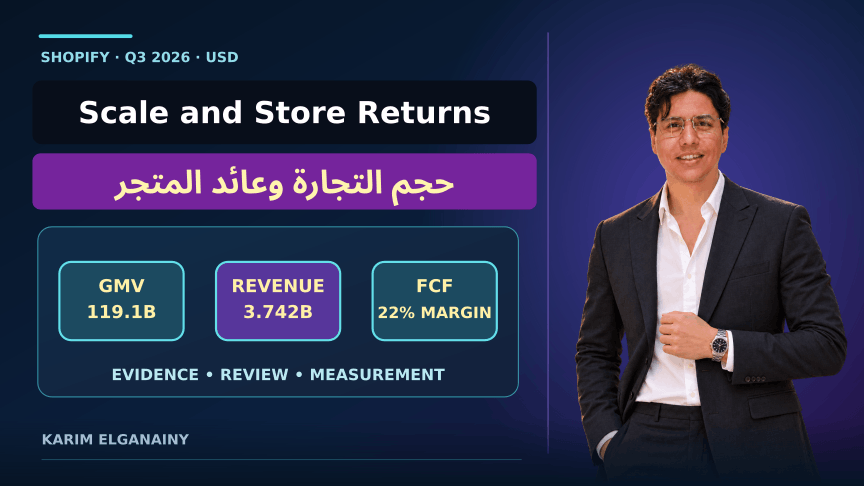
Shopify reported third-quarter GMV of US$119.145 billion and revenue of US$3.742 billion, up 32%, for the period ended September 30. Its free cash flow margin was 22%, a non-GAAP measure. GMV is commerce volume, not Shopify revenue. The release does not isolate an AI contribution to growth. Shopify results.
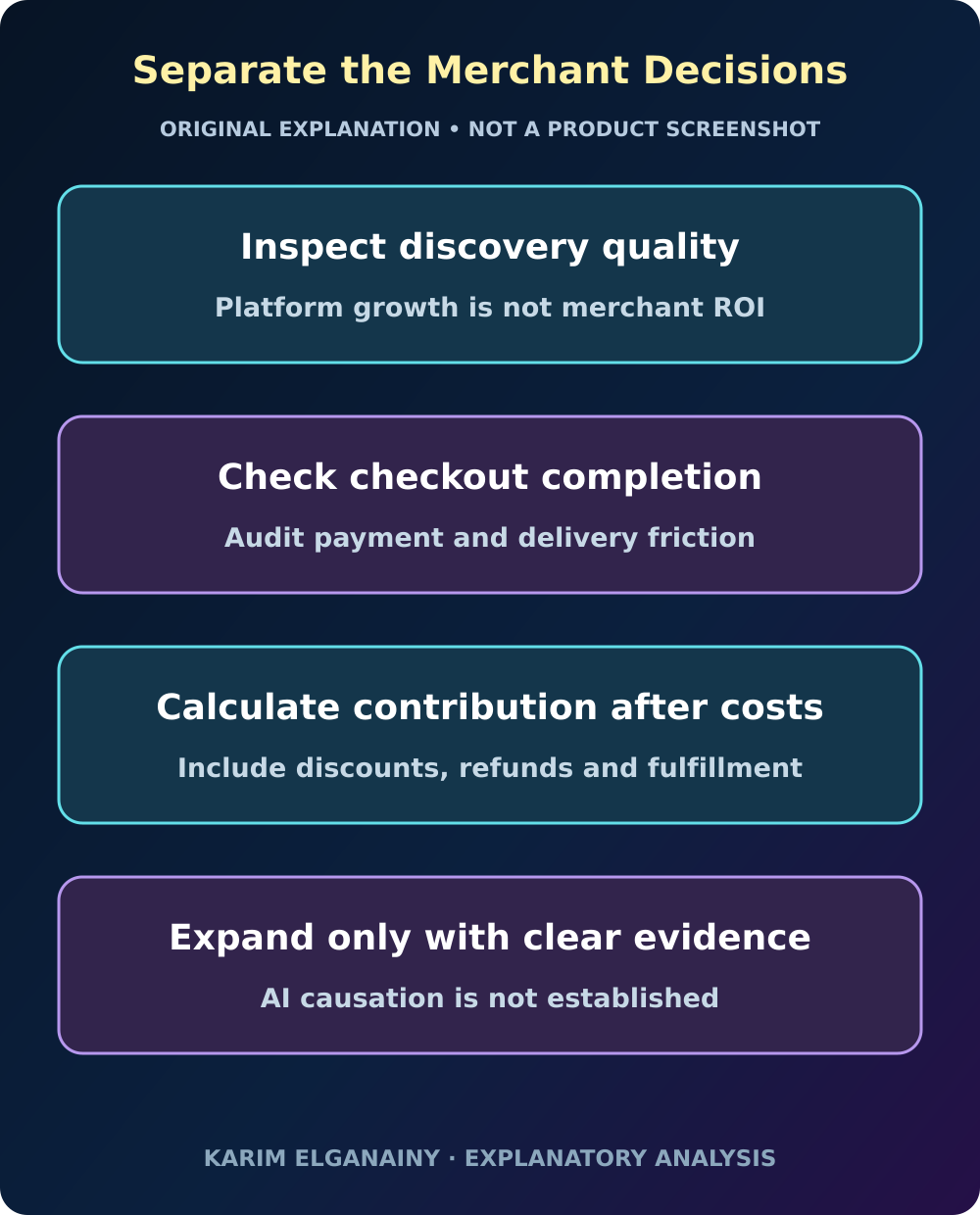
Original editorial framework; not a product screenshot or proof of campaign results.
Original analysis: turn market context into a merchant decision
The following sections are independent editorial analysis and a proposed operating framework. They are not additional Shopify disclosures, a description of features supplied by the company, or investment advice. All worked scenarios are hypothetical. The central question for a growth team is practical: what evidence would justify changing its own acquisition budget after reading a large commerce platform's results?
A useful answer starts with the merchant's economics rather than the headline. Platform activity can provide context for a strategy discussion, but a particular store still has to earn the next order. The team should identify the decision under consideration, the products involved, the customer group, and the period in which results will be judged. Without those boundaries, a conversation about growth can become a general vote of confidence instead of a decision that someone can later evaluate.
The decision also needs an owner. Marketing may recommend more traffic, operations may warn about delivery constraints, and finance may challenge the margin assumption. Those perspectives are complementary when the team records them before spending. Ask the owner to distinguish evidence already available from assumptions that need a test. A modest, reversible experiment is more useful than treating a corporate announcement as permission for an unlimited budget increase.
Give each commercial number a clear job
For this proposed framework, start by separating sales activity, the merchant's recognized revenue, and the contribution left after serving an order. A large amount at the top of a report does not explain how much money is available to fund acquisition. The team should use its own documented definitions and reconcile them with finance rather than borrow labels from an advertising dashboard.
Make the calculation visible. List discounts, refunds, product costs, payment costs and fulfilment costs in the same review, stating how each is allocated. Where a cost cannot yet be assigned accurately, mark it as an estimate and show how the decision changes if that estimate is less favorable. A precise-looking ratio built from incompatible definitions can be less useful than a simple range whose assumptions everyone understands.
Keep the currency and reporting period consistent as well. If orders, media invoices and returns are recorded in different currencies or different weeks, explain the conversion and cutoff. Otherwise, a budget discussion can mistake accounting timing for commercial improvement. This is particularly important when teams compare campaigns across countries while finance closes the books on a separate schedule.
Review discovery before buying more of it
The first dashboard should examine the quality of incoming demand. Separate searches or messages that express a specific product need from broad interest, accidental visits and existing customers returning for service. The objective is to understand what people expected when they arrived, not to assign a moral ranking to channels.
Read a bounded sample of landing pages and customer questions alongside campaign data. Does the advertisement name a product that is available? Does the first page answer the question that the creative raised? Can someone see the material, size, price or delivery condition that matters to the choice? These checks give the marketing team something concrete to repair before assuming that the audience itself is wrong.
Use the same care when evaluating unfamiliar discovery surfaces. Tag traffic where reliable identification is available, preserve an unknown category when it is not, and avoid assigning every unexplained visit to the newest technology. A hypothesis about AI-assisted shopping can deserve a test without becoming a growth explanation. The evidence standard should remain the same: identify the observable path, define the commercial outcome and acknowledge what cannot be attributed.
Treat checkout as a sequence of promises
The second dashboard should follow the customer from a chosen product to a completed, valid order. Review the stages separately so that a problem with payment, address entry or delivery eligibility does not disappear inside an overall conversion rate. Pair quantitative events with a limited set of direct journey checks on relevant devices.
For a Gulf-facing store, those checks can include Arabic product information, right-to-left readability, address instructions, payment acceptance and delivery coverage. These are recommended review questions for the merchant's actual setup. They are not claims about newly announced Shopify capabilities or a guarantee that a particular service is available in every market.
Write the promise in plain language at each stage. If a product is shown as available, what exactly does that mean for the buyer's location? If a delivery estimate appears, when is it calculated and when can it change? If a promotion applies only to certain items, can the shopper understand that before committing time to checkout? Improving clarity may be a more sensible first experiment than increasing the number of visitors exposed to an unclear offer.
Measure what remains after the sale
The third dashboard should connect orders with contribution after the agreed cost categories. Keep new and returning customers distinguishable where the data supports that distinction. A campaign that brings back familiar buyers answers a different planning question from one that reaches customers who would otherwise be difficult to acquire.
Use order cohorts that have had enough time for the business's normal returns and service processes. The appropriate observation window should come from the merchant's experience, not a universal rule imposed for convenience. Where the latest cohort is immature, show a provisional result and the unresolved exposure rather than comparing it directly with a fully settled cohort.
Repeat purchase should be examined with the same restraint. A forecast can help planning, but label it as a forecast and preserve the assumptions about frequency, margin and retention. Do not justify an expensive first order with an untested lifetime-value figure. Finance and marketing should agree on what evidence would support a more generous acquisition allowance and what result would require it to be reduced.
A hypothetical assortment decision
Consider a hypothetical retailer with two product groups. One group attracts many first-time visitors but needs expensive fulfilment and generates frequent sizing questions. The other attracts less traffic but fits a simpler delivery process and has clear product information. No performance figures are assumed here; the example illustrates a decision structure rather than a prediction.
The team could first inspect whether the first group has a solvable information problem. It might improve size guidance and delivery explanations for a defined set of products, while recording the date and scope of the change. A second test could examine whether the revised experience supports better qualified order completion. Increasing media spend before those checks would mix an acquisition decision with an unresolved service problem.
For the second group, the next question might be whether additional demand can be served without exhausting stock or degrading service. A promising contribution estimate is not enough if replenishment is uncertain. The budget owner should therefore ask for both a commercial hypothesis and an operational condition. The outcome could reasonably be to expand one campaign, repair another and leave a third unchanged.
Design a comparison that can survive review
Choose the primary outcome before launching the test. A practical candidate is contribution from valid orders after the agreed observation window, supported by diagnostic measures such as payment completion, refund reasons and delivery exceptions. The supporting measures explain what happened; they should not replace the primary outcome after results arrive.
Keep the comparison credible. Where random assignment is feasible and appropriate, document it. Where the team instead compares periods or locations, record the limitations and the factors that changed at the same time. Price, stock, promotions, creative and fulfilment conditions can all complicate interpretation. A comparison with those differences disclosed is more useful than a confident causal statement that hides them.
Set operating guardrails in advance. Define who can pause spending if stock or service conditions deteriorate, and who can approve expansion after the review. Avoid monitoring so many small movements that the team repeatedly changes the experiment before it can teach anything. Check urgent operational risks promptly, but preserve the agreed evaluation design unless a material reason requires a change.
Make the data usable without collecting everything
A merchant does not need unrestricted personal data to ask whether its acquisition process is economically sound. Start with the minimum fields required for the decision and assign access according to role. Aggregate reporting can often support planning while detailed customer records remain with the people who need them for service.
Before adding new tracking or joining datasets, ask the appropriate privacy and technical owners to review the proposed use. Record which identifiers connect an advertisement, session, order and subsequent service event, and where that connection is incomplete. A missing link should be treated as a measurement limitation rather than filled with an invented attribution story.
Give the team a short data dictionary. State what qualifies as an order, how cancellations are handled, when a customer is considered new, and which date determines the reporting period. These choices sound administrative, but they determine whether colleagues are discussing the same business outcome. Reconcile disputed definitions before presenting a budget recommendation to leadership.
A practical review for the next planning meeting
Bring a one-page decision record to the meeting. It should name the proposed budget action, the products and markets in scope, the evidence supporting it, the unresolved assumptions, the observation window and the person accountable. Attach the detailed analysis for review without forcing every participant to reconstruct the argument from dashboards.
Ask operations to confirm capacity, finance to confirm the contribution definition and marketing to explain the customer journey hypothesis. If any of those inputs is missing, choose a narrower test or postpone the expansion. A decision to wait can be disciplined when the missing information could materially change the result; it should have a named next step rather than become an indefinite delay.
The strategic takeaway is to use a platform's results as a prompt for better questions, then earn each merchant-level conclusion with merchant-level evidence. The most useful growth plan connects discovery, checkout and service economics in one accountable decision. That approach gives the team a reason to expand when the evidence supports it, a reason to repair when it does not, and a clear record of what it learned.
Comments
No published comments yet.