Editorial review: November 4, 2026.
What Nielsen reported
Nielsen’s November 3, 2026 release reports RM604.4 million in tracked Malaysian media investment for March 2026. Retail advertising was RM70.5 million in February and RM69.1 million in March; IT advertising reached RM51.6 million in April. These historical advertising expenditure figures do not measure sales or incremental campaign returns. Nielsen's Malaysia release.
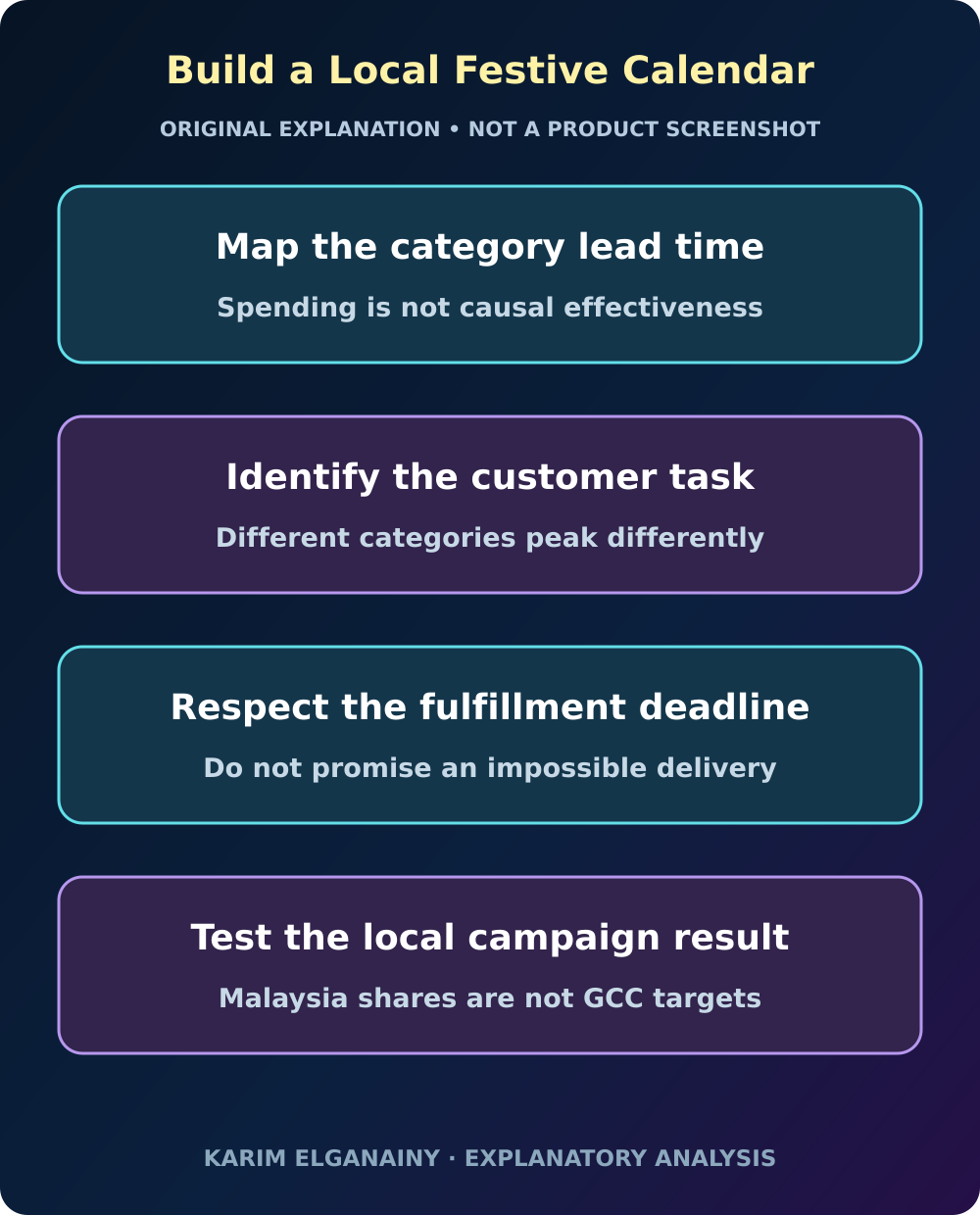
Original editorial framework; not a product screenshot or proof of campaign results.
Original analysis: build the calendar around decisions
The framework below is independent editorial analysis. It is not a further summary of Nielsen's findings, a description of its products, or a forecast for Malaysia or another market. Every business, workflow and calendar example is hypothetical. The purpose is to show how a marketing team could create a reviewable seasonal plan from its own commercial constraints rather than copy a competitor's spending pattern.
Begin with the decision the business needs to make: when should a particular offer be promoted to people who can still use it? A campaign calendar organized around that question will look different from one organized only around an event date. It needs to account for the time customers need to decide, the work required to fulfil the promise, and what happens when the original purchase opportunity closes.
Give each offer its own planning record
A useful planning record names the offer, the intended customer task and the conditions under which the business can deliver it. Include the applicable geography, price or approved pricing source, stock owner, service capacity and last reliable fulfilment date. These details belong in the media brief because they determine whether an advertisement remains useful after somebody sees it.
Imagine a fictional retailer offering both ready-made tableware and personalized gifts. The products can appear in the same seasonal creative theme, but personalization introduces a separate production dependency. A single promotional end date could leave the gift advertisement running after the workshop can accept more orders. Give each offer a separate readiness decision even if the campaign shares a visual identity and media account.
Do not make the planner infer operational facts from an old landing page. Assign a named owner to confirm each changing field before launch and when conditions change. An unconfirmed promise should remain visibly unresolved in the plan.
Work backward from the last useful action
For each offer, identify the last action that can reasonably lead to the advertised result. It might be a paid order, a completed design approval or a confirmed collection slot. These actions are different, so avoid putting them all under a vague label such as purchase deadline. The team must know which event the customer has to complete.
Then work backward through the actual steps: customer consideration, internal review, production, dispatch and any contingency the business has approved. Use the operation's own evidence rather than inventing a universal buffer. If the business cannot support a precise delivery promise, the creative should not manufacture one to make the campaign feel urgent.
This approach also identifies the point at which the offer must change. An item that can no longer be shipped in time may still be available for collection, but only if that service actually exists and its availability is confirmed. A different fulfilment route needs a different message.
Use a hypothetical four-window calendar
Consider a fictional seasonal homeware campaign. In a discovery window, the team could explain product dimensions, materials and ways to compare options. In a decision window, it could make prices, availability and service conditions easier to evaluate. In a final feasible purchase window, it could show only offers whose fulfilment promises remain valid. In a post-event window, it could support care, exchanges and relevant replenishment.
Those windows are a planning example, not dates from a research report. They can overlap because different products and customers have different constraints. Some customers may arrive ready to choose, while others need information that the campaign published earlier. Keep useful product information accessible instead of withdrawing it merely because the internal calendar has advanced.
Give each window an entry condition and an exit condition. For example, the final purchase message should become eligible only when the operation confirms the advertised service, and stop when that confirmation no longer holds. Conditions are more useful than a decorative timeline that nobody can maintain.
Make the message answer the current question
A creative brief should identify what the customer needs to understand before taking the next step. Early in a hypothetical furniture journey, the unresolved question might be whether an item fits the available space. Later it might concern assembly or a collection appointment. Repeating the same celebratory headline at every stage leaves those questions unanswered, regardless of how consistent the campaign looks.
Keep a shared set of verified product facts across all versions. Writers can vary the emphasis without changing the offer, eligibility or certainty of the promise. A concise reminder should not become more absolute than the detailed product page. If the page says an appointment is subject to confirmation, the advertisement should preserve that qualification.
Build a simple review habit: ask someone outside the campaign team to describe what they think will happen after responding. If their interpretation differs from the service actually available, repair the wording or the journey before increasing distribution.
Assign channel roles before allocating money
Start a channel brief with the job it is expected to do, not its fashionable reputation. One placement might introduce the product category to an appropriate audience. Another might help people compare options or return to information they requested. A store display could explain a collection process. Those are proposed roles to test, not guaranteed properties of a medium.
For each role, specify the suitable audience, the message, the destination and the observable next action. Ask whether the destination can handle the questions generated by the advertisement. A broad awareness message and a detailed purchasing instruction may need different creative, even when they point to the same product family.
Only then compare the available buying options and commercial terms. Large competitor expenditure can be a reason to examine an environment more closely, but it cannot choose the right role for your campaign. The team still needs to establish whether it can buy a useful opportunity at an acceptable cost.
Keep competition, demand and performance separate
Maintain three distinct questions in the planning meeting. What advertising activity can the team observe? What evidence does the business have about customer needs? What result did its own activity produce? A competitive spending report can contribute to the first question. Customer research and operational records may inform the second. The third requires an appropriate campaign evaluation.
When those questions are combined, a busy advertising period can be mistaken for proof that more spending will pay back. It may instead describe a crowded environment, a strategic launch or an attempt to stimulate weak demand. Without additional evidence, the team should record competing explanations rather than pick the one that supports a preferred budget.
Use the distinction in presentation titles as well as footnotes. A slide about observed category activity should not be titled as a proven growth opportunity. Clear labels make it easier for commercial colleagues to decide what further evidence is worth buying or collecting.
Budget around readiness and explicit tests
Separate the spending needed to meet an agreed campaign commitment from the spending reserved for learning. The learning portion should answer a named question, such as whether an earlier information message helps suitable customers complete a purchase. Decide the comparison and the outcome before launching that test. Otherwise a changing calendar can become an excuse to reinterpret any favorable movement as success.
Retain a contingency that has an owner and a release condition. For example, a fictional retailer might hold additional promotion until a delayed product passes its readiness check. This is an operational control, not a recommended percentage allocation. The appropriate amount depends on the actual commercial plan and the cost of an unavailable promise.
Record why a budget changes. Capacity, a newly confirmed offer and experimental evidence are different reasons. Keeping them distinct helps the final review explain what happened without pretending that every adjustment was a performance optimization.
Design measurement before the busiest period
Choose an outcome that matches the decision. Completed and fulfilled orders may suit one commercial question; an approved appointment may suit another. Define exclusions and timing consistently. A provisional enquiry, a cancelled order and a completed transaction should not be treated as interchangeable simply because a reporting system calls all three conversions.
Where a suitable experimental comparison is feasible, have an analyst specify assignment, observation period and the limitations before launch. If there is no credible comparison, describe the results as observed activity rather than proven incremental impact. A seasonal increase in sales can coincide with advertising without revealing how much the advertising caused.
Plan for delayed outcomes. The campaign may stop before returns, cancellations or service completion are known. Preserve the initial result as provisional and schedule a later reconciliation tied to those business processes. Ending media delivery does not automatically mean the commercial result is settled.
Build a daily exception routine
During the most demanding window, an exception review can be more useful than a long meeting about every metric. Check whether a promise has become unavailable, whether an essential destination step has broken, and whether a service team is receiving a question the creative failed to explain. These checks are a proposed operating practice, not a requirement attributed to any research provider.
Agree who can pause an affected message and who must verify its replacement. The response should be proportionate: a problem with one offer does not necessarily require stopping every campaign. Equally, continuing to promote an unavailable product while colleagues debate attribution is a poor use of both attention and money.
Keep a short decision log with the issue, evidence, owner and action. Include the time at which the problem was resolved. This record can help the later analysis distinguish weak demand from periods when customers could not complete the advertised journey.
Preserve the limits when planning for another market
The Malaysian figures above should not be converted into a Saudi, Emirati or other market's spending recommendation. A regional team can use the planning questions in this article while supplying its own evidence about customer needs, stock, service capacity and media options. That is a proposed local process, not a regional conclusion drawn from the source dataset.
For a bilingual campaign, review the whole journey in each supported language. Check that prices, availability, material conditions and the final action mean the same thing. A translated headline cannot resolve a destination that leaves important questions unanswered. Likewise, a culturally appropriate theme does not establish that the advertised service is ready.
Have colleagues with relevant market and language knowledge review the proposed calendar. Ask them to identify unsupported assumptions, not merely approve the visual theme. Their observations should become questions to verify rather than untested rules about a whole population.
Karim's strategic takeaway
A strong festive plan makes the next decision easier for both the customer and the business. It connects an available offer to a useful message, a feasible action and a clearly defined result. The calendar becomes valuable when the team can explain why each phase starts, what would stop it and which evidence would justify spending more.
At the close, preserve what the team learned about lead times, unanswered questions, readiness failures and measurement limits. Turn those observations into changes for the next plan, with owners who can implement them. A polished retrospective is less useful than a corrected fulfilment assumption or a clearer product page. Better preparation begins with those specific improvements, not with copying the busiest month on somebody else's chart.
Comments
No published comments yet.