A marketing plan can look convincing while remaining disconnected from everyday work. The organization has strengths, a market opportunity appears attractive, and the team can name several competitive threats. Yet nobody has examined whether current campaigns reach the intended audience, whether approvals take too long, or whether the people expected to deliver the plan have available time. The missing connection is between strategic diagnosis and the marketing operation that must act on it.
SWOTELL helps make that connection. In the digital marketing strategy course material used for this series, it extends SWOT with three marketing questions: what already exists, what limits progress, and what can be leveraged. This article explains the seven components, shows how to assemble useful evidence, and develops two hypothetical applications. The practical workflow below is an editorial application of the course model, rather than a claim that every organization must follow a universal SWOTELL standard.
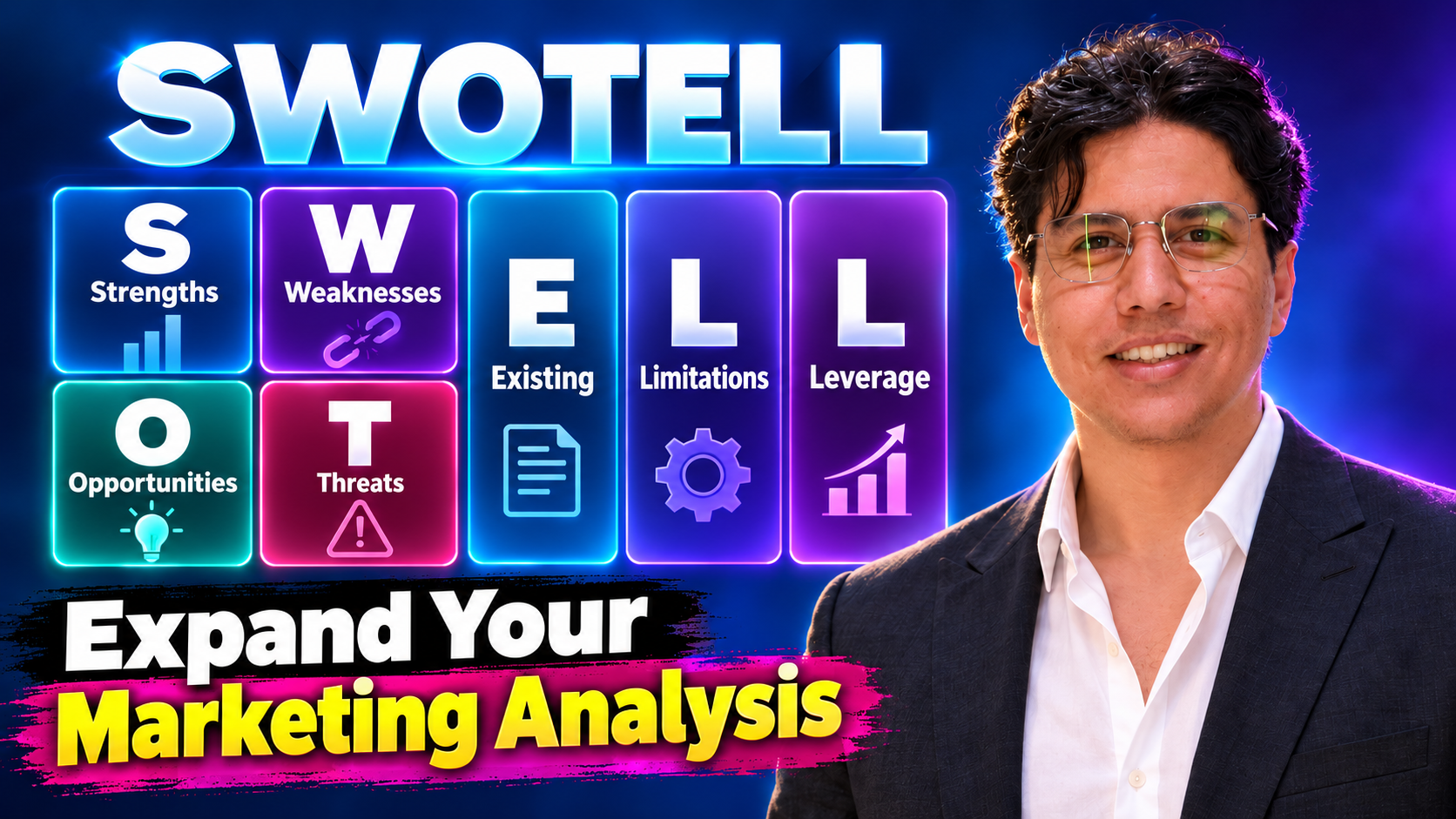
What SWOTELL means in this course
SWOTELL brings together Strengths, Weaknesses, Opportunities, Threats, Existing activity, Limitations, and Leverage. The first four components establish the organization's position. The final three examine its current marketing activity, the constraints affecting that activity, and the useful capabilities or tactics it could build on. Read together, they help a team ask whether a proposed direction makes sense and whether the organization can support it.
The source for this explanation is the Arabic explanatory digital marketing strategy course PDF, pages 23–25. Page 23 introduces the three additions to SWOT and connects them to the organization's existing SWOT findings. Page 24 discusses artificial intelligence as a starting point or a review aid, with an explicit warning that it does not know the organization's context. Page 25 asks learners to apply the model, adding the three new elements to an earlier SWOT when one exists.
That source supports the model as taught in the course. It does not establish its original inventor, historical date of creation, universal adoption, or comparative effectiveness against other planning tools. Those claims are unnecessary for useful application. The immediate value is a better set of questions about decisions, evidence, and the practical conditions under which marketing operates.
If you already have a credible SWOT, do not rebuild it just to create another document. Review its scope and freshness, then add Existing activity, Limitations, and Leverage. If the earlier SWOT is vague or outdated, repair the important inputs first. Adding three categories to unsupported statements will produce a longer analysis without making the underlying judgment more reliable.
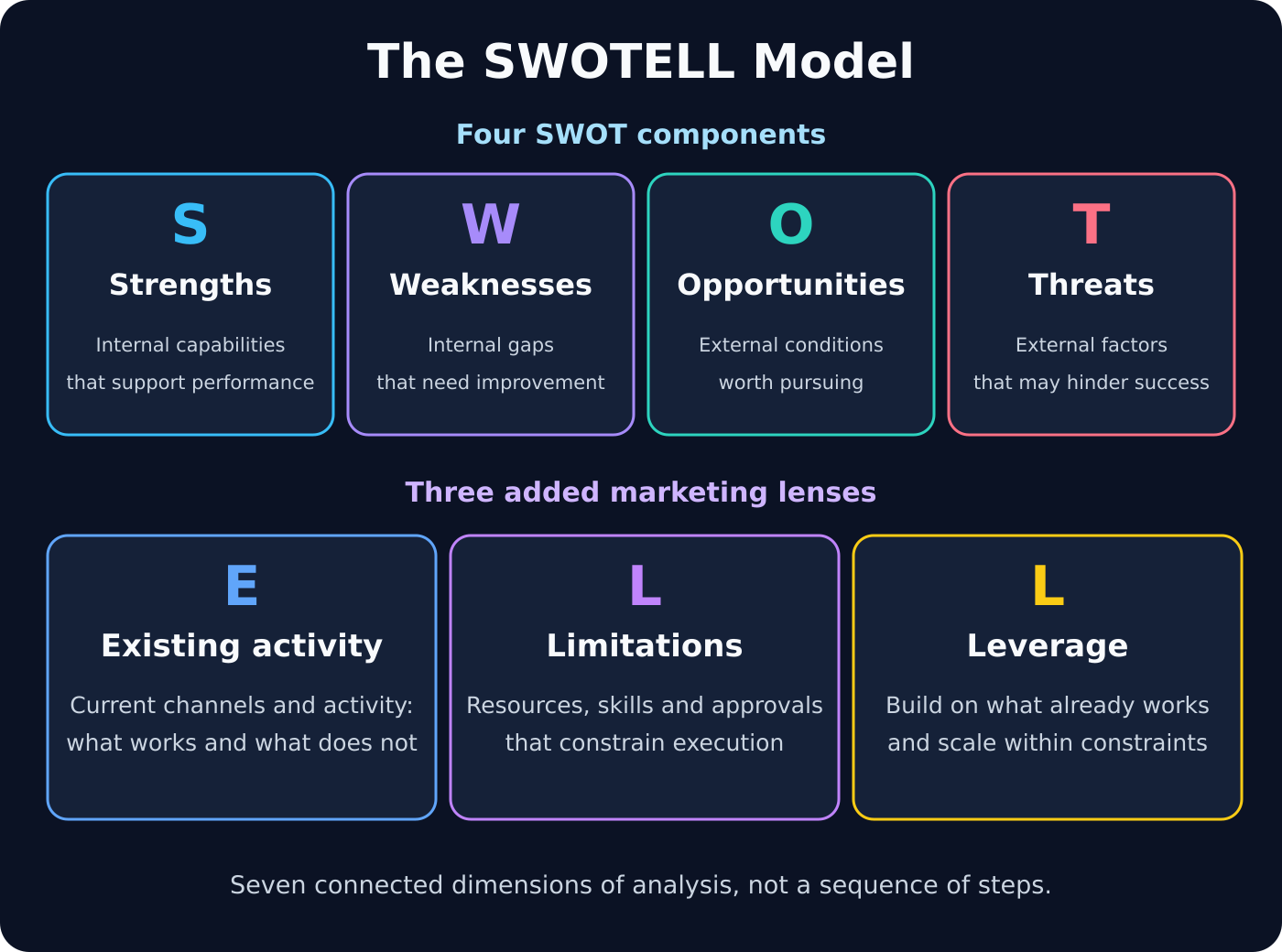
Original explanatory diagram: four SWOT components plus Existing activity, Limitations and Leverage, connected analysis dimensions rather than sequential steps.
The seven components, explained through decisions
Strengths: capabilities that matter to the chosen audience
A strength is an internal capability or asset that helps the organization serve its intended customers. It might be dependable fulfillment, a knowledgeable service team, trusted educational material, a useful distribution relationship, or a well-maintained customer database. The important question is what advantage the capability creates for a specific decision. Calling the whole organization innovative or customer focused provides little guidance unless the statement has observable support.
Record evidence and boundaries. A team may respond quickly during ordinary demand but struggle when inquiries double. A brand may be familiar to existing customers while remaining unknown in a new segment. Those details do not invalidate the strength; they explain where it can be used responsibly. In SWOTELL, this distinction becomes especially important when deciding what to leverage later.
Weaknesses: internal gaps that reduce performance
Weaknesses are internal deficiencies that make it harder to deliver value or achieve the objective. Examples include inconsistent lead handling, unclear product information, unreliable measurement, or a difficult purchasing journey. Describe the gap in a way that can be investigated. “Weak digital marketing” is too broad; “qualified inquiries remain unanswered until the next working day” identifies a process that can be examined.
Do not assume that disappointing results prove the initial diagnosis. Low sales could reflect poor audience fit, an uncompetitive offer, limited availability, or an error in measurement. A useful weakness statement includes the observed symptom and acknowledges uncertainty about its cause. That prevents the team from purchasing a solution before it understands the problem.
Opportunities: relevant openings outside the organization
Opportunities are external conditions that could support the objective if the organization can respond appropriately. They might include an underserved customer need, a change in buying behavior, a suitable partnership opening, or demand in a segment the organization can realistically serve. The opportunity is the favorable condition. A new campaign, website, or product launch is a possible response to it.
Scope matters. A broad increase in online purchasing does not establish demand for your particular offer. Look for evidence about the intended audience, the need, and the conditions under which people would choose your organization. Where evidence is incomplete, describe a hypothesis worth testing. Avoid converting an attractive market story into an assumed revenue forecast.
Threats: external changes that could weaken the plan
Threats are external conditions that could undermine the objective or increase exposure. These may include stronger competitors, changes in customer expectations, a platform becoming more expensive or less dependable, or a supplier relationship becoming uncertain. Separate the external event from the internal vulnerability that makes it consequential. A channel policy change is external; having no alternative route to customers is an internal dependency.
The purpose is not to produce the longest possible risk list. Identify the threats that could materially change a decision within the planning horizon. For each important threat, explain which activity or assumption it affects. That makes later discussions about limitations and leverage more concrete, particularly when a successful tactic depends heavily on one channel or partner.
Existing activity: what marketing actually does today
Existing activity examines the current marketing operation. The course asks about channels, achievement of key performance indicators, whether the right audience is being reached, and what is or is not working. This category should describe observable activity before judging what ought to happen. Include the work that customers experience across the journey, rather than only the campaigns that appear in a marketing dashboard.
For example, record paid advertisements, search content, email, social publishing, referrals, inquiry handling, and relevant follow-up. Note the purpose, audience, owner, cost where available, and useful result for each activity. A channel can generate impressive reach while attracting people the organization cannot serve. Another may generate fewer inquiries but contribute more suitable customers. Existing activity creates the place to examine that difference.
The course also notes that a startup with little current activity can benefit from this question. A limited history means there is less evidence about what works, but also room to test assumptions. Record the absence of data honestly. Do not fill an empty category with imagined results or borrow another company's performance as though it describes your own.
Limitations: what restricts feasible execution
Limitations examine the conditions that constrain marketing work. The course includes resources, expertise, skills, team structure, approval delays, and budget in comparison with competitors. These conditions shape how quickly and reliably a plan can be delivered. A proposal requiring weekly creative changes may be unrealistic when every revision needs several sequential approvals and the only designer supports multiple departments.
Some limitations overlap with weaknesses, but the questions differ. A weakness identifies a deficiency; a limitation explains a boundary on action. Inconsistent analytics may be a weakness, while having no available analyst this month limits the repair options. The same fact can inform both categories when its role is clear. Repeating it without explaining the consequence adds little value.
Distinguish constraints that are fixed for the planning period from those that can be changed. A limited budget might be addressed through a smaller experiment. A skills gap could require training or a partner. A service-capacity limit may mean that generating more demand is currently the wrong priority. Constraints should guide sequencing, rather than become excuses or disappear from the plan because they are inconvenient.
Leverage: what can be built on responsibly
Leverage asks which useful activities, relationships, or capabilities can be repeated, extended, or used more effectively while respecting limitations. The course points to successful tactics, agencies, partners, consultants, team capability, and unused skills. This is broader than increasing advertising spend. It may involve reusing a sound process, bringing an underused specialist into the work, or making a successful service approach available to another appropriate segment.
A strength describes an advantage; leverage describes a plausible way to put an advantage or a demonstrated success to further use. For example, knowledgeable staff are a strength. Giving those staff a manageable role in answering recurring customer questions could be a leverage opportunity. The second statement requires attention to availability, quality review, audience relevance, and the work displaced by the new responsibility.
Success at a small scale does not prove success at a larger one. A useful tactic may work because it reaches the easiest customers first or depends on personal attention that cannot expand indefinitely. Record why you think it works, what additional resources expansion requires, and what evidence would challenge the idea. Leverage should remain a testable proposition rather than a promise of effortless growth.
Build an evidence base before the workshop
Start with one decision, audience, and time horizon. An organization-wide annual strategy and a six-week improvement to one inquiry journey need different levels of detail. A bounded question might be: how can we increase completed purchases from suitable repeat customers next quarter without worsening fulfillment? This question makes it easier to decide which strengths, activities, constraints, and risks deserve attention.
Gather evidence from more than one function. Marketing can explain campaign activity, while sales or reception can describe the suitability of inquiries. Operations can identify delivery constraints, finance can clarify resource boundaries, and customers can explain why they hesitate. Each perspective has limitations. A dashboard may miss offline conversions, and memorable complaints may not represent the typical experience. Preserve those qualifications instead of forcing false agreement.
For important findings, record the observation, source, period, confidence, and implication. “Staff believe customers want faster quotes” should remain distinct from a measured delay and direct customer feedback. Both can be useful, but they support different levels of commitment. Label an inference as an inference and assign a practical way to check it when the decision depends on it.
Review measurement definitions before comparing channels. Teams may count a submitted form, a qualified inquiry, and a completed transaction as equivalent conversions even though they answer different questions. Clarify what is counted, whether records can be duplicated, and whether attribution is reliable enough for the proposed decision. Imperfect data can still support a limited experiment if the uncertainty is visible and the decision is proportionate.
Turn seven categories into a manageable plan
Read the categories together and look for a specific connection. An opportunity may fit a strength but collide with a limitation. Existing activity may reveal a successful tactic that can be leveraged, while a threat makes dependence on it risky. Write the connection in ordinary language: this customer need appears relevant, this capability helps us serve it, this constraint limits the first step, and this observation will tell us whether the approach is working.
Generate a small number of alternatives rather than treating the first plausible idea as the answer. A slow response process could be improved by simplifying forms, clarifying ownership, adjusting schedules, or using a suitable tool. Compare which cause each alternative addresses and what dependencies it introduces. The point of SWOTELL is to improve the decision, not to justify a solution that was already preferred before the analysis began.
For each selected initiative, create a short decision record with an accountable owner, resource estimate, main assumption, success measure, review date, and stopping condition. This is an implementation aid proposed in this article, not an additional component of the course model. It helps prevent useful observations from disappearing between the workshop and the weekly work schedule.
Make explicit what will stop or wait. If every new initiative is added to an unchanged workload, the limitations analysis has had no effect. A realistic plan may pause a low-value channel, narrow an audience, reduce publishing frequency, or repair the buying journey before increasing promotion. Resource choices are part of strategy even when they produce less visible activity in the short term.
Hypothetical application one: a healthcare center's booking journey
Imagine a healthcare center reviewing how suitable inquiries become completed bookings for one service. This entire example, including every number, is hypothetical; it is not a client case, a claim about a real organization, or a healthcare marketing benchmark. The objective concerns communication and administrative reliability. Qualified professionals remain responsible for clinical decisions, and marketing targets should not determine whether someone needs medical care. The team defines the service, area, and available capacity before considering more promotion.
The center identifies reliable inquiry follow-up during working hours and clear service information as strengths. Its weakness is an inconsistent handoff between staff, which sometimes leads to customers being asked for information they have already provided. The assumed opportunity is a recurring need for clearer explanations of booking steps. The assumed threat is increasing competition for attention in the channel on which the center depends. These factors need evidence before they can support a substantial commitment.
Under Existing activity, the team maps the service page, inquiry messages, and awareness advertising. Suppose a hypothetical four-week record contains 100 suitable inquiries and 30 completed bookings. The descriptive inquiry-to-booking rate is 30 percent, provided the definition of a suitable inquiry is consistent and duplicates have been removed. That rate alone cannot explain why the other inquiries did not become bookings. Staff examine where the journey becomes difficult before attributing the result to price, advertising, or any single cause.
Under Limitations, the team records restricted staffing at some times and delays in approving changes. Under Leverage, it identifies existing answers and questions that staff hear repeatedly. The proposed response is to standardize the booking steps and reorganize general information on the service page before expanding advertising. Appropriate staff review the wording. The example does not require using identifiable patient details or personal testimonials; any real use of such material would need appropriate permissions and safeguards.
The experiment assigns one owner to the page and another to the staff handoff. The team tracks completed bookings among suitable inquiries, response time, errors, and bookings that exceed available capacity. A target may help guide an internal test, but it must remain distinct from a guaranteed forecast. The organization should not interpret a rising booking count as success if information quality or administrative reliability deteriorates.
Now suppose a later hypothetical period records 40 bookings from 120 suitable inquiries. That is approximately 33.3 percent, compared with the earlier 30 percent. The booking count rose by ten, but that difference alone does not measure the effect of the changes. Audience composition, campaign timing, appointment availability, or recording quality may also have changed. Comparing two periods can reveal a pattern worth investigating; it does not establish that the intervention caused it.
The lesson is the relationship between categories. The SWOT identifies relevant capabilities and concerns; Existing activity reveals a journey and measurement question; Limitations bound the experiment; and Leverage identifies information already inside the organization. The resulting decision is more testable than a general instruction to attract more inquiries, and its interpretation remains proportionate to the evidence available.
Hypothetical application two: a hospitality supplier's quotation requests
Consider a supplier of hospitality consumables serving small cafés. This example and all its numbers are also entirely hypothetical. The supplier receives quotation requests, but employees spend considerable time asking for missing information. Its strategic question is how to improve the proportion of complete, suitable requests within operating capacity. Before increasing advertising, the team needs to understand whether the difficulty comes from audience fit, the request process, or the way products are presented.
The supplier identifies its sales team's knowledge of café needs and its frequently requested product range as strengths. A weakness is that different employees collect different information. The assumed opportunity is a need among some new cafés for clearer guidance when choosing basic supplies. The assumed threats are price competition and delays affecting some external supplies. The team connects those threats to the relevant products rather than assuming every customer and item faces the same exposure.
The Existing activity review covers the product catalog, customer messages, advertisements, and quotation process. In this scenario, a post explaining basic choices appears to be associated with more complete requests. The team treats that observation as a clue rather than proof that the post caused the difference. Customers who read it might already have clearer requirements or differ in other important ways from those who do not.
Under Limitations, the team records scarce sales time and difficulty keeping the entire catalog current. Under Leverage, it identifies staff knowledge that could support a short guide and a request form asking only for necessary details. The proposed experiment is a focused page for one café segment, with clear product information and quotation-request steps. The team reviews availability wording and avoids promising stock or delivery terms that operations have not confirmed.
Execution requires someone to own updates and a reliable way for inventory changes to reach that person. These details matter because a page that attracts requests while creating inaccurate expectations can increase work elsewhere. The team compares the proposed page with other options, including a simpler standard response or a change in staff responsibilities. A new digital asset is useful only if it addresses the identified source of friction.
Suppose the previous two hypothetical weeks produced 50 requests, of which 20 included the necessary information. The baseline completeness rate is 40 percent. During the experiment, the team measures the same rate, quotation preparation time, the proportion of suitable requests, and pricing errors. More complete information and lower handling time could make the process useful even if total request volume does not immediately rise. Sales, margin, and delivery quality still matter when assessing the broader commercial result.
Before extending the approach, the supplier checks whether another segment needs different information and whether operations can absorb additional demand. It might adapt the page, maintain the limited scope, or resolve stock problems first. SWOTELL connects current activity, constraints, and reusable knowledge to that decision. It also shows why improving request quality may deserve attention before seeking a larger volume of requests.
Use artificial intelligence as a critical assistant
The course material offers two useful roles for AI: suggesting areas to investigate when a team needs a starting point, and reviewing an existing analysis for omissions. In both cases, the organization must provide relevant context and verify the output. A plausible statement about customer behavior, competitors, or team capability is not evidence merely because an AI system presents it confidently.
A practical review request can describe the decision, audience, known activities, and constraints, then ask which assumptions need checking or which perspectives are missing. Ask the system to distinguish supplied facts from inferred possibilities. Do not invite it to invent performance figures to complete an empty section. Keep confidential or personal information out of tools that are not approved for that information.
The human team remains responsible for selecting evidence and making trade-offs. AI can help challenge vague wording or organize questions, but it cannot know undocumented internal circumstances without being told. It may overlook a constraint that staff regard as obvious or recommend an activity that the organization cannot deliver. The course's warning is therefore a working rule for the analysis, not a footnote to add after decisions have already been made.
Review the analysis when the decision changes
SWOTELL should remain connected to the planning decision rather than become a permanent description of the business. Review important findings when performance changes, a constraint is removed, a new threat emerges, or the pilot provides useful evidence. A limitation that once blocked an initiative may no longer apply. A previously successful tactic may lose its value when customer behavior or delivery conditions change.
At review, separate implementation failure from a weak underlying idea. A pilot that never received the agreed staff time cannot fully test the proposed approach. Equally, a well-executed activity that attracts unsuitable demand should not be defended simply because the team worked hard on it. Update the relevant category and the decision record so the next cycle uses what was learned.
The strongest outcome is a clear choice supported by a realistic understanding of the organization. Keep the seven components accurate, make assumptions visible, and connect each proposed action to current activity and actual constraints. Then use limited, measurable steps to discover what can genuinely be leveraged. The framework becomes useful when it changes what the team does, what it postpones, and what evidence it seeks next.
Related models and source
Review SWOT analysis for the four foundational categories, and the TOWS matrix for another way to turn those findings into strategic alternatives. SWOTELL instead adds a focused review of existing marketing activity, execution constraints and what can be built on.
Source: the explanatory digital marketing strategy course PDF, pages 23–25. The workflow and examples here are original educational applications, not reported client results.
Comments
No published comments yet.