Imagine that you run an online store and sales have started slowing down. One person suggests increasing the advertising budget, another proposes lowering prices, and the content team wants to publish more videos. Any of these ideas might be appropriate, but everyone has jumped to a solution before identifying the problem. Are you attracting the wrong visitors? Does the product lack a clear value proposition? Do customers hesitate when they see the delivery charge? Or is a competitor offering a better experience?
This is where SWOT analysis becomes useful. It helps you organize what you know about your business and its surrounding market before spending money or changing direction. In this article, we will use it as a decision-making tool, rather than simply memorizing the names of four boxes. You will learn to distinguish its components, collect evidence, write a useful analysis, and turn it into priorities, experiments, and measurable results.
Every business, number, and practical case used here is hypothetical and created for teaching. These are not actual client results, established market averages, or a promise that your business will achieve the same outcomes. The purpose is to learn the method of thinking, then replace the example data with information from your own business.
1. What Is SWOT Analysis, and What Question Does It Answer?
SWOT stands for Strengths, Weaknesses, Opportunities, and Threats. The question connecting these four categories is: what helps us achieve a specific objective, and what might prevent us from achieving it, whether inside the business or outside it?
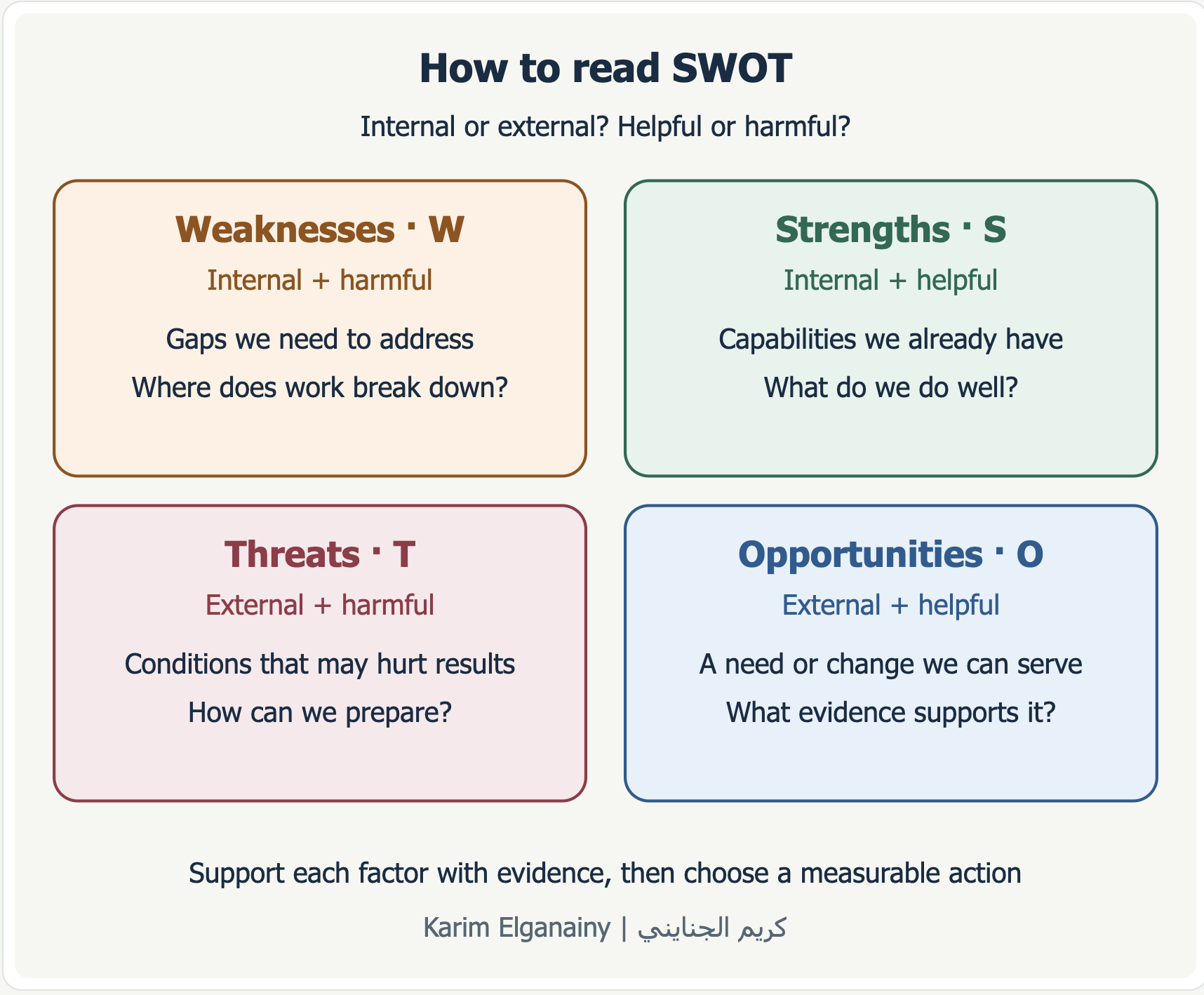
Strengths and weaknesses concern the business's resources, capabilities, and ways of working. Opportunities and threats concern the external environment, including customers, competitors, suppliers, and market changes. This is the basic distinction also emphasized in the Australian Government's guidance on SWOT analysis. Dividing factors into positive and negative is not enough; you also need to identify where each factor comes from.
Start with a clear objective. An analysis for a store seeking to increase repeat purchases will differ from an analysis for the same store considering expansion into a new city. Its existing customer base may be a strength for the first objective, while limited delivery capacity could be a critical obstacle for the second. A factor is evaluated against a decision, a context, and a time frame, rather than in isolation.
For example, write this at the top of your page: “We want to assess our ability to increase profitable orders in Riyadh over the next ninety days.” That sentence defines the subject of the analysis, the market, the desired outcome, and the time horizon. It also helps you exclude details that do not affect the decision, however interesting they may seem.

Read the top row as the business's capabilities and the bottom row as its surrounding conditions. Then ask whether each factor supports your objective or obstructs it.
2. Understand Internal and External Factors Before Filling Any Box
Consider the statement “Advertising has become more expensive.” This could describe an external threat if the cost of reaching your audience is rising because of market competition and you have suitable evidence. But “We do not test advertising messages or filter out unsuitable traffic” describes an internal weakness. Both factors may exist at the same time, but they require different responses.
The same distinction applies to delivery. Widespread disruption among shipping companies is a potential external condition, whereas your team's delay in preparing an order before handing it to the carrier is an internal weakness. Combining both under “shipping problems” can hide the part you can fix immediately and the part that requires alternatives or contingency planning.
Similarly, “Launching a YouTube channel” is not an external opportunity in itself; it is an action you can take. The opportunity might be that your audience repeatedly asks educational questions that competitors do not answer clearly. If this gap is established, video could be one solution, but an article or illustrated guide might be more appropriate. Separate the condition you discover from the response you propose.
Use a simple test: does this sentence describe something we have or do inside the business, or something happening in the market? Then ask whether it is an evidence-backed fact, an impression, or a proposal. Many crowded SWOT tables contain proposals disguised as opportunities, or assumptions stated with greater confidence than the available evidence supports.
3. Strengths: What Do We Actually Do Well?
A strength is not a promotional statement such as “We are the best.” It is a capability, asset, or result that helps you achieve your objective and can be explained with evidence. Examples include expertise in a specialist category, fast order preparation, useful content that attracts relevant traffic, or a stable supplier relationship that keeps needed products available.
Instead of writing “Excellent service,” write: “We answer most pre-purchase questions within a defined period, and customers report that clear answers helped them choose.” Add the period measured, the measurement method, and the sample size. If you do not have data, label it “A potential strength requiring verification,” rather than presenting it as an established fact.
Also ask whether the strength matters to your target customer. A huge warehouse is not automatically a meaningful advantage, but having the required size available and dispatching it quickly may matter. Advanced technology does not create value by itself; value appears when it saves customers time, reduces ordering mistakes, or helps them make better decisions.
A strength does not have to be unique. You may have a useful capability that many competitors share. Record it when relevant, but do not automatically treat it as a differentiator. There is a difference between a capability needed to compete and a capability that makes customers specifically choose you. That distinction affects the marketing message you can honestly communicate later.
4. Weaknesses: Where Do We Lose Customers or Waste Resources?
Weaknesses are internal factors that reduce your ability to achieve the objective. They might include missing order data, a complicated checkout page, slow responses, dependence on one employee for a critical task, or an unclear exchange policy. Recognizing them does not diminish the business; it identifies where improvement can make a difference.
Do not stop at a broad description such as “The website is weak.” Ask what the specific problem is. Is it difficult to use on a phone? Can visitors find the product price? Does payment produce an error? Was the problem observed in an actual test, a support record, or reliable data? The more specific the statement, the easier it becomes to turn it into an action.
Separate symptoms from causes. Falling sales are an outcome requiring explanation, rather than a sufficient diagnosis. The issue might involve traffic quality, the offer, product availability, or payment experience. If you jump straight to more advertising, you may send more people into the same problem. Good analysis encourages you to test the explanation before funding the solution.
Constraints also differ according to business size. A small team cannot execute ten campaigns simultaneously, but that does not necessarily justify immediate large-scale hiring. It may need fewer initiatives and one carefully chosen channel. Describe weaknesses in relation to the objective, instead of compiling everything a large company has that your business lacks.
5. Opportunities: Where Is There a Need or Gap We Could Serve?
An opportunity is an external condition that could help the business achieve its objective if it responds with suitable capabilities. Examples include a segment that cannot find clear product explanations, a recurring need inadequately addressed by current market offerings, or a possible partnership with an organization serving the same audience. An opportunity does not automatically mean you can exploit it immediately or profitably.
Imagine that customer interviews and product reviews repeatedly reveal difficulty choosing equipment for making coffee at home. This observation deserves investigation. But do not jump from a few comments to “The whole market wants a training course.” Collect more information, assess the problem within your target segment, and test interest in a simple solution before expanding it.
Distinguish a need from willingness to pay. A customer may say they like a new service but decline to buy when shown the actual price and conditions. Treat a survey as one part of the evidence, rather than a substitute for behavior. A limited experiment, a clearly described waiting list, or an appropriate trial offer can help test the hypothesis, provided you interpret results within the experiment's scale.
Finally, do not choose an opportunity merely because it sounds attractive. If it requires skills, time, and capital beyond your current capacity, it may belong in a later phase. A suitable opportunity combines a real need with reasonable execution capacity and supports the direction you want for your business, rather than whichever direction happens to be fashionable this week.
6. Threats: What Could Put Pressure on Our Results?
A threat is an external factor that could harm achievement of the objective. Examples include a competitor entering with a strong offer, dependence on a supplier facing disruption, changing purchasing behavior, or declining demand for a particular category. Monitor relevant signals instead of listing every possible disaster in the world.
Describe threats practically. Instead of “Competition is strong,” write: “Two competitors serving the same segment now offer faster delivery within our service area.” Verify the locations, conditions, and costs rather than relying on an advertising slogan alone. You may discover that the offer does not cover your audience, or that you were comparing two different services.
Distinguish a current threat from a possible scenario. A confirmed supplier cost increase is different from an undocumented prediction that prices will rise. Record your confidence level, the expected timing, and the signal that would trigger action. This makes analysis a preparation tool instead of a collection of fears that prevents progress.
The same change can be an opportunity for one business and a threat to another. A tool that speeds up a service may benefit a team that knows how to integrate it while putting pressure on a provider dependent on manual work that adds little value. Study the change's effect on your business, audience, and specific objective rather than assigning every development a permanent category.
7. Gather Evidence from People and Data Together
Before the analysis meeting, collect information from sales, support, operations, and marketing. The advertising team understands what attracts clicks, but support staff hear reasons for hesitation, and operations see causes of delay. Relying on a single perspective can make every challenge look like a problem with the channel you personally manage.
Review an appropriate number of conversations, orders, and comments while respecting people's privacy, and look for recurring patterns. Ask customers about specific experiences: what were they trying to accomplish? What did they not understand? Why did they decide to purchase or stop? Questions about an actual experience are often clearer than a broad question such as “Did you like our store?”
Combine research you conduct yourself with information already available. The distinction concerns the data's source and the purpose for which it was collected; either type can contain numbers or qualitative observations. Do not treat a small sample as representative of the whole market. Interviews may reveal an important hypothesis that still needs broader data or an additional test before a major decision.
Create a simple record for each observation: the factor, its category, the evidence, the evidence date, confidence level, and expected impact. When the team disagrees, do not resolve it only by voting. Ask what missing information you could collect and which small experiment might distinguish the explanations. The best analysis is the clearest about what is known and what remains unverified.
8. A Complete Example: A Hypothetical Coffee Equipment Store
We will use a fictional store called “Rukn Al-Bunn,” selling home coffee equipment to individuals in Riyadh. Its objective is to increase profitable orders over three months without worsening delivery experience. During a hypothetical month, the store received 8,000 website sessions, completed 160 orders, and recorded an average order value of SAR 180.
The orders-to-sessions rate is 160 divided by 8,000, or 2%. Revenue is 160 multiplied by 180, or SAR 28,800. Assume that the contribution remaining per order after variable costs, but before marketing expenditure and fixed expenses, is SAR 60. Total contribution is therefore SAR 9,600.
If marketing expenditure for the month was SAR 7,000, SAR 2,600 remains before fixed expenses and other items excluded from the example. This is not the company's net profit. The point is that more orders alone do not establish success: discounts may consume contribution, or a campaign may cost more than the contribution it adds.
In the same teaching case, forty orders arrived after the promised date, representing one quarter of all orders. Twelve short interviews revealed recurring questions about compatibility between equipment and brewing methods. These interviews help us understand the problem but do not establish its prevalence among all customers. The team also identified an older educational guide attracting relevant visitors that had not been updated for some time.
9. Turn the Case Information into a SWOT Matrix
The first strength could be the team's practical equipment knowledge and ability to answer compatibility questions. The second is educational content that attracts genuinely interested visitors. The third is a stable relationship with a supplier providing core products. We do not describe the store as a “market leader,” because the example provides no evidence for that claim.
The first weakness is failure to meet the delivery promise on forty orders. The second is that product pages do not clearly answer the compatibility questions raised in interviews. The third is the absence of a consistent way to record checkout abandonment or support-contact reasons, leaving some decisions dependent on team memory rather than reviewable data.
The potential opportunity is an educational gap among some buyers choosing suitable equipment. We need to test its scale and the value of addressing it. A partnership opportunity might also exist with a coffee trainer running workshops for a relevant audience, if both parties' interest and the offer's relevance are verified, rather than relying solely on the trainer's follower count.
The hypothetical threats include a competitor offering faster local delivery and strong pricing offers on similar products. We do not add “Poor customer service” as a threat when it concerns the store itself, because that is an internal issue. Nor do we add “Launching an influencer campaign” as an opportunity, because it is a proposed response rather than a description of the environment.

The diagram summarizes the case; the supporting evidence and details remain in the text. A single image should not be expected to contain everything needed for a decision.
10. How Do You Choose Priorities When the List Is Long?
After collecting observations, do not try to solve every item simultaneously. Select factors most closely related to the objective and consider their potential impact, evidence strength, and urgency. Simple scores can help your team compare options, but they are not precise scientific measurements or a formula predicting success.
In our example, delivery problems are supported by order records and directly affect the promise made to customers. Expanding into a new product category remains a general proposal. Fixing delays and clarifying delivery times may therefore take priority over launching a campaign that generates extra orders the team cannot serve at the required standard.
This does not mean stopping all marketing until operations are perfect. Activity can continue within realistic capacity, using limited experiments that avoid unplanned pressure. For example, improve the equipment-selection guide and test it with part of the traffic while reviewing order preparation. Good prioritization considers dependencies between tasks and the resources available.
For each priority, write why it was chosen now and why other ideas were postponed. This brief note prevents meetings from returning to the beginning whenever a new idea appears. During review, it helps distinguish an incorrect hypothesis, weak execution, and changed conditions instead of declaring the entire analysis successful or unsuccessful all at once.
11. From SWOT to a Decision: A Simple Introduction to TOWS
SWOT describes the situation, but description alone is insufficient. We need to connect factors to identify possible responses. TOWS provides a useful logic: combine strengths with opportunities, weaknesses with opportunities, strengths with threats, and weaknesses with threats. A separate article will explore this model, but we can use it here to understand the next step.
For strengths combined with opportunities, connect Rukn Al-Bunn's expertise with the potential need for compatibility guidance. The proposed response is a clear selection guide and a practical equipment comparison, followed by testing whether the content helps visitors choose suitable products. Do not promise a specific improvement before the experiment or assume that every visitor needs the same explanation.
For weaknesses combined with opportunities, address missing product-page information to serve people seeking better guidance. For strengths combined with threats, use expertise and helpful support to explain value instead of automatically entering a price war. For weaknesses combined with threats, adjust delivery promises and service coverage so a faster competitor does not amplify the effect of existing delays.
These paths are alternatives requiring evaluation, not instructions to execute four campaigns. You might choose only two actions because they are the most worthwhile now. Each response should have a clear connection to the analysis: address this weakness, or use this strength, to respond to this condition and achieve this outcome.
12. Write an Execution Plan Someone Else Can Understand
Turn the delivery priority into a practical task. Assign someone to review the last forty delayed orders and set a deadline for classifying causes: internal preparation, handover to the carrier, incomplete addresses, or unrealistic delivery promises. Then select the most influential cause and design an appropriate response, rather than changing the entire system without diagnosis.
For the information priority, ask the content owner to review the most visited products, collect compatibility questions from support, and write concise, specific answers. Have someone who understands the products check them, and display them clearly on mobile. Decide in advance how you will assess comprehension, such as a simple usability exercise or follow-up questions alongside available behavior data.
Every task needs five elements: a desired outcome, an owner, a deadline, resources, and a verification method. “Improve customer experience” is insufficient for assigning work. “Review delay causes and adjust the delivery promise for affected products within two weeks” is an actionable starting point, provided that deadline fits the problem's scale and the team's capacity.
Also maintain a list of assumptions: clearer compatibility information should reduce confusion; reviewing the promise should reduce complaints; limiting the service area should improve reliability. Writing expectations explicitly makes them testable and adjustable. Hiding them inside a plan that sounds certain makes it harder to explain why outcomes differ from expectations.

13. Measure Progress Without Being Misled by Numbers
Connect measurement to the problem being addressed. For delivery, track the proportion of orders arriving within the defined promise, how that promise is calculated, and the number of included orders. For information, assess understanding, recurring questions, and conversion on affected pages. Likes should not be the primary measure for an action intended to reduce product-selection mistakes.
If the orders-to-sessions rate rose from 2% to 2.6% while sessions remained at 8,000, orders would become 208 rather than 160. This illustrates a possible target; it is not a forecast or an observed result. You also cannot automatically attribute an increase to one change, because visitor mix, price, or season may have changed.
Document changes during the observation period and use an appropriate comparison or controlled experiment where possible. Interpret small counts carefully; do not declare one page version a winner simply because it generated two additional orders. An early observation may justify continuing a test but does not establish strong causality by itself.
Review quality alongside quantity. More orders accompanied by more cancellations, complaints, or lower contribution may be undesirable. Supporting measures prevent the team from improving one number at the expense of customers or the business. At the end of the period, record what you learned and what you will change, rather than only the numbers that look attractive.
14. How Does the Analysis Differ for a Service Business?
Imagine a hypothetical training center offering professional workshops. Its strengths might be experienced trainers and clear practical content, while its weakness is a registration page that fails to explain course level or prerequisites. The opportunity might be employees needing evening training, and the threat more flexible alternatives. The table remains the same, but evidence and decisions differ from an online store.
The response is not simply an advertisement claiming “The best course.” It might begin with explaining whom the workshop suits, what learners will be able to do afterward, showing a training example, and interviewing interested people about scheduling. If the trainer cannot teach additional groups, a plan to double registrations makes little sense without addressing delivery capacity.
In healthcare services, the same thinking can improve clarity of service information, booking convenience, and communication while protecting patient privacy. However, a marketing strength must not become a promise of a clinical outcome or an unsupported professional claim. The model helps improve service and communication; it does not replace specialist verification of claims intended for publication.
15. Common Mistakes That Make the Analysis Useless
The first mistake is generic language: high quality, strong competition, promising market. Such statements apply to almost any business and therefore offer little specific help. Rewrite each point so readers understand what you mean, why it matters to the objective, and what evidence is available. If you cannot do that, more research may be necessary.
The second mistake is filling every box with the same number of items to satisfy the diagram's appearance. You do not need five factors per square. Three reliable, influential observations are better than ten weak statements. Missing information in a category does not prove that relevant factors are absent; it may mean you have not investigated sufficiently.
The third mistake is relying solely on the founder's opinion or a ready-made answer from an AI tool. A tool can organize evidence and suggest questions, but it does not know the reality of your operations without information. Ask it to separate assumptions from facts, and never turn a market guess into a published statistic or a characteristic attributed to a competitor.
The fourth mistake is saving the analysis and forgetting it. Set a review schedule appropriate to your business's rate of change, and revisit it when important events or new data appear. You do not need to rewrite everything daily. Update factors that have changed and assess whether previous priorities remain appropriate.
16. Practical Exercise: Build Your First Analysis
Choose one product or service rather than a large company with many activities. Write an objective and a time frame, then collect three customer observations, three operational observations, and three observations from available performance data. This is a training starting point for organizing work, not a research sample sufficient to generalize about the market.
Classify each observation as internal or external, then helpful or harmful. Mark items without evidence and turn them into research questions. Select the two most important factors and propose a small action for each that the team can execute, with an owner, deadline, and indicator of progress or need for adjustment.
Try this quick classification exercise. “Our team does not answer messages on weekends” is an internal weakness. “Some customers want to complete purchases on Friday evenings, according to initial interviews” is a potential opportunity requiring verification. “A competitor has started providing support then” is an external threat if it serves the same segment. “Hire another employee” is an action, not an analysis factor.
Ask yourself whether another reader would understand why you selected the action, could trace it to the evidence, and would know when the experiment is encouraging or needs changing. Clear answers mean you have moved beyond memorizing the model's name and begun using it practically.
17. A Short Worksheet to Reuse
Start with the business name, the decision being considered, the audience or market, and the time frame. Under strengths and weaknesses, record internal capabilities and problems. Under opportunities and threats, record external conditions. Add evidence, its date, and confidence level beside every factor. Keep observations separate from what you wish were true.
Then write three separate statements: the most important thing we learned, the most important thing we do not know, and the first experiment we will run. The second matters as much as the first because it directs the next research effort. The third prevents the analysis from remaining a pleasing theoretical exercise with no operational effect.
SWOT's value comes from good questions, honest evidence, and clear decisions, rather than drawing four squares. Understanding what you can build on, what needs repair, and what is happening around you makes channel, message, and budget choices more consistent with your business's reality. Start small, test assumptions, and return to the analysis with what execution teaches you.
Sources and Teaching Notes
This explanation uses original wording, examples, and diagrams based on educational materials supplied by the series owner: “Explanation of Introduction to Digital Marketing,” PDF pages 40–49 and 61–63, and “Explanation of Digital Marketing Strategy,” PDF pages 19–27 and 47–54. The materials include slides from Jenna Tiffany's lectures at the London School of Business Administration. Page numbers refer to physical page order within the supplied PDF files, not slide numbers.
The SWOT page at business.gov.au was used to check the definition and internal/external distinction, with the Business Queensland guide as an additional reference. Other cases, calculations, and applications are original teaching examples. Their results are not attributed to these organizations or the lectures.
Next in the proposed series: TOWS—turning analysis factors into strategic alternatives and choosing what to implement first.
Comments
No published comments yet.