A strategy workshop can produce a convincing list of findings without changing a single decision. The team has strong service skills. The booking journey is difficult. A promising customer segment is emerging. Competitors are becoming easier to buy from. Everyone agrees, then marketing returns to its campaigns and operations returns to its capacity problems. What should the organization actually do with the analysis?
The TOWS matrix gives that discussion a practical structure. It connects external conditions with internal capabilities and constraints so a team can develop strategic alternatives. Building on the guide to actionable SWOT analysis, this article explains the four combinations, develops hypothetical healthcare and business examples, and shows how to choose a manageable set of initiatives. The aim is a decision that can be tested, owned and reviewed.
What the TOWS matrix adds to SWOT
TOWS stands for threats, opportunities, weaknesses and strengths. Heinz Weihrich introduced the matrix in his 1982 article in Long Range Planning, emphasizing systematic relationships between external and internal factors as a basis for strategy. The original TOWS paper provides the historical reference for the model.
The useful distinction in a planning session is between listing factors and connecting them. “Our service team is responsive” describes a capability. Pairing that capability with a segment that needs faster support creates a strategic question: could a service offer for that segment generate enough value to justify the resources involved?
The four combinations organize alternatives: use strengths to pursue opportunities, use strengths to respond to threats, address weaknesses to pursue opportunities, or reduce weaknesses and exposure to threats together. The matrix itself does not establish demand, prove profitability or select the best initiative. Those decisions require evidence, financial judgment and an understanding of execution constraints.
Understand the four strategy combinations
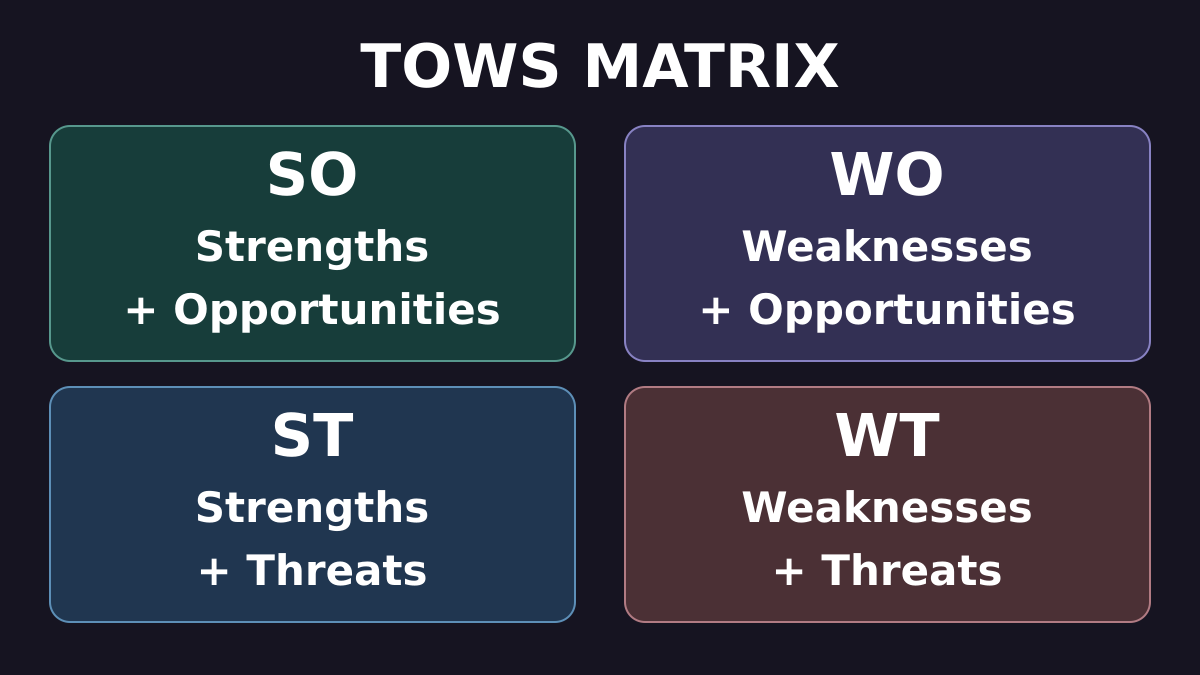
Original explanatory diagram based on the TOWS model by Heinz Weihrich (1982). The four combinations are alternatives, not chronological stages.
SO strategies use strengths to pursue opportunities
An SO option connects a demonstrated capability with a relevant opening in the market. A distributor with reliable local coverage might serve a nearby customer group using its existing delivery operation. The reasoning should identify what the strength contributes: a more dependable experience, lower delivery cost, faster access or another advantage that matters to the intended buyer.
Check whether the capability has spare capacity. A good team that is already fully occupied cannot support expansion simply because its name appears in the strengths column. Specify which segment will receive attention and what activity will be postponed. Otherwise, several attractive opportunities can compete for the same people and weaken the service that made expansion plausible.
ST strategies use strengths to respond to threats
An ST option connects a capability with a specific external risk. If a lower-priced competitor enters, a business might use its dependable delivery and support to retain customers whose operations are disrupted by delays. That choice depends on evidence that reliability matters to those customers and that the business can consistently provide it.
A defensive strategy can require active investment. It may involve redesigning the offer, improving the customer relationship or making service commitments clearer. The team should explain how the investment reduces the threat's effect. “Protect the brand” is too broad to guide resource allocation unless it names the vulnerable segment and the value being protected.
WO strategies address weaknesses to pursue opportunities
A WO option starts with an attractive opportunity that an internal gap prevents the business from serving. Customers may want to reorder online while the company still relies on repeated phone calls. Possible responses include simplifying the current process, buying an existing tool, building a capability internally or working with a suitable partner.
Compare those routes before treating technology procurement as the strategy. A temporary opportunity may not justify a permanent team. A partnership may solve a capability gap while creating dependence on a provider. The decision should reflect the opportunity's likely duration, the cost of learning and the practical options available if the arrangement fails.
WT strategies reduce weakness and exposure together
A WT option addresses a vulnerability made more dangerous by an external threat. Consider a company with inconsistent order handling facing aggressive price competition. It could narrow its offer to products it can fulfill reliably and profitably while repairing the process. That reduces the chance of attracting unprofitable demand that overwhelms the operation.
The pairing must identify both the weakness and the threat. General efficiency work does not automatically belong in this category. A WT option may include postponing expansion, reducing commitments or leaving an unattractive activity. Such choices deserve the same attention as growth proposals when an unresolved vulnerability could undermine the whole plan.
Prepare evidence before generating initiatives
Define the decision's scope first. Are you planning for one clinic, one service, a customer segment or the whole organization? Set a useful time horizon as well. Improving an existing booking journey over the next quarter involves different capabilities from entering another city. Mixing these decisions produces a long matrix with little practical focus.
Replace broad statements with bounded observations. Instead of “strong brand,” record the evidence available, such as recent customer interviews identifying recommendations as a reason for choosing the business. Instead of “growing market,” name the segment, need, source and period. When evidence is missing, label the factor as an assumption and record how it could be checked.
Keep external conditions separate from proposed actions. “Launch an app” is an initiative. “Customers want to complete repeat orders without calling” could be an opportunity if supported by research. Rising advertising costs are external; poor conversion on an owned booking page is internal. That distinction helps the team investigate the right cause before increasing its budget.
Choose a short list of influential factors and label them S1, W1, O1 and T1. Attach the source, update date and confidence level to each. Additional observations can remain in supporting notes. A focused list makes it easier to challenge the important relationships rather than fill every cell with variations of the same idea.
Build options that lead to a decision
Write the strategic question in a sentence: how can we increase suitable bookings for a particular service while protecting available capacity? Involve marketing, operations, finance and customer service in reviewing the inputs. Ask each function to challenge assumptions that affect its work. An early disagreement about capacity is more useful than a late discovery after the campaign launches.
Next, pair factors that have a plausible relationship. There is no requirement to combine every strength with every opportunity. Explain the relationship in ordinary language: we will use this capability to serve this customer need through this specific change. If the causal link remains unclear, turn it into a research question rather than forcing an initiative into the matrix.
Develop alternatives for important pairings. A booking problem might be addressed by removing unnecessary fields, changing reception responsibilities or introducing a new tool. Compare the cause each alternative addresses and the dependencies it creates. This prevents a TOWS workshop from becoming a formal justification for the first solution somebody wanted to buy.
For selected options, create a brief decision record containing the factor references, target segment, proposed change, accountable owner, estimated resources, main assumption, success measure and stopping condition. This record is an execution aid suggested here, rather than a required component of the original model. Its purpose is to make the transition from analysis to action explicit.
A hypothetical healthcare example
Imagine an outpatient clinic in a Gulf city trying to make better use of available appointments. Every detail and number in this example is hypothetical, provided for learning rather than as a client result or market benchmark. The decisions concern access, information and administration. Clinical professionals remain responsible for medical suitability and care; marketing targets should never determine whether someone needs a service.
The clinic identifies two strengths. S1 is available evening capacity supported by reception staff. S2 is clear, professionally reviewed information about services and provider qualifications. Its weaknesses are W1, too many steps between an inquiry and appointment confirmation, and W2, inconsistent recording of booking sources. Some records attribute the same customer journey to both an advertisement and a telephone call.
Its hypothetical opportunities are O1, interviews suggesting that some working adults value appointments after work, and O2, an available booking solution that can be piloted without replacing the entire operating system. Threat T1 is competitors offering clearer information and easier booking. T2 is volatility in the cost of reaching people through a major advertising channel.
SO option for the clinic
Pair S1 with O1 and develop a clear route to available evening appointments for services with genuine capacity. Present opening times accurately and test information about convenient access with people who have expressed that scheduling need. The offer should avoid promised treatment outcomes or an assumption that everyone in the segment needs an appointment.
Operations owns the capacity decision; marketing owns the communication test. Campaign channels come after the strategic choice to serve a timing need the clinic can fulfill. Increasing promotion should depend on appointment availability and a functioning booking process. If reception cannot handle additional inquiries, the team must address that constraint before expanding reach.
ST option for the clinic
Pair S2 with T1 and improve service pages so visitors can understand the administrative process before contacting the clinic. Explain how booking works, which practical information they need and what happens after confirmation. Relevant professionals review the content, and comparisons avoid unsupported claims of superiority.
The test can examine repeated administrative questions, the ability to find essential information and progression from suitable inquiries to confirmed bookings. Higher booking volume alone says nothing about clinical quality. If the page change produces little improvement, investigate other explanations, including availability, price and whether the service fits the person's needs.
WO option for the clinic
Pair W1 with O2 and pilot a simpler booking journey in a limited service area. Map the current steps first so the team knows where people encounter difficulty. Then test a change that can be evaluated without disrupting the whole system. Compare similar periods while checking differences in channel mix, weekdays and available appointments.
Before implementation, have appropriate specialists review the information collected, access controls and applicable privacy requirements. Keep advertising tools separate from patient details. The operational question is whether people can complete an appropriate booking reliably; collecting more sensitive information for targeting is not necessary to answer it. This is a planning safeguard, not jurisdiction-specific compliance advice.
WT option for the clinic
Pair W2 with T2 and limit expansion of spending on the volatile channel until booking measurement becomes more dependable. Agree on the meaning of a confirmed booking, remove duplicates and record sources when known. Retain an explicit unknown category rather than assigning uncertain bookings to whichever campaign needs better results.
The clinic can maintain a limited campaign under a defined spending ceiling while acknowledging uncertainty about its return. It can also investigate measurable improvements to owned access routes. The constraint is reviewable: if reliable evidence later supports profitable acquisition and operations can cope, the team can reconsider the spending limit.
Prioritize options without mistaking scores for evidence
Start with essential conditions: a suitable customer experience, operational feasibility, adequate capacity, required reviews and available funding. An option that fails an essential condition should not win because it scores highly for potential revenue. Clarify which problems need resolution before the option can even enter the comparison.
A simple scoring exercise can help a team compare expected impact, confidence in the evidence and ease of implementation. Use a consistent direction so higher always means more favorable. Explain each rating and discuss major disagreements. This is a practical prioritization method suggested for the workshop, not a validated scoring formula provided by TOWS.
In the clinic example, simplifying booking might precede the evening campaign because it improves the journey for existing demand. Cleaning up measurement can proceed alongside that work and support later spending decisions. Dependencies matter: an initiative with a slightly lower score may need to happen first because another cannot succeed without it.
If small changes in assumptions reverse the ranking, gather more evidence or run a limited test before making a large commitment. Record opportunity cost as well. Staff hours used here cannot support another project. A realistic plan states what begins now, what waits and what evidence would bring a deferred option back into consideration.
Measure the hypothesis behind the strategy
Suppose, purely for illustration, that the clinic receives 100 suitable inquiries and confirms 20 bookings in a week. The conversion rate under that definition is 20 percent. If a later period generates 150 inquiries and 30 confirmed bookings, volume has increased but conversion remains 20 percent. The higher count does not establish that a booking change improved conversion.
If the clinic instead confirms 25 bookings from 100 inquiries, the observed rate becomes 25 percent. That is a descriptive improvement of five percentage points, but it does not establish that the change caused it. Review channel mix, seasonality, capacity and simultaneous changes. Use an appropriate comparison design when feasible without compromising access or suitability.
Choose one main measure for each initiative and supporting measures that protect the experience. A booking test could track completion from suitable inquiries alongside errors, cancellations and confirmation time. A measurement initiative could track duplicate records and the share with unknown sources. Define the denominator, time window and counting rules before reporting progress.
Agree in advance what evidence supports expansion, revision or stopping. Thresholds should reflect costs, risk, capacity and the starting position; there is no universal target. Give the test enough time to generate useful information. When data are limited, report the result as inconclusive and explain what remains unknown instead of forcing an early success label.
A hypothetical supplier example outside healthcare
Consider a business selling operating supplies to cafés and restaurants. Its strength S1 is accurate, dependable delivery within a small service area. Weakness W1 is an informal repeat-order process that requires customers to reconstruct their orders. Opportunity O1 is demand for regular replenishment. Threat T1 is a competitor using a broad catalog and price promotions. These are fictional teaching assumptions that require verification in a real business.
The SO option is scheduled replenishment for frequently purchased items within the existing delivery area. Reliable fulfillment supports a recurring operational need. The ST option is a clearly defined service promise around delivery timing and agreed substitutes for unavailable items. This targets customers who value continuity, provided the supplier can meet the promise economically.
The WO option is a simple repeat-order process using an approved item list and clear confirmation. It addresses friction that prevents the business from serving recurring demand effectively. The WT option is narrowing offers that combine weak margins with difficult fulfillment while the order process is improved, reducing exposure to price pressure and avoidable handling costs.
Pilot the repeat-order offer with willing customers. Track reorder behavior, contribution after picking and delivery costs, delivery reliability and order errors. Revenue growth can conceal declining economics when extra deliveries consume the margin. If the pilot works locally, assess a new area separately because longer routes may require a different service design and cost structure.
Run a workshop that ends with accountable choices
Share factors and supporting evidence before the meeting, inviting participants to identify uncertainties. Separate reviewing inputs from generating alternatives. When somebody jumps straight to a campaign, ask which pairing supports it. Preserve disagreements in the record rather than smoothing them into language broad enough for everyone to accept without making a choice.
For each serious option, ask what is most likely to make it fail and how that assumption could be tested responsibly. A segment may value something different, a capability may be unreliable or the economics may deteriorate at higher volume. Give each important information gap an owner and a decision date that fits the planned commitment.
Close with a short record of chosen and rejected options, reasons, responsibilities and the next review. Keep a dated version of the assumptions. At the review, discuss what was learned about customers and execution before interpreting the dashboard. That makes it possible to distinguish a poor strategy from a sound idea implemented under different conditions.
Common mistakes and practical limits
Avoid writing desired outcomes such as “increase sales” inside the cells without specifying the choices that could produce them. Similarly, a platform or campaign format does not explain the target customer, value proposition or reason the business can compete. The matrix should expose the reasoning behind a decision so colleagues can question and improve it.
Resist launching every credible option. Assign an accountable owner and select a limited, coherent set that fits available resources. Revisit the matrix when a material assumption changes, such as losing a capability or encountering a different competitor. TOWS is a time-bound judgment aid; customer research, financial analysis and experiments remain necessary to test its conclusions.
A final checklist before committing resources
- Is the decision, target segment and planning horizon clear?
- Are internal capabilities separate from external conditions?
- Does every factor have evidence or an explicit assumption label?
- Can each initiative be traced to meaningful factor pairings?
- Have alternative ways of addressing the problem been compared?
- Are capacity, cost, dependencies and risks understood?
- Is it clear what the team will postpone?
- Does each initiative have an owner and defined measures?
- What evidence would change the decision at the next review?
The value of TOWS becomes visible when a team can follow the path from evidence to a strategic choice and then to a measurable test. Begin with a small set of meaningful relationships, choose initiatives the organization can support and keep the assumptions open to challenge. The resulting plan can evolve as the team learns rather than simply repeat last quarter's activities.
Comments
No published comments yet.