The verified development
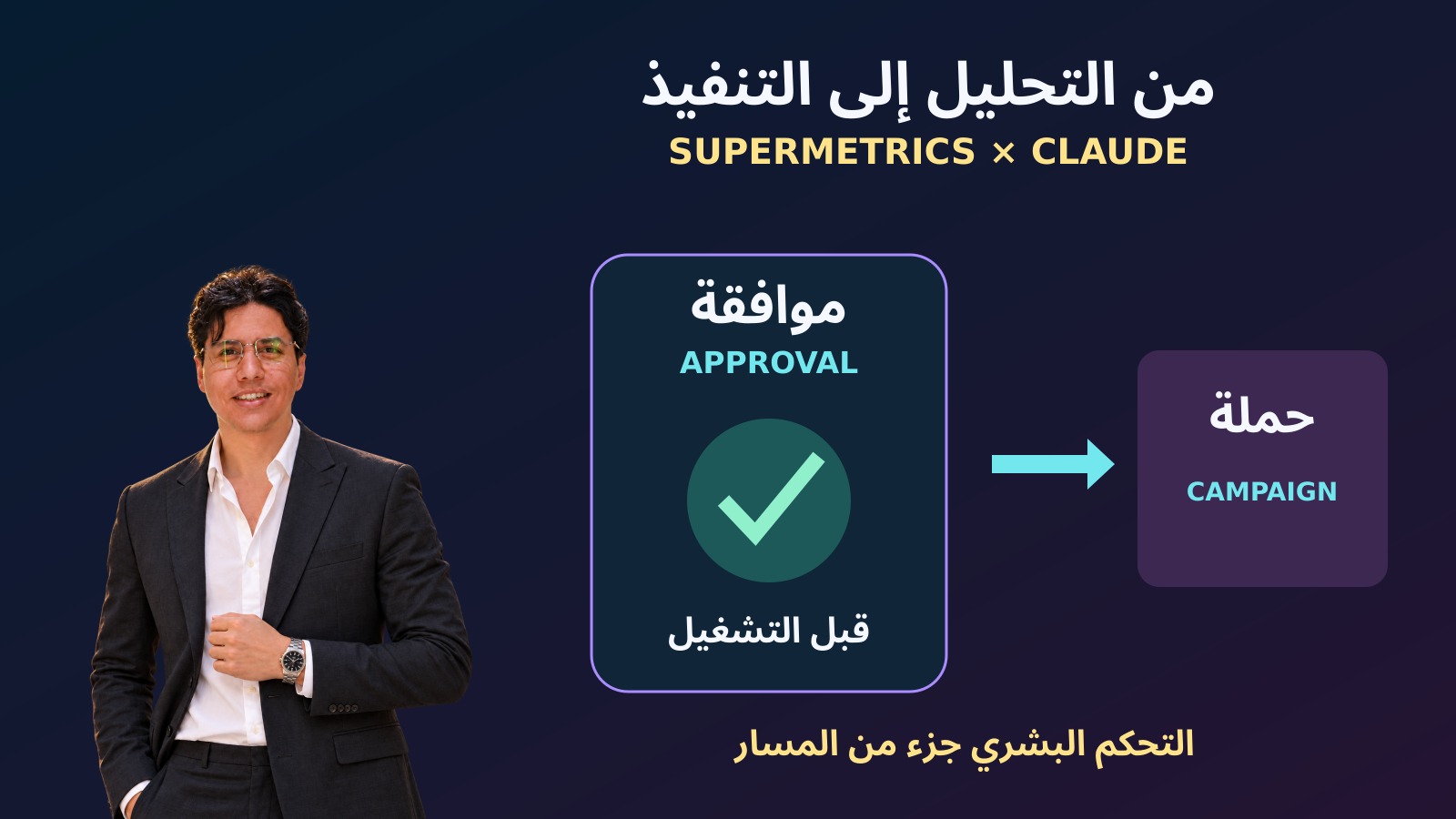
On November 3, 2026, Supermetrics announced campaign creation and editing through Claude across six advertising platforms. New campaigns remain paused pending review, and approval requirements can vary by account. These are the vendor's stated capabilities, not independently verified performance results. Read the company announcement.
Analysis: the decision changes before the interface does
The practical question for a marketing director is what happens between a recommendation and a live change. A conversational interface can make that journey shorter. It can also compress the time in which a person would normally notice an incorrect account, a weak assumption or an inappropriate message. Evaluating the product therefore requires more than asking whether its answers sound intelligent. A team needs to know how an action is defined, who can approve it, what evidence accompanies it and how the previous state can be recovered. The following framework is independent implementation analysis, rather than a claim about features guaranteed by the announcement.
A useful starting point is to separate three jobs: understanding a result, proposing an intervention and authorizing execution. They may happen in the same conversation, but they should remain distinct decisions. An analyst can identify that lead costs rose without having permission to change spending. A campaign specialist can propose an audience adjustment without approving a new medical claim. A budget owner can approve a spending limit without reviewing every creative detail. Keeping those distinctions visible makes the workflow accountable even when the interface presents everything as a simple request.
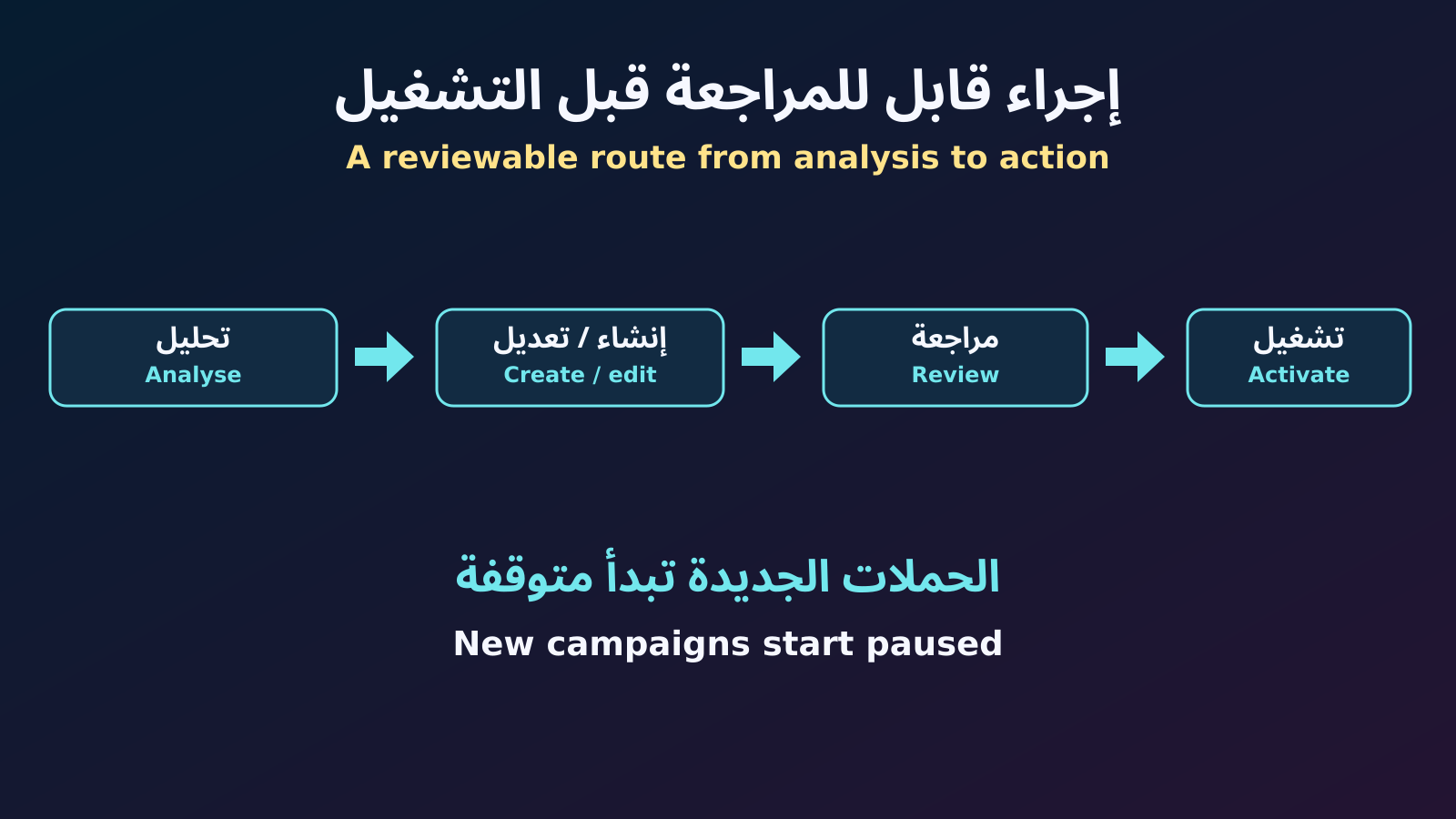
Original editorial illustration, not a product screenshot or evidence of campaign outcomes. Based on the source.
Begin with a decision contract
Before connecting an action-capable assistant, write a one-page contract for the chosen workflow. Specify the account, campaign objective, permitted changes, protected settings and approval owner. Include an explicit instruction about what should happen when required information is absent. A reasonable default is to return a question or an incomplete proposal, rather than infer a price, service availability or budget. This contract is a management document. Its existence does not prove that every software control enforces it, so the implementation team must test the corresponding behavior in the actual environment.
For example, a clinic group might allow an assistant to prepare alternative text for an existing campaign while prohibiting changes to geographic coverage, pricing and health-related claims. The assistant's output would identify the source material supporting each proposed message and mark any unknowns. The medical or compliance reviewer would review the relevant content before a campaign manager considers publication. This example describes a possible governance arrangement, not an account of a real clinic or a statement that the integration provides clinical review. The organization remains responsible for deciding who is qualified to approve the material.
Repair measurement definitions before automating decisions
Consider a hypothetical campaign report in which an advertising platform records form submissions, while the sales system distinguishes genuine inquiries from duplicate requests and unreachable numbers. Optimizing against the first measure may make the dashboard look healthier without improving the business. An assistant that sees only platform data cannot resolve this difference by reasoning more confidently. The team must define its lead stages, reconcile identifiers where permitted and explain the reporting delay. It should also record whether the relevant numbers are gross events, unique people, accepted opportunities or completed transactions.
The same discipline applies to dates and currencies. A daily report may combine an account configured in one time zone with a booking system using another. A campaign's apparent decline could reflect an incomplete reporting day. Currency conversion can introduce another source of noise. Create a compact metric dictionary covering calculation, source, refresh time and known exclusions. Ask the assistant to display those definitions with any consequential proposal. If two systems disagree, the output should show the disagreement and its possible causes instead of silently choosing whichever number makes the recommendation appear strongest.
Use proposals that people can inspect
An actionable proposal should be readable without reopening the entire conversation. It should state what will change, what will remain unchanged, the expected mechanism, the evidence and the main uncertainty. For an audience change, that means naming the audience and explaining why the evidence supports testing it. For a creative change, it means showing the existing and proposed wording. For spending, it means showing the current amount, proposed amount, currency and applicable period. A general instruction such as “improve efficiency” is too vague to function as an approval record.
Require the proposal to explain alternative interpretations. If performance weakened after a landing-page revision, increasing bids might not address the cause. If appointment availability is constrained, generating more inquiries can increase frustration rather than revenue. Ask whether a tracking change, operational bottleneck or delayed conversion could explain the same pattern. This does not require an exhaustive investigation every time. It requires enough skepticism to avoid turning the easiest editable setting into the automatic answer to every problem. A good proposal should sometimes conclude that no campaign change is justified yet.
Design a small, reversible first test
The first deployment should answer a narrow operational question. One option is to ask whether the new workflow reduces the time required to prepare an approved campaign change without increasing review errors. Choose a low-complexity account with stable measurement, clear ownership and a reversible change. Avoid launching across a large portfolio simply because the connection works. Record the baseline process, including time spent checking data, preparing a proposal, reviewing it and implementing the approved change. Compare equivalent tasks rather than a difficult historical task with an unusually simple new one.
An illustrative test could prepare two landing-page message variants for one service, while holding the approved offer, geography and spending constant. The variants should differ in a meaningful way, such as explaining the service process versus clarifying eligibility. Define the review criteria before generating them. Confirm that both reflect current services and have an appropriate destination. If the assistant produces an unsupported promise, treat it as a process failure even if the text is persuasive. The aim is to demonstrate reliable preparation and review, not to celebrate the number of drafts produced.
Separate workflow success from advertising success
Two scorecards are needed. The workflow scorecard tracks preparation time, corrections, approval clarity, unexpected changes and recovery effort. The business scorecard tracks the outcome appropriate to the campaign, such as accepted opportunities or completed bookings, alongside cost and quality. An improvement in the first scorecard does not automatically establish an improvement in the second. A faster process can be valuable even when campaign performance is unchanged, but that value should be described accurately. Conversely, a short-term improvement in campaign results should not excuse a workflow that repeatedly applies changes outside its scope.
Define the evaluation window in advance and account for the normal delay between an inquiry and its outcome. Avoid stopping an experiment as soon as a favorable number appears. Where the sample is small, report the uncertainty and preserve the result as an early signal rather than a firm conclusion. If a team cannot run a clean comparison, it can still document operational observations, but it should not label them causal proof. The distinction protects decision quality and prevents a successful demonstration from becoming an exaggerated business case.
Permissions require their own review
Access should match the task rather than the assistant's potential capabilities. Inventory which accounts can be read, which can be edited and who can approve publication or spending. Verify how access is removed when an employee changes role or a client relationship ends. Keep credentials out of prompts and documents. Do not assume that a conversation-level instruction replaces platform permissions. The organization's technical team should confirm what enforcement exists, what remains procedural and where audit records are stored. These are questions to investigate, not assertions about the vendor's specific implementation.
Healthcare teams should apply an additional data-minimization check. A marketing optimization task usually does not require a patient's clinical notes or a detailed description of an individual's condition. Use aggregated reporting and approved business information wherever possible. Before transmitting personal information to any connected service, establish the appropriate permissions, purpose and contractual safeguards. Obtain jurisdiction-specific legal and privacy advice where needed. The presence of an AI feature does not remove existing duties, and the convenience of a connector is not evidence that every dataset is suitable for that connector.
Plan the failure path before the launch path
Every approved change should have a defined recovery owner. Record the previous settings, the implementation time and the conditions that would trigger review or reversal. A failed deployment, an unexpected budget movement or a broken destination needs a practical response, not another ambiguous request to “fix performance.” Reversal may itself carry consequences, particularly if a platform has already started delivery or learning. Test the recovery procedure with a harmless change before relying on it during an incident. Also decide who communicates with stakeholders and how the incident will be documented.
The strategic takeaway is to evaluate conversational campaign management as an operating process. Start with trustworthy definitions, narrow permissions and inspectable proposals. Expand only after the team can demonstrate that decisions remain understandable and controlled. The most useful assistant is not the one that changes the most settings. It is the one that helps the organization make appropriate changes with less avoidable effort, while leaving a clear account of what was decided and why. Product announcements can identify a new possibility; disciplined testing determines whether that possibility deserves a place in the team's daily work.
Source and editorial boundary
Supermetrics company announcement, November 3, 2026. The opening section reports the announcement. The implementation examples, governance framework and evaluation criteria above are original analysis. They are not vendor performance claims, legal advice or evidence of a real client's results.
Comments
No published comments yet.