Original announcement date: November 5, 2026. This article analyzes an announcement, not a general release or an independent product test.
What was actually announced?
SeenThis announced limited early access to Studio MCP, connecting compatible AI tools with its video-ad production platform. The company describes editable creative, review, and delivery of approved ads through Studio to destinations including DV360, Meta and TikTok. Its claim of more than 90% shorter production time comes from early tests reported by the vendor, not an independent benchmark or a guaranteed outcome. Original SeenThis announcement.
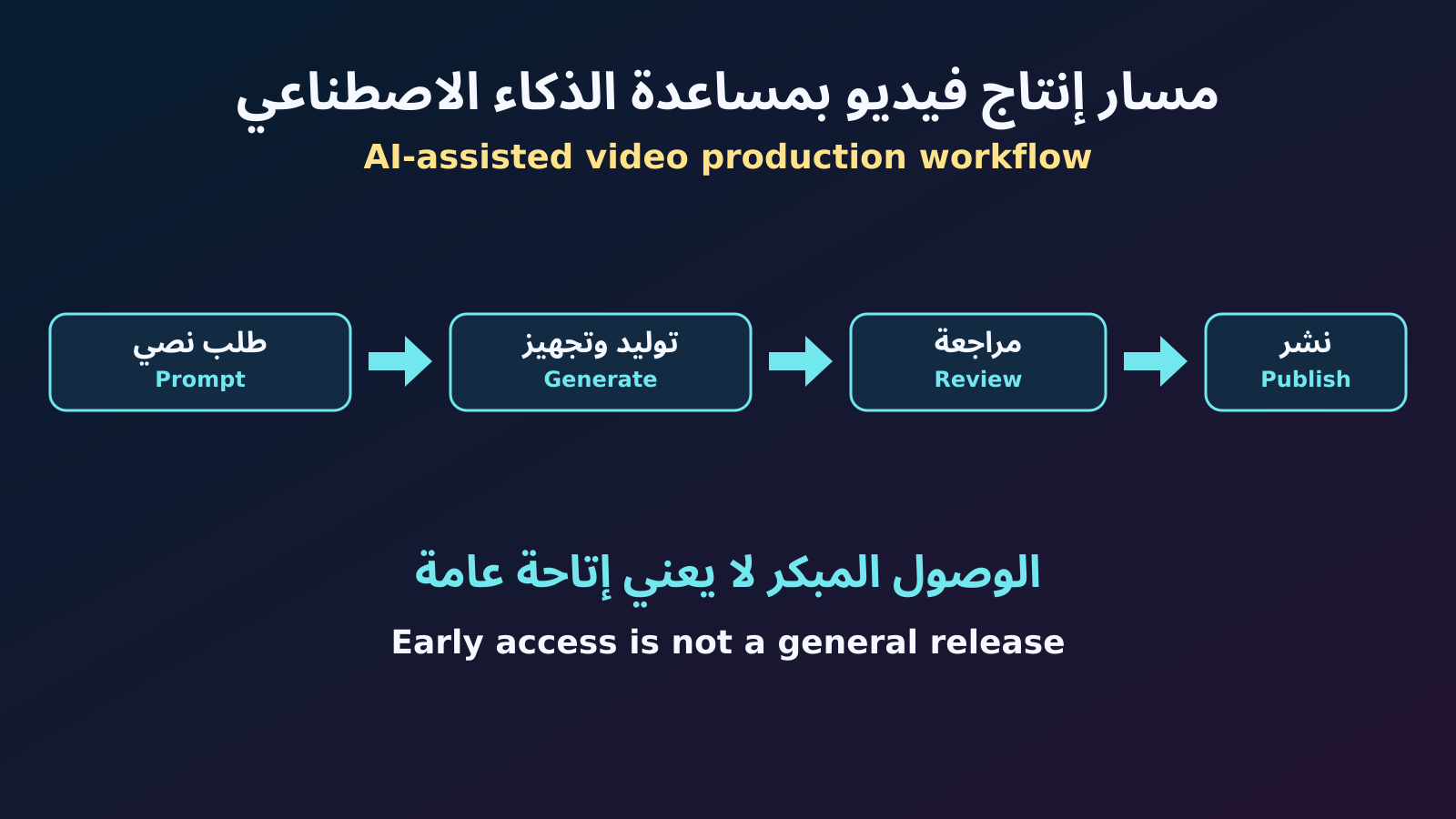
Original editorial illustration, not a product screenshot or evidence of campaign outcomes. Based on the source.
Analysis: where could the workflow change?
The potential value sits between an idea and a reviewable asset. Teams can often write a concept quickly, then lose time adapting it to different formats, languages and placements. If that work becomes easier, creative leaders can spend more time examining the proposition and less time coordinating repetitive production changes.
However, producing more video does not supply a strategy. A team still needs to know its audience, the objection it wants to address and the action it wants viewers to take. A production tool can multiply a weak idea as efficiently as a strong one. Useful implementation therefore begins with a specific brief: audience, service, permitted offer, evidence, brand voice and prohibited claims.
Responsibilities also need to remain visible. Who reviews the copy? Who approves a final version? Who checks the landing page and tracking? Who authorizes spending? A technical connection between systems does not automatically combine those responsibilities into one safe decision.
A practical pilot for an agency or marketing team
Start with a small campaign using assets that already have approval. Choose one proposition and develop three genuinely different creative angles, rather than ten cosmetic variations. Keep the audience, offer and destination reasonably stable so that changes in results remain interpretable.
Record human time across the whole workflow: briefing, production, review, corrections and release preparation. Compare it with a similar job completed through the existing process. File-generation time alone is an incomplete measure; an asset that arrives quickly but requires repeated correction can still be expensive.
Maintain separate production and campaign scorecards. Production measures could include time to an approved asset, revision rounds and format or localization errors. Campaign measures should follow the business objective, such as qualified enquiries or completed bookings. A lower production cost does not establish a lower customer acquisition cost. More clicks do not necessarily indicate better prospective customers.
Agree on the comparison before launching. Otherwise, a team may be tempted to declare success using whichever metric happened to improve. A useful pilot should also record failures and the amount of specialist assistance required, not just the fastest example.
A healthcare-marketing example with privacy boundaries
Consider a hypothetical medical center promoting evening appointments. The team could produce variations explaining the location, opening hours and booking process, after verifying each detail. This experiment does not require patient records or private conversations to be supplied to a creative tool.
A qualified reviewer should check medical claims and treatment comparisons. Faster production must not transform a cautious explanation into a promise of clinical results. Asset rights matter too: verify permission for photography, music and voice, preserve meaning across languages, and check that text remains legible on a phone.
The same discipline applies to operational facts. A beautifully produced campaign for appointments that are unavailable creates avoidable frustration. The booking team should confirm actual capacity before the creative is approved, and there should be a clear owner for pausing outdated versions.
Questions to answer before expansion
A procurement review should examine connection permissions, version history, access revocation, data destinations and total cost. These are evaluation questions, not claims that the product lacks those capabilities. Teams should establish which actions require human approval and test those boundaries in a controlled setting.
Expansion makes sense when a pilot demonstrates less production and review effort while maintaining message quality and reliable publishing. The vendor's speed claim can motivate an experiment, but it should not become an assumed result in a business case.
Build a brief that another person can verify
Before connecting an assistant to a production system, prepare a short brief that a colleague can review without guessing what the business intends. “Make a compelling ad” leaves too many decisions unresolved. A useful brief identifies the service, the audience problem, the evidence available and the destination viewers will reach when they respond.
Attach a list of approved materials: the correct logo, colors, licensed imagery and service naming. An old brand folder may contain expired prices or assets whose permissions have changed. Give the brief a review date and name the person who can resolve questions. This prevents a supposedly faster workflow from stalling in an undefined approval chain.
Separate fixed facts from creative choices. The business name and restrictions on medical claims should remain controlled, while opening lines, visual sequencing and calls to action may be tested. That separation creates room for useful experimentation without allowing production software to invent a commercial offer or change an essential fact.
Create variations that answer different questions
When versions become easier to generate, volume can become an end in itself. Instead, write a hypothesis for each creative group. Does the audience hesitate because it cannot find the location, does not understand the service or does not know how to start booking? Those questions require different information. Changing a background color is unlikely to resolve all three.
For the hypothetical medical-center campaign, one version could explain booking steps, another could clarify access to the branch, and a third could explain general administrative preparation for an appointment. Avoid personalized treatment instructions in advertising. Define the useful outcome for each concept, such as fewer repeated questions, more booking starts or more completed requests.
Keep the comparison fair. If offer, audience, spending and campaign duration all change, the team will struggle to explain the outcome. Small samples also deserve caution. An early difference may justify more testing rather than a definitive winner. Sometimes the appropriate next action is to fix a landing-page problem before judging the creative idea.
Review in four separate stages
Start with meaning. Does the advertisement accurately describe the service? Can its claims be substantiated? Can a viewer understand the intended action? Review these issues before polishing animation, because attractive typography cannot repair an inaccurate proposition.
Next, review presentation and language. Watch the asset on a phone at its normal size. Check Arabic direction, place names, spacing, reading time and agreement between narration and on-screen text. Consider whether viewers can understand the message without sound where that matters to the placement. Localization should preserve meaning, rather than merely fit translated words into the available space.
The third stage is technical. Open the destination, try the contact form and check the intended tracking configuration. Confirm that the landing page presents the same offer and that each placement receives the appropriate approved version. These are proposed quality checks, not a verified list of capabilities in the announced product.
Finally, check commercial and operating readiness. Is the offer still valid? Is the service available? Can the response team handle enquiries? Define who may change spending and by how much. Approval of a video file should not silently become permission to increase a campaign budget.
Treat permissions as part of delivery quality
A connection to another system may enable different kinds of action. Understand the scope before adding it to a client account. Start with the access needed for the task, establish which account actions are attributed to, and know how access can be removed when a person leaves or a contract ends. Credentials do not belong in creative briefs or shared production chats.
Ask where client data travels, how it is retained and which parties are responsible for protecting it. A public logo and a private customer list create very different obligations. A first test may be possible with synthetic data and approved public assets. This reduces exposure during learning without making assumptions about any particular supplier's security practices.
Keep a simple record linking each approved version with its approval date and publishing destinations. If an error emerges, the team can identify affected placements rather than search through disconnected files. Speed becomes more valuable when it is paired with an orderly way to stop or replace incorrect material.
Calculate value without overstating savings
Include training, review, subscriptions, integration and correction work in the cost assessment. Separate elapsed turnaround time from human working hours. A system may return an asset sooner because it operates overnight, even if staff effort falls by a smaller amount. Both benefits can matter, but they are different entries in the business case.
Likewise, a saved hour is not automatically a realized cash saving. Additional capacity may improve quality or support more campaigns without reducing direct spending. Describe the observed benefit accurately: higher throughput, faster delivery or less rework. Then decide whether expansion is justified by evidence from the team's own process.
Prepare a fallback before a time-sensitive launch
Before depending on a new production connection, decide how work will continue if access fails, approval is delayed or a particular requirement cannot be completed. Keep the brief, original assets and required-version list somewhere the team can reach without depending on one conversation. This is continuity planning, not a claim of a known defect in SeenThis or another connected tool.
Establish who holds the approved asset and whether a conventional workflow can make urgent corrections. Otherwise, a small change to a date or address could create a disproportionate delay. Test replacement on a non-live asset before relying on the process for a campaign with external commitments.
After the pilot, collect feedback from everyone who handled the output. A designer may save time while a reviewer struggles to trace version differences. A campaign manager may find that filenames make the correct asset difficult to identify. An overall production-speed figure can miss these practical costs.
Translate findings into a few simple rules: consistent naming, a clearly identified final version and an owner for retiring outdated assets. Keep procedures only when they prevent a recognizable error or save useful effort. Adoption then becomes a measured operating decision rather than an assumed transformation on the first day.
Source
The practical sections are editorial analysis and proposed testing methods, not results from a test performed by the author or commitments made by the vendor.
Comments
No published comments yet.