The announcement, and its boundaries
In its November 6, 2026 announcement, Stensul described early access to Self-Improving Email: connecting previous campaign performance with variant creation and subsequent learning while retaining human approval. The announcement separately described its Marketing Cloud Next integration as generally available. These are different availability statements, not evidence that the entire offering is generally available. Read the company announcement.
Analysis: a learning loop needs a defensible objective
The strategic question is not whether software can produce another email. It is whether the organization can identify a better decision and explain why it was better. The analysis below is an independent operating framework, not a description of capabilities tested in Stensul or a forecast of results. It applies to any team considering performance-informed email production.
Start with the decision that the email should support. A renewal reminder, a product introduction and an onboarding explanation have different jobs. A system rewarded for immediate clicks can favor an attention-grabbing message over an explanation that prevents unnecessary support requests. Neither outcome is inherently wrong; the mistake is treating the easiest measurement as the business objective.
Write one primary objective before generating variants. Name the audience, desired action, measurement window and conditions that would invalidate the comparison. This short brief becomes the reference against which both creative suggestions and later results are judged.
Historical performance is evidence, not instruction
Campaign history contains valuable context, but it also contains mistakes and changing circumstances. An apparently successful promotion may have benefited from a stock shortage at a competitor, unusually generous terms or a highly engaged audience. Feeding its performance into future production does not isolate the contribution of the copy or design.
Create a campaign evidence sheet that records the offer, eligible audience, actual recipients, timing, channel mix and relevant operational changes. Flag records where tracking broke or eligibility rules changed. Do not silently combine a welcome series with a discount campaign just because both are emails. Similar metrics can describe fundamentally different customer decisions.
Keep unsuccessful campaigns in the review set when the data is usable. A library containing only winners teaches a distorted history. More importantly, preserve uncertainty: a small difference from a small audience should not acquire authority merely because it has been stored in a dashboard.
Build a measurement contract before a content pipeline
A measurement contract states what counts, where it is counted and who resolves disagreements. For a purchase-oriented campaign, define whether the outcome is an order placed, an order paid or a purchase retained after cancellations. For an informational campaign, distinguish an opened page from completion of a useful task. The right definition depends on the program, not on a universal email benchmark.
Select guardrails alongside the primary outcome. Unsubscribes, complaints, support contacts, delivery problems and fulfillment costs may reveal that a short-term gain came with an unacceptable tradeoff. Avoid merging all these into a mysterious score that nobody can explain. A clear primary metric with explicit limits is often easier to govern.
Document known gaps. If offline purchases cannot be linked reliably, say so. If tracking changes during the experiment, pause interpretation rather than inventing continuity. Improving the content pipeline without stabilizing the measurement contract can simply make unreliable decisions happen faster.
Generate hypotheses, not a pile of variations
Useful experimentation begins with a reason a change might help. For example, a team may hypothesize that customers abandon a renewal because the next step is unclear. One variant could emphasize the action and another could explain the deadline. That is more informative than producing dozens of messages that simultaneously change the offer, tone, layout and destination.
Limit each experiment to a decision the team is prepared to act on. Record the hypothesis, the main change and the expected mechanism. Keep factual claims, commercial terms and mandatory disclosures stable unless they are specifically under authorized review. This helps reviewers identify what is genuinely being tested.
A variant is not automatically a new strategy. Small language changes can be useful, but they should not consume attention that belongs to a broken landing page or an irrelevant audience definition. The creative queue should include the option to fix the underlying journey instead of sending more persuasive messages into it.
Human approval must have an actual owner
Human approval is meaningful only when someone has the authority, information and time to reject a message. A generic approval button can conceal divided responsibility. Assign named roles for factual accuracy, brand suitability, accessibility and audience permission. Smaller teams may combine these roles, but should still preserve the distinct checks.
Review the rendered experience rather than copy alone. Examine the subject line, preview text, mobile layout, links, image alternatives and destination page. An approved sentence can become misleading when the accompanying image or button changes its apparent meaning. Offer expiry and customer eligibility also belong in the review.
Maintain a record of the version approved and the version actually sent. If a later change modifies the audience or terms, establish whether approval must reopen. The point is not to create ceremonial bureaucracy. It is to make responsibility traceable when an automated suggestion moves from an internal draft to a real customer interaction.
A practical architecture for the feedback loop
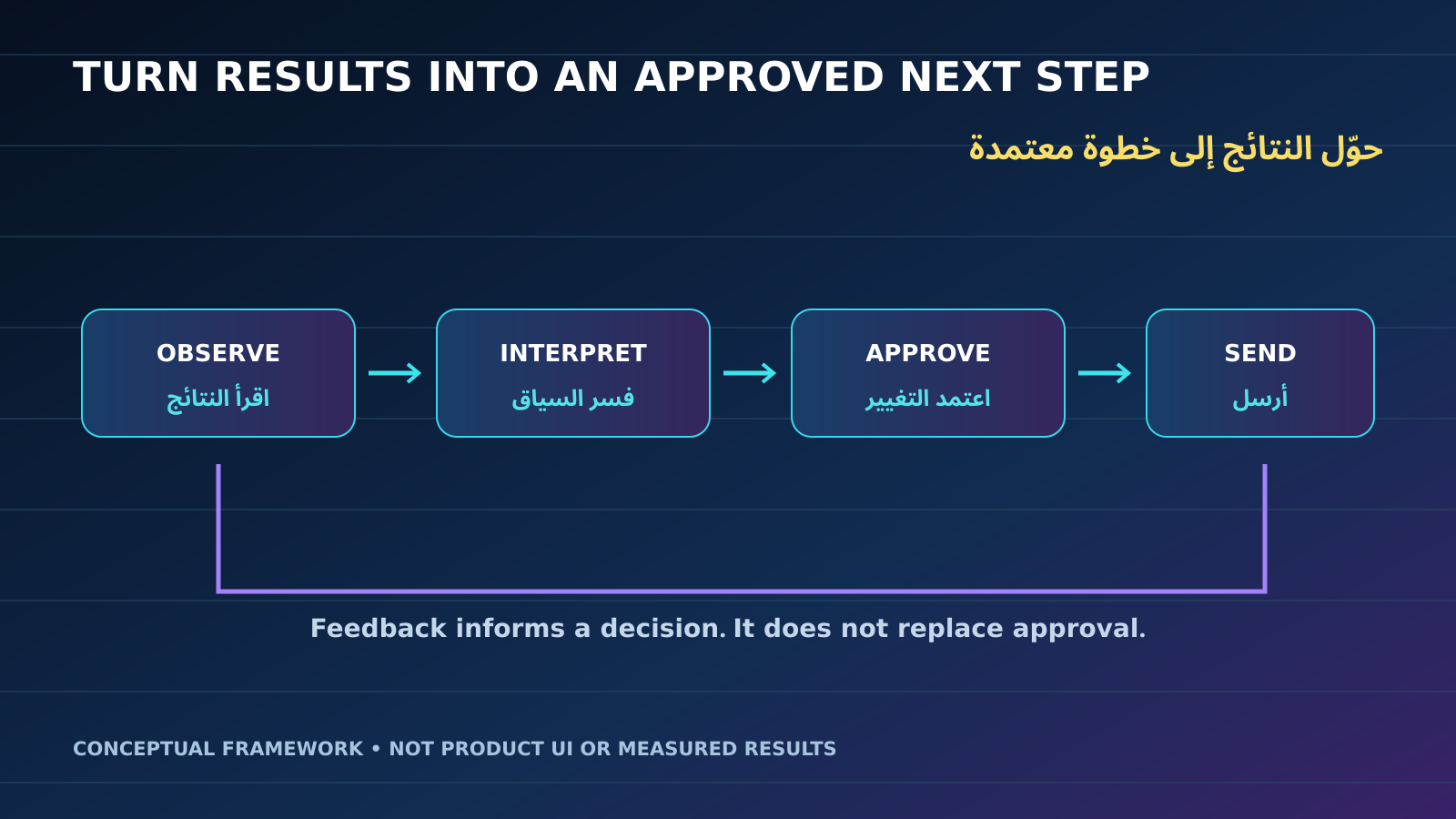
Original explanatory illustration of an editorial operating model, not a Stensul interface or verified product architecture. News context: [company announcement](https://www.businesswire.com/news/home/20261106001232/en/Stensul-Debuts-Self-Improving-Email-for-Enterprise-Marketers).
Separate the loop into five stages: evidence, hypothesis, production, approval and evaluation. Each stage should have an input, an accountable owner and a stopping condition. For example, incomplete permission records can stop audience selection before a designer spends time on variants. An inconsistent offer can stop approval before delivery.
Store enough context to reconstruct a decision without retaining unnecessary personal information. A campaign identifier, audience rule, content version, approval record and aggregate result may support many operational reviews. The precise data requirements depend on the organization and applicable obligations; more customer data is not automatically more useful evidence.
The feedback step should produce a decision note, not just a winner label. State what changed, what was observed, what remains uncertain and whether the finding is appropriate for reuse. This keeps a temporary result from becoming an undocumented permanent rule.
Design experiments that can survive inconvenient results
Use an eligible audience defined before assignment and compare groups that receive materially comparable treatment. Where appropriate, retain a holdout that receives the existing approach or no additional message. The comparison should answer the actual business question rather than merely rank two attractive alternatives.
Agree on the measurement window and stopping rules in advance. Repeatedly checking results and stopping whenever one variant looks favorable can produce misleading confidence. Teams without specialist analytical support should prefer a simple, well-documented experiment to elaborate optimization they cannot interpret.
Record what happens after the initial action. A purchase followed by cancellation is different from a retained purchase; an appointment request that creates confusion is different from a completed appropriate booking. If results are inconclusive, preserve that conclusion. “No defensible winner” is useful evidence, especially when it prevents an organization from standardizing a weak claim.
Hypothetical GCC and healthcare applications
Consider a hypothetical GCC retailer with Arabic and English customers. The useful experiment might concern whether delivery timing is explained clearly, not whether one language “performs better.” Compare alternatives within an appropriate language group, check right-to-left rendering and ensure the same commercial promise survives translation. Differences between markets, seasons or customer histories should not be casually attributed to language.
A hypothetical healthcare organization requires tighter boundaries. An administrative email might explain how to prepare for a booked visit or find practical service information. It should not turn inferred health concerns into aggressive promotional targeting. Clinical claims, patient permissions and sensitive information require appropriate professional and privacy review.
In both examples, local context is a design input rather than a decorative translation step. Ask whether the destination, support route and availability match what the email promises. These are illustrative scenarios, not reported customer deployments, experiments or outcomes associated with Stensul.
Before launch, rehearse one failure rather than assuming the normal path is sufficient. Ask what the team does if the audience file arrives late, a destination becomes unavailable or a factual correction arrives after approval. Establish who can stop delivery and who communicates the correction. These are proposed operational checks, not claims about any particular platform. A learning system should reduce avoidable mistakes without making the organization dependent on uninterrupted automation. Record the rehearsal outcome as a process observation, not as evidence that the campaign will produce a commercial lift.
Evaluate availability and integration as separate decisions
Early access and general availability answer different procurement questions. For an early-access feature, request the written participation terms, supported workflows, known limitations, data handling arrangements and exit process. Establish what happens if a feature changes or the pilot ends. Do not let enthusiasm for a demonstration substitute for an operational dependency review.
For an integration described as generally available, still verify compatibility with the specific environment, permissions, data flows and release process your organization uses. General availability is not a guarantee that every custom configuration is supported. Map the handoff between production and delivery, including failure handling and duplicate prevention.
A sensible pilot can be deliberately narrow: one established campaign, one accountable team and a reversible workflow. Define success as better decision quality and reliable execution as well as any commercial outcome. Expansion should follow evidence, not the number of variants generated. Performance-informed production becomes valuable when learning is trustworthy, approvals are substantive and customers receive clearer, more appropriate communication.
Comments
No published comments yet.