
News date: November 5, 2026. This analysis covers Almoosa Health's third quarter ended September 30, 2026, compared with the same quarter of 2025. All financial amounts below are millions of Saudi riyals. It is an independent business and healthcare-marketing analysis, not an investment recommendation or a claim of working with the company.
The reported figures
Almoosa disclosed revenue of 403.6 versus 356.4, operating profit of 64.6 versus 55.6, and a reported net loss of 31.8 versus net profit of 65.8. Non-cash derivative valuation moved from a 14.2 gain to an 81.9 loss. The company's non-IFRS adjusted profit, excluding derivatives, was 50.1 versus 51.6. Issuer announcement, accessible republication.
The company-issued release reports EBITDA of 91.4 versus 79.8 and patient-volume growth of 28.6%. It supplies neither an absolute patient count nor a definition distinguishing visits from unique people. These are company statements. Issuer release carried by Argaam.
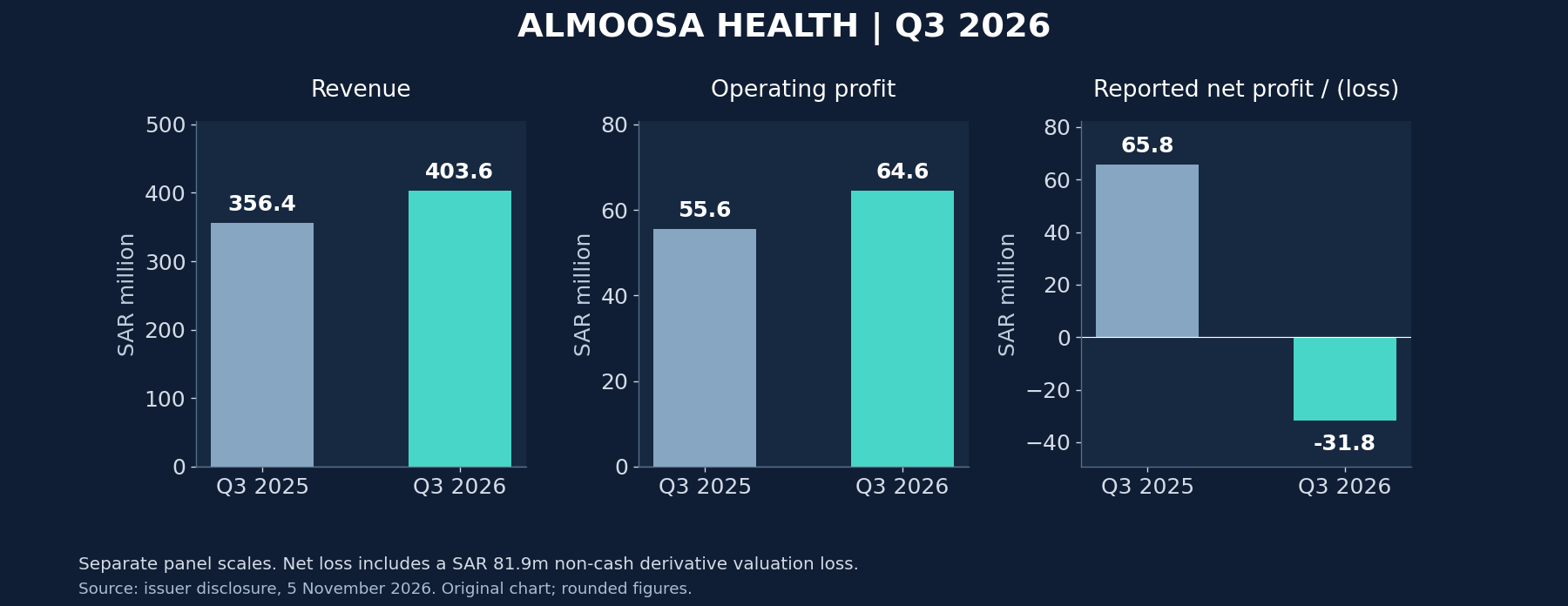
Original chart based on the disclosed Q3 comparison. Financial measures use separate scales. A negative result is shown below zero; no annual or nine-month figure is mixed into the quarterly comparison.
Analysis: start by separating the questions
The following interpretation and proposed actions are independent analysis. The disclosures do not demonstrate which campaign, specialty or facility produced the changes.
For a healthcare leadership team, a headline loss creates an understandable desire for a quick explanation. The useful response is to identify which decisions each measure can inform. Revenue helps describe recognized activity and its monetary value. Operating profit adds a view of the costs included in operations. Net profit incorporates further items. A fair-value movement on a financial instrument requires a different discussion from an empty appointment book.
That separation protects decision quality. A team should not cut a promising service campaign solely because an accounting valuation affected the consolidated result. It should also avoid using stronger operating figures to dismiss the reported loss. Finance must explain the valuation, exposures and cash implications using the full statements. Marketing must explain demand, booking quality, attendance and the economics of the services it supports.
Adjusted earnings can help isolate a stated item, but the adjustment is a management-defined lens. Keep the reported result visible beside it and preserve the calculation. Neither EBITDA nor an adjusted profit number should be presented as cash available for spending. A campaign budget still needs cash planning, collection expectations and a clear investment case.
Build a measurement chain the hospital can actually use
A practical growth review follows the patient journey without turning health information into advertising data. Start with a service and location, then distinguish an inquiry, an appropriate booking request, a confirmed appointment and an attended visit. Agree on definitions before combining data from the advertising platform, contact center and scheduling system.
An inquiry may concern an unavailable specialty, an insurance question or an emergency that should follow a clinical route. A form submission alone therefore cannot establish demand suitable for a campaign. Record only the operational categories needed for evaluation, restrict access, and keep diagnosis and treatment details out of advertising tools.
Next, compare attended appointments with staffed, bookable capacity. Use clinic sessions or available slots rather than an end-of-period room count. New locations and mature services should be reviewed separately. Otherwise, an expanding network can make a historical average difficult to interpret even when every reported total is accurate.
Finally, ask finance to connect the service view with collected revenue and relevant costs over an agreed period. This does not require attributing every hospital profit movement to marketing. It creates a smaller, testable question: did this intervention improve appropriate access and contribute to a financially sustainable service?
A hypothetical application: improve booking clarity before increasing spend
Consider an imaginary healthcare network introducing an outpatient service in a new location. This example is not a description of Almoosa's operations and contains no claimed business results.
Before expanding paid search, the team checks that the landing page states the correct location, consultation scope, booking channel and hours. Insurance information is reviewed by the responsible operational team. Clinical claims require medical review. The appointment request must not imply that eligibility, coverage or clinical suitability is already confirmed.
The team then tests a clearer booking page against the existing experience. The test changes one main feature, such as making location selection explicit. It keeps campaign targeting and service availability as stable as practical, records changes that could affect interpretation, and defines the decision rule before examining outcomes.
Its primary outcome could be attended appointments per eligible booking request after a sufficient follow-up window. Secondary measures could include unanswered inquiries, time to first response, booking abandonment and complaints about mismatched expectations. Advertising cost per inquiry remains useful for diagnosis, but it is not the sole success criterion.
If attendance improves while the waiting time becomes unacceptable, increasing advertising would be premature. If inquiries are relevant but bookings fail because availability is inaccurate, the next action belongs partly to scheduling. If the evidence is inconclusive, extend or redesign the test rather than announcing a success. No universal uplift or guaranteed patient growth should be promised.
What to bring to the next operating review
Use one page with four sections: public financial context; service capacity; the measurable patient-access journey; and the next controlled action. Assign an owner to each unresolved issue and note the period each metric covers. Keep quarterly company comparisons separate from weekly campaign experiments.
The practical lesson is disciplined interpretation. Public results can frame better questions, but a marketing decision needs evidence at the level where the decision will operate. Transparent definitions, patient privacy and truthful service information are part of growth quality, not optional checks after a campaign launches.
Sources and verification limits
The original Saudi Exchange announcement could not be retrieved directly during this review. The figures were checked in the full announcement republication linked above and the company-issued release carried by Argaam. The latter is issuer material, not independent corroboration of operational claims. Argaam's financial-results page provides additional reference. Public information does not establish campaign effectiveness, facility-level utilization or patient outcomes.
Related analysis: [SMC capacity and patient growth](/articles/smc-q3-2026-capacity-patient-growth).
Comments
No published comments yet.