Published October 26, 2026. Sprinklr announced on October 22 that its Voice of the Customer Agent Suite is available in the Gemini Enterprise Agent Marketplace through Agent-to-Agent integration. The company says existing customers can use their authenticated Sprinklr environments and data. This is an availability announcement, not independent evidence of better marketing results. Read the issuer announcement.
The useful marketing question is whether an easier route to customer intelligence produces a better decision. A team can generate polished summaries all week without changing a confusing offer, correcting an inaccurate location page, or improving a handoff. This article proposes an evaluation framework for that gap. The recommendations below are original analysis, not additional features promised by Sprinklr, and the examples are hypothetical. For teams working across Arabic and English, the first test should be whether the evidence survives translation and segmentation, rather than whether the output sounds confident.

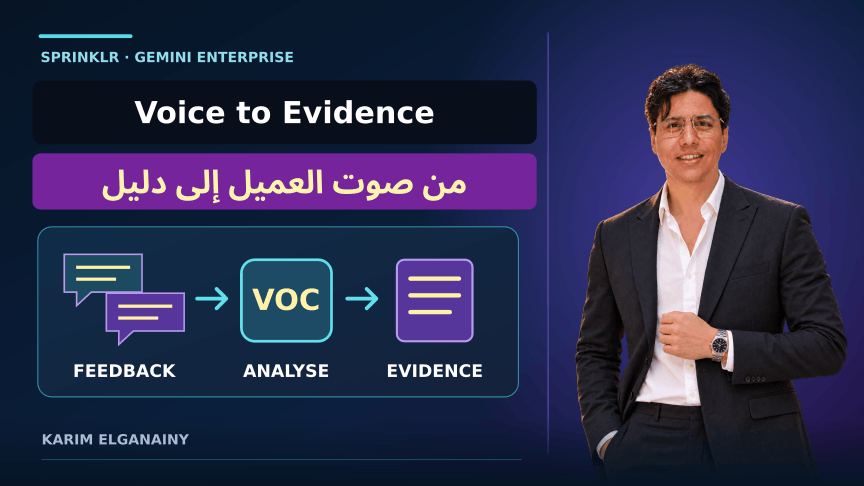
Original explanatory illustration by Karim Elganainy; conceptual workflow, not a product screenshot. News source: Sprinklr announcement.
Start with a decision, not an open-ended prompt
Choose a question with an owner and a practical consequence. For example, a regional service business might ask whether customers misunderstand the difference between two packages. The useful output would identify the ambiguous wording, show examples that support the interpretation, and recommend a bounded page experiment. A general request to summarize brand sentiment gives the team far more freedom to produce interesting but unactionable observations.
Write the decision before choosing the prompt: which page might change, who approves it, and what evidence would justify leaving it alone? Include the possibility that the initial assumption is wrong. If every possible answer leads to a new campaign, the exercise is a campaign justification process rather than research. That distinction matters more than the particular interface through which the question is asked.
Create a source map before combining signals
Prepare a simple inventory of the material the team is authorized to analyze. Record the channel, collection period, market, language, known exclusions, and business owner. Keep explicit distinctions between solicited survey responses, public comments, and operational feedback. They may describe similar experiences, but they arrive through different selection mechanisms and should not automatically receive the same weight.
A practical source map also records what is missing. A location with limited feedback should not disappear into a regional average. An account that collects only English responses cannot support a strong conclusion about Arabic-speaking customers. Ask the analyst, human or automated, to carry these limitations into the final brief. A summary that hides missing coverage can make a weak decision look more comprehensive than it really is.
Preserve the route from conclusion to evidence
Design the review document around traceability. Each proposed finding should link to permitted supporting material, identify its date range, and separate observation from interpretation. Reviewers need enough context to tell whether a complaint concerns the campaign, the purchasing process, or a service issue that marketing cannot fix alone. Do not circulate unnecessary personal details merely to make an example feel authentic.
One useful format has four fields: what was observed, what it might mean, what else could explain it, and what would be tested next. The alternative explanation is especially valuable. A cluster of negative comments might reflect one incident, a change in collection coverage, or a wider problem. The brief should preserve those possibilities until someone has checked the underlying material and spoken with the responsible operational team.
Treat Arabic evaluation as its own workstream
For a GCC pilot, define separate review sets for the languages and markets actually in scope. Include naturally occurring variation where the organization has permission to use it, and have qualified reviewers judge meaning rather than literal word matching. A mixed Arabic-English comment may require context that a single-language score does not capture. Do not infer dialect quality from a fluent generated Arabic paragraph.
Ask reviewers to label the business issue, the expressed attitude, and whether the text is too ambiguous to classify. Preserve an uncertain category. Forced certainty produces cleaner charts but can erase precisely the cases that need human judgment. Compare disagreements systematically and document recurring failure patterns. This is an evaluation recommendation, not a claim about Sprinklr's language coverage or a verified benchmark of its performance in Gulf markets.
Separate campaign response from service delivery
Imagine a hypothetical healthcare campaign that receives complaints about reaching a clinic. The first task is to distinguish unclear advertising from a booking problem. Revising a headline will not repair an unanswered phone line, while expanding the contact center will not explain a confusing offer. Route each issue to the team capable of changing the underlying condition.
Marketing can maintain a shared decision register containing the suspected cause, supporting observations, owner, and next review date. Avoid treating every service complaint as a creative insight. In a healthcare setting, keep this exercise focused on communication and administrative access, not diagnosis or clinical recommendations. Any sensitive information needs the organization's approved handling process before it enters an analysis workflow, regardless of how convenient the interface appears.
Evaluate the workflow against a human baseline
Use a small set of previously resolved questions to compare the proposed workflow with the current approach. Give both methods the same permitted evidence and the same decision brief. Evaluate factual support, omitted context, uncertainty handling, and whether a reviewer can reconstruct the reasoning. A faster first draft is useful only if the full review process remains manageable.
Record elapsed effort across collection, analysis, correction, and approval rather than timing generation alone. A workflow that saves ten minutes of drafting but adds extensive verification may still be worthwhile, but its benefit is different from the headline impression. Keep the evaluation proportionate to the decision's consequences. A content planning suggestion and a public response to a sensitive incident should not pass through identical approval requirements.
Keep action permissions narrower than reading permissions
An intelligence pilot should not quietly become an autonomous publishing system. Specify which users may inspect material, prepare recommendations, approve changes, and execute them. A team member who can review customer feedback does not automatically need authority to modify campaigns or send public replies. Keep the pilot's action boundary clear in both documentation and access configuration.
Test how the process behaves when evidence is incomplete or contradictory. The safest useful response may be a request for human review, not a more confident recommendation. Ask vendors to explain the relevant controls for the specific deployment under consideration, and verify them through the organization's normal assessment process. Marketplace availability alone does not establish suitability for every dataset, geography, contractual requirement, or healthcare use case.
Build measurement around changed decisions
Before the pilot begins, define what would count as an improvement. Candidate measures include fewer unsupported conclusions, less time to an approved brief, or more issues reaching the correct owner. These are process measures. Keep them separate from business outcomes such as completed bookings or retained customers, which may have multiple causes and longer observation periods.
Where a marketing change follows the analysis, document the hypothesis and comparison method in advance. If a page is rewritten to clarify eligibility, assess whether the intended audience understands it better and whether administrative confusion declines. Avoid presenting a simultaneous increase in inquiries as proof that the intelligence workflow caused it. A useful evaluation can conclude that the process improved while the business impact remains unresolved.
Make the purchasing conversation specific
Ask for a deployment walkthrough using a representative, approved task rather than a broad product tour. Clarify what must already exist in the customer's environment, which connections are required, how access is controlled, and what the team must configure. Confirm commercial terms directly rather than assuming a marketplace listing means inclusion in an existing subscription.
Request clear explanations of failure handling, review history, and how supporting evidence can be inspected. These are procurement questions, not assertions that a particular feature is missing. Bring marketing, analytics, technology, and the relevant data owner into the conversation early. Their different questions can prevent a successful demonstration from becoming an implementation that nobody owns once the first set of generated reports arrives.
Use a bounded GCC pilot instead of a regional rollout
Start with one market, a limited set of approved sources, and a recurring decision that already has an accountable owner. A bilingual organization could choose a specific service-information problem and compare Arabic and English findings separately. Do not pool markets merely to produce a larger dataset if the services, customer expectations, or operational arrangements differ.
Set an exit criterion before launch. The pilot might proceed only if reviewers can trace conclusions to evidence, language-specific errors are understood, and the operating team can act on the output. An equally legitimate outcome is to stop because the underlying data is inconsistent or the decision process is not ready. That is useful learning, not a reason to invent a positive return figure.
Design a review rhythm that produces closure
A weekly intelligence meeting should end with a short list of decisions, not another dashboard request. For each issue, record whether the team will act, investigate, defer, or reject the interpretation. Add a reason and a named owner. At the next review, begin with those open decisions before accepting a new stream of recommendations.
This rhythm helps reveal whether the bottleneck is analysis or execution. If validated findings repeatedly wait for the same approval, another analytical capability may not be the next investment. If reviewers spend most of their time correcting source coverage, improve the collection process first. The technology should make the operating problem easier to see, rather than provide more output that hides it behind an impressive volume of observations.
The practical takeaway for marketing leaders
The announcement is a reason to examine how customer evidence enters decisions, not a reason to assume that a new integration will improve every campaign. Start from one question, preserve the evidence, test language performance, and measure the complete human review cycle. Expand only after the team can explain what improved and what still needs supervision.
For healthcare and GCC organizations, keep the work grounded in their own approved context. Public product messaging cannot settle local deployment choices, clinical boundaries, or data-handling requirements. A credible pilot ends with a decision record that another person can inspect and challenge. That standard remains useful whether the organization adopts this suite, evaluates a different platform, or discovers that a simpler existing process is sufficient for the problem at hand.
Comments
No published comments yet.