Published October 26, 2026. Beacon Media + Marketing announced its 2026 Beacon Signal Report on October 23. The issuer says the report places practice survey responses beside its own marketing performance data. Its public report page describes a survey conducted July 17 to August 2. These are agency-reported observations, not a representative benchmark for every healthcare market. Issuer release and report page.
The practical opportunity is to audit the distance between an interested visitor and a well-handled inquiry. That audit does not require accepting every vendor conclusion or buying a new system. It requires a clear view of what the practice offers, what the visitor needs to understand, and what happens after someone makes contact. The following framework is original marketing analysis. It does not reproduce the full report, claim access to private respondent data, or offer medical or legal advice. Its GCC applications are proposed local tests, not findings about Gulf patients.

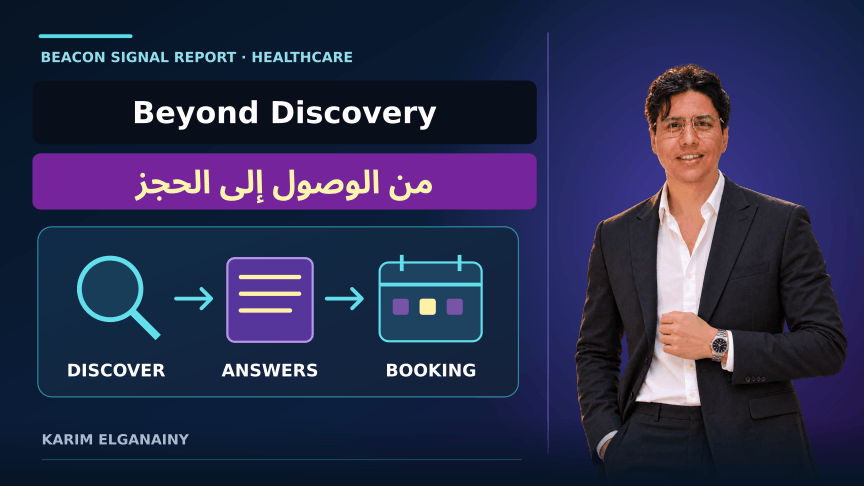
Original explanatory illustration by Karim Elganainy; an editorial planning framework, not a Beacon chart or screenshot. Primary source: Beacon Signal Report page.
Read the evidence boundaries before using the findings
A vendor report can help a team ask better questions without serving as a universal forecast. Before borrowing a conclusion, identify who contributed information, how they were recruited, which organizations appear in the performance dataset, and whether definitions are comparable. Survey opinions and campaign records answer different questions. Agreement between them may be informative, but it does not remove selection effects or establish a causal relationship.
The public materials reviewed for this article do not justify estimating a GCC market average. They also should not be treated as evidence that a particular tactic will produce the same outcome for a different practice. Use the announcement as a prompt for local investigation. Ask what information would be necessary to confirm the proposed issue in the organization's own context, then collect only what is appropriate and authorized.
Audit a real visitor question from beginning to end
Choose a practical question that a prospective patient or family member may reasonably ask, such as how to request an appointment or which languages are available. Follow it from an advertisement or search result to the relevant page and then to the contact route. Record where the information changes, disappears, or requires the visitor to repeat work. This is a communication audit, not an assessment of clinical suitability.
Make the audit concrete enough to assign ownership. Instead of writing that the website needs more trust, record that the location page lists one telephone number while the campaign sends visitors to another. Instead of requesting better conversion, identify an unclear next step after form submission. Specific defects give designers, administrators, and marketers a shared problem they can resolve and verify together.
Distinguish audience fit from persuasive pressure
Healthcare marketing should help someone understand whether a service may be relevant and how to ask appropriate questions. It should not manufacture urgency, promise outcomes, or imply a diagnosis based on an advertisement. Review the language used to describe services and remove claims that the organization cannot substantiate through its own approved review process.
A useful editorial test is whether the page would still be clear without its strongest promotional adjective. If removing exceptional or transformative leaves no concrete information, the copy may be relying on mood rather than explanation. Replace vague promises with verified administrative details and an accurate description approved by the responsible team. These changes are proposed communication improvements, not a guarantee of conversion growth or an assertion that any specific wording satisfies a regulatory requirement.
Separate content maintenance from content production
Build an inventory of pages that explain services, locations, clinician information, and contact processes. Give each item an owner and a review date. The operational task is to keep published information aligned with reality, not simply increase the number of articles produced each month. A page with current administrative details may be more useful to a visitor than another general awareness post.
Establish a change trigger. When a location's contact route changes, identify every page, directory entry, campaign destination, and automated acknowledgment that needs review. This creates a manageable maintenance process rather than relying on someone to remember every channel. For a multi-location practice, record which details are shared centrally and which belong to local teams. Avoid copying one branch's arrangements across the network without confirmation from the relevant owner.
Give bilingual pages equivalent practical value
An Arabic version should enable the same next step as its English counterpart. Compare service descriptions, contact choices, operating information, and acknowledgment messages across languages. A translated headline is insufficient if the Arabic visitor reaches a form with unexplained English fields or receives a message that does not match the language of the inquiry.
For a GCC practice, test with reviewers who understand the intended audience and the actual service context. Ask them to complete a specific information-finding task without coaching, then describe where they hesitated. Do not infer an entire market's preferences from a few sessions. Treat the observations as a way to find avoidable confusion and plan a broader evaluation if needed. Keep the language task distinct from clinical review, even when both require qualified people.
Define the handoff after an inquiry
Map what happens after a person contacts the practice through each approved channel. Identify who receives the inquiry, how ownership is assigned, what acknowledgment is provided, and when unresolved items are reviewed. A contact form is only one part of this process. The rest depends on staffing, operational choices, and clear internal responsibilities.
Set response expectations that the team can actually maintain. Do not publish a rapid-response promise merely because it looks persuasive on a landing page. If a channel is not monitored continuously, the wording should not suggest otherwise. Clinical and operational leaders should approve any guidance about urgent needs and service boundaries. The marketing team's role is to make approved information visible and consistent, not to improvise care instructions or create a new triage process through campaign copy.
Use a small measurement vocabulary
Define the stages the organization can responsibly measure: an inquiry received, an administrative response completed, an appointment requested, or another approved operational outcome. Specify how duplicates and unrelated contacts are handled. Different teams using the same word for different events can produce misleading reports even when every individual count is technically correct.
Keep marketing analytics separate from unnecessary clinical detail. A report intended to improve a contact process does not need to become a record of personal health narratives. Work with the appropriate internal specialists to decide what may be collected, retained, and shared. This article does not recommend a particular tracking configuration or imply that a CRM, server-side setup, or offline conversion connection is automatically suitable for healthcare data. Those decisions require their own review.
Compare changes without inventing attribution
When a page or intake message changes, write down the hypothesis before reviewing results. For example, a clearer explanation might reduce repetitive administrative questions. Choose a relevant observation period and document other changes that could affect the comparison, such as staffing, appointment availability, campaign spend, or a revised service offering. Avoid treating every movement in the dashboard as a marketing effect.
Where a controlled comparison is impractical, use a cautious before-and-after review and state its limitations. A pattern can justify another test without proving causation. Report both the desired result and possible negative effects, such as additional inquiries that the team cannot handle. The objective is a better-informed operational decision, not a chart that makes the redesign appear successful regardless of what happened elsewhere in the organization.
Build an editorial plan from verified information gaps
Collect recurring administrative questions through approved internal channels and group them by topic. Prioritize questions that the organization can answer accurately and that currently require visitors to search several places. Each proposed article or page update should have a clear audience, an information owner, and an intended next step. Avoid turning sensitive individual stories into marketing material without the appropriate authorization.
Use subject-matter review to preserve boundaries. A clinician may need to assess clinical descriptions, while operations confirms contact and access information. Marketing can improve structure and readability without taking over those responsibilities. Keep the content brief where the question is simple and provide depth where genuine explanation is needed. Publishing a longer answer solely to meet a keyword target can make essential information harder to locate and maintain.
Treat channel diversification as a capacity decision
A practice does not need to expand into every discovery channel at once. First establish whether the organization can keep its existing public information accurate and handle the inquiries it already receives. Adding another channel creates maintenance, moderation, and response work. Without an owner for those tasks, additional visibility can produce a fragmented experience rather than a useful new route.
Evaluate a potential channel by the audience question it can serve and the resources required to serve it well. A directory listing may need a different operating rhythm from a video series or a social account. Use a small, reversible experiment with defined responsibilities. Do not assume that greater publishing volume will compensate for a confusing destination page, an inconsistent language experience, or an unresolved administrative handoff after someone has made contact.
Use a four-week improvement cycle
In the first week, select one service pathway and document its current public information and internal handoff. In the second, correct a small number of verified communication problems and obtain the necessary reviews. In the third, check that the changes appear consistently across the relevant destinations and that staff understand any revised process. In the fourth, assess what changed using the definitions agreed at the start.
This is a suggested planning cadence, not a promise that meaningful results will appear within four weeks. Some questions require longer observation or more evidence. The cycle's value is in creating a repeatable connection between a specific issue, an authorized change, and a reviewable outcome. If the process reveals a staffing or service-capacity constraint, record it honestly rather than treating more advertising as the automatic response.
The decision for healthcare marketing leaders
Beacon's announcement offers a timely reason to examine how marketing and administrative access connect. The responsible next step is a local audit with narrow questions and clear ownership. Teams should distinguish the issuer's research from their own evidence, maintain realistic claims, and preserve the difference between a marketing inquiry and a clinical decision.
For organizations in the GCC, begin with the actual markets, languages, and service arrangements they operate. Adapt the evaluation to those conditions rather than importing a foreign benchmark as a target. A useful outcome is a clearer page, a consistent bilingual journey, or a reliably owned handoff whose effect can be examined. That is a stronger basis for future budget choices than adopting a broad industry narrative without checking whether the same problem exists locally.
Comments
No published comments yet.