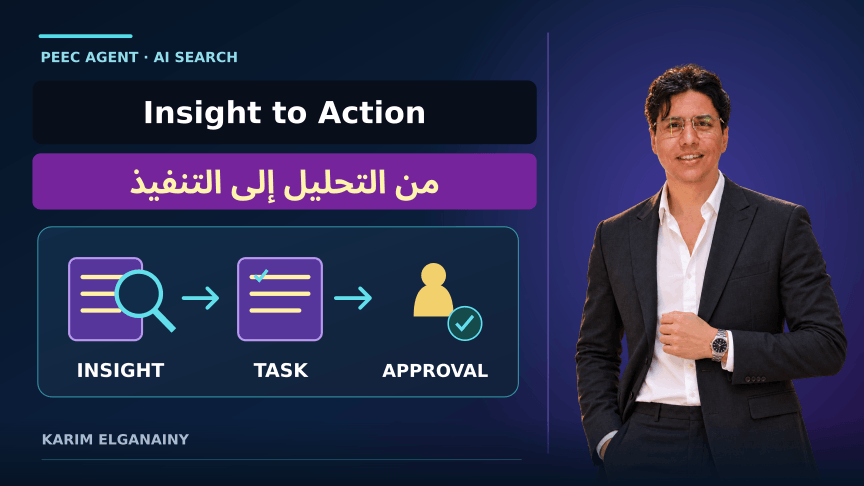
Peec AI announced Peec Agent and expanded Actions on October 22, 2026. This analysis, published October 26, examines the operating questions that announcement raises for marketing teams. The practical question is how a team moves from noticing an AI visibility problem to making a justified, reviewable improvement, without treating every recommendation as a command.

Original explanatory illustration by Karim Elganainy, not a product screenshot. The workflow is our editorial interpretation; the announcement is available in Peec AI’s release.
What Peec actually announced
According to its October 22 announcement, Peec’s expanded Actions attaches evidence and relative impact ratings to recommendations. Peec Agent can investigate findings and help prepare follow-on work. The company says changes require approval by default, with optional approval settings. Actions and Agent are available across plans, while Agent usage draws on a shared monthly credit allowance determined by subscription; additional credit packs can be purchased.
Those statements describe a vendor’s product and commercial arrangements, not independently verified marketing outcomes. The analysis below proposes a way to assess such a workflow. It does not report a hands-on test, establish improved rankings, or claim that adopting the product will increase revenue. A buyer should confirm current account availability, permissions and charges before connecting production systems.
Start with a question worth answering
A useful investigation begins with a business question narrow enough to challenge. “Why are we less visible?” is difficult to resolve because it can combine different markets, product categories and kinds of customer intent. A stronger starting point identifies a product, an audience and a decision: why does a particular service fail to appear when prospective customers compare a defined set of alternatives?
Write down the intended decision before asking an assistant to investigate. Perhaps the team must choose between clarifying an existing comparison page and commissioning a genuinely missing explanation. That framing makes it easier to reject interesting but irrelevant findings. It also gives reviewers a way to decide whether the work is finished. A lengthy generated analysis should not become its own deliverable when the original question required a short evidence-backed decision.
Build an evidence packet before a task list
An editorially useful evidence packet should preserve the question, the observed answer, the observation date and the material cited by that answer. It should also record the market and language being examined. This is a recommended review practice, not a claim about any specific product’s export features. Without that context, a screenshot passed between teams can look more definitive than the underlying observation warrants.
The packet should distinguish a factual mistake from an omission, a negative opinion from a source-quality concern, and a technical access problem from weak content. Those categories require different remedies. A missing mention may justify investigation but does not establish that the brand deserves inclusion. A factually incorrect statement may justify a correction, but the team still needs to identify its source rather than guessing which page caused it.
Treat a priority score as a hypothesis
A ranking can organize attention, but a marketing team should ask what a proposed action costs and what uncertainty remains. In our suggested decision process, priority combines customer relevance, evidence strength, implementation effort and the consequences of being wrong. A recommendation that sounds commercially important may still be a poor first project if it depends on an assumption nobody can validate.
Create a small decision note for each shortlisted action. Describe the observation, the proposed change, the expected mechanism and a reason the change might fail. For example, improving a product explanation could help customers understand it even if AI visibility does not change. That independent customer benefit is valuable. By contrast, rewriting accurate copy solely to chase a speculative signal may introduce risk without creating a better page for anyone.
Separate research permissions from publishing permissions
The safest trial starts with the least access needed to answer its question. A team can often evaluate the quality of an investigation before allowing an assistant to modify external systems. Decide explicitly which environments are for reading, drafting and publishing. A permission boundary should be understandable to the people responsible for the affected content, not hidden in a setup conversation that only one administrator remembers.
Review rights at the level of actions as well as accounts. Preparing a brief, creating a ticket, editing a draft and publishing a page are different commitments. A buyer should ask what approvals apply to each one and how those decisions are recorded. The default behavior described by a vendor should not substitute for checking the actual settings and connected account permissions in the organisation’s own deployment.
Give each recommendation a human owner
A recommendation can be technically sound and still disappear between departments. A content team may assume engineering owns it because it mentions crawlability; engineering may return it because the actual problem is an unclear explanation. Prevent that loop by assigning ownership according to the proposed change rather than the tool that discovered it.
Each task should name a decision maker, an implementer and a reviewer when those responsibilities differ. Include the evidence packet and a concrete acceptance condition. “Improve AI visibility” is not a testable completion criterion for an individual editing task. “Publish an accurate, sourced explanation of the product limitation after subject-matter review” is much clearer. Visibility can remain a separate outcome to investigate after the work is complete, rather than an obligation an editor cannot reliably control.
Protect editorial judgment during content changes
Before approving a suggested edit, compare it with the actual product, service and customer need. Does it remove ambiguity? Does it explain an important limitation? Does it replace a vague claim with evidence? Those questions are more useful than asking whether the text sounds optimised. The goal should be a page that remains useful even if the discovery interface changes again.
Require support for comparative and quantitative claims, and preserve necessary qualifications. An assistant may propose a concise summary that accidentally drops an exception a buyer needs to know. Subject-matter review should examine meaning, not just grammar. Store the earlier version and the reason for the change so the team can reverse an unhelpful edit without reconstructing its history from messages and meeting notes.
Handle third-party coverage without manufacturing endorsement
When an investigation points to external publications, communities or review sites, the marketing response should respect their independence. A missing mention is not permission to manufacture testimonials, pressure an editor or present promotional copy as neutral advice. The useful question is whether the organisation can provide accurate information, a relevant correction or genuinely helpful expertise.
Separate factual outreach from reputation management. A correction request should identify the precise statement, explain why it is wrong and supply verifiable evidence. A request for consideration should acknowledge that inclusion is the publisher’s decision. Keep records of the outreach and avoid promising a particular AI answer as its result. The communications team can control the quality and honesty of its contribution; it cannot reasonably guarantee how another publisher or an AI service will use it.
Measure implementation before claiming impact
An early pilot needs operational measures as well as marketing measures. Track whether the team could reproduce the finding, whether reviewers accepted the recommendation, how long implementation took and how much rework was required. These measures can reveal whether the process is useful even when downstream results are still uncertain.
Keep implementation and outcome reporting separate. Completing a correction establishes that a page changed. Observing a different answer later establishes that a later observation differed. Neither fact alone proves causation. A stronger evaluation preserves a baseline, repeats a consistent set of questions and documents other changes that could explain the result. Where a controlled comparison is impractical, describe the finding as directional evidence rather than converting it into a precise return claim.
Design a pilot that can produce a negative result
A credible pilot should be allowed to conclude that the workflow is not a good fit. Choose a bounded set of questions and pages, establish a review schedule and agree on the evidence required to continue. Avoid starting with the entire website, where too many simultaneous changes make it hard to learn anything specific.
Include a sample of recommendations the team declines. Record whether rejection came from weak evidence, poor relevance, implementation cost or a conflict with accurate messaging. That information can be more revealing than a list of completed tasks. If reviewers repeatedly need to rebuild the investigation themselves, the workflow may be shifting effort rather than saving it. The purchasing decision should reflect that total burden, not just the speed with which a draft appears.
Calculate the full cost of an investigation
For a credit-based tool, the relevant unit of value is a useful decision or a completed, accepted improvement. A long session can consume resources without producing either. Before a trial begins, choose a budget owner and a way to associate usage with a project. Confirm what happens when the allowance is exhausted and who may approve additional spending.
Include staff time in the evaluation. Research review, legal checks, subject-matter validation and engineering work remain real costs even when the initial recommendation is generated quickly. A simple internal worksheet can compare total effort with the previous process. It should also capture avoided work, such as a well-supported decision not to rewrite a page. Productivity is better understood as reduced wasted effort than as an ever-growing volume of output.
Make multilingual review a separate workstream
For organisations publishing in Arabic and English, a recommendation in one language should not automatically become an instruction for the other. Customer vocabulary, product naming and available evidence can differ. Review the actual question and answer in each language instead of assuming a translated prompt represents the same decision or audience.
Use a reviewer who can assess both accuracy and natural expression. Literal translations can preserve terminology while losing the distinction that matters to a customer. Keep market-specific conditions visible, especially prices, availability and service scope. A multilingual pilot should report its results by language and market so an improvement in one does not conceal a deterioration in another. This is an evaluation recommendation, not a claim about supported models or language coverage in Peec.
The decision marketers should make now
The useful next step is to audit one existing investigation: how did an observation become a task, who checked the evidence and how was completion judged? That exercise can reveal whether the missing component is software, access to reliable product knowledge or a clearer approval process. Buying an assistant before answering those questions risks making an unclear process move faster.
Peec’s announcement is a reason to examine the handoff between discovery and action. Our assessment is that the strongest buying case would combine better evidence, fewer unnecessary changes and accountable execution. Those benefits must be demonstrated in a bounded trial. Keep the final decision with the people responsible for the brand, and ask the workflow to make their reasoning easier to inspect rather than replacing that reasoning with a score.
Sources
Peec AI announcement, October 22, 2026. Product reference pages: Actions and Peec Agent. Product statements above are attributed to the issuer; the evaluation framework is original editorial analysis.
Comments
No published comments yet.