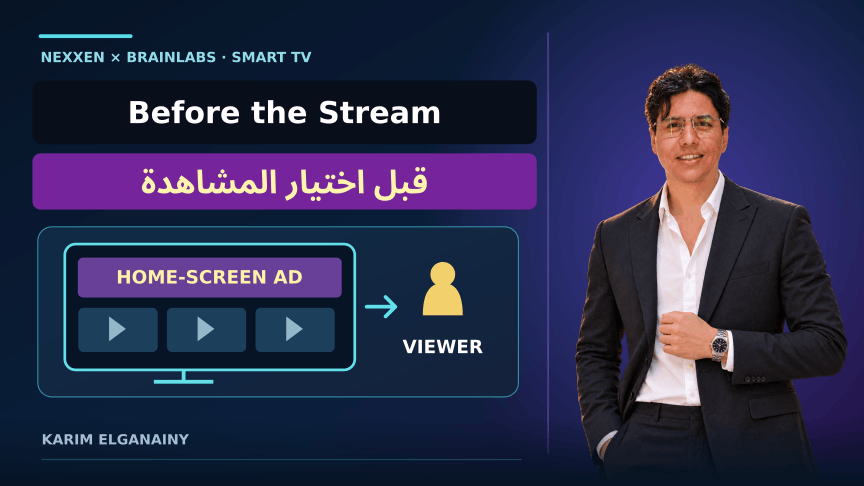
Nexxen and Brainlabs have offered a useful prompt for the next connected-TV planning meeting: what should a brand buy before a viewer chooses a programme? In an announcement dated 23 October 2026, Nexxen reported more than 8.1 million impressions and over 516,000 unique viewers for an unnamed global retailer in Canada. This article, published on 26 October, examines the planning questions behind those delivery figures rather than treating them as proof of commercial effectiveness. Read the issuer announcement.
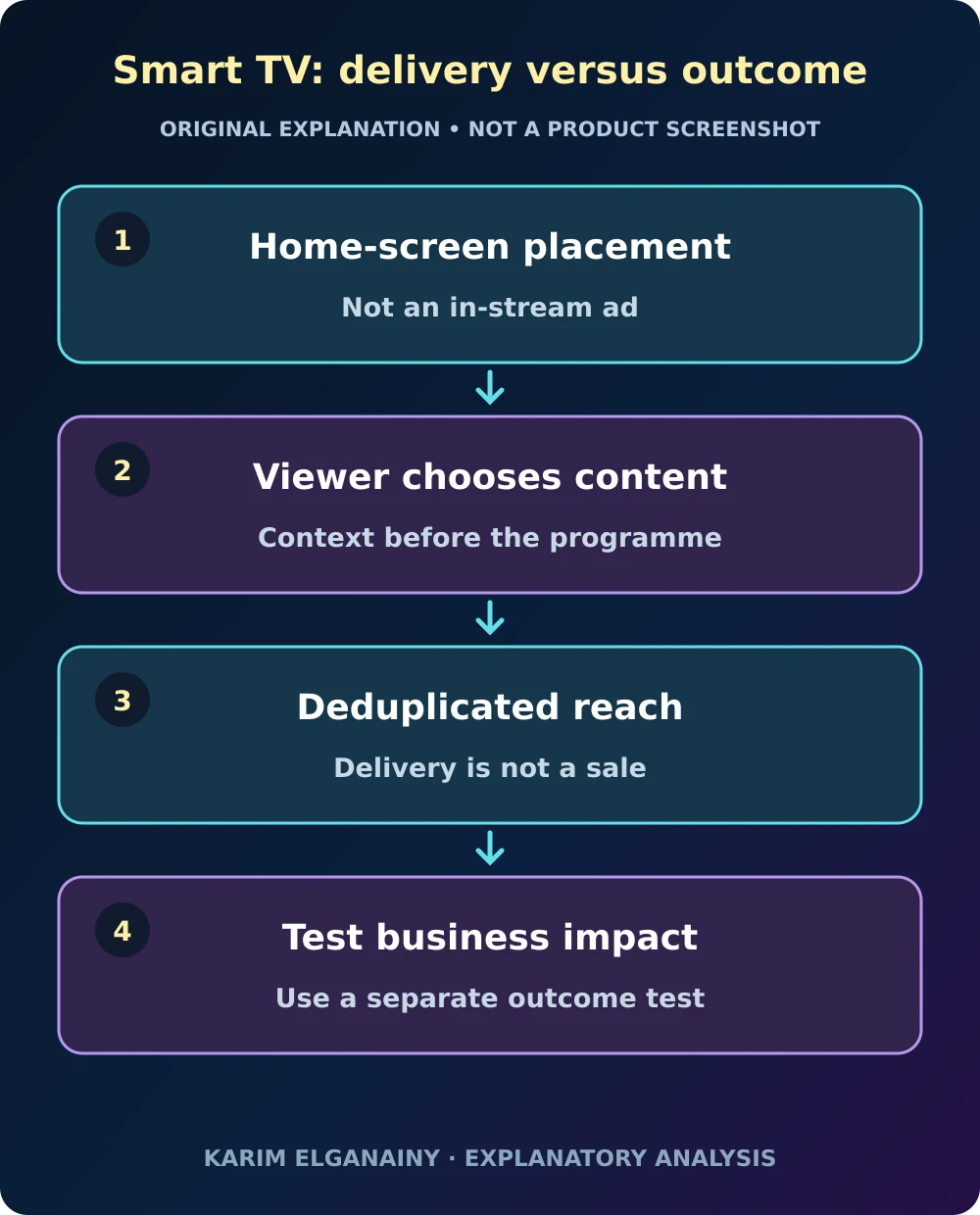
Original explanatory illustration by Karim Elganainy: a proposed measurement framework, not campaign creative or a Nexxen dashboard. Campaign context: Nexxen announcement.
What the announcement establishes
The campaign used Home Screen Hero and Banner placements on Hisense televisions powered by V OS, formerly VIDAA, around the summer international soccer tournament. Nexxen’s accompanying case study identifies the measurement period as Q2–Q3 2026. Its published results describe delivery and audience reach; the announcement does not disclose sales lift, campaign cost or a controlled comparison. Those boundaries matter when deciding what the case can support. Campaign case study.
The analysis below is an independent planning framework, not additional reporting about the retailer. A team considering similar inventory should start with its own objective, available evidence and buying constraints. The interesting question is whether this particular moment solves a problem in the media plan that other placements leave unresolved. A large delivery number can justify further investigation without determining the answer.
Define the moment before defining the format
A home-screen placement introduces a distinct planning hypothesis: someone may encounter the brand while deciding what to watch. That hypothesis should guide the brief. A message designed for a settled, uninterrupted viewing session may be poorly suited to a navigation screen where the viewer is trying to accomplish another task.
Before commissioning creative, ask what the audience needs to understand at a glance. A launch might need a recognizable product and an availability message. A seasonal promotion might need a memorable offer with a clear validity window. Neither requires assuming that every served impression receives deliberate attention. The placement should be evaluated against the job it is meant to perform, with success defined before delivery begins and with a separate explanation of what the format cannot establish on its own.
Separate reach from incremental reach
A useful planning sheet should have different rows for the people reached by the placement and the people reached beyond the rest of the campaign. These measures answer different questions. The first describes the inventory’s delivered audience; the second requires a comparison with the audience already reached elsewhere.
For a proposed test, ask the measurement partner how it would identify overlap, what population its method represents and which channels it cannot observe. If it can compare only selected television environments, label the result accordingly. Avoid presenting a partial comparison as incremental reach across the entire marketing plan. A clear limitation is more useful than an impressive aggregate that hides the measurement boundary. The decision maker needs to know whether the next unit of budget is buying additional people, additional frequency or an uncertain mixture of both.
Make frequency a distribution question
An average frequency can conceal sharply different audience experiences. Some people might receive a single exposure while others receive many. That possibility is a reason to request a distribution, not a reason to infer that the campaign reported by Nexxen had an overexposure problem.
In a future brief, specify the information needed to review repetition: the share reached once, the share within the intended range and the share above an agreed threshold. Ask whether frequency controls apply within one placement, across devices or across the wider buy. These distinctions should be written into the measurement discussion before launch. When the creative changes, retain a record of which message was eligible in each period. Otherwise, a frequency report can count exposures without explaining whether viewers repeatedly encountered the same proposition or saw a deliberately sequenced story.
Build creative for a navigation environment
The safest creative starting point is a hierarchy that survives a short glance: a recognizable brand, one proposition and one next step. That is a design recommendation, not a claim that short exposure always produces effective advertising. Test whether the message remains intelligible at the actual display size and viewing distance expected in the placement.
A practical review should examine contrast, text density, product recognition and any dependence on fine print. Where the format supports interaction, the destination should continue the same promise. Where it does not, the message should still work without a click. Creative approval also needs to consider surrounding interface elements, cropping and the distinction between a brand message and a navigation control. Clarity should be judged in context rather than from a full-screen presentation slide that makes every element look larger and more prominent.
Treat the sporting context as a hypothesis
Major events can provide a useful organizing idea for a campaign, but the presence of an event does not establish audience interest or sponsorship rights. A planning team should distinguish event-related timing from verified exposure to event content, and both from a contractual association with the event itself.
The proposed creative brief should therefore state exactly what is authorized. It might use a general seasonal occasion without implying official affiliation. It might instead draw on rights the advertiser genuinely holds. Those are different executions with different approval requirements. Audience planning should be equally precise: a household available during a tournament is not automatically a household watching it. A test can explore whether the timing improves relevance, but the reporting should not transform contextual availability into a fact about individual viewing behaviour.
Decide what attention evidence would change
Attention is useful only when its definition is clear enough to influence a decision. Before adding an attention metric to the dashboard, ask what is being observed, whether the measure is direct or modelled, and how the sample relates to the purchased audience. A named metric without an operational definition can create confidence without resolving uncertainty.
Then state the decision rule. Would a stronger attention result justify changing creative, increasing the placement’s share or simply conducting another test? A team should also document what the measure cannot tell it. Even a credible exposure or attention signal does not automatically establish comprehension, memory or purchase. Keeping these stages separate makes it easier to diagnose a weak result and harder to use a favourable intermediate metric as a substitute for the campaign’s actual objective.
Design a test around the decision
A useful experiment begins with a choice the business expects to make. For example, should the next tentpole plan add home-screen inventory, replace part of another placement or retain the existing mix? Each question implies a different comparison. Testing an addition while later claiming to have proven the value of a replacement would confuse the result.
Work with a qualified measurement partner to choose a feasible design, define the comparison and assess whether the available sample can answer the question. Keep offer changes, distribution differences and other campaign activity visible in the plan. If randomization is impractical, be explicit about the weaker assumptions of the alternative. An inconclusive result should remain inconclusive. The discipline is valuable because it protects the next budget decision from being driven only by a persuasive case-study headline.
Put cost beside the chosen outcome
A delivery report becomes more actionable when the cost denominator matches the decision. For an awareness test, cost per relevant person reached may be useful. For an incremental-reach objective, the relevant comparison is the cost of reaching additional people under a clearly stated measurement method. Neither should quietly replace a profitability objective when the business requires commercial evidence.
Include creative production, measurement and operational effort in the comparison where they are material. A placement can look attractive on media pricing while becoming difficult to justify after the full execution cost is considered. Equally, a higher media price could be acceptable if it solves a specific audience problem. The purpose of a complete cost view is not to favour the cheapest option; it is to make the trade-off visible and comparable with the alternatives the team could actually buy.
Ask buyers and sellers the same questions
The insertion order, creative specification and measurement plan should describe the same campaign. Confirm the devices, markets, placement types, dates and reporting dimensions available. Ask how unavailable inventory, creative rejection and reporting discrepancies would be handled. These are proposed procurement questions, not unresolved allegations about the announced campaign.
A shared checklist can prevent teams from discovering late that a sales presentation, buying interface and final report use different definitions. It should also establish who owns each approval and how changes are recorded. If the media plan depends on a particular event window, confirm the delivery commitments and alternatives in writing. Good governance does not eliminate uncertainty, but it allows both sides to distinguish an execution problem from a measurement limitation or a hypothesis that simply did not work.
Make the executive readout decision-ready
A concise executive summary should separate three layers: what was delivered, what was independently established and what remains unknown. Put the campaign objective beside those layers so the reader can see whether the evidence answers the original question. Avoid letting a prominent reach figure become the conclusion merely because it is the easiest number to communicate.
The recommendation can then be proportionate. A team might approve another bounded test, request a better comparison, change the creative or decline further investment. Each is a legitimate outcome when it follows from the evidence. The Nexxen and Brainlabs announcement is valuable as a concrete reason to examine home-screen inventory. For advertisers, its more durable lesson is methodological: specify the audience problem, make the measurement boundary visible and require a defensible link between the next spending decision and the evidence available.
Sources and editorial scope
This article distinguishes the 23 October announcement from its 26 October publication date. Reported campaign details come from the Nexxen issuer release and Nexxen case study. The planning framework, procurement questions and suggested test design are original analysis; they are not representations of the retailer’s internal strategy or a guarantee of results.
Comments
No published comments yet.