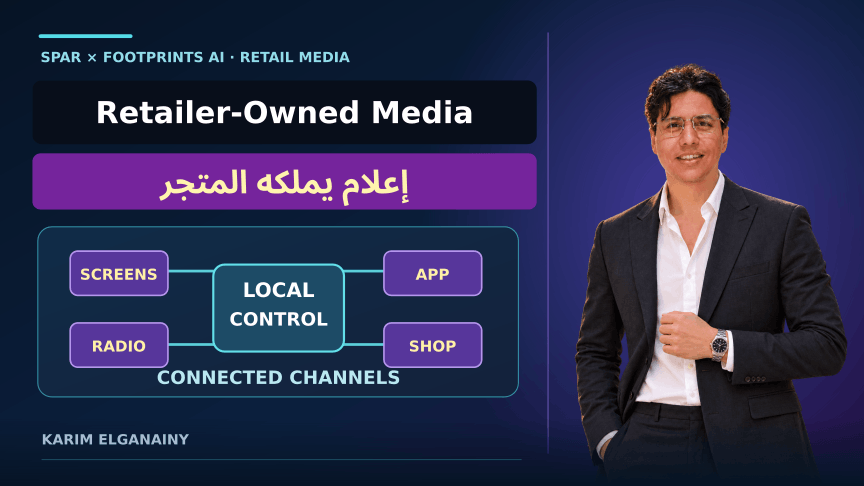
SPAR International published its Footprints AI retail-media partnership announcement on October 23, 2026. Its network spans more than 13,500 stores in 50 markets, but that footprint must not be mistaken for activated advertising inventory. The announcement describes expansion as country organisations connect. SPAR announcement
For marketers reviewing the news on October 26, the useful question is not how large the headline sounds. It is what evidence would make this infrastructure worth testing. The analysis below offers an original planning framework, not a report of campaign results or a claim that particular markets are available.
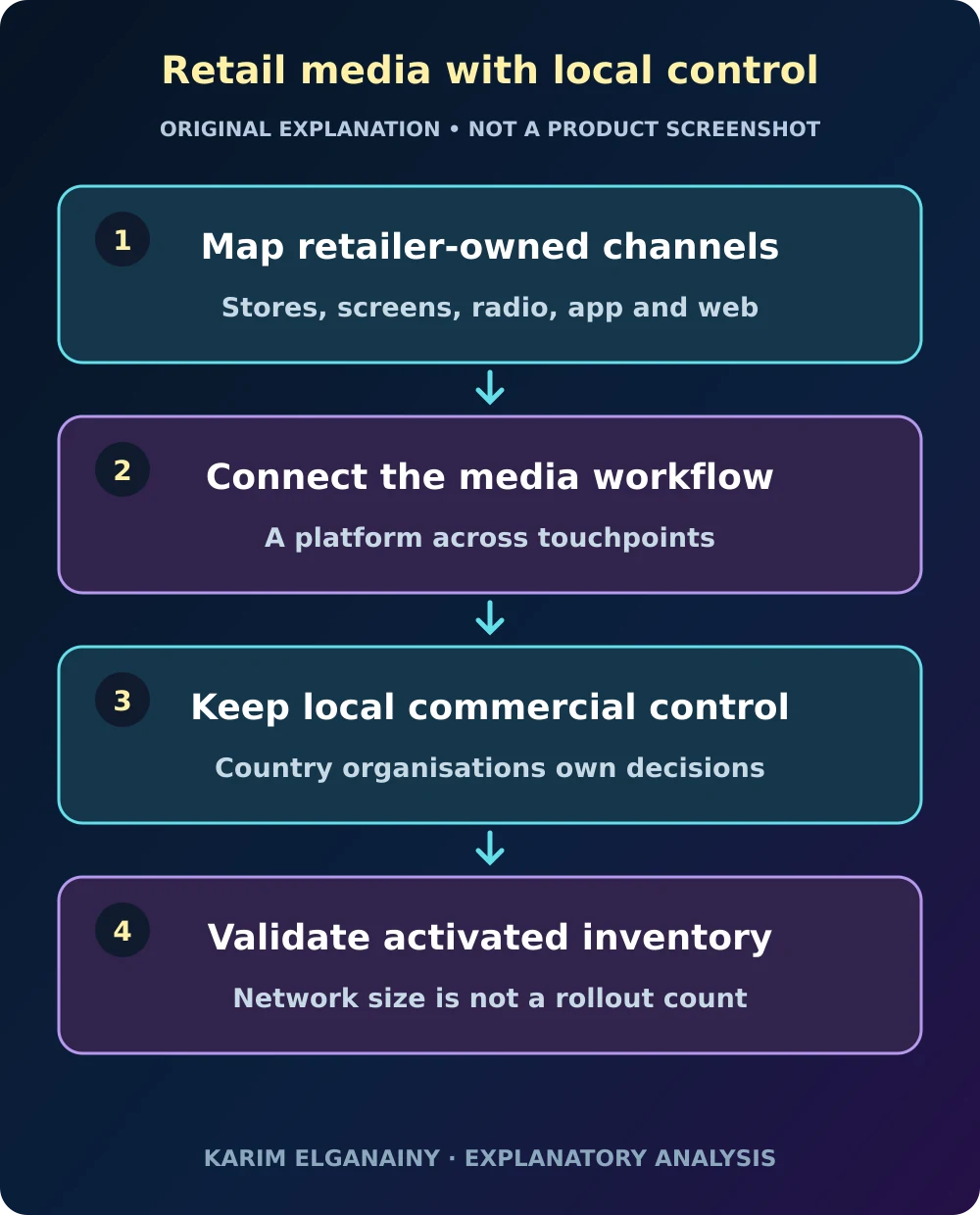
Original explanatory illustration by Karim Elganainy, showing a shared planning layer and local retail control; not a platform screenshot or rollout map. News context: SPAR announcement.
Read the announcement date correctly
The partner's own release is datelined October 20, 2026, three days before SPAR's publication. These are distinct source dates, not evidence of two separate launches. Footprints AI release
An editorial timeline should preserve that distinction. A buyer's operational timeline should go further, separating announcement, contracting, technical integration, inventory certification and campaign readiness. Those milestones answer different questions. A signed commercial agreement can precede usable placements, while an available placement can precede a reliable measurement pipeline.
Ask for a dated readiness sheet rather than relying on a launch headline. It should identify the selling entity, participating geography, channel, first bookable date and unresolved dependencies. Keep the document attached to the campaign brief so that later changes remain visible. This is a recommended diligence step, not a claim that the partners have published such a sheet.
Separate shared infrastructure from local authority
SPAR says the software connects existing retail infrastructure while country organisations retain control of their data, assets and commercial models. SPAR announcement
For planning purposes, treat shared access and shared authority as different things. One interface may simplify a workflow without creating one universal commercial agreement. A central team should therefore document who approves creative, accepts payment, sets floor prices and resolves disputes in each proposed market.
Build a responsibility matrix before consolidating spend. Assign an owner for inventory quality, product availability, customer complaints and reporting corrections. If an agency operates the campaign, specify which decisions it may make without retailer approval. The practical objective is not administrative perfection. It is avoiding a situation where a campaign is technically live but no one can authorise a necessary correction. Local flexibility becomes an advantage only when responsibilities are clear enough to support it.
Convert the headline footprint into a buying checklist
A useful inventory request should ask for named countries, participating retailers and eligible stores, followed by the actual placements available at those locations. Screen presence, screen operation and a bookable advertising slot are separate conditions. Digital placements need equivalent scrutiny: page location, device coverage, stock eligibility and creative specifications should be explicit.
Then ask what portion of that supply can support the intended measurement design. Some placements may provide delivery evidence but not comparable sales reporting. Others may be suitable for awareness without supporting a product-level outcome study. These are different products, not necessarily defective ones.
Put availability, reporting and pricing in separate columns. This prevents the largest number in the proposal from becoming an accidental proxy for quality. A smaller verified footprint may be the better first purchase if it allows a cleaner test and a clearer decision afterward.
Start with one commercial question
A pilot should answer something more specific than whether retail media works. Consider a question such as whether a particular message increases purchases of an eligible product among the stores that can keep it stocked. Another useful question is whether a localised creative approach outperforms a standard version under otherwise similar conditions.
Choose one primary outcome and list the supporting indicators separately. Product sales, category sales and retailer revenue are not interchangeable objectives. A campaign can help one while leaving another unchanged. Agree in advance which result will influence the next budget decision.
Also write down what the pilot cannot establish. A limited store test should not automatically be treated as evidence for every country, category or season. This boundary makes the result more useful, not less ambitious. It prevents a narrow success from turning into a broad promise that the study was never designed to support.
Make the comparison credible before launch
For an incrementality-oriented pilot, the central design question is what would have happened without the advertising. Where feasible, consider randomly assigned test and comparison stores. Where randomisation is impractical, document how comparison locations are chosen and what differences remain. Neither method becomes credible merely because a dashboard labels a number incremental.
Review baseline sales patterns, promotion schedules, pricing, store size and local demand conditions. Avoid selecting comparison stores only after seeing campaign results. Decide how closures, missing transactions and supply disruptions will be handled before they occur.
A written measurement plan should distinguish observed sales, attributed sales and estimated additional sales. It should also explain uncertainty. Small tests may produce results that are directionally interesting but inconclusive. In that situation, the appropriate next step may be improving the design or collecting more evidence rather than declaring the channel a success or failure.
Ask what every measurement term means
Create a short reporting dictionary before negotiating a performance commitment. Ask what counts as an impression, an exposure, a shopper and a sale. In a physical store, an advertising playback and a verified human view are not the same event. A reporting system should make its chosen proxy understandable rather than letting familiar digital labels hide different assumptions.
For sales outcomes, clarify product matching, returns, reporting delays and the treatment of repeat purchases. Ask whether an outcome window follows exposure, the shopping trip or another event. Confirm whether totals can be reconciled with the retailer's agreed source data.
This is not an argument for demanding impossible precision. It is a recommendation to price and interpret each measure according to what it can actually establish. Buyers should be able to explain the final report to a finance colleague without relying on undefined platform terminology.
Treat prediction as a testable input
The partner describes predictive targeting and in-store measurement capabilities. These are supplier descriptions, not independent proof of performance for a future advertiser. Footprints AI release
When reviewing a targeting proposal, ask which decision the prediction changes. Does it determine audience eligibility, scheduling, product choice or creative selection? Then compare that approach with a simpler alternative that the team could realistically buy. The value of complexity should be judged against a relevant baseline, not against doing nothing by default.
Keep prediction quality separate from commercial impact. A model can identify likely buyers without proving that advertising changes their behaviour. Conversely, a broad audience may produce useful incremental demand even if individual purchase prediction is imperfect. A pilot should connect the chosen targeting method to the business question while leaving room for an honest negative or inconclusive result.
Review data governance as an operating process
Before sharing information, map the proposed data flows, access permissions and retention arrangements. Ask which organisation controls each dataset, which parties process it and what the advertiser actually receives. This is operational diligence, not legal advice or an independent finding about the partnership's compliance.
The campaign team should involve the appropriate privacy and legal reviewers for each relevant market. A marketing brief is not a substitute for that review. Requirements should be translated into practical settings, including access restrictions, permitted reporting granularity and procedures for correcting or deleting information where applicable.
Test those arrangements with ordinary scenarios. Who responds if a data feed contains an unexpected field? Who can suspend an integration? Who approves a new reporting audience? A governance plan becomes useful when it tells people what to do during an imperfect launch, rather than merely describing an ideal architecture.
Design creative around the shopping moment
Develop a creative hypothesis that fits the proposed placement. A brief message near a shelf may need a different structure from a mobile placement where the customer can inspect details. Start with the action the shopper can realistically take, then remove claims or visual elements that compete with that action.
Localisation should include more than translation. Review product names, pack formats, price presentation, offer conditions and the relationship between the advertised item and local assortment. Require a local approval step before a central creative team distributes assets across markets.
For testing, change one meaningful element at a time when the design allows it. Compare a benefit-led message with a use-occasion message, for example, instead of changing copy, format, offer and placement simultaneously. The purpose is to produce a lesson the next campaign can use, not simply to select a winning file without understanding why it worked.
Connect media operations with retail operations
A media calendar should sit beside the product and promotion calendar. Confirm that the advertised item is stocked in the eligible locations and that the proposed offer is valid during the booked period. Assign someone to review exceptions rather than assuming the connection between merchandising and advertising will manage itself.
Define a response for stock shortages before the campaign starts. Depending on the agreement and technical capability, the appropriate action may be pausing a placement, switching creative or excluding a location. These are options to negotiate, not confirmed functions of the announced platform.
Also preserve a change log. If a price reduction, display move or assortment change occurs mid-test, the analyst needs to know. Otherwise, a genuine retail intervention may be mistaken for an advertising effect. Good coordination protects both the customer experience and the credibility of the final evaluation.
Evaluate economics beyond a headline return
Build the pilot budget from media, creative adaptation, setup, measurement and agency costs. Decide which expenses are one-time learning investments and which would recur at scale. A low media price can look less attractive once operational work is included, while an expensive setup may become more reasonable if it supports repeated use.
Agree on the economic lens before reviewing results. Revenue attributed to advertising is different from additional contribution after product costs, discounts and campaign expenses. The relevant calculation depends on the advertiser's decision, but the inputs should be visible and consistent.
Use scenarios instead of promising a universal return. Ask how the decision changes if sales lift is smaller, measurement coverage is incomplete or operational costs remain high. The goal is a decision that survives reasonable uncertainty, rather than a single attractive ratio that disappears when assumptions are examined.
Set a clear threshold for the next decision
Before launch, write three possible outcomes: expand, revise or stop. Expansion should require credible delivery, acceptable economics and evidence relevant to the original question. Revision should identify a repairable issue, such as weak creative or incomplete reporting. Stopping should remain a legitimate outcome when the opportunity does not meet the agreed conditions.
Finish the pilot with a short decision memo that separates findings from explanations and open questions. Include what was purchased, what actually ran, what was measured and what remains uncertain. Keep the recommendation proportional to the evidence.
That is the practical way to read this partnership: as a reason to investigate a potentially useful buying route, not permission to assume universal availability or guaranteed returns. The next meaningful development for an advertiser is verified local readiness and a testable proposition. Until then, disciplined questions are more valuable than a larger forecast.
Comments
No published comments yet.