
Prepared November 4, 2026, covering a November 3 interview and financial results announced November 2. Financial periods end September 30, 2026; comparisons are with the corresponding 2025 periods. Monetary values below are SAR million unless otherwise stated.
The development: management emphasizes revenue quality
In an original Argaam interview, Scientific & Medical Equipment House's chief executive cited a Q 3 gross margin of 16.3%, versus 14.3%, and approximately SAR 87 m in nine-month operating cash flow. He linked a positive outlook to new projects and cost discipline, while describing gradual project mobilization. These are management expectations, not assured future results. Original interview, November 3.
The financial comparison adds context: quarterly revenue 198.5 versus 200.5, operating profit 13.4 versus 6.9, and shareholder net profit 8.6 versus 7.7. Nine-month revenue was 602.5 versus 694.8, with shareholder profit 27.8 versus 27.7. Revenue, profit and operating cash flow measure different things and should not be combined as interchangeable descriptions of performance. Argaam financial report.
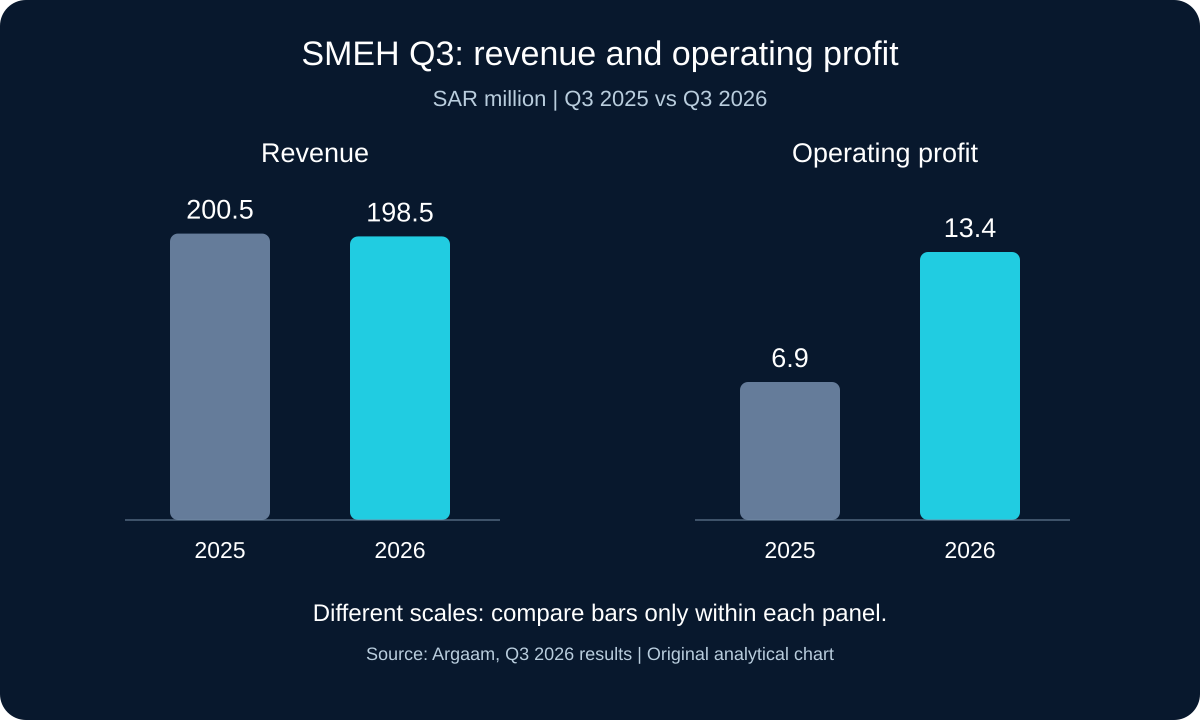
Original visualization of published values. Each panel has its own scale; bar heights should only be compared within the same measure. Data source.
Independent analysis: an award starts another commercial journey
The following framework is for business-to-business healthcare marketing and business-development teams. It is not a diagnosis of SMEH's internal processes or a claim of personal involvement. Its central question is whether a commercial opportunity matches the organization's ability to deliver, not simply whether the headline contract value is attractive.
Contract businesses move through distinct stages. A commercial award precedes mobilization. Service delivery then follows the agreed scope, while invoicing and collection follow their own processes. Treating all these stages as sales obscures delays and can encourage commitments that the delivery organization has not validated.
Marketing should therefore understand the exact offer. Equipment supply, ongoing maintenance and an integrated service package may address the same institution but create different obligations. The buyer needs different evidence for each. A broad promise of comprehensive support is useful only when its scope and delivery conditions are clear.
Qualify fit before paying for more attention
A simple opportunity sheet should capture the customer's need, proposed scope, available resources and unresolved questions. This is not an invitation to publish confidential commercial information. It is a way to identify when finance or operations must review a proposal before the commercial team commits.
Separate fit from nominal value. A large opportunity can require a long mobilization period or resources that are difficult to secure on time. A smaller one may fit established expertise more closely. These are general decision considerations, not findings about SMEH's portfolio or recommendations concerning particular buyers.
Marketing can improve the incoming opportunity mix through clearer service information. A useful page explains inclusions, exclusions, transition steps and available proof of capability. Ambiguity may create more inquiries, but it can also increase qualification work and delay meaningful discussions. The objective is informed interest rather than indiscriminate lead volume.
Build an evidence library for commercial teams
Organize verified capability descriptions, approved examples, team qualifications and service-monitoring approaches by service line. Give each document an owner and review date. Do not use customer names, site images or private performance information without appropriate permission. Do not present unsupported operational numbers as achievements.
Distinguish existing capability from planned expansion. If delivery depends on hiring, procurement or approvals, the commercial discussion should reflect those dependencies accurately. Operations should review public promises before publication. A vague claim of rapid response is less useful than a defined commitment whose conditions the responsible team can assess.
Evidence should help a professional buyer evaluate uncertainty. A proposal can follow the customer's need, the delivery approach, relevant risks and the monitoring process instead of repeating generic claims of superiority. This also helps the sales team explain why an offer is suitable without making promises beyond its approved scope.
Design the handover into delivery
A newly started project need not immediately resemble an established operation. In a hypothetical example, the team may need to receive facilities, train staff and arrange spare-parts availability before a stable service pattern emerges. A commercial plan should therefore include explicit handover stages rather than leaving the customer between sales and operations.
The handover checklist can identify the accountable contact, required documents, resources, service boundaries and escalation route. Transition quality becomes part of the brand experience. Strong presentation materials cannot compensate for an unclear first month of delivery, and commercial expectations should not disappear when a contract is signed.
Compare projects at relevant stages without allowing mobilization to become an indefinite excuse. Specify which indicators can be assessed now and which need longer observation. Explain differences rather than hiding new and established projects inside one average that cannot guide a practical decision.
Keep margin and cash questions distinct
A margin improvement calls for an explanation of its components rather than a single assumed cause. Service mix, costs and accounting treatments can affect comparisons. The chief executive's interview also discussed the effect of a revised spare-parts provision methodology. It would therefore be inappropriate to attribute the entire improvement to marketing or operating efficiency alone. Management explanation.
Accounting profit does not mean the same amount was collected in cash during that period. Growth teams should ask finance to define each measure and its timing rather than inventing their own accounting interpretation. Collection concerns should not lead salespeople to promise unapproved terms merely to secure a contract.
A useful joint review ends with a specific question or action: improve scope clarity, resolve a delivery dependency, or investigate a financial issue. Not every problem should trigger a campaign change. The team responsible for the affected stage needs evidence before the organization assigns a cause.
Test whether the commercial materials improve qualification
Select one service and collect recurring reasons for unsuitable or delayed opportunities from the authorized teams, using aggregated information. Improve the service page or proposal to answer one important qualification question. Assess subsequent meetings against a consistent definition of fit rather than counting submitted forms alone.
Track qualification success, time needed to clarify scope, reasons for repeated negotiation and readiness for handover after signature. Apply a consistent cost methodology. A change in season, customer mix or available staffing can affect the result, so a before-and-after improvement does not establish causation on its own.
Conclude with a decision to retain, revise or stop the change, recording what remains uncertain. The practical aim is growth the business can deliver and explain. A larger pipeline is not automatically better if its opportunities depend on capabilities or conditions that have not been checked.
Sources and evidence limits
- Argaam's original chief-executive interview, November 3,2026: source for attributed management statements and expectations.
- Financial-results comparison: figures for periods ending September 30.
- Rounded results were cross-checked against Mubasher's reproduction of the announcement. The original exchange-hosted disclosure was not directly inspected in this verification. The operational recommendations are independent hypothetical analysis, not company guidance or personalized investment advice.
Pre-publication verification: figures were matched against the company-hosted disclosure, and the interview reproduced on the company website was reviewed.
Comments
No published comments yet.