Announcement: November 2, 2026. Editorial analysis: November 3, 2026.
What Smartly announced, and what remains open
Smartly announced Intelligence Pro for eligible customers, combining Reach Planner, Headroom Analysis, anonymized Benchmarks and INCRMNTAL Connect. The release describes reach forecasting, investment opportunity, peer context and modeled incremental contribution; it provides no public price or quantified new-product lift. Smartly announcement.
The current page for its September 29 ADVANCE event mentions Intelligence Pro. We describe November 2 as the launch and availability announcement without claiming it was the first public mention; the current page does not establish when that wording appeared. ADVANCE page.
The sections below are original practical analysis. They describe a proposed decision process, not additional product functionality, verified customer outcomes or an endorsement. Any example is hypothetical.
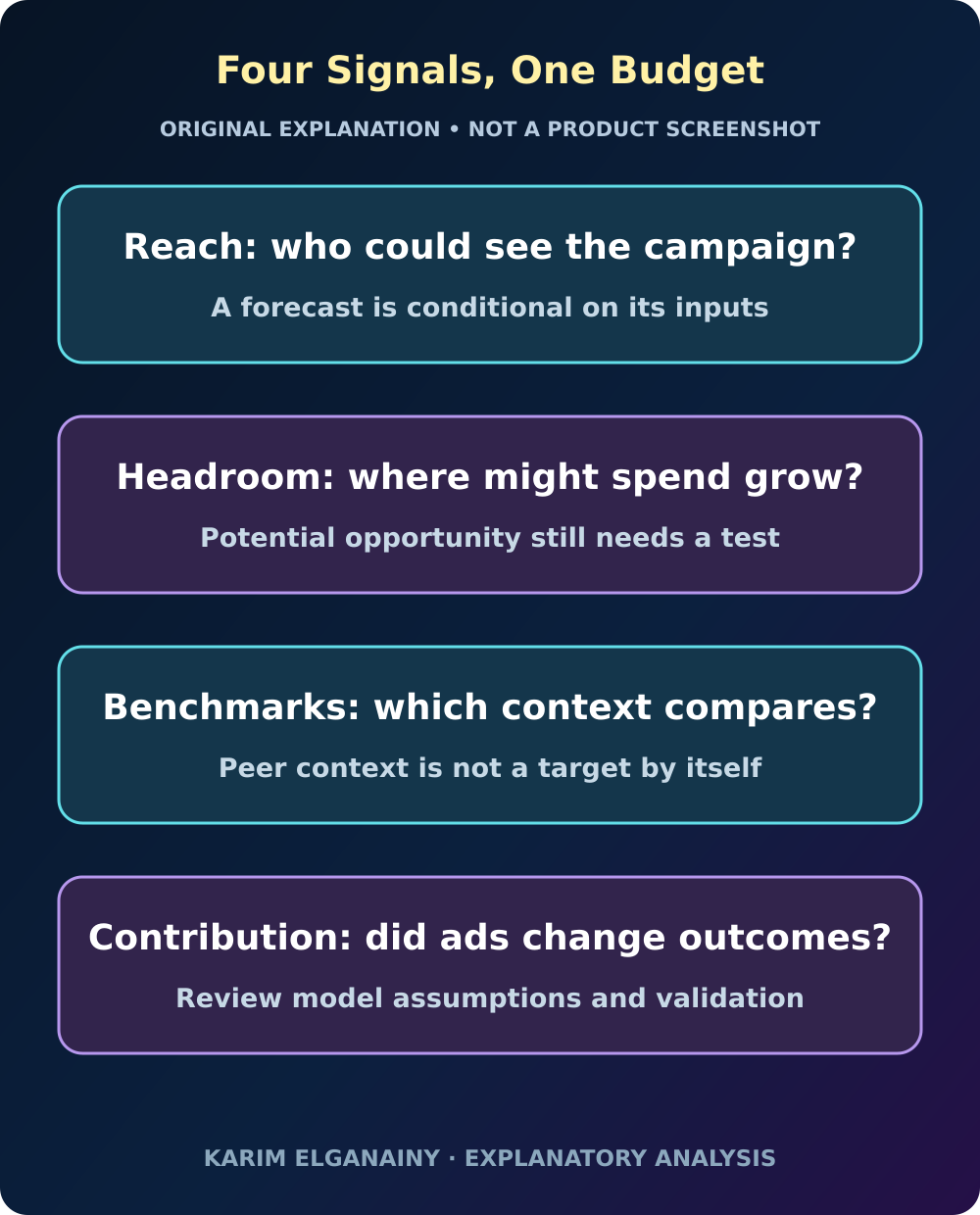
Original editorial framework; not a product screenshot or proof of campaign results.
Start with the decision that could change
A planning tool earns its place when a team can name the decision it will improve. “Understand performance” is too broad to make a useful acceptance criterion. A clearer question is whether to put the next approved increment of spending into an existing campaign, open a new audience, repair the offer or retain the money. Those choices require different evidence and have different operational consequences.
Write the decision before opening the dashboard. State the business objective, the geography, the period, the budget under discussion and the person allowed to act. Also state what cannot change during the review. If the landing page is being rebuilt and the product price is moving at the same time, the team should acknowledge that it is evaluating a changing commercial system, not simply a media allocation.
This discipline prevents an attractive new view from becoming the reason for a decision that was already politically convenient. It also makes disagreement useful. Finance can question the margin assumption, creative can question whether the message is exhausted, and media can question the inventory assumption without arguing over whose dashboard is correct.
Reach describes an opportunity to be seen
The first analytical question is whether additional spending could reach people the campaign has not already reached often enough. A reach scenario is useful because it makes a planning assumption visible. It does not establish that the people reached will understand the offer, qualify for it or buy it.
A practical review should distinguish a new channel from genuinely additional audience exposure. Two placements can look different to the buying team while still addressing much of the same customer pool. Conversely, a channel with a less impressive reported conversion rate may expose the offer to people who were missing from the original plan. Neither possibility can be resolved by comparing conversion rates alone.
Ask what population the forecast represents, how duplication is handled and which observations become less certain when spend moves beyond familiar conditions. Record an interval or scenario range where the available method supports one. Do not turn an uncertain projection into a precise customer count merely because a presentation needs a single number. The useful output is a bounded planning assumption that can later be checked against actual delivery.
Remaining headroom depends on the business
A channel can have room to accept more advertising while the business has little room to benefit from more demand. Stock, appointment capacity, sales response, fulfilment quality and margin all affect the value of the next customer. The spending decision should therefore involve the person responsible for delivering the promise, not only the person buying attention.
Consider a hypothetical retailer promoting a limited assortment. The campaign may still find additional interested shoppers, but an unavailable popular item can turn that extra attention into wasted visits or disappointing substitutions. A different creative message may help only if it points to an offer the retailer can actually fulfil. Media capacity and commercial capacity need separate checks.
The review should also distinguish average return from the likely return on the next increment of investment. A campaign's earlier, easier opportunities can make its cumulative result look attractive after its current opportunity has narrowed. Equally, a weak historical average can hide a newly improved offer. Ask which conditions produced the historical pattern and whether those conditions still describe the decision being made today.
Benchmarks are a conversation starter
External comparisons help teams notice questions they might otherwise ignore. Their value depends on the match between the comparison group and the business decision. An industry label alone may conceal differences in price, customer maturity, market access, buying cycle and the meaning of a conversion.
Before interpreting a gap, agree on the denominator. A completed purchase, a form submission and an enquiry that passed sales review are different outcomes. Differences in attribution windows or campaign objectives can make equally named metrics describe different processes. The team should be able to explain the comparison in ordinary language before it relies on the comparison to move money.
Use a benchmark to open an investigation: is the creative unclear, is the destination slow, is the audience already saturated, or does this business simply sell through a different journey? Avoid converting a peer percentile into a target detached from economics. Becoming more similar to an anonymous average is not necessarily a commercial improvement. A defensible target follows from the business's own costs, capacity and desired customer relationship.
Incrementality needs an explicit counterfactual
The question of incremental impact asks what would have happened without the spending or change under review. That is different from asking which touchpoint received credit for an observed purchase. A useful measurement discussion should make the proposed counterfactual visible rather than treating “incremental” as a quality badge attached to a number.
Ask the measurement owner to explain the method, required observations, important assumptions and situations in which the estimate should not guide action. If a forecast relies heavily on historical relationships, ask what happens when the offer, market or creative changes. If the available evidence cannot distinguish a campaign effect from another simultaneous change, the report should say so plainly.
The operating response should match the uncertainty. A directional model may justify a bounded test while remaining insufficient for a large, durable reallocation. Where a suitable controlled comparison is feasible, define the comparison before the change and protect it from unrelated interventions. Where it is not feasible, preserve the limitation in the decision record. Do not upgrade observational evidence into experimental proof by changing its presentation.
Make one decision log, not one blended score
Putting different signals in the same workflow is useful only if their meanings remain visible. Combining them into an unexplained score can conceal the very disagreements the team needs to resolve. A simple decision log is often more helpful than an elaborate ranking.
The proposed log contains the decision, the alternative being rejected, the evidence for each option and the assumption that matters most. It names the owner, the date of approval, the spending boundary, the planned observation period and the condition that would trigger reconsideration. A final field records the next validation event, such as completed delivery, a capacity review or a suitably designed experiment.
For example, a team may see room for additional exposure but weak evidence that recent conversions were caused by advertising. The appropriate entry might be a small, reversible allocation to learn more, not an unconditional expansion. Another team may have persuasive impact evidence but no capacity to serve extra demand. Its next action could be operational preparation. The same dashboard can support different decisions because the relevant constraints differ.
Test the workflow as well as the media
A pilot should evaluate whether better information actually changes a decision in a useful way. Start by documenting the current process: how a spending recommendation is assembled, which disagreements cause delays and what information arrives too late. Keep this baseline practical. A short description of the last comparable decision is more useful than a theoretical process map nobody follows.
Then choose a contained decision with a clear owner and an observable outcome. Define the intervention, comparison, outcome window and rules for handling missing data before results arrive. Confirm that the outcome reflects the commercial goal. A campaign can generate more enquiries while producing fewer suitable customers if the new message attracts the wrong need.
Evaluate two things separately. The operational review asks whether the team made its decision more clearly, with fewer unresolved assumptions and an auditable rationale. The commercial review asks what changed in qualified demand, contribution or another agreed business outcome. A faster meeting is useful, but it should not be presented as proof of incremental revenue. Equally, a cautious decision to avoid an unsupported expansion may be the pilot's most valuable result.
A hypothetical regional healthcare application
Imagine a healthcare group assessing whether to promote appointment availability in another city. This is an illustrative planning exercise, not a report about a Smartly customer or a recommendation to use any particular targeting method. The group would first establish which services it can responsibly promote, which locations have capacity and how an enquiry becomes a suitable appointment.
Language and service geography belong in the decision itself. An Arabic advertisement and an English destination can create a different customer journey from two consistent Arabic touchpoints. A headline about immediate availability can create avoidable disappointment if the booking team cannot offer that service locally. These are operational questions to resolve before interpreting an apparent media opportunity.
The team should use approved aggregate reporting and obtain appropriate privacy and clinical review for its intended workflow. This article does not establish legal compliance or product availability in any GCC market. Sensitive patient information should not be introduced merely to make a campaign report more granular. For the example, the commercial review can focus on the agreed journey and service capacity while the responsible specialists determine which data may be used.
Evaluate the cost of making a better decision
The purchasing case should include more than the subscription or service fee. Teams need time to connect data, understand definitions, train users, investigate disagreements and maintain the process when people change roles. A tool that provides a more sophisticated view can still disappoint if nobody has the authority or time to act on it.
Ask the supplier for the precise scope of the proposed arrangement: eligibility, supported uses, commercial terms, onboarding needs, data requirements and responsibilities when results are disputed. Request a demonstration around the business's actual decision rather than a generic success narrative. If a capability is essential to the business case, make its availability an explicit point to confirm rather than an assumption inferred from a launch headline.
The economic question is whether the process is likely to prevent sufficiently costly errors or reveal sufficiently valuable opportunities to justify the full operating burden. That assessment will differ by advertiser. There is no universal saving or uplift that can be inferred from the announcement. Keep unverified benefits out of the approval memo and state what the pilot must establish.
Karim's strategic takeaway
The strongest use of a combined intelligence offer is a more disciplined conversation about the next decision. Keep the questions separate: who could be reached, where the business can grow, what comparison is meaningful and how much impact can reasonably be attributed to the change. Then bring the answers together through an accountable owner.
Before approving a material increase, ask the team to show one page containing the choice, the evidence, the main uncertainty and the next opportunity to validate the decision. If that page remains vague, another dashboard will not fix the underlying problem. If it becomes clear, even an inconclusive test can improve the next allocation by exposing which assumption deserves attention first.
Comments
No published comments yet.