An inaccurate answer about your business is first an evidence problem, then a content problem, and only later a measurement problem. Publishing more pages without resolving the underlying facts can multiply the inconsistency. A better response connects a verified claim to an accountable owner, a reviewed change and a clearly defined observation of what happened afterwards. This article proposes that operating model for marketing teams evaluating AI discovery tools.
The announcement and its limits
On November 11, 2026, Sitecore introduced MarketingIQ: approved brand information informs proposed responses to AI-discovery findings, with human review before release. The company describes compatibility with existing business systems. Some customer-agent actions are planned, rather than available capabilities. These are vendor statements, not independent evidence of increased sales. See the original announcement.
The rest of this article is independent practical analysis. It does not describe an implementation by Sitecore customers or claim that a particular product already performs every suggested control. Evaluate the relevant edition, integration and contract before treating a proposed workflow as a purchasable capability. A demonstration can establish that a task is possible in a prepared environment; it cannot establish reliable performance with your own content, permissions and exceptions.
Start with a question worth correcting
Create a small inventory of questions that people genuinely ask before choosing your service. Separate factual questions, such as opening hours, from preference questions, such as which provider is best. The first can often be checked against an authoritative record. The second requires understanding the criteria and evidence behind the recommendation, not demanding that every assistant name your brand. Begin with questions that affect customer understanding or create avoidable friction, rather than chasing mentions for their own sake.
For each observation, retain the question, answer, date, language, platform and relevant conditions. An isolated screenshot is evidence of one response, not a stable market-wide ranking. Repeat observations with a documented protocol and record contradictory answers too. If the answer changes between checks, preserve that variation instead of selecting only the screenshot that supports the preferred narrative. This makes the issue reproducible enough to investigate while keeping the uncertainty visible to colleagues.
Establish an authoritative fact register
A usable register contains the fact itself, its applicable audience or location, its source, the accountable owner and the date when it must be reviewed. A price without a currency, eligibility rule or validity period is not ready for reuse. Neither is a service description that fails to distinguish what is offered at one location from what is offered throughout the organization. Put those boundaries next to the claim, not in a separate document that an editor may never open.
Resolve disagreements before generating new copy. If a product page, sales deck and customer-service script disagree, asking a model to summarize them merely hides the conflict inside fluent prose. Assign the decision to the person who owns the underlying service or commercial policy. Record the resolution and which older materials need correction. The register should be a maintained source of truth, not a second collection of unreviewed text that becomes stale alongside the website.
Build a chain from evidence to publication
Use a simple sequence: observation, verified fact, proposed change, approval, publication and measurement. At each handoff, preserve the reason for the action and the relevant version of the source. A reviewer should be able to see which claim a sentence relies on and what changed from the previous version. That is more useful than asking the reviewer to approve a polished paragraph with no visible supporting context.
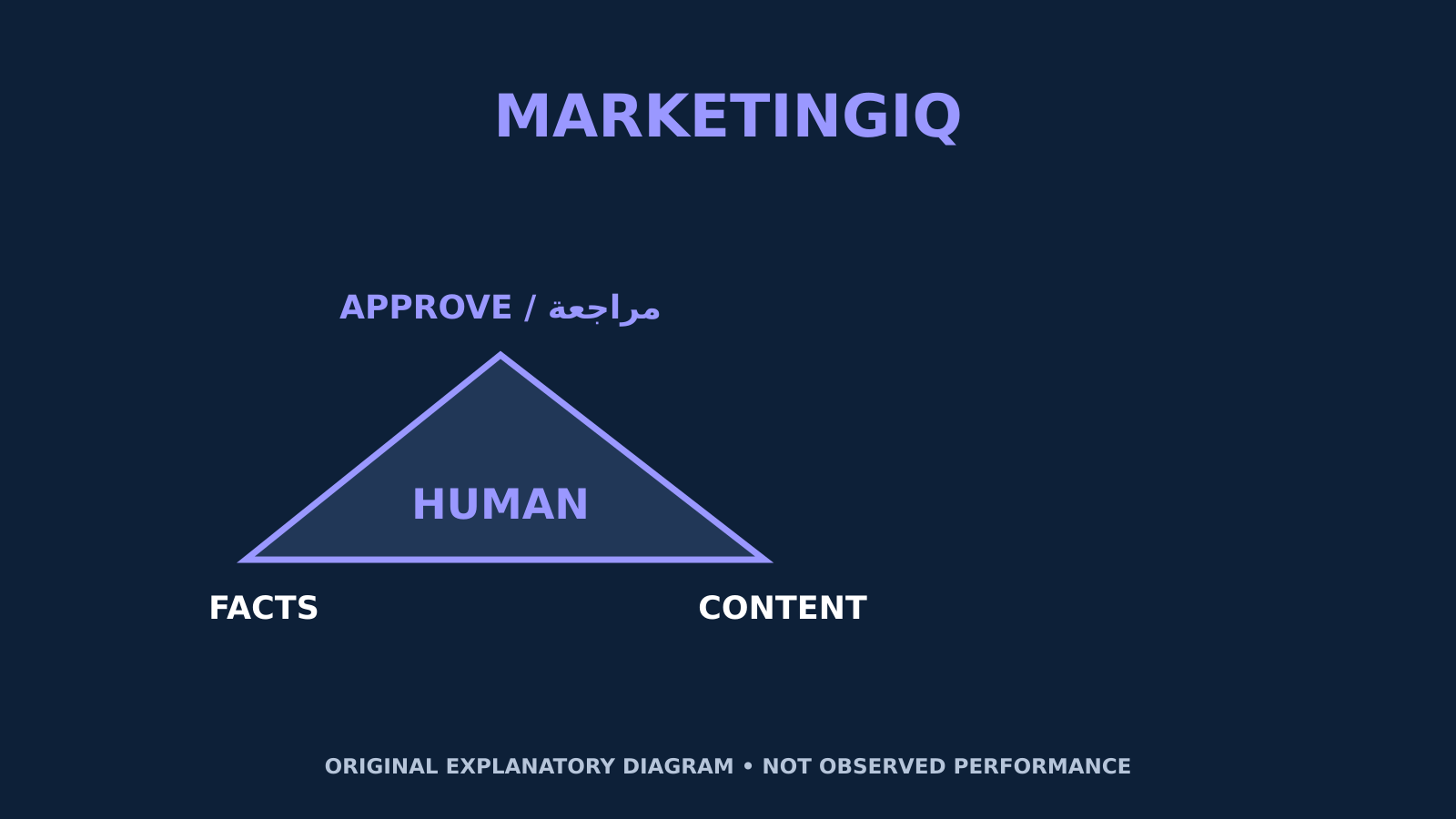
Original conceptual diagram: FACTS and CONTENT support APPROVE, with HUMAN judgment inside the triangle. These labels mean verified facts, proposed content, approval and human review; not a product screenshot or measured performance result.
Define a stopping condition as well as a route forward. If a claim has no current source, the workflow should request clarification instead of filling the gap with plausible language. If two markets have different rules, the output should remain separated until local review is complete. Speed is valuable only when the organization can explain what it has accelerated and which decisions still require accountable judgment.
Make approvals specific rather than ceremonial
A useful approval names the exact content, language, destination and effective date. It should not become a blanket permission for an agent to reuse a sentence anywhere forever. Distinguish a factual review from a brand review and a legal or clinical review where appropriate. One person may cover several roles in a small team, but the questions remain different: is it true, is it understandable, and is it permissible in this context?
Record rejections and requested changes with reasons. These records reveal recurring weaknesses in the inputs, such as missing service boundaries or inconsistent terminology. They also help the team improve templates without silently turning previous approvals into standing authorization. When a material fact changes after approval, route the affected content back for review. Do not assume that approval of the original draft covers a new price, audience, promise or channel.
A hypothetical healthcare example
Imagine a clinic whose public booking page clearly lists an evening appointment option, while an assistant sometimes says appointments are available only in the morning. This is a hypothetical scenario, not a report about a named hospital or an actual campaign. The marketing team first checks the current schedule with the service owner and confirms whether the option applies to every department, selected practitioners or only particular dates.
The team then corrects public information at the appropriate source and aligns the relevant language versions. It uses no patient records and makes no new claim about treatment outcomes. A reviewer checks the page, visible booking instructions and any structured data for consistency. Later observations ask whether the outdated answer persists. Separately, the team checks whether people can successfully locate the evening option and complete the intended booking step. Improved answer accuracy and improved booking completion are related questions, not the same result.
Keep four measurement layers apart
The first layer is factual accuracy: does the observed answer match the current approved information, including its limits? The second is discovery: does the brand or relevant page appear for the selected question set? The third is qualified activity on the website, where identifiable: did visitors reach an appropriate page and perform a meaningful action? The fourth is business contribution, which requires a stronger design than simply counting visits after an edit.
Report each layer with its denominator and collection method. A share of sampled answers is not a share of all market demand. A referral visit may not reveal every earlier interaction, and a completed form is not necessarily a qualified opportunity. Keep unknown or unattributable traffic visible. Avoid presenting an attractive chain of percentages as a proven funnel unless the observations actually follow the same population through the same steps.
Design a test before reading the outcome
Write down the proposed change, the expected mechanism and what evidence would challenge the hypothesis. Where feasible, compare a suitable set of corrected pages with a comparable set whose changes occur later. Keep other major changes documented, including paid campaigns, seasonality and booking-process updates. The design will rarely be perfect, but stating its limits before the results arrive is better than inventing a confident causal explanation afterwards.
Use an observation window that fits the decision and the available volume, rather than promising an immediate answer. Check both intended benefits and harms, such as confused enquiries or inconsistent localized information. If the sample is small, report the counts and uncertainty rather than magnifying a percentage movement. A useful test can end with an inconclusive result and a better next question; it does not need to manufacture a victory for the tool or team.
Protect the boundaries between languages
A translation is not approved merely because it sounds natural. Preserve dates, conditions, service names, currencies and limits, and ask an appropriate reviewer to assess whether the local wording changes the promise. A broad English term may imply a narrower or more regulated service in another language. Record approved terminology and keep the factual source shared, while allowing natural local expression and reading order.
When a fact changes, identify every dependent language version rather than updating only the page that attracted attention. Check language-switch links and ensure that users reach the corresponding content, not a generic homepage. Measurement should also be separated by language where volume permits. Combining all markets into one average can conceal an improvement in one version and a serious error in another, especially when audience sizes differ substantially.
Evaluate integration through exceptions
Before procurement, ask for a demonstration using a deliberately conflicting source, an expired asset and a reviewer with restricted permissions. Observe whether the system surfaces the problem, preserves the relevant evidence and stops the inappropriate action. Test a rollback as well as a successful publication. These exercises assess operational fit more directly than watching a perfectly prepared campaign move through an idealized presentation.
Clarify where content and credentials are stored, who can authorize changes and how those permissions can be revoked. Keep customer information out of a discovery-correction workflow unless it is genuinely necessary and appropriately governed. Public service facts are often enough for the first pilot. Document the cost of review and maintenance alongside software fees so the business case does not mistake automated drafting for the elimination of editorial responsibility.
A practical starting plan
Choose one service or product, a limited set of real questions and a named factual owner. Audit the public source material, reconcile conflicts and define the review path. Establish baseline observations before publishing changes, then monitor both answer quality and the appropriate website action. Hold a review meeting that examines failures and uncertainty as carefully as apparent gains. Expand only when the process can be maintained without creating unmanaged copies of the same facts.
The central decision is not whether an AI system can write a response quickly. It is whether the organization can trace that response to current evidence, approve it for the intended context and judge its effects without confusing visibility with revenue. That discipline remains valuable regardless of which platform is selected. It also gives marketers a clearer role: setting the standard of evidence and deciding when an observation is strong enough to justify the next action.
Source and editorial boundary
The dated product announcement is linked above. All workflows, examples, evaluation criteria and measurement recommendations in this article are original proposals, not reported product outcomes or guarantees. No customer data, independent performance benchmark or commercial uplift study was reviewed.
Comments
No published comments yet.