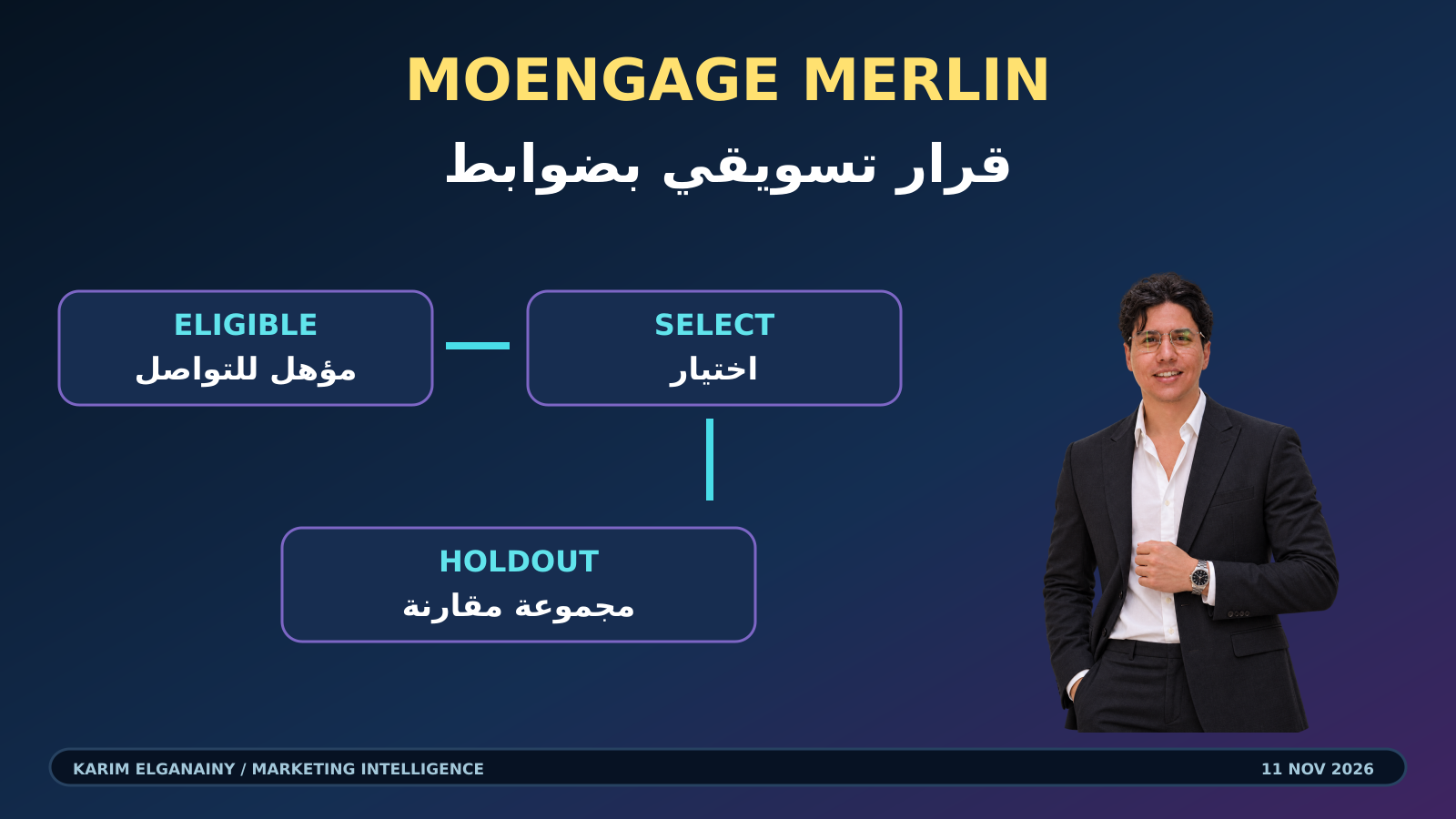
MoEngage’s latest launch puts a consequential marketing decision closer to the individual customer: which offer, message, channel and time should be chosen? The useful commercial question is broader. Would contacting this person now create enough additional value to justify the incentive, delivery cost and contact pressure? Sometimes the best permitted decision will be to send nothing.
That question should shape the pilot before optimization begins. The factual digest below covers the November 10 announcement. The remaining framework is independent editorial analysis, with clearly hypothetical arithmetic. It describes decisions a marketing team can define and test, not verified MoEngage operating procedures, independently demonstrated product results or a promise that every suggested control is available in the product.
What MoEngage announced at NEXT Autumn’26
On November 10, 2026, MoEngage announced an expanded Merlin Agent Harness, Merlin Agent and fully integrated AI Decisioning from Aampe. The Harness includes a shared workspace, Context Hub, creative generation and two-way stack connectors. The release describes Merlin Agent as identifying metric changes, diagnosing performance and proposing campaigns across MoEngage, warehouses, CRM and analytics. Decisioning is intended to learn individual preferences across offers, content, channels and timing. Source: MoEngage’s release.
These are distinct components. The living launch hub uses “Global Agent,” while the dated release uses “Merlin Agent.” Neither source establishes incremental revenue for every newly announced capability. Pricing, eligible plans, universal rollout, exact operator permissions and local-market availability were not verified. Product naming, access and configuration should therefore be checked against the actual proposal before a team commits to an implementation.
Start with the business decision, not the message
Choose a narrow decision that the organization already understands. A useful first experiment might concern whether an eligible existing customer should receive an ordinary replenishment reminder. Define the customer population, product category, decision window and permitted actions. Avoid combining acquisition, retention, cross-selling and service recovery in one pilot. Different objectives can make the same action look successful or harmful depending on which outcome is emphasized.
Write down what success means in business terms. Clicks, redemptions and orders can provide diagnostic signals, but a decision that generates more of them may still reduce value. Discount expense, fulfillment costs, returns and customer service effort can change the result. Choose a primary measure that reflects the purpose of the experiment and retain supporting measures that explain how the result occurred. Do not select the most favorable metric after the test ends.
Name the owner who can resolve trade-offs. Marketing may prefer more conversions while finance questions margin and customer care sees avoidable complaints. Agree before launch which conditions limit the experiment and which concerns require review. A clear decision owner does not remove specialist responsibilities; it prevents a weak result from being defended through whichever department happens to have the most positive chart.
Define the allowed choices before learning begins
Describe eligibility separately from predicted response. A person may be likely to click but ineligible for a particular offer because of product restrictions, service availability, an existing commitment or a suppression rule. Establish which customers, offers, channels and times are allowed before the optimization step. Confirm that the actual implementation can enforce those conditions consistently, including when upstream data is missing or arrives late.
Keep the first action set small enough to inspect. It might contain a reminder without an incentive, an approved incentive and no contact. State the qualifying conditions and limits for each action. Do not assume that adding every available discount creates a better experiment. A larger choice set increases the work needed to understand exposure, compare outcomes and identify whether the system is repeatedly selecting an expensive shortcut.
Treat inventory and serviceability as practical constraints. An attractive offer is unhelpful if the product is unavailable or the service team cannot fulfill the promised experience. Define what happens when a constraint changes after selection but before delivery. The safe operational answer may be to cancel the send or return it for review, rather than substituting a different offer whose economics and wording were never approved.
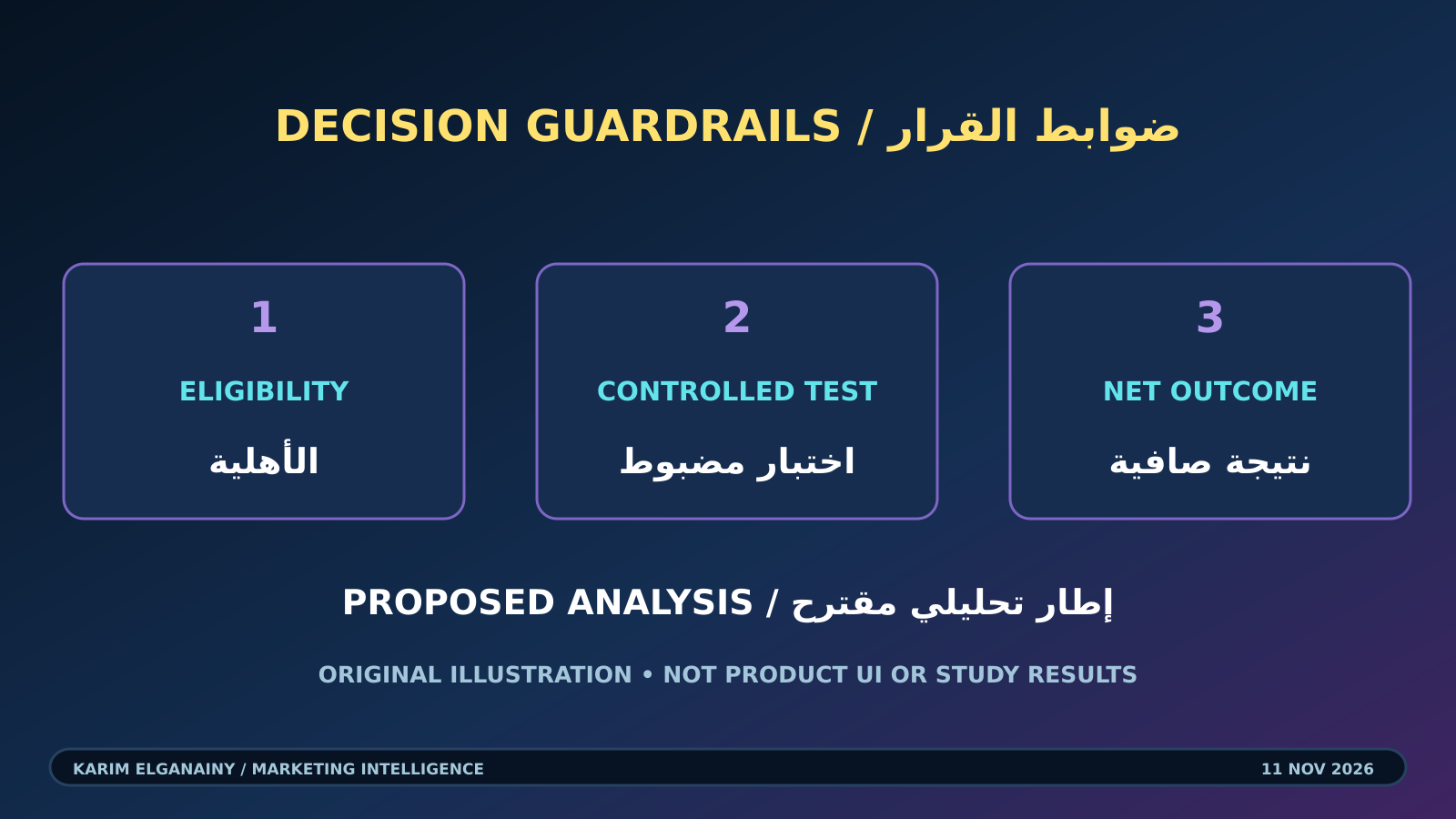
Original illustration by Karim Elganainy. Original conceptual illustration for this article: the panels show Eligibility, Controlled Test and Net Outcome. They describe a proposed evaluation sequence, not a MoEngage interface, confirmed technical architecture or measured customer result. The artwork has Arabic and English labels, explained in the surrounding localized text. Source context: announcement.
Keep no contact as a genuine option
A no-contact option asks a question that campaign reporting often overlooks: what would this customer do without this particular intervention? Someone who was already likely to purchase may redeem a discount without changing their behavior. The campaign then receives visible credit while the business pays for an action that might have happened anyway. This possibility should be tested rather than assumed either way.
Distinguish the action selected within an optimization policy from the comparison group used to evaluate that policy. If a system chooses no contact for some customers, those customers are not automatically a valid holdout for customers receiving offers. Their characteristics may differ precisely because the selection process assigned them different actions. A separate randomized comparison can estimate the effect of offering the policy to an eligible population.
Also specify what “no contact” means operationally. It may mean no message from this experiment while normal service communications continue. Record other campaigns that could reach the same customers and determine how overlaps will be handled. If the comparison group receives an equivalent promotion elsewhere, the test is answering a different question from a clean comparison between the new policy and no promotional intervention.
Calculate contribution after the incentive
Consider a hypothetical campaign, not a MoEngage customer result. A retained order leaves $20 after product, payment and fulfillment costs, but before the campaign incentive. The selected offer discounts every qualifying order by $5. Suppose 1,000 eligible customers receive the offer policy and 1,000 comparable customers form a randomized holdout. Over the defined window, the groups produce 150 and 120 retained orders respectively.
The offer group contributes 150 multiplied by $15, or $2,250. The holdout contributes 120 multiplied by $20, or $2,400. Before messaging and additional program costs, the offer group is therefore $150 lower despite producing 30 more retained orders. This deliberately simplified example assumes identical underlying order economics and that all 150 offer-group orders use the discount. Real analysis must use observed costs and redemption rather than those assumptions.
The lesson is not that incentives are always unprofitable. It is that higher conversion is insufficient evidence of profitable incrementality. Calculate contribution per eligible customer and show the components. In this example the difference is negative $0.15 per customer. Report uncertainty and the maturity of the outcomes before treating a small observed difference as a stable effect. Include continuing operating costs when deciding whether to expand the program.
Design the comparison around the eligible population
Fix the eligibility definition and assignment rule before results accumulate. Where appropriate, randomly assign eligible customers to the proposed policy and a defined comparison condition. Keep assignment stable across the evaluation window so that repeat visits do not quietly move the same person between groups. Record exceptions and implementation failures. Randomization does not repair incorrect data, inconsistent delivery or a comparison whose treatment changes without documentation.
Choose the unit of assignment carefully. A household, account or organization may contain several contacts who influence one another. Assigning them independently can allow the intervention to spill into the comparison group. The right unit depends on the business relationship and available data. Document the choice and its limitations rather than pretending every customer record represents an isolated, independent decision maker.
Agree the evaluation window before launch. A purchase recorded immediately may later be returned, canceled or refunded. A renewal can create service costs after the first payment. Report early activity as provisional and wait for the relevant outcomes to mature before claiming net value. If operational constraints require an early decision, state what remains unknown and choose a limited next step rather than presenting incomplete results as final.
Measure contact pressure beside commercial value
Track how many messages customers receive across the program, not only within the most successful campaign. A policy that improves one campaign’s response can increase the total burden on the same people. Include unsubscribes, complaints, delivery failures and requests to stop particular communications. These measures may be sparse in a small test, but they should still be inspected and considered when deciding whether expansion is acceptable.
Set contact limits and quiet periods in terms that the implementation can actually apply. Clarify the relevant time zone, treatment of multiple channels and precedence of essential service messages. Ask what happens when customer preferences conflict with a proposed send. The experiment should honor the applicable preferences and permissions rather than treating a likely response as evidence that any contact method is welcome.
Look beyond the immediate window for repeated discount use and changes in purchase timing. A short-term increase may reflect customers buying earlier or learning to wait for an incentive. These are hypotheses to investigate, not effects established by the announcement. Where the business cycle allows it, inspect subsequent behavior and cumulative contribution. A policy that appears attractive for one send may look different across several customer decisions.
Separate recommendations, execution and review
An agent that proposes a campaign, a workspace that assembles context and a decisioning system that selects an action play different roles. Ask the implementation team to map the actual handovers. Which step reads information, which produces a recommendation, which can change a live campaign and which requires an authorized operator? The announcement does not establish the exact permissions for every customer configuration.
Use a review record that connects the approved objective, eligible population, allowed actions, version of the offer and evaluation plan. When an operator changes a discount or audience rule, record the change and assess whether the experiment still supports the original comparison. This need not become a complicated bureaucracy. A concise, maintained record is more useful than a detailed launch document that becomes inaccurate after the first adjustment.
Define a pause procedure before it is needed. Identify who can stop sending, how pending actions are handled and what evidence is checked before restarting. Rehearse the process with a harmless test scenario. The purpose is to make correction practical, not to imply that an announced product is unsafe. Any system capable of applying choices at scale deserves a way to contain an ordinary configuration or data error.
Keep sensitive contexts narrowly bounded
In healthcare or other sensitive settings, begin with a clearly bounded operational task, such as a non-clinical reminder within an already permitted communication workflow. Do not treat the availability of personalization as permission to use health information for promotional targeting. The relevant specialists should review the data, purpose, recipients and applicable requirements before any pilot begins. This is a governance recommendation, not a claim of legal compliance.
Use only the information necessary for the approved decision. A reminder’s delivery status may be operationally useful without transmitting the content of a private conversation into marketing analytics. Separate aggregate commercial reporting from records that require restricted handling. When the team cannot explain why a field is necessary, remove it from the proposed test until its role and permitted use have been established.
The same discipline improves ordinary retail experiments. Clear data ownership, defined retention and understandable customer choices make it easier to diagnose an unexpected result. The objective is a bounded, inspectable decision process whose costs and consequences can be assessed. More context is useful only when it is appropriate to use and actually improves the decision being tested.
Expand only the decisions supported by evidence
At the pilot review, compare net contribution, contact pressure and operational reliability together. Explain the assignment method, observed exposure, outcome maturity and remaining uncertainty. A result may justify expanding one reminder policy without authorizing additional products, incentives or channels. Treat each material expansion as a new decision about applicability, rather than assuming a favorable average transfers to every part of the customer lifecycle.
MoEngage’s announcement makes individual-level choice a timely topic for marketing leaders. The strongest response is to define what the business is willing to offer, preserve a credible comparison and count what remains after the incentive and service costs. A useful decisioning system should earn trust by improving a permitted, measurable decision, including the decision to leave a customer alone.
Comments
No published comments yet.