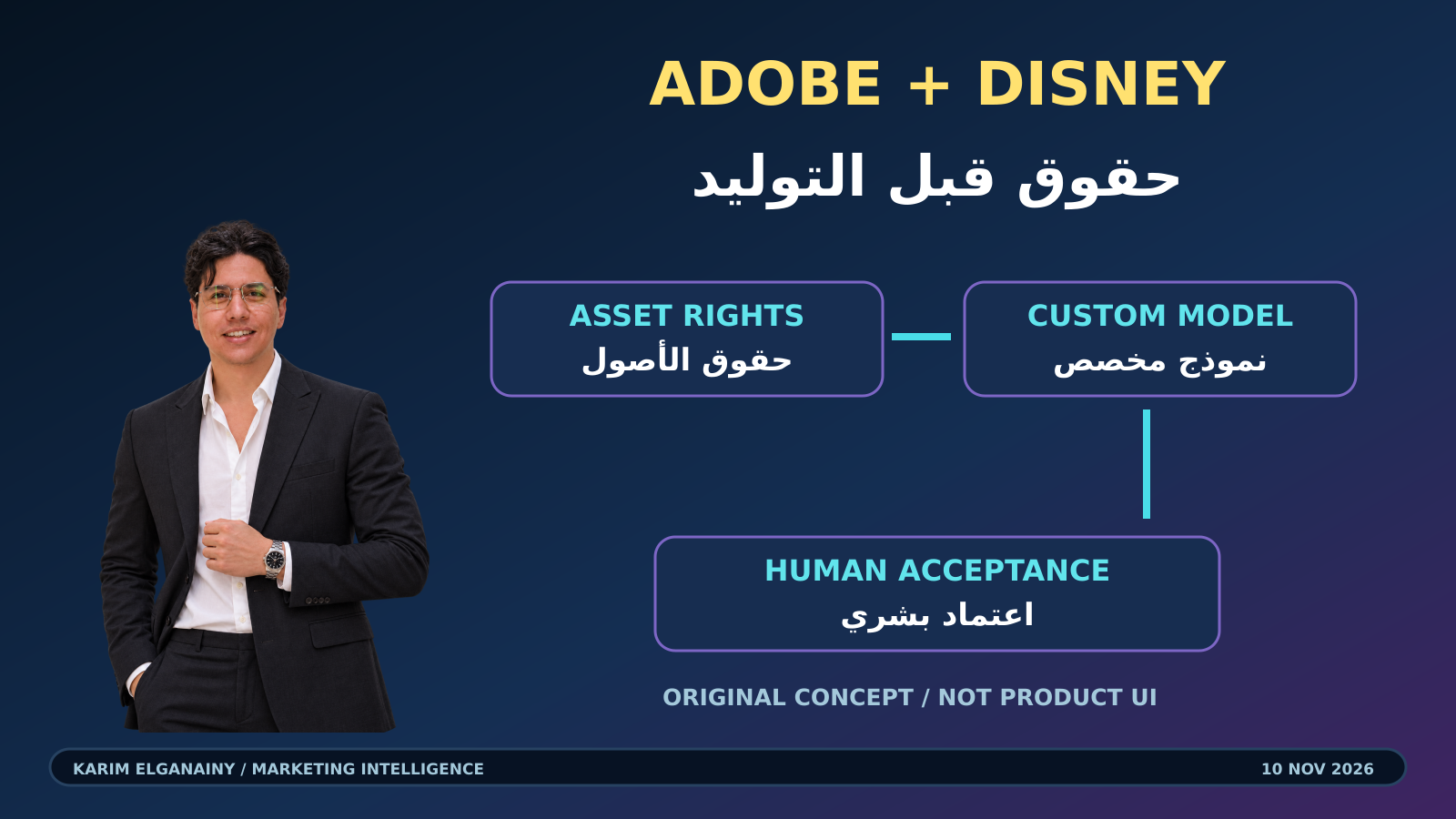
Adobe and Disney’s new alliance puts a familiar marketing challenge into a different production setting: how can a company make more creative options while retaining control of the properties, standards and decisions that make those options usable? The announcement is significant because it links tools, engineering support and company-specific models. It does not establish a ready-made operating model for every brand.
For marketing leaders, the useful response is to separate the reported agreement from the decisions their own organization would need to make. The following factual digest covers the announcement. The remaining sections are independent practical analysis, not a description of Disney’s internal procedures or a recommendation supplied by either company.
What Adobe and Disney actually announced
In its November 9, 2026 announcement, Adobe described a multi-year strategic alliance with The Walt Disney Company spanning technology collaboration and marketing activations. Adobe becomes an Official AI Innovation Partner. The agreement includes early access to Firefly, Firefly Foundry, Premiere and Photoshop, together with engineering and research support. The companies will develop proprietary AI models tailored to Disney properties.
Some work already exists. Adobe says Walt Disney Imagineering research and development uses a sketch-to-image model and a custom image model in theme-park concept development. The announcement also identifies projects underway with StudioLAB and ESPN Edge, with additional activations planned during the alliance. Those statements should not be collapsed into a claim that every planned application has launched.
The release gives no contract value, exact duration, general customer launch date or quantified return on investment. Claims about creative benefits, productivity and commercial safety remain company assertions rather than independently measured outcomes. This is a Disney-specific relationship, not public access to Disney models or a general license to use Disney characters. Source: Adobe’s announcement.
Start with a job small enough to evaluate
A custom model becomes easier to assess when the first task has a clear input, useful output and named reviewer. “Transform our creative production” is too broad to test. A narrower example is preparing initial composition options for an existing campaign format, using approved assets and a fixed brief. The purpose would be to help a designer choose a direction, not to authorize finished public advertising.
Record the current process before introducing the tool. Identify who receives the brief, where source material comes from, how many review stages occur and what commonly sends work back. If a brief changes repeatedly or approval ownership is unclear, a model may generate additional work without removing the actual delay.
Select a task with enough repetition to compare similar assignments, but keep the initial use limited. A sporadic, highly sensitive launch may be a poor first experiment even when it has a large budget. The decision is about the suitability of the work, not the prestige of the campaign.
Make asset rights part of the production record
An asset library should answer practical questions before it feeds a model or a generation request. Who owns the material? What use does the relevant agreement permit? Does that permission cover the proposed AI activity? Are there limits involving market, channel, duration, modification or third-party material? Contract interpretation belongs with the responsible legal or rights specialist, rather than an assumption made by the production team.
Store the answers with an identifiable asset version and an accountable owner. A folder marked “approved” is inadequate when its contents include different licensing conditions. Separate assets cleared for the specific experiment from material that is awaiting review. When permission is uncertain, exclude that material until the uncertainty is resolved.
Rights review also needs a maintenance step. A replacement image, revised agreement or expired permission can change what a previously acceptable workflow may use. Define who updates the record and how that change reaches people preparing briefs. A useful library is a maintained operating resource, not a one-time collection exercise.
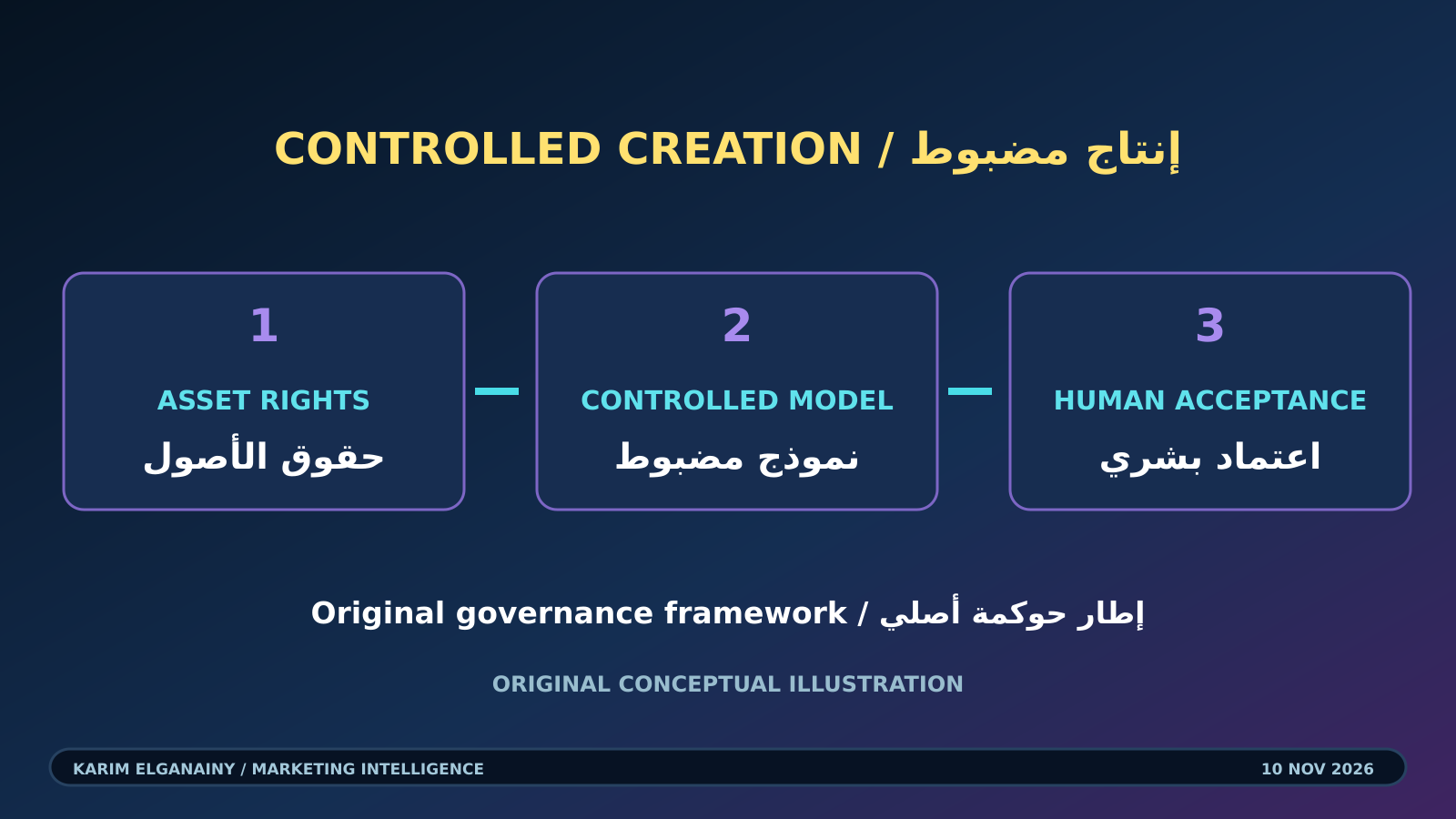
Original explanatory diagram proposed for this article, not an Adobe interface or an official Disney workflow: documented asset rights → controlled model → human acceptance. It illustrates the analysis below rather than a confirmed technical architecture. Announcement context: Adobe.
Turn brand guidance into acceptance criteria
A visual identity guide may describe color, composition and tone without specifying how a generated option will be judged. Convert those principles into observable review questions. Does the product retain its correct shape? Is the logo treatment permitted? Does the image imply a feature the product does not have? Can the team edit the result without rebuilding it? A visually polished output can fail any of these checks.
Use examples of acceptable and unacceptable work to align reviewers before the experiment. Include difficult cases rather than only obvious errors. Two reviewers may disagree about whether a composition feels appropriate; documenting the reason makes that disagreement useful for future briefs.
Keep distinct decisions separate. Brand consistency, factual accuracy, technical quality and usage rights are different assessments, even when the same person handles more than one. Avoid reducing them to a single score that hides a critical failure. A rights problem or an inaccurate product claim should not disappear because the image performs well on visual appeal.
Assign responsibility at each handover
Map the path from request to accepted asset. A practical sequence is brief approval, source selection, generation, creative editing, specialist review where needed and final release approval. This sequence is an editorial recommendation; the announcement does not disclose Disney’s detailed approval process.
At each transition, name the person or role that can accept the work and the information they need. The designer should receive an approved brief and cleared source material. The reviewer should see the candidate asset, intended placement and relevant claims. The publisher should receive an identifiable approved version, not a folder containing several similar exports.
Plan a return route as carefully as the forward route. If a reviewer rejects a result, record whether the problem came from the brief, source selection, generation or later editing. Otherwise, teams may repeatedly change prompts to solve a problem that actually requires a new brief or different permissions. The model can propose options; responsibility for approving and releasing them remains explicit.
Measure the time to accepted work
Generation speed is only one component of production. Measure the time from a usable brief to an accepted asset, including waiting, review and rework. Compare the experiment with similar work completed through the current process. Keep the brief, placement and acceptance standard as consistent as reasonably possible, and describe any differences that make the comparison imperfect.
Track how many candidates enter review, how many are accepted, why others fail and how much editing accepted work requires. A team producing more files may still deliver fewer usable assets. Conversely, an experiment may be worthwhile if it improves exploratory work without reducing final production time. State which benefit was actually observed.
Do not quietly change the quality threshold to produce a favorable result. Review a sample against the original standard, preferably without telling reviewers which process produced it when that is practical. Record disagreement rather than deleting inconvenient assessments. Small pilots cannot establish universal performance, but they can reveal where the workflow needs attention before additional spending.
Count the cost of an accepted asset
A useful cost view includes more than software charges. Account for preparing and maintaining the asset library, specialist review, model or workflow setup, integration, staff training, creative editing and rejected work. Distinguish initial setup from continuing operating costs so that the first pilot is not mistaken for the mature process, or vice versa.
Use a simple definition consistently: total attributable production cost divided by the number of accepted assets. Explain which costs are included and whether an asset must actually be used to count. An approved option that stays in a folder may have exploratory value, but it should not automatically be treated as delivered campaign inventory.
Avoid forecasting savings from the Adobe–Disney announcement, which provides no quantified ROI. Estimate the organization’s own costs using its own observed process, and label forecasts as forecasts. If faster concept development creates more downstream editing, the budget should show both effects. The economic question is whether the complete workflow creates useful work at an acceptable total cost.
A hypothetical healthcare marketing example
Consider a healthcare organization preparing general educational campaign visuals about how to find information on its website. This is a hypothetical use case, not a project described in the announcement. The team could test initial layout options using its own cleared illustrations and approved public wording. No patient records, identifiable patient images or confidential clinical material would enter the experiment.
The creative reviewer would check identity, readability and accessibility. A qualified content reviewer would separately check any health-related statements and whether the visual could imply an unsupported clinical outcome. A layout that passes brand review would still wait for that content decision before publication.
The team would compare time to approval, the extent of corrections and the usefulness of the final materials. If generated imagery repeatedly introduces misleading clinical details, restricting the tool to nonclinical composition exploration may be more appropriate than expanding its role. Any real implementation would require the organization’s privacy, legal and relevant professional review; this example is not a claim of regulatory compliance.
Ask procurement questions that connect to use
A vendor discussion should begin with the proposed job and the assets it needs, rather than a broad request for “enterprise AI.” Ask how the organization can define permitted inputs, control access, review outputs and keep records of approved versions. Request clear explanations of data handling, retention and the conditions governing customer material. Do not assume a customized model answers these questions automatically.
Clarify what the supplier supports and what the organization must operate itself. Engineering support, integration work, ongoing maintenance and reviewer training can have different owners and costs. Establish how changes to the system will be communicated and how a team can reassess quality after a material update.
The announcement signals a substantial relationship between two large companies. It does not establish the same service package, commercial terms or access for other buyers. Treat it as a reason to ask better questions, not as evidence that a smaller organization should buy an equivalent arrangement or that a particular product is available under identical conditions.
Set conditions for expansion and stopping
Agree before the pilot what would justify a broader rollout. Useful conditions could include stable acceptance quality, a manageable review burden, clear rights records and a demonstrable benefit for the selected task. The organization should choose thresholds appropriate to its work rather than borrow an unsupported industry benchmark.
Define stopping conditions too. Unresolved rights questions, repeated factual mistakes, unclear ownership or review effort that exceeds the benefit are reasons to pause and repair the process. Preserve the findings even when the answer is to continue using the existing approach. A pilot that prevents a poor investment has still produced a useful decision.
The Adobe–Disney alliance makes company-specific creative AI a concrete subject for marketing planning. Its most practical lesson is the need to connect assets, tools and human acceptance in one accountable process. Brands can begin that work without assuming access to Disney’s models, predicting unreported savings or treating an attractive generated image as a finished marketing asset.
Comments
No published comments yet.