
The announcement and its date On November 3, 2026, Reddit announced an initial test of advertising placements in search results for selected eligible advertisers. It identifies relevance to a user's query as one factor in ad appearance. The announcement establishes a limited test, not general availability or proven performance. [Reddit announcement](https://redditinc.com/news/we-are-testing-ad-placements-in-reddit-search-pages?hsLang=en)
Community search carries a particular context The following is independent strategic analysis, not a report of an advertising-account trial or a performance forecast. Someone searching within a community may want other people's experiences, a comparison of alternatives or an explanation of a problem. Those intentions differ from an immediate desire to purchase. A media plan should not classify every search as ready-made demand. Start by understanding the question the person is trying to answer, then provide information that helps them evaluate the offer honestly.
Search can be viewed as a moment when the user needs evidence. An advertisement that repeats a brand slogan without useful information may add noise. One that explains suitability, limitations and how a claim can be checked may offer more value. That is a testable strategic proposition, not a reported result for the new placement. Actual response must be measured; context alone cannot compensate for a weak offer, missing trust or an unclear next step.
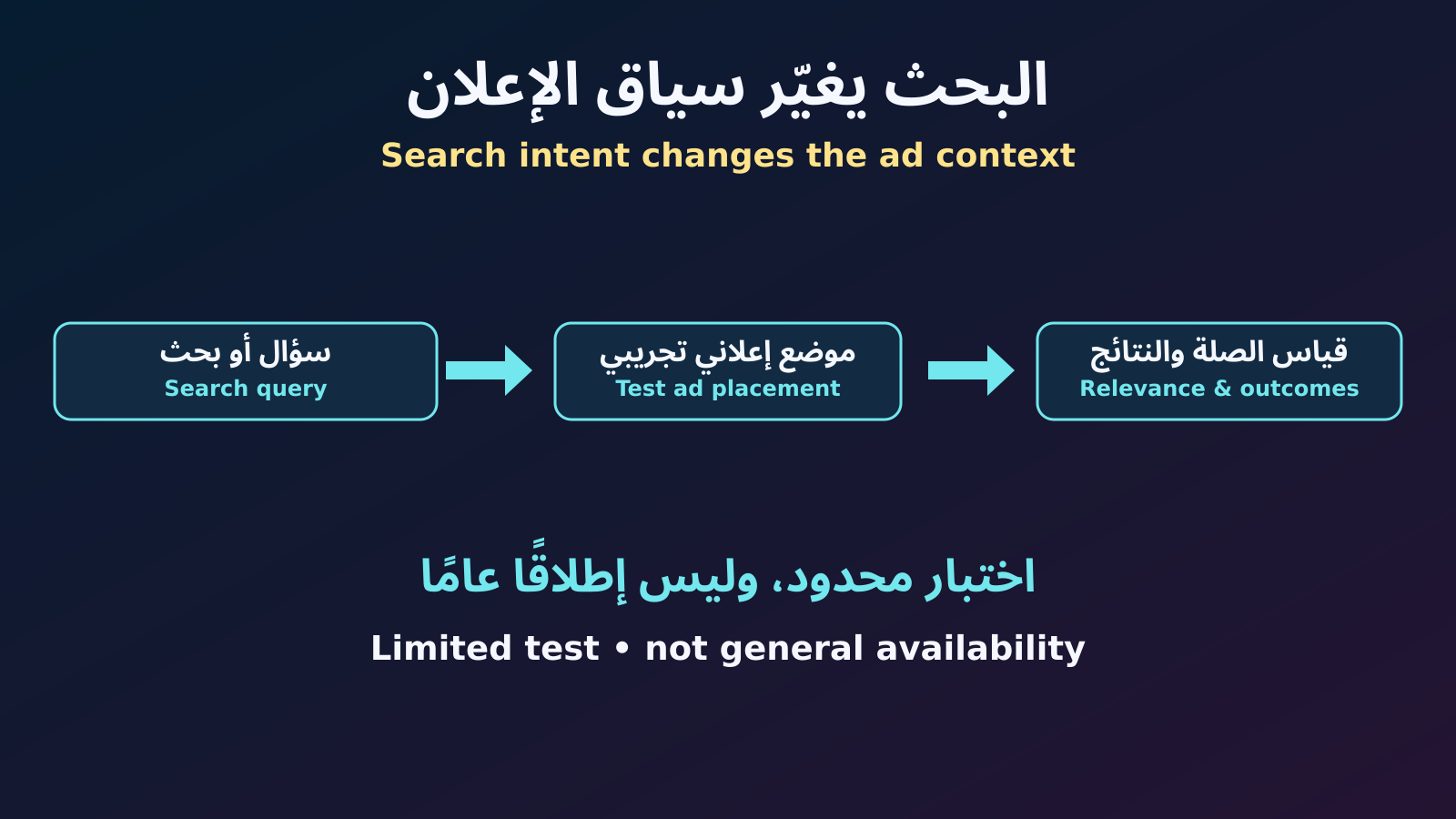
Original editorial illustration, not a product screenshot or evidence of campaign outcomes. Based on the source.
Distinguish learning from buying Before developing creative, separate likely questions into learning, comparison, troubleshooting and supplier selection. A question about choosing a device differs from a question about a specific model's price or a fault after purchase. Each deserves suitable content and a suitable destination. Not every interaction needs a lead form. A transparent comparison or a short selection guide may be closer to the user's need, especially where the decision is expensive, unfamiliar or operationally complex.
Teams can research recurring public questions through permitted sources without copying personal stories or assembling profiles of individuals. The purpose is to understand topic-level language and concerns. Connect each group of questions to something the business can substantiate. If people ask about maintenance costs, a purchase discount does not answer them. If service terms are unclear, a detailed explanatory page may be more valuable than more enthusiastic copy or an expanded target audience.
An illustrative business-service scenario Imagine a scheduling-software company seeking managers who want to reduce missed appointments. This is a hypothetical example, not a published Reddit campaign. A useful page could explain reminder steps, integration requirements, where employees remain involved and where customer permission is needed. It can show an illustrative workflow without claiming a particular improvement rate. The visitor can then assess practical suitability before committing time to a sales conversation or sharing business information.
One message might explain reminder mechanics, while another introduces questions to ask before selecting a system. This example does not establish that the current placement supports every targeting or testing configuration a team might imagine; account capabilities must be checked. Its purpose is to organize the proposition and measurement. The meaningful outcome is not clicks alone, but inquiries matching the supplier's service scope and customer profile that progress into useful commercial conversations.
Do not budget around unconfirmed availability Because the announcement concerns a limited test, the first execution step is to confirm eligibility and settings in the account or through an authorized support route. Do not promise a launch date or sales target dependent on an unconfirmed placement. The team can still prepare messages, landing pages and measurement criteria. These are useful assets even before access. A spending commitment should wait until the team understands what can actually run and under which conditions.
Separate readiness from purchasing. Readiness means understanding the audience, preparing a coherent journey and validating measurement, all of which may help other channels. Buying depends on availability, cost, restrictions and the ability to learn from the trial. This distinction avoids both paralysis while waiting for access and an unsuitable substitute chosen merely to demonstrate activity. The commercial objective should remain stable even when the tools available to serve it change.
Build the message around evidence and limits People comparing others' experiences may be particularly alert to exaggerated promises. A destination should offer verifiable information: specifications, conditions, practical examples, clear steps and answers to objections. State limitations where they help the decision. Concealing a constraint can increase early response while creating unsuitable inquiries or cancellations later. Good marketing also helps people recognize when the offer is not right for them before both sides invest substantial time in an avoidable mismatch.
Do not imitate an independent user's voice or imply an unsolicited endorsement that does not exist. A brand can identify itself openly and still contribute useful information. A genuine customer example requires appropriate permission and context that preserves its meaning. A public comment should not be removed from its context and converted into a commercial recommendation. These editorial principles apply regardless of the advertisement's format or the targeting sophistication available in the account.
Answer the question before requesting information A useful landing page begins with an answer connected to the user's question, then provides evidence and a clear next step. The visitor may need a comparison, total cost, implementation requirements or service limitations. Avoid forcing a form submission to obtain basic information that could be published openly. Invite contact when the answer genuinely depends on the prospect's circumstances. This balance can improve the later conversation and reduce the sales team's burden of sorting unsuitable inquiries.
Check the page on a phone, including loading behavior, language clarity, navigation and functioning links. The advertisement and destination should describe the same offer rather than introducing unexpected conditions after the click. For bilingual journeys, translating a headline while leaving key terms in another language is insufficient. Users should be able to understand pricing, eligibility and contact steps in the language that brought them to the page, with equivalent meaning across both versions.
Run a bounded commercial experiment Once access is confirmed, begin with one topic, a clear outcome and an approved test budget. The objective might be qualified conversations for a defined service rather than maximum traffic. Agree in advance on qualification criteria, how sales will record outcomes and when the evidence will be reviewed. Do not invent a success threshold without reference to business economics, follow-up capacity and existing-channel experience. A new channel may also require learning before a fair commercial assessment is possible.
Keep core elements stable enough to interpret the result. Changing the offer, page and audience together obscures the source of any difference. Record adjustments and reasons without chasing every daily fluctuation. Fewer clicks may be acceptable if inquiry fit improves, while more clicks may be unhelpful if they represent needs the business cannot serve. Connecting an inquiry to its eventual outcome is more useful than celebrating an isolated early metric disconnected from the actual sales process.
Explain what the metrics can establish Clicks and visits are useful observations, but they do not independently prove new commercial demand. Add accepted inquiries, relevant meetings, progressing opportunities and eventual outcome cost where the sales cycle permits. Keep stages separate so that all form submissions are not presented as sales opportunities. In a long sales cycle, early reporting measures the quality of the beginning; revenue judgment requires more time. That distinction should appear in the management report rather than remain an informal caveat.
The new channel may overlap with others in a customer's journey. A person could see an advertisement elsewhere, search, read and contact the business later. Adding every platform's attributed conversions can therefore overstate total outcomes. Review attribution definitions and, where appropriate, record a voluntarily supplied source of awareness during contact. Compare overall business trends as well. When incremental impact cannot be established, say so explicitly instead of allowing an encouraging platform report to become a causal claim.
Apply additional care in healthcare People may discuss health experiences in communities, but that does not authorize an advertiser to infer their diagnoses or exploit their concerns. Do not assemble patient stories into targeting profiles or promise unsubstantiated treatment outcomes. General content can explain a service, visit process or questions to raise with a qualified professional. Individual clinical questions belong with appropriate professionals. Review relevant advertising requirements, platform rules and privacy obligations before launching a healthcare-related campaign.
Even a professional or organizational audience requires care with forms and analytics. Request only information needed for the stated contact purpose, and avoid collecting clinical details on a marketing page unnecessarily. Review tracking events so they do not expose sensitive personal information through labels, parameters or payloads. Marketing, technology and privacy teams should share responsibility for this inspection. A well-written advertisement cannot compensate for an inappropriate data flow occurring after the visitor reaches the site.
Establish local fit rather than assuming it A platform's popularity in one market does not demonstrate a suitable audience for a local service in Riyadh, Jeddah or Dubai. Check geography, language, reachable scale, relevant topics and the business's ability to serve resulting inquiries. An internationally oriented company may find a different opportunity from a tightly local operation, but that remains a hypothesis requiring evidence. Do not transfer another market's response rates into a local forecast without explaining the material differences.
My strategic recommendation is to prepare a more useful conversation with the searcher rather than simply wait for another advertising slot. Build a question map, a clear destination and a qualification measurement process, then test access when available. Expand gradually if evidence supports audience fit and reasonable economics. Otherwise retain what the experiment taught about messages and the customer journey and apply it in a better-suited channel. A disciplined trial can improve understanding without requiring an automatic increase in spending.
Comments
No published comments yet.