The announcement is about formats, not proven outcomes
A Samsung Ads press release published on November 12, 2026 announces polls and surveys, product carousels and QR codes launching in November across Samsung TV Plus and the Samsung home screen. This article is analysis dated November 15. The announcement identifies new interaction opportunities; it does not establish a sales result for the new formats. Earlier-format tests and separate supplier research should not be imported as their performance benchmarks.
The useful marketing question is what a viewer's action actually means. A vote, a product browse and a phone visit are different responses, even if a dashboard places them under engagement. The original framework below proposes a hypothetical evaluation plan, not a report of a campaign we ran. Its purpose is to connect each interaction to a decision the business can defend, without mistaking an easier action for a more valuable outcome.
Give each format one decision to support
Begin with a short statement of the uncertainty the campaign should reduce. A poll might investigate which product explanation attracts voluntary responses. A carousel might test whether viewers explore a relevant assortment. A QR destination might help interested people continue on a phone. These are proposed uses, not claims about specific reporting fields or functionality available in every account. Confirm the implementation before promising that a format can answer the question.
Do not launch all three simply because they are offered together. Choose the interaction that matches the immediate decision and the team's ability to follow through. If the commercial problem is an unclear offer, more response mechanisms may produce additional confusion rather than better evidence. Write what the team would change if the test succeeds and what finding would make it reconsider. A format has a useful role when its result can inform a concrete choice.
Design a poll without pretending it is the market
Keep the question understandable without a long introduction. Ask about one idea and make the available responses meaningfully distinct. Avoid wording that praises the brand before asking for a preference. Give people a reasonable way not to answer, and verify what the actual format supports. A viewer who does not respond may be uninterested, distracted or unable to interact at that moment; silence is not a reliable vote against the product.
Treat respondents as a self-selected group. Their answers can inform a creative hypothesis without representing all viewers or customers. Record the question, response options, placement and period alongside the result. If wording or options change, retain the earlier version rather than combining incompatible responses into a single trend. This is an original research recommendation, not a claim that the new format provides a representative survey sample or removes the need for methodological review.
Make a carousel clarify choice rather than multiply it
A product assortment needs a visible organizing principle. Select items that belong to a coherent buying question, such as different uses within one category, rather than filling every available slot. Make the differences legible at television viewing distance. Check that names, images and descriptions refer to the same offer. A visually attractive collection that hides essential distinctions can generate browsing without helping anyone decide what is relevant.
Document item order as part of the test. An item placed first may receive more attention because of its position, not because it is inherently preferred. Where the implementation permits, compare alternative ordering carefully; otherwise acknowledge that limitation. Do not label a frequently selected card the best-selling product without separate transaction evidence. The practical output is an understanding of exploration under defined presentation conditions, not an unrestricted ranking of customer demand.
Treat the QR scan as a handoff
Before showing a code, decide what the viewer should receive after scanning. The destination should continue the promise made on the television, not restart the relationship with an unrelated homepage. Make the next step clear and proportionate: inspect details, compare options or submit an appropriate enquiry. This is a proposed design principle, not a guarantee that a particular scan will identify a person or connect to a transaction.
Test the complete journey on representative phones and networks using non-sensitive test data. Check loading, readability, the destination language and whether the offer remains available. Also provide a usable experience for someone who arrives without remembering the advertisement. A successful scan followed by a confusing page is a failed handoff even if the media report records an interaction. Assign ownership of that page before launch so that problems do not fall between creative and web teams.
Keep interaction and outcome on separate lines
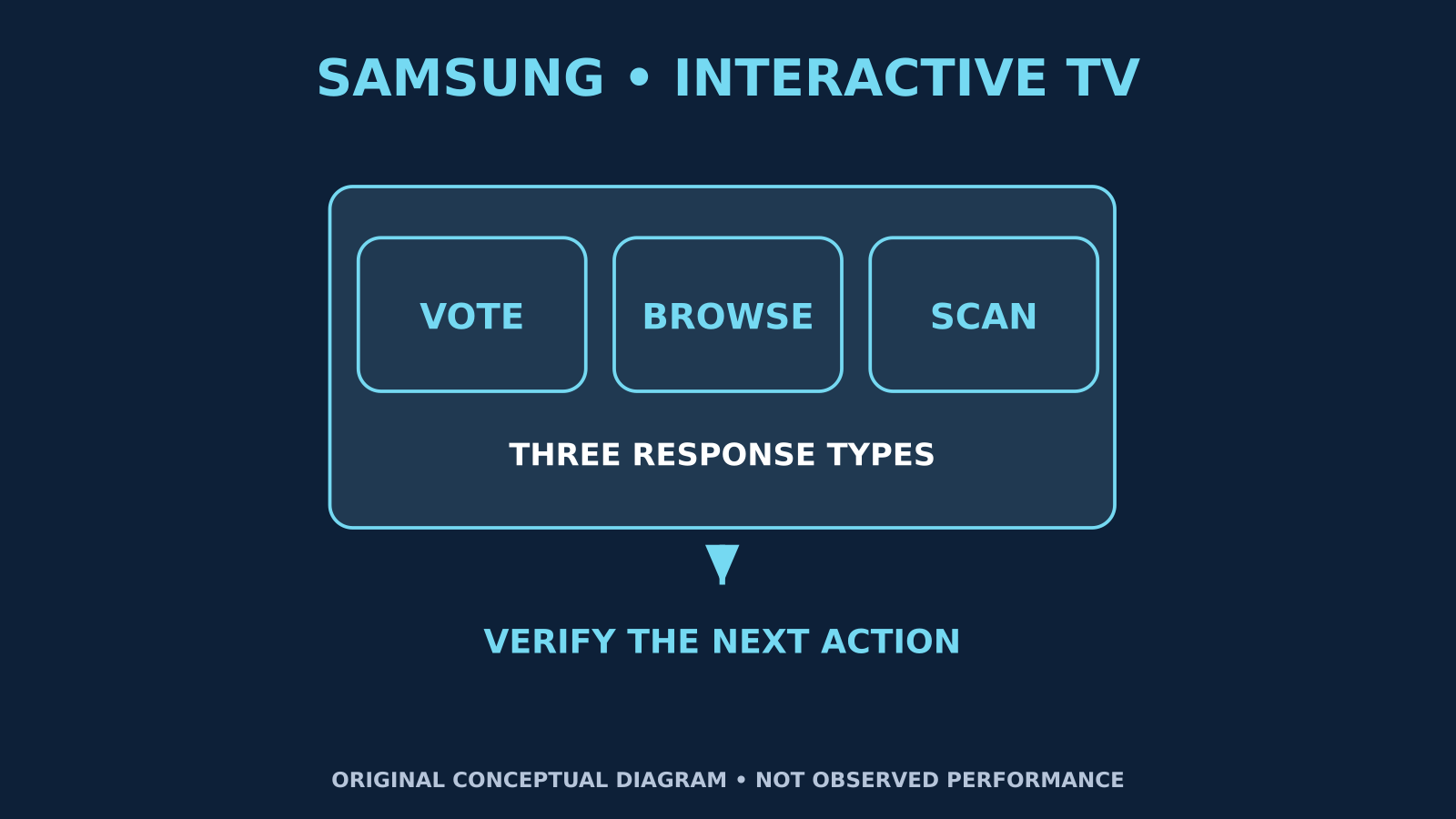
Original explanatory diagram, not a Samsung interface or measured campaign result. VOTE, BROWSE and SCAN name distinct responses; VERIFIED ACTION means a useful action has been checked. The arrows do not guarantee that every response produces an outcome: the connection requires evidence. The issuer announcement supplies the news context only. The illustration does not describe guaranteed platform reporting, personal identity matching or a path every viewer follows.
Use a small event dictionary that states what each measure means and where it comes from. A displayed invitation, selected response, destination arrival and completed action should not share one ambiguous label. Record whether counts describe events, sessions or people. When systems cannot reliably connect stages, report the gap. Do not repair missing evidence by assuming that every destination visitor came from the television or that every repeated response represents another interested customer.
Preserve denominators in an illustrative report
Imagine a hypothetical test with 1,000 eligible invitations and 200 recorded interactions. The interaction rate is 20%. If 80 destination visits are separately recorded, they are not automatically 80 identifiable people or proof that all arrived from those interactions. Suppose 10 qualified enquiries are verified within those visits: 10 divided by 80 is 12.5%, using visits as the denominator. These invented figures teach reporting, not expected Samsung performance.
Keep the distinction between a within-stage rate and a connected funnel. The example does not establish that the same individuals moved through every step, nor that the campaign caused every enquiry. A reviewer should see the counts, definitions and unresolved links together. If the commercial team removes duplicates or disqualifies an enquiry, update the outcome count without rewriting the original media events. Honest reconciliation is more useful than a tidy funnel built from incompatible units.
Separate home-screen and programme-context learning
Two surfaces may invite different behavior even when they display related creative. Design the reporting question around context: was the person choosing something to watch, already watching content or encountering the message in another documented setting? Do not assume that a response rate difference proves one surface is intrinsically better. Audience composition, opportunity to respond and presentation can differ. Confirm the placement definitions actually available before building a comparison around them.
Keep surface-level results visible and ask how overlap is handled before reporting combined reach. Adding two reach totals does not necessarily produce a unique audience total. If deduplication is unavailable or its scope is unclear, state that limitation instead of inventing a unified number. A combined campaign can still be operationally useful, but its interpretation should reflect what the measurement can support rather than the appeal of describing an entire television ecosystem.
Build a comparison around the mechanism
Choose a comparison that isolates the question as far as practical. If testing whether interaction improves understanding, keep the underlying message and offer similar rather than changing the product, creative and destination together. Seek a controlled design when feasible and appropriate. If the test is observational, call it observational and document differences between groups. No universal sample size, duration or uplift target is implied by this framework.
Specify success before looking at results. A poll with many responses may fail if people misunderstand its question. A carousel may improve exploration while increasing confusion about price or availability. A QR execution may create visits that the destination cannot serve. Include a check of comprehension or relevance alongside activity where suitable. Otherwise, optimization can reward the easiest observable action while quietly worsening the experience the campaign was supposed to improve.
Limit the data to the task
Collect only information needed for the stated purpose and review any connection between media interaction and customer records before using it. An interaction is not blanket permission to contact someone or reuse their details elsewhere. Keep reporting access limited to the people responsible for the decision. Use approved storage and agreed retention practices, and involve the appropriate internal specialists when the planned collection or sharing is unclear.
In a hypothetical healthcare-service campaign, administrative information can be explained without asking viewers about symptoms, treatment or personal medical history. Use synthetic material for testing and avoid turning a poll into a collection of sensitive disclosures. This is a design boundary, not a legal or clinical conclusion about the product. If a useful marketing question cannot be answered within an appropriate data scope, change the question instead of expanding collection merely to make the report richer.
Budget for the whole response experience
Evaluate media, creative adaptation, destination maintenance, measurement and follow-up together. A format that produces more interactions may also create additional review or support work. Record that work rather than presenting it as free because another team absorbs it. Compare the proposed pilot with a realistic alternative, such as improving the offer explanation or the mobile destination before purchasing more exposure. The best next investment may be outside the ad unit.
Agree on practical stop conditions and a person who can act on them. An incorrect product detail, broken destination, unavailable offer or unexpected data collection should trigger review before spending continues. Preserve the original configuration and a way to revert changes. These are recommended operating controls, not findings that Samsung's formats have these problems. A reversible pilot protects both the customer experience and the credibility of the evidence collected while it runs.
Decide what to repeat, revise or stop
At the end, write a decision brief rather than a celebration of interaction volume. State what was offered, who could respond, what was observed and which business outcome was verified. Keep uncertain links explicit. Recommend repeating the test only where the useful result and its operating cost justify it. Revise the part that failed instead of treating one weak destination as proof that every interactive television format is ineffective.
The strategic opportunity is not to make every viewer press, browse or scan. It is to offer an action that fits the moment and leads somewhere worthwhile. Separate voluntary response from representative research, exploration from preference and destination activity from incremental business effect. Samsung's announcement opens possibilities for experimentation; the advertiser still has to earn its conclusion through clear definitions, appropriate comparison and a customer experience that remains useful after the interaction ends.
Comments
No published comments yet.