A signed agreement, not a completed acquisition
On November 13, 2026, Wolters Kluwer Health announced an agreement to acquire AgileMD for up to $100 million: $40 million upfront, with the remaining consideration dependent on performance targets. The company expects completion in the first quarter of 2027 or sooner, subject to closing conditions. Its stated direction is deeper integration of clinical knowledge into healthcare workflows. The announcement is not confirmation that the transaction has closed or that a combined product is available. Sources: company announcement and issuer press release (PDF).
AgileMD’s own product description presents clinical pathways and predictive decision support within clinical workflows. These are supplier descriptions, not independent verification of outcomes in a particular institution. This November 15 analysis does not evaluate treatment, recommend clinical decisions, or report a customer implementation. The framework below is original commercial and operational analysis for healthcare growth, procurement and communications teams.
Original framework: separate evidence, workflow and measurement
An acquisition announcement can create attention before it creates customer value. A growth team should therefore build three separate files. The evidence file records what a proposed capability is supposed to do and which claims have adequate support. The workflow file explains who would use it, at what moment, and with whose approval. The measurement file defines what the organization would count before making a claim about value. An impressive presentation cannot substitute for any of these files.
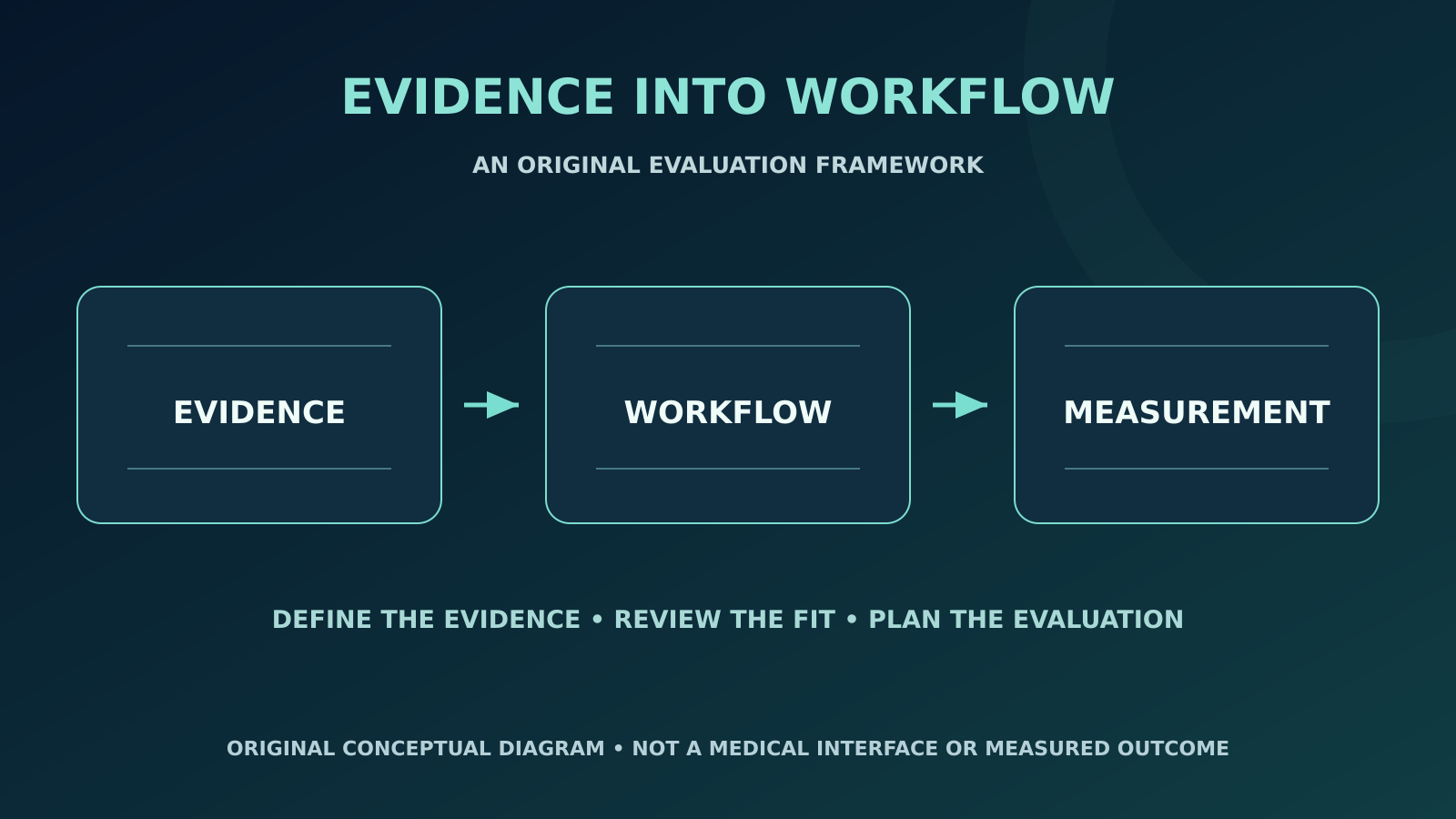
Original conceptual diagram: EVIDENCE means support for a claim; WORKFLOW means the local process in which a capability would be used; MEASUREMENT means a defined evaluation. The labels are analytical categories, not a product interface, integration architecture or demonstrated result. Announcement context: Wolters Kluwer.
Start with the buyer’s unresolved problem
A useful discovery conversation begins with a specific operational problem, not with the word AI. Ask which handoff repeatedly causes confusion, which information staff struggle to locate, and which approval process makes change slow. Record the answer in language that the operational owner recognizes. If the buyer says that staff cannot find the current approved material, a proposal about broad automation may be answering the wrong question.
Different participants may describe different problems. A growth leader might want a clearer service proposition, an implementation manager might want predictable onboarding, and a clinical owner might need controlled content updates. These are related but not interchangeable. The commercial team should write a shared problem statement and identify disagreements before designing a demonstration. Otherwise, a positive response from one stakeholder can conceal an unresolved objection elsewhere in the buying group.
Sell a bounded use case, not an unlimited transformation
A hypothetical first evaluation could focus on whether authorized staff can find the current approved workflow material and identify its owner. This is an administrative evaluation design, not a recommendation about medical care. Its scope should specify participating roles, the environment used, the material included and the questions excluded. It should also state which existing process remains authoritative while the evaluation runs.
A bounded proposal is easier to reject honestly and easier to improve intelligently. If the relevant material cannot be versioned reliably, the team has learned something important before promising a wider rollout. If the demonstration succeeds only with a specialist guiding every click, that dependence belongs in the implementation plan. Commercial qualification becomes stronger when the proposal exposes the work required rather than hiding it behind a broad transformation narrative.
Map ownership before mapping screens
Create a responsibility map before discussing interface design. Identify who owns the content, who approves revisions, who manages access, who handles technical issues and who can suspend the evaluation. One person can hold several responsibilities, but none should be left implicit. The map should include a substitute when the usual owner is unavailable and a clear route for questions that cross team boundaries.
This matters commercially because an unowned dependency can become a delayed contract, a stalled implementation or an avoidable support burden. A sales plan should therefore include operational readiness alongside budget and interest. Ask prospective customers to confirm that the necessary owners can participate. A smaller opportunity with clear ownership may be more implementable than a larger opportunity whose sponsors agree on ambition but not on who will do the work.
Ask for evidence at the level of the proposed claim
A claim about access to information needs different evidence from a claim about staff time, and neither automatically supports a claim about patient outcomes. Build a claim register with the proposed sentence, its intended audience, the supporting material, the limitations and the reviewer. Unsupported language should remain an internal hypothesis, not quietly move into a landing page or sales deck.
Evidence also has boundaries. A study or customer example may concern a different version, setting, implementation or population. A buyer should ask whether those differences matter for the proposed use. This article does not establish that any particular published result transfers to another institution. The practical commercial discipline is to preserve the distinction between a supplier’s evidence portfolio and the specific promise a seller is asking a new customer to believe.
Treat integration as work that must be scoped
A demonstration can show a coherent journey without proving that a customer’s environment can reproduce it. Request a written account of dependencies, access requirements, configuration, testing, maintenance and support responsibilities. Distinguish capabilities available now from capabilities proposed for a future combination. Do not infer a delivered integration merely because two businesses have announced a transaction.
For an evaluation, use approved test materials and an environment appropriate to the question being asked. Record what is simulated, what is connected and what remains untested. A demonstration using synthetic information can answer interface and process questions without proving production reliability. The sales team should describe that limit clearly. Honest boundaries protect the customer from buying an assumption and protect the implementation team from inheriting a promise it never agreed to deliver.
Build the baseline before building the success story
Define the baseline process in enough detail that another reviewer could repeat the measurement. For a nonclinical information-finding task, the team might record completion time, successful identification of the approved version and requests for assistance. Decide whether the unit of observation is a task, a session or a staff member. Repeated tasks from one person are not automatically independent observations.
A small hypothetical test illustrates the arithmetic, not an expected product result. Suppose 20 comparable administrative tasks each take 6 minutes under an existing process and 4 minutes in a proposed process. Total observed task time would be 120 versus 80 minutes, a difference of 40 minutes. That is a one-third reduction in this defined task time. It is not a one-third reduction in staffing costs, evidence of better care or proof that the tool caused the difference.
Design comparison and inspect the extra work
Task familiarity, participant experience and assistance can change the result. A practical evaluation should use a comparable task mix and record the order in which participants see each process. Where feasible, vary that order rather than always giving the proposed process the advantage of coming second. Have the evaluation owner decide the design before the results are visible, and record deviations rather than silently excluding awkward observations.
Also measure work that moves outside the visible task. Preparing content, maintaining versions, resolving access issues and supporting staff may consume time even when the interface feels faster. If the hypothetical 40 minutes saved required an hour of extra preparation for that same small exercise, the total labor story would be different. That does not invalidate the interface observation. It means the commercial case needs a wider cost boundary before anyone calls it an efficiency gain.
Keep growth measurement separate from clinical evaluation
A healthcare marketing team can measure qualified interest, completed buyer meetings, implementation readiness and the accuracy of its messaging without making treatment claims. Its conversion funnel should distinguish an inquiry from an accepted evaluation and an accepted evaluation from a signed agreement. Each stage needs a definition, an owner and an explanation of why an opportunity moved or stopped.
Clinical evaluation belongs with appropriately qualified owners and an appropriate review process. Commercial enthusiasm should not determine clinical success criteria or turn an administrative metric into a patient outcome. The same separation applies to case studies: permission to describe a purchasing process is not permission to disclose patient information or imply clinical benefit. A strong growth program can explain its operational learning while leaving unsupported medical conclusions entirely out of the story.
Price the implementation burden, not just the license
A comparison of software fees alone can reward the option that leaves the most work unpriced. Build a total-cost worksheet covering configuration, staff participation, training, content maintenance, support and exit preparation. Use the same time horizon and cost categories for each option. Mark unknown figures as unknown instead of replacing them with optimistic assumptions that make the preferred option look cheaper.
Separate cash expenditure from staff time, and distinguish a one-time setup burden from recurring maintenance. If time is valued using an internal hourly estimate, label that estimate and show how the conclusion changes when it varies. Time released is not automatically cash saved. It might create capacity, reduce overtime or simply remain distributed across short intervals. The commercial case should state which of these mechanisms is actually expected and what evidence would confirm it.
Prepare communication for a transaction in progress
The wording of a proposal should reflect the state of the transaction when the proposal is issued. Maintain a dated source note and ask the appropriate supplier contact to confirm any material change before relying on it. Future product direction should appear as future direction, not as a currently contracted feature. Written customer commitments should identify the capability and service being purchased rather than depend on an acquisition narrative.
A communications team can prepare separate materials for the announcement, any later completion confirmation and any separately verified product release. Those are different events with different evidence requirements. Combining them into one celebratory message may be simpler, but it can blur what a customer can actually buy or use. The stronger message explains the present offering clearly and reserves later claims for later evidence.
End with a decision gate and an honest customer story
Before an evaluation starts, define what would justify continuation, revision or a stop. A continuation decision might require workable ownership, acceptable task performance, a supportable cost picture and resolved technical dependencies. A revision could narrow the scope or change the training approach. A stop should remain a legitimate outcome when the evaluation cannot answer the buyer’s question or when an important dependency remains unresolved.
The final customer story should describe the original problem, the agreed scope, the observations and the limits. It should say which results were measured and which remain hypotheses. This is a more durable foundation for healthcare growth than turning an acquisition headline into a promise of better care or effortless efficiency. The commercial opportunity is not merely to attach a larger brand to a workflow. It is to make the path from a credible claim to an implementable process and a defensible measurement easier for a buyer to inspect.
Comments
No published comments yet.