What was announced, and what remains unproven
IAG announced IAG Media on 12 November 2026, bringing together advertising across its airlines. The release describes in-flight entertainment, the Starlink Wi-Fi login portal, airport lounges and inflight magazines, alongside an in-house creative studio using generative AI. It cites 122 million travellers as group scale, not verified deduplicated advertising reach. Its expectation that 50% of the long-haul fleet will have Starlink by the end of 2026 is a forecast, not a statement of current coverage across the entire fleet. Read IAG's announcement.
This analysis, published on 15 November, asks how a marketer should evaluate the commercial opportunity. It is not an inventory audit, a live campaign review or a claim that every described placement can already be purchased for every journey. The remaining sections are original planning recommendations and a clearly hypothetical example. They separate a promising distribution environment from the evidence required to justify a particular media buy.
Start with a traveller's task, not a captive-audience story
A journey contains different activities: planning arrival, passing time, finding an onward service or concentrating on something unrelated to shopping. Being physically present does not establish attention to an advertisement. Begin with the practical problem an offer can solve at the proposed moment. A useful message may help someone understand a destination service; an irrelevant one can simply add friction. Do not assume that time spent travelling is time available for a brand.
Write a testable proposition before requesting a broad package. For example, a fictional luggage retailer might want to learn whether a clear explanation of a delivery option encourages qualified visits to its product page. That is narrower than claiming access to valuable travellers. Specify the relevant need, the promised service and the action the customer can complete. If the offer does not fit the moment, additional distribution will not repair the mismatch.
Build an inventory map with units that mean something
Ask for a placement-level description rather than relying on a network headline. Identify the environment, format, buying unit, planned dates, geographic scope, supported language, reporting definition and practical availability. A magazine placement and a digital exposure are different products. They may support the same campaign objective, but they should not be combined into a single exposure figure without a defensible method. Keep the original units visible throughout planning and reporting.
Request an example report before agreeing on how success will be assessed. It should show what is directly counted, what is estimated and what remains unavailable. If a seller can report distribution but not individual viewing, describe it that way. A useful media plan does not require every placement to be measured identically. It requires the buyer to understand the evidence attached to each placement and avoid filling missing fields with optimistic assumptions.
Translate network scale into an eligible buying universe
Separate the population associated with a travel business from people eligible for a specific campaign, the inventory actually purchased and the exposures eventually delivered. These are different layers of the plan. Repeated journeys, overlapping environments and unavailable placements can all matter to the denominator. Ask which elements the seller can establish and which depend on modeling. Do not manufacture a unique audience by adding together numbers that count different things.
A buyer can use a simple reconciliation worksheet: proposed package, included inventory, excluded inventory, delivery basis and unresolved limitations. The worksheet is an original planning aid, not a description of an IAG interface. Its value is to expose the distance between a commercial pitch and an executable order. If a number cannot be traced to a definition and a reporting source, keep it out of any claim about how many distinct people the campaign will reach.
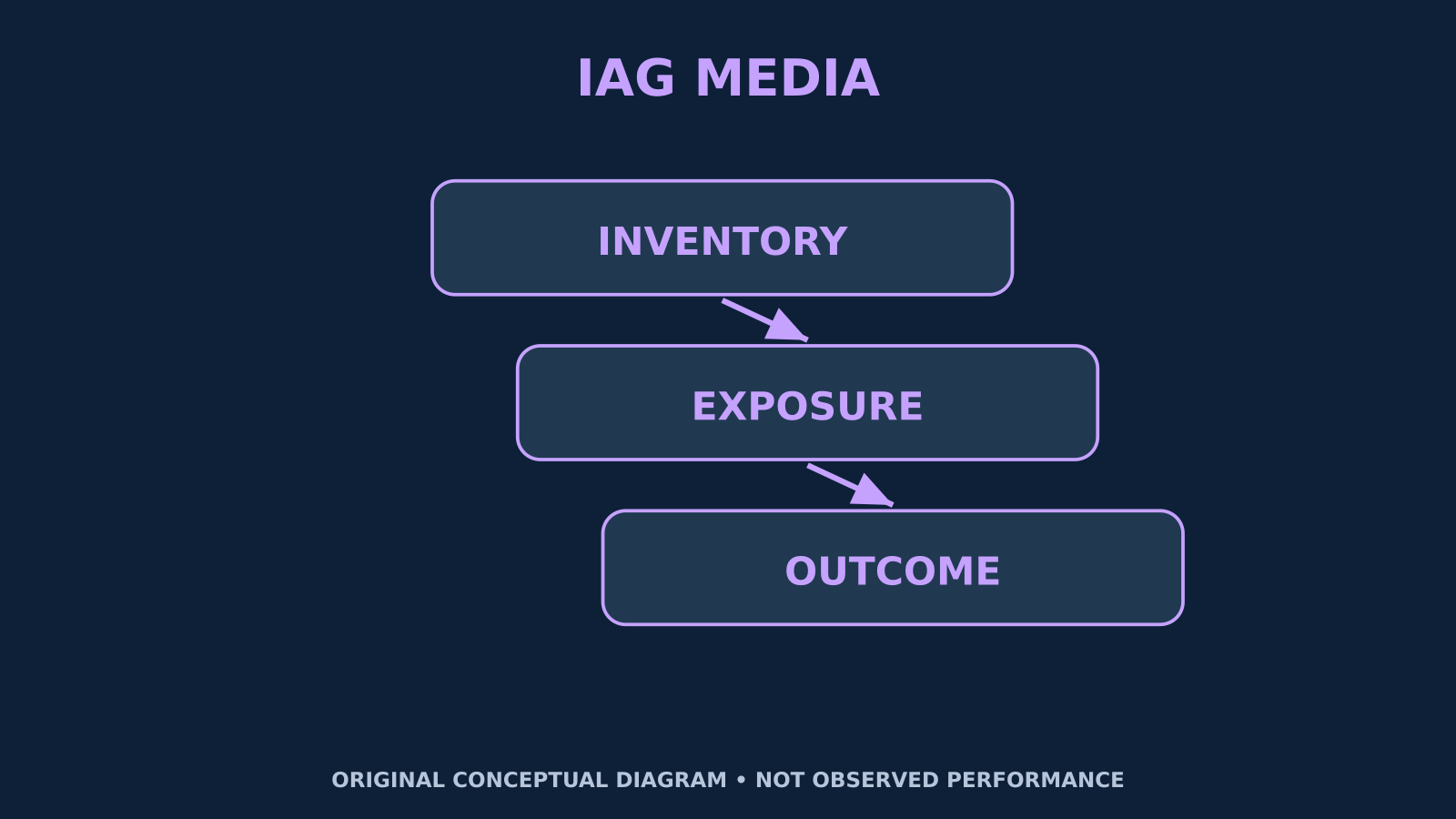
Original editorial illustration, not an IAG interface or a measured funnel. INVENTORY means available advertising space; EXPOSURE means documented delivery; OUTCOME means the business response being evaluated. The concept distinguishes travel scale from verified distinct advertising reach. Announcement context: IAG Media.
Treat connectivity and availability as operating conditions
A connected format needs a practical delivery plan. Ask what happens when the intended placement is unavailable, when schedules change or when a technical interruption prevents delivery. Establish which substitutions need approval and whether the proposed substitute preserves the original objective. A convenient replacement in a different environment may have a different value. Do not let an operational adjustment silently turn a carefully scoped experiment into an unrelated bundle of media.
Define the handling of underdelivery before the campaign begins. The answer may involve rescheduling, an agreed alternative or another commercial remedy, depending on the actual offer. This article does not establish IAG's contract terms or guarantee any remedy. The recommendation is to make the decision explicit with the seller. Keep forecast availability separate from committed delivery, and keep both separate from a report of what was ultimately supplied.
Design creative for the actual surface and language
A concept that works in a magazine may fail on a small digital surface or during a brief interaction. Request the real specifications and review a representative preview. Check legibility, contrast, message length, sound assumptions and the visibility of any important condition. Test the destination as well as the advertisement. A clear promise that leads to an unsuitable mobile page is an incomplete customer experience, even if the media placement itself is delivered correctly.
For Arabic and English executions, review meaning and layout together. Confirm product names, delivery areas and offer conditions in both versions. Avoid compressing an essential limitation into unreadable text simply to preserve a visual design. If creative production uses AI assistance, assign a person to verify claims, rights and final assets. Faster generation should reduce drafting effort, not reduce scrutiny of what a traveller will actually see and understand.
Make the response path useful beyond the first interaction
Decide what the person can realistically do at the proposed moment. An immediate purchase, a saved product reference and a later visit are not interchangeable outcomes. Choose a primary response and explain why it fits the journey. Avoid asking for unnecessary personal details just to continue to ordinary product information. A low-friction path should help the customer, not merely create an additional data field for the advertiser's report.
Check continuity when a person returns later on another connection or device. The offer should remain understandable, with a stable destination and clear conditions. Do not assume every delayed purchase can be linked back to the exposure. Where tracking is incomplete, preserve that uncertainty. A usable journey can still be valuable without a perfect identity graph, while a highly instrumented but confusing experience can undermine the very response the campaign seeks.
Set privacy boundaries before discussing personalization
Context can inform a creative idea without requiring an intimate profile of the traveller. Start with the least intrusive information needed for the campaign objective. Ask what data would be used, who controls it, what the reporting contains and which uses are permitted. Do not assume a commercial media proposal grants the advertiser access to booking records or identifiable customer histories. The actual arrangement must be understood before anyone designs an activation around it.
Keep proposed reporting aggregated where practical and avoid unnecessary collection or onward sharing. Give the appropriate privacy and commercial owners a concrete plan to review, rather than a vague promise of relevant messaging. Document whether an audience description is observed, inferred or modeled. Those distinctions affect both interpretation and responsible execution. This is operational guidance, not a determination of applicable legal requirements or a statement about IAG's unpublished data practices.
Use hypothetical arithmetic to expose measurement choices
Consider an invented pilot with EUR 30,000 in total cost: EUR 20,000 for media, EUR 6,000 for creative and adaptation, and EUR 4,000 for evaluation. Suppose its agreed report records 500,000 delivered impressions and 1,000 qualified visits. These are illustrative inputs, not IAG prices, forecasts or campaign results. The implied media CPM is EUR 40, the media cost per qualified visit is EUR 20 and the all-in cost per qualified visit is EUR 30.
Those calculations describe cost relationships, not unique reach or causal impact. Repeated exposures could be included in impressions, and some visits might have happened without the campaign. Define a qualified visit before launch and state the exclusions consistently. Include required charges within the approved ceiling or seek a revised approval. A tidy spreadsheet is only useful when the underlying units are clear; it cannot rescue an ambiguous impression count or a changing definition of success.
Evaluate contribution without claiming every response
Agree on a measurement question that the available data can answer. If the objective is an additional customer action, consider a credible comparison rather than treating all observed actions as incremental. Document other marketing activity, normal demand patterns and important changes during the test. Where isolation is weak, describe association rather than proof. A small pilot can support a limited learning decision without becoming a universal statement about travel audiences or the entire network.
Separate delivery quality, creative response and business value in the final review. A well-delivered campaign can reveal a weak offer; a strong response can coexist with incomplete attribution. Report these findings plainly instead of collapsing them into one success score. If distinct-person reach is not available, do not relabel impressions as people. If sales cannot be connected reliably, do not invent a return calculation by assigning every nearby purchase to the campaign.
Negotiate a learning package, not just a large package
Ask for a configuration that can answer the chosen question with manageable complexity. A smaller, coherent selection of placements may be easier to interpret than a broad bundle spanning many contexts. Decide in advance which changes are allowed during the test and which would make comparison misleading. Keep a record of creative revisions, inventory substitutions and timing changes so the final analysis reflects what actually ran rather than the original proposal alone.
Assign owners for delivery checks, creative review, response-path testing and the final decision. Set a review point at which the team will continue, revise or stop based on the agreed evidence. The objective is not to make the experiment look successful; it is to reduce uncertainty about the next investment. A network launch creates a reason to investigate a new option, not an obligation to allocate a large budget before that option has been understood.
What a decision-ready brief should contain
The immediate output should be a concise buying brief with a business question, suitable traveller context, placement definitions, verified availability, reviewed creative, approved costs and a proportionate evaluation plan. Add the unresolved questions rather than hiding them in optimistic language. Before commitment, confirm the details with the actual seller and distinguish current capability from future development. No rates, booking availability or campaign performance were independently tested for this article.
The commercial opportunity is to make useful advertising fit a journey without confusing travel scale with proven attention or business impact. Start with an offer worth considering, buy clearly defined inventory and demand reporting that preserves the meaning of its units. Then decide what the evidence justifies. This approach leaves room for a promising travel-media proposition while protecting the budget from conclusions that a launch announcement alone cannot support.
Comments
No published comments yet.