
What the filings confirm
On November 19, 2026, Intuit signed an agreement to sell Mailchimp to Bending Spoons. The quarterly filing describes about $3.68 billion in total consideration, not enterprise value: roughly $3.31 billion in cash and $368 million in buyer common stock, subject to closing adjustments. Intuit expects closing in early calendar 2027, subject to approvals and other conditions. Mailchimp’s total revenue was $313 million, down 1% year over year, for fiscal Q1 2027 ended October 31, 2026. November was the announcement month, not the quarter-end. The transaction filing distinguishes the signed agreement from completion. Those filings are not a customer notice about price or service changes.
Inventory the email program, not just the list
The following is an editorial continuity exercise, not a forecast for Mailchimp. Draw a small map from each incoming event to the message it triggers. For a welcome series, that means naming the signup source, consent record, entry rule, delay, exclusion logic and the person who can pause the sequence. Do the same for any flow that affects orders or customer commitments. Record which system owns each field and which records cannot currently be recovered. A download that preserves addresses but omits why those addresses may be contacted is not a usable backup.
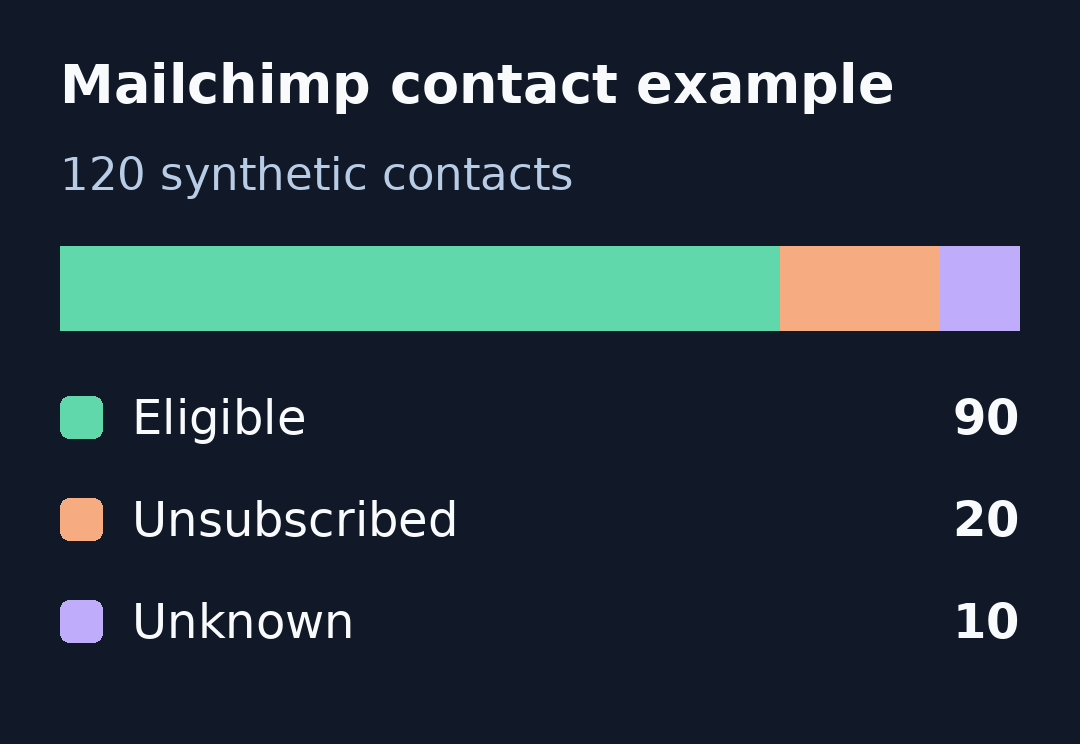
Original example visualization; these are fictional records, not Mailchimp customer data.
Prove you can restore without sending
Run an isolated exercise with synthetic records and outgoing delivery disabled. In a fictional store, the team creates 120 test contacts: 90 eligible, 20 unsubscribed and 10 with no reliable consent record. After a test export and restore, simulate a welcome trigger. The 90 eligible contacts should enter once each; the other 30 should never enter. If the restored system sees 120 rows but cannot distinguish permissions, fail the exercise. Also replay one event twice: the second pass should not create another pending send. Test results do not prove deliverability to real inboxes.
Give exceptions a deadline and an owner
Store an approved backup in a restricted location, assign an owner to any missing route or field, and set a deletion date for temporary working copies. Compare recovery time with the business tolerance for that flow. A deferred newsletter can wait while its records are checked; an operational notification may need an approved alternative path. Separate that decision from marketing consent. Write down the person who can stop sends, the person who clears resumption, and the evidence each needs. Otherwise a handover can create more uncertainty than the incident that prompted it.
Watch for changes, not rumors
Keep the platform decision open until you have documented product or contract information. Monitor official notices for concrete changes to access, integrations or terms. If one arrives, map it to a workflow and update the recovery test rather than treating the entire program as broken. Fix a failed consent or duplicate-send check now, even if you never move. A successful rehearsal does not argue for either switching or staying; it tells you what your team can recover and how long that takes.
Comments
No published comments yet.