A report is not a decision
A customer asks whether an appointment is confirmed. The help team answers, closes the ticket and records the question in its monthly report. The report reaches several managers. Next month the same question returns. Nobody can say what should change, who gets to decide, or how the team would know whether its answer fixed anything. The organization listened, but the person trying to complete a task still had to ask.
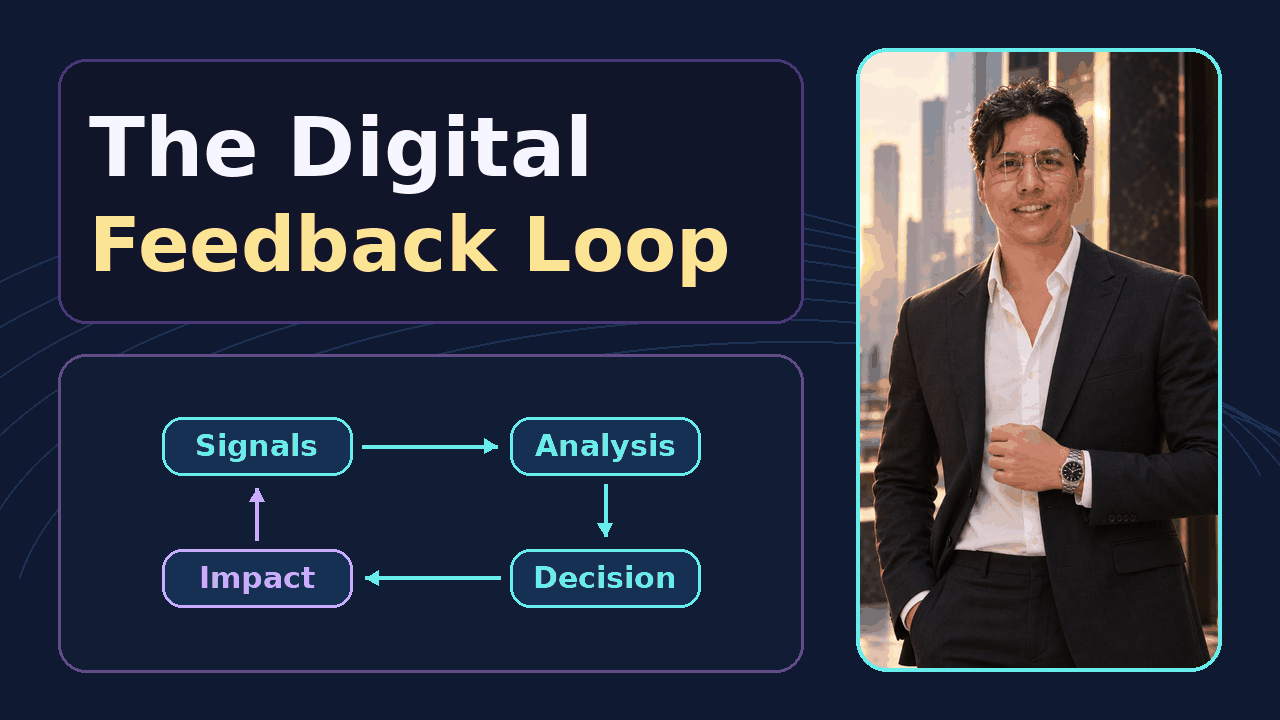
A feedback loop connects a signal to a decision, an action and a check on what happened next. In this lesson, we use a practical sequence: notice the signal, interpret and triage it, have a named owner decide and act, and return what was learned to the people and processes that can use it. That sequence is our teaching device, not a formal Microsoft step-by-step taxonomy. The capacity to revisit a mistaken assumption matters as much as shipping the first fix.
Make the decision observable. A useful note states which journey is affected, what evidence is available, what the team will change or deliberately leave unchanged, and when it will evaluate the result. If the evidence is too weak to act, say what could change that judgment. A short decision note with a named owner is more valuable than a dashboard that generates many charts but no next step.
Four areas that can illuminate the same problem
Microsoft describes its Digital Feedback Loop in terms of connected signals from customers, employees, products and operations. A customer can tell you that an outcome felt unclear. An employee can explain which types of question reach the help queue. A product can show that a workflow stops at a particular interface state. Operations can tell you that fulfillment or ownership rules left the next action unresolved. None of those views is the whole journey.
Take an otherwise ordinary order. A customer says two promised delivery dates conflict. A support employee classifies the resulting inquiry. A storefront event identifies the status shown at checkout. An operations record identifies which shipment state the carrier reported. Those signals complement each other. A large count of checkout events cannot tell you whether the customer understood the message, and an employee’s observation cannot establish how often the problem occurs among eligible purchases.
Microsoft’s framing also connects those areas to changes in the business: improving products or services, engaging customers and partners, enabling employees, and improving how work is carried out. A change can be as simple as a clearer interface or a better ownership rule. The approach does not inherently require Microsoft software, artificial intelligence, a data warehouse or even a survey. Vendor descriptions explain the concept; they are not independent evidence that adopting it produces a particular result.
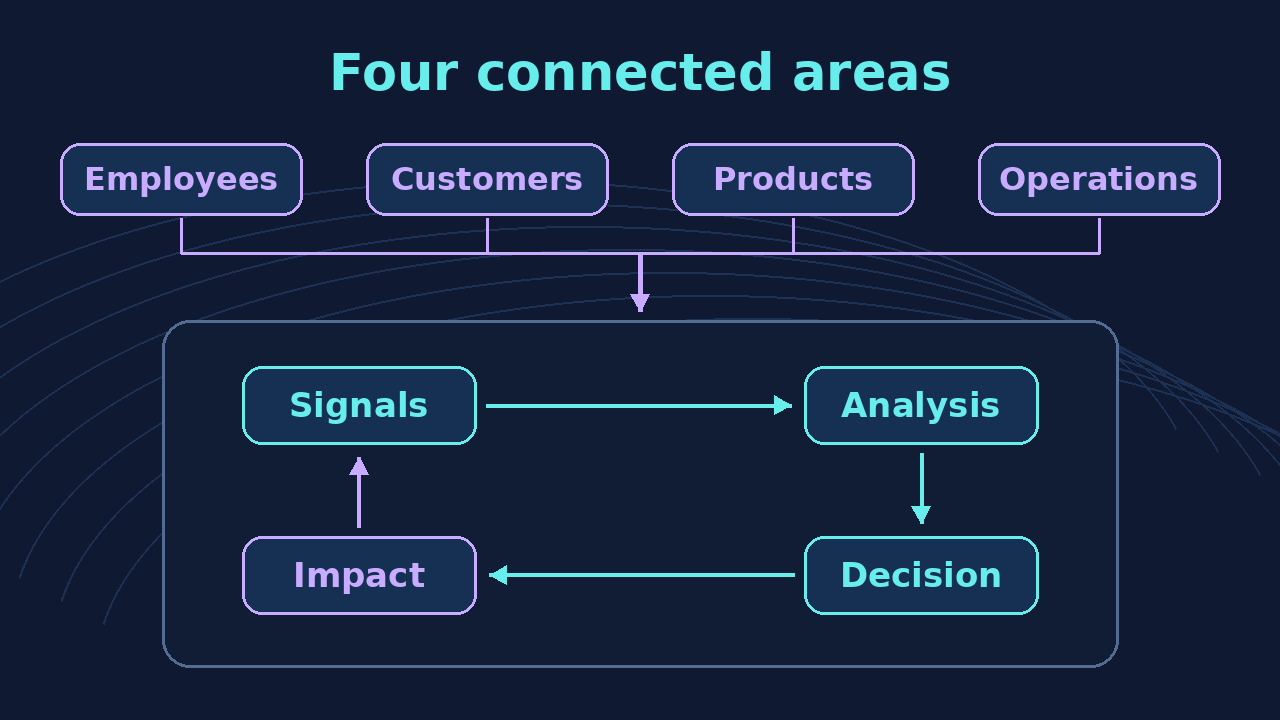
Original illustration: the impact of a decision generates signals for the next cycle.
Define the smallest useful event
Before adding an event, write the question it needs to answer. For example: did an eligible session reach the first confirmation decision, what status was presented, and did the service confirm in the agreed window? Document the eligible unit, timestamp or window, reporting definition, duplicate handling and known gaps. Use a purpose-limited identifier only when the chosen question genuinely needs events to be linked. Leave names, contact details and free-text conversations out of a measurement design that does not need them.
Give similar labels different meanings only when the data dictionary makes the difference explicit. A request sent from a page is not a confirmed booking, and a page refreshed after a reply is not a new request by default. Write down which system can establish each fact. If you change the meaning of a status, keep the prior definition in the changelog so the team can distinguish a real operational change from a rename.
People do not give blanket permission to collect information by speaking to support, working for the organization or posting in public. Keep employee observations at a suitable category level rather than turning the exercise into individual surveillance. Use opt-in qualitative feedback where appropriate, and define who can access and retain the minimum information needed for the stated purpose. A team that cannot explain why it collects a field should omit it from the first design and reconsider only if a concrete use emerges.
Combine evidence without mistaking visibility for coverage
A visible signal is not necessarily a representative signal. Some people complain repeatedly; others quietly leave. Some support channels collect reason codes faithfully while others record a general category. Product telemetry may miss sessions that fail before an event is sent. Start the review by naming which people, channels and workflow stages the organization can see, and which it cannot.
Triangulation means checking whether distinct sources support the same explanation. If customer notes report uncertainty, product events show a long pending state, and operation records show callbacks without owners, an unresolved handoff becomes a reasonable hypothesis. If customers report uncertainty but confirmations are typically prompt, inspect message wording and the paths that bypass those logs before assuming the queue caused the trouble. Contradictions help direct the next investigation.
Use qualitative sampling to find plausible mechanisms, not to estimate prevalence without an appropriate design. Include people who completed a task and, where you can do so appropriately, those who did not. Review examples from different days and channels. Examine cases that contradict your working explanation. Document how the examples were found and how consent was handled. If a channel is missing or the same incident appears in several systems, say so before combining counts or claiming independent corroboration.
Give someone the decision, not just the notification
Route the signal according to who can change the relevant workflow. A status label belongs with the product or storefront owner. A queue without an assigned callback belongs with operations. Cross-team problems still need one accountable decision owner, even if several teams perform the work. Agree who can accept the issue, who can make a change, and who can decide to stop a trial.
Track the time from a qualifying signal to assignment, from assignment to the decision, and from the decision to the outcome review, using boundaries appropriate to the process. Otherwise a team can report fast closure while unresolved work waits in a different queue. A response standard should distinguish an acknowledgment from the time required to investigate or act. Avoid promising a deadline to a customer that the receiving team cannot uphold.
Choose a response proportionate to the evidence and consequences. A single well-documented example may justify correcting a clearly misleading message; it does not establish how common the error is. A broader process change may need stronger evidence and a bounded pilot. Record the reason for the response as well as the owner’s name or role. That gives the next reviewer enough information to revisit the choice rather than treating it as permanent policy.
Change the workflow and make follow-through visible
State the problem as an observable gap: “People cannot tell whether their request is waiting or complete.” Then define the proposed change: label both states clearly and assign callbacks to an accountable queue. Keep a record of what changed, which journeys were affected, when the rollout began and what remained unchanged. If the team also modifies staffing or the definition of a logged event, record that because it can complicate the evaluation.
Make the correction visible where the person needs it. The right place for trustworthy booking status is the booking journey or a suitable progress channel, not just a public announcement that the team “heard your feedback.” Internal staff also need the updated status definitions and a way to report exceptions. Return an appropriate summary to people who supplied feedback without exposing another person’s records or promising individual follow-up that was never offered.
A shipped change is an intermediate event. It tells you work was released, not that the problem improved. Define the comparison period, practical guardrails and rollback conditions before looking at results. Preserve valid controls when testing a status change so you do not confuse a layout regression with the intended intervention. If the check later shows that the wrong problem was addressed, reopen the decision and preserve that learning.
A safe rollout can use one staffed shift, one web form, or a small share of eligible sessions. Decide who watches the queue and what will trigger a pause before you expose the change. Even if the change is limited to wording, check that the new labels reflect states the underlying service can actually verify. Test what an employee sees when a request arrives after the shift ends, not only what the customer sees in the easiest example. Publish a short internal note with the two states, who handles exceptions, and the rollback procedure. If the team has to reverse the change, record what broke and return that evidence to the next planning meeting. A rollback is not a failed feedback loop when it prevents a wider mistake and produces a better next decision.
Worked case: a fictional outpatient appointment center
In this fictional case, the question is administrative: can a person tell whether the booking service has confirmed the appointment? The eligible unit is an attempted virtual booking session that reaches the first confirmation decision step, under a consistent deduplication rule. It is not a unique patient, a completed visit or attendance. No names, contact details, diagnoses, sensitive records or actual facility data are used.
The four evidence areas point to different parts of the journey. The product team distinguishes awaiting confirmation from confirmed. Employees classify repeated questions by reason code without copying conversations. Operations checks callback ownership and slot-hold expiry. Customers contribute opt-in qualitative notes, or the team uses aggregate help requests to identify a recurring question. An apt intervention is clearer pending and confirmed states together with named callback ownership. Measure the queue, compare relevant days and channels, and record which sessions or channels are missing.
| Fictional period | Eligible sessions | Confirmed within 24 hours | Confirmation rate | Sessions with repeat help | Repeat-help rate |
|---|---|---|---|---|---|
| Before the change | 400 | 240 | 60% | 40 | 10% |
| After the change | 400 | 280 | 70% | 28 | 7% |
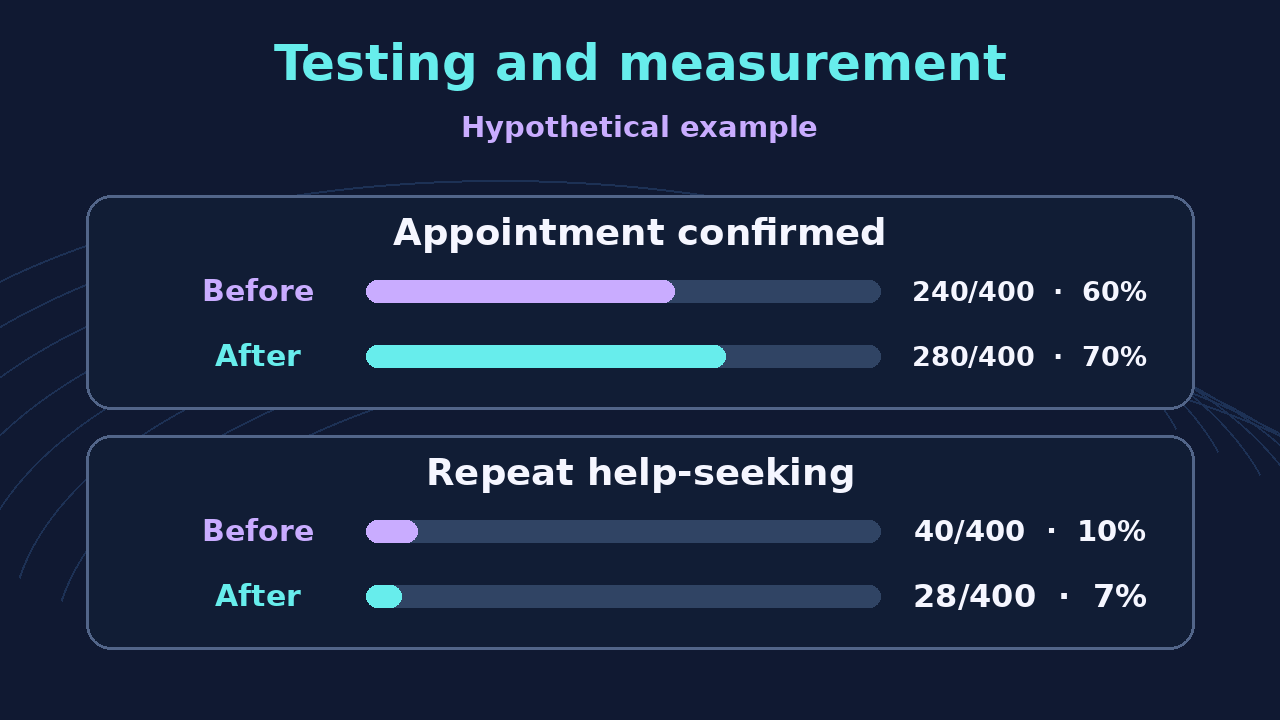
An illustrative before-and-after comparison, not a randomized experiment or causal evidence.
In this fictional comparison, the confirmation rate rises from 60% to 70%, or 10 percentage points, while the repeat-help rate falls from 10% to 7%, or 3 percentage points.
The confirmation column counts eligible sessions with confirmation within 24 hours. The repeat-help column counts eligible sessions with repeat help within that same window. It is not a raw event count. A session can contribute to the repeat-help column without appearing in the confirmed subset, so do not divide the repeat-help numerator by confirmed sessions. The table gives the definitions, denominators and direction of change without relying on chart color. These are hypothetical figures, not observations or evidence of a causal effect, improved attendance or a clinical outcome.
Second worked case: a fictional desk-accessories retailer
At checkout, the store gives one delivery estimate; the carrier trace later gives another. Customers repeatedly ask which message to trust. The retailer maps shipment states and delivery exceptions, then asks warehouse and service staff where handoffs break. It groups customer complaints by the contradiction they describe, not merely by the general category “delivery.” The storefront’s displayed message and the carrier’s event may each be accurate at the time shown, yet fail to explain that the forecast changed.
Give operations ownership of the shipment-state rules and designate a storefront product or copy owner to reflect those rules in customer messages. Align wording with the state, distinguish an estimate from an exception, and make clear when an update is unavailable. Test what happens when carrier information is incomplete. The goal is not to invent certainty when one source goes quiet; it is to prevent the storefront from implying certainty the organization does not have.
Measure complete on-time deliveries per due tracked shipment, repeated status inquiries per eligible purchase session, and wrong-information messages. These indicators have different units and should not be combined into a single count. Keep partial data and exceptions visible: a shipment may be tracked only after a scan, and a purchase session may not always link to a later inquiry. If the message improves but logistics reliability does not, the team should say so. Clarity and fulfillment are separate problems even when they appear in the same complaint.
Evaluate rates, coverage and false success
Always read a rate with its numerator, denominator, window and coverage. A drop in repeat questions may be welcome, but it could reflect fewer help channels, changed tracking or a shift in who reached the eligible step. Check what happened to the stages before and after the measured window. Compare by meaningful segments such as day or channel if the data support it, and avoid presenting differences as precise when coverage is poor.
Use a trial that matches the question. If an A/B test is feasible under appropriate consent and governance, assign at a stable, suitable non-personal eligible unit and keep the definition consistent. Consider whether overlapping queues or simultaneous changes contaminate the comparison. If the design is before-and-after only, name the plausible competing explanations and resist giving the difference a causal label. The fictional booking rates above establish neither causal effect nor the adequacy of any sample.
Define a rollback or pause when a change creates misleading confirmation, disrupts a valid control or makes important evidence unavailable. Make the decision explicit rather than continuing because a headline indicator moved in the desired direction. Some apparent success is purely administrative: tickets close faster while the same question comes back. A reliable loop checks the user’s subsequent experience, not just the team’s processing speed.
Before a review, separate the measures that describe what the team did from the measures that describe what became easier for people. A quicker assignment is useful but does not demonstrate a clearer status. A drop in repeat help is encouraging only if the confirmation definition and what the support channels can observe are still comparable. If the signals move in opposite directions, document the trade-off instead of choosing the most flattering number. Then give the team a date and an owner for the next check.
Run a weekly review and practice the diagnosis
Bring a manageable set of signals, one accountable decision owner for each item and the current evidence needed to act. Review unassigned work and open exceptions before celebrating closed tickets. Ask whether the agreed next action happened and when the outcome should be checked. Note missing coverage and anything that changed in the measurement definition. Return the useful result to the teams that can change the work, and leave a deliberate decision to continue, revise, stop or gather more evidence.
Practice: resolution speed rises, but repeat contacts stay steady. What do you check before celebrating? Ask what “resolution” means in the ticketing process and whether closure practices changed. Verify whether repeat contacts can be linked appropriately, whether the relevant channels are covered, whether the status message explains the state and whether the same repeat-contact definition and denominator apply across periods.
A defensible answer proposes one bounded trial after those checks, such as a clearer status message in a comparable workflow while preserving valid controls and the existing measure. Assign a decision owner, state the outcome window and record what would prompt a rollback or a revised explanation. Faster ticket closure may still be useful, but it does not show that the original problem is fixed. Tell support and operations what the trial found and what will change in their workflow; if the evidence is inconclusive, share that too.
References: the authorized course material *شرح تجربة العميل الرقمية*, Lecture 7, physical pages 165–166, introduces collection, interpretation and action across connected areas. See Microsoft’s original 2018 discussion, its Microsoft Learn operational example, and Intelligence Driven Organizations, page 11. Return to Garrett’s Five Planes of UX for a way to locate the product decision behind a signal.
Comments
No published comments yet.