A hero product at the centre of a wider campaign
Quince has chosen a recognisable product to lead a wider brand story. Its campaign, The Red Sweater, uses a 60-second hero film featuring David Schwimmer and the brand’s Coulis Red cashmere. The interesting marketing question is what viewers retain after the entertainment: the performer, the sweater, an understandable product promise, or a clear association with Quince itself.
According to the Quince-issued announcement, published by PRNewswire on 9 November 2026 at 09:05 ET, the campaign launched that day. Quince describes it as its largest integrated brand campaign and its first major activation across owned, earned and paid channels. Distribution includes YouTube and a collaborative Instagram post, shorter social, digital and connected-TV edits, plus the brand’s website, app and email channels. The named paid-media markets are the United States, Canada and United Kingdom.
Those details establish the campaign’s declared scope. They do not establish effectiveness. The release is the brand’s own account, not an independent study, and it provides no campaign spend, sales lift or incremental-acquisition result. The following analysis develops a way to evaluate a signature-product strategy. It should not be read as a finding that this campaign has already improved recognition, customer quality or sales.
Make the product memorable without losing the brand
A signature product can give a broad assortment an accessible entry point. Instead of asking audiences to absorb an entire catalogue, the campaign concentrates attention on a concrete object. Colour, shape and material can make that object easy to describe and recognise. The strategic benefit depends on whether the object becomes a useful cue for the brand, rather than a memorable item detached from its maker.
A familiar performer creates an additional attribution problem. Viewers may recognise the person immediately and still struggle to identify the advertiser later. That does not make celebrity participation inherently ineffective. It means the research needs to separate execution recall, product understanding and brand linkage. An entertaining scene and a correctly identified brand are different outcomes, and the campaign team should know which one it is trying to improve.
The practical creative question is where Quince becomes indispensable to the story. A brand can appear in a closing frame yet remain peripheral to what people remember. Review the connection between the central product, the stated promise and the brand at each important moment. This is a recommended evaluation method, not a claim about how prominently Quince appears in every edit or how audiences have responded to the film.
Decide what the sweater is supposed to communicate
A hero product needs a clear job beyond being attractive. Is it meant to introduce material, usefulness, design, value or a combination that customers can easily explain? The answer should come from the actual campaign and supporting product information. Teams should avoid supplying a stronger promise in their analysis than the brand can substantiate, especially when language about quality, sourcing or value could influence purchase expectations.
For a signature-product strategy, a useful creative brief pairs one central promise with the evidence available on the product page. The brief can state what viewers should understand, what they should associate with the brand and what remains outside the claim. This prevents different teams from turning the same product into several incompatible stories when adapting it for separate channels.
A simple review exercise is to ask someone to describe the product’s appeal without naming the performer. If the answer is only that the advertisement was funny or familiar, the product message may need attention. That response is a diagnostic clue, not proof that the campaign fails. Qualitative interviews can identify confusing language and unexpected interpretations, while a more structured study is needed to estimate how common those responses are.
Adapt the idea to each format’s real task
The announced mix includes a 60-second film and shorter edits. A short placement cannot be assumed to deliver the same sequence of information as the hero film. Decide what the audience needs to understand in the time and context actually available. A shorter version may need to establish product and brand earlier, while a longer version can allow the story to develop before presenting the next step.
Consistency should come from the central product idea and credible promise, rather than identical editing everywhere. A connected-TV exposure, a social view and a website visit involve different opportunities to respond. Review legibility, sound-dependent meaning, product identification and the suitability of the destination for each placement. These are general production checks; the announcement does not disclose the creative performance of individual formats.
Owned channels can continue the same story with more practical information. Email can make the product and destination clear, while the website or app can answer the questions left open by the film. Keep a simple record of the promise and action assigned to each asset. That makes it easier to spot a mismatch, such as an ad centred on one product leading to a page where that product is difficult to find.
Preserve continuity when the customer reaches the assortment
A recognisable hero product can create interest in a larger brand, but the transition needs care. The arrival page should make the advertised item easy to recognise, explain its relevant options and provide accurate availability, delivery and returns information. If the campaign creates a specific expectation, the page should help the customer verify it instead of immediately replacing it with an unrelated promotion.
Broader assortment discovery can follow when the connection is understandable. A customer interested in the hero item may welcome related products that serve a clear need. An indiscriminate wall of categories can make the next choice harder. Teams should decide whether a destination is primarily helping the visitor buy the featured product, understand the brand or explore alternatives, then organise the page around that priority.
Inventory also changes the communication problem. When the featured option is unavailable, a substitute should be described accurately rather than presented as if it were the identical item. Track variant availability and destination changes alongside media activity. If users encounter stock problems during the campaign, weak conversion may say more about the shopping experience than about whether they understood or liked the advertising.
Test recognition in three separate layers
A useful research design asks three questions separately: do people remember the execution, understand the intended product promise and connect that promise to the brand? Open responses can reveal what viewers actually retained before prompted questions supply names or benefits. Keep the order and wording consistent across comparison groups, and document who was sampled and what exposure information is reliable.
For illustration only, imagine 100 respondents: 60 recall the execution, 35 describe the intended promise accurately and 20 name the brand without a prompt. These are hypothetical counts, not Quince results. They identify different measures, not three successive conversion stages. Without respondent-level overlap, the counts cannot show which people answered all three correctly. A sample of this size also does not automatically represent the target market or establish a campaign effect.
A suitable comparison group can strengthen the evaluation, especially if exposure is assigned or measured in a defensible way. Account for existing brand familiarity and different opportunities to see the campaign. Report uncertainty and study limitations rather than treating every percentage difference as meaningful. Repeating the same well-designed questions over time can reveal patterns, but a change following launch still requires care before being attributed to the campaign.
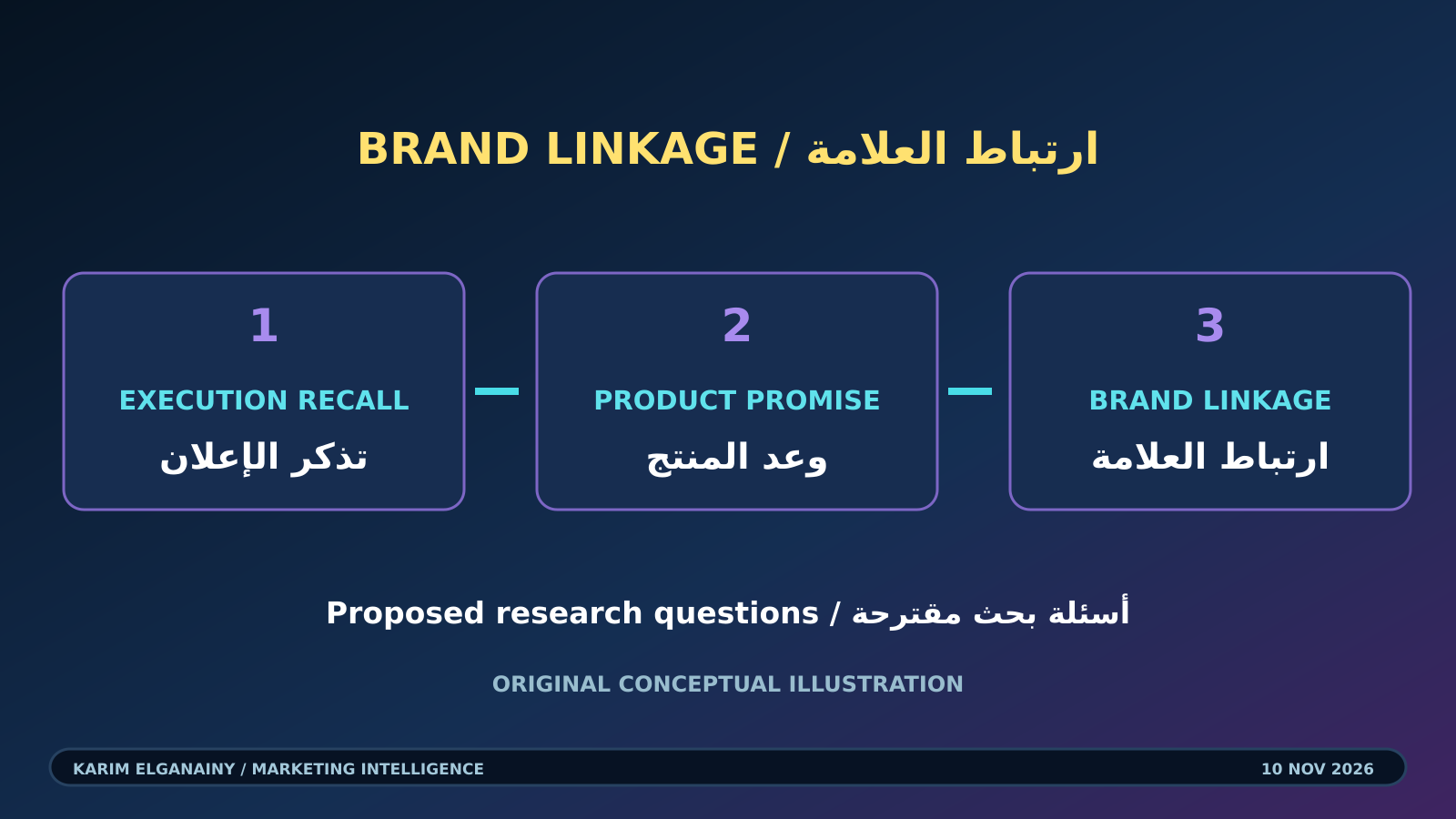
Original explanatory diagram: three proposed recognition checks, not a measured funnel or reported campaign result. The campaign facts come from the Quince announcement; the analytical framework is independent editorial work.
Measure customer quality beyond visits and first orders
Traffic is a useful sign that people reached a destination, but it says little about what they understood or the value of the resulting purchases. Teams should examine conversion alongside product availability, cancellations, returns and the contribution remaining after relevant costs. A large increase in visits can coexist with poor commercial quality if the product or shopping experience does not meet the expectations created by the advertisement.
New-customer reporting also needs a definition. Specify whether “new” means new to the retailer, new to a category or absent from a particular system for a set period. Avoid turning whichever definition is easiest to retrieve into an unqualified acquisition claim. Campaign attribution should be reported with its window and rules, separately from any estimate of customers who would not have purchased without the activity.
Longer-term behaviour can add useful context when there has been enough time to observe it. Repeat purchasing, the categories customers explore and returns may help explain whether the signature product opened a durable relationship. Early launch reporting cannot establish these outcomes immediately. Decide when each measure becomes mature enough to review, and resist comparing a recent customer group with an older group that has had much more time to buy again.
Carry the lesson across markets, not unverified availability
For teams in Saudi Arabia, the UAE and other Gulf markets, the campaign offers a strategic example rather than evidence of a local rollout. Its stated paid-media footprint is the United States, Canada and United Kingdom. A regional team can examine the product-led approach without implying local campaign activity, local fulfilment or the availability of the same item. Those operational facts require separate verification.
The transferable decision is whether one product can explain a broader brand in a way customers recognise and trust. Choose the product for the promise it can credibly carry, adapt the idea to each channel, and make the arrival experience fulfil the expectations created. Measure execution recall, product understanding and brand linkage separately, then connect those findings to mature commercial measures without claiming causality that the evidence cannot support.
Quince’s announcement supplies a clear campaign structure and distribution plan, not a verdict on results. For another marketer considering a signature-product campaign, the next useful deliverable is a one-page brief linking the hero item, the supported promise, the brand cue and the customer’s next step. Assign responsibility for the creative, destination and measurement checks. A memorable product becomes a stronger brand asset when these parts work together and the evidence confirms that audiences made the intended connection.
Comments
No published comments yet.