
Analysis date: November 10, 2026. Canadian Medical Center Company (CMCER) issued two separate announcements on November 9: results for the quarter and nine months ended September 30, 2026, and a Dammam property lease signed on November 8. Together, they show pressure on current earnings alongside a planned expansion in specialized services. The lease is a new commitment, not evidence that the planned complex is already operating.
What the financial disclosures actually show
Every amount in the numbered rows below is in actual Saudi riyals (SAR), not millions. All profit figures are positive. “Net profit” means net profit attributable to the issuer’s shareholders. Quarterly and nine-month comparisons are kept separate. The figures follow the company’s reproduced results disclosure, cross-checked against Argaam’s results report.
For Q3 2026 versus Q3 2025:
- Revenue: SAR 36,383,939 versus SAR 41,687,814, down 12.722%.
- Gross profit: SAR 10,106,914 versus SAR 12,614,503, down 19.878%.
- Operating profit: SAR 3,128,936 versus SAR 6,551,860, down 52.243%.
- Attributable net profit: SAR 2,015,460 versus SAR 3,484,876, down 42.165%.
For the nine months ended September 30, 2026 versus the same period of 2025:
- Revenue: SAR 113,086,823 versus SAR 104,030,318, up 8.705%.
- Gross profit: SAR 28,462,352 versus SAR 29,773,795, down 4.404%.
- Operating profit: SAR 11,782,136 versus SAR 15,247,917, down 22.729%.
- Attributable net profit: SAR 8,551,278 versus SAR 11,761,775, down 27.296%.
The separate sequential comparison also weakened: Q3 2026 revenue fell 5.885% from Q2 2026’s SAR 38,659,246, and attributable net profit fell 42.365% from SAR 3,496,943. These are quarter-on-quarter changes, not annual declines. Rounded headlines of SAR 8.55 million in nine-month profit and SAR 2.02 million in quarterly profit describe the same underlying figures.
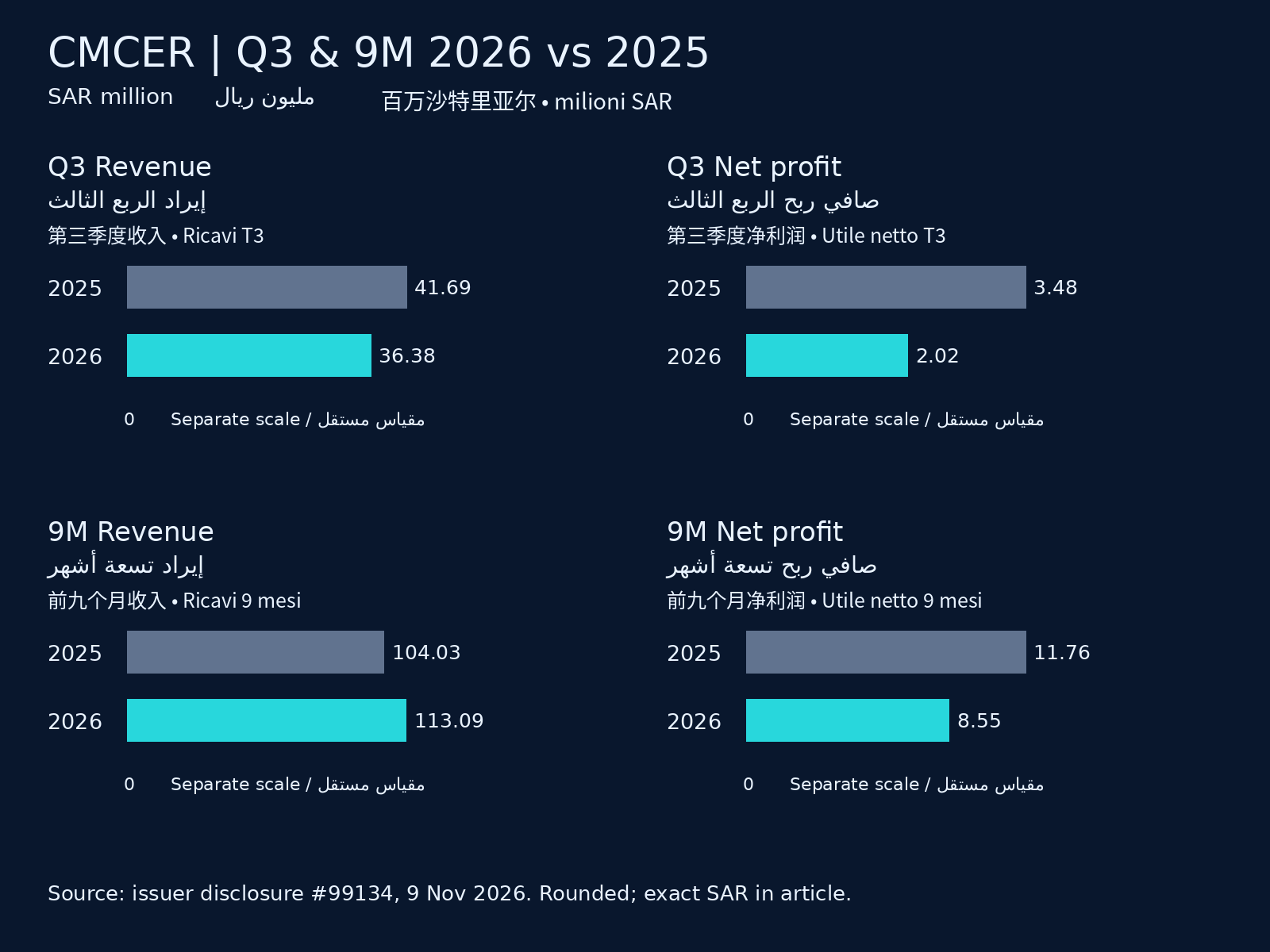
The chart uses SAR millions for readability; the numbered rows retain actual SAR. Each comparison uses matching periods, with revenue and profit labelled separately. Original explanatory chart by Karim Elganainy; data: issuer disclosure. Each panel has its own zero-based scale; do not compare bar lengths across panels.
Why higher nine-month revenue did not protect profit
The company attributes nine-month revenue growth to new projects, wider operations and diversification across regions. It says growth came mainly from lower-margin projects and activities, while additional expected-credit-loss allowances on trade receivables increased expenses. Those explanations account for the direction of the revenue and profit figures without implying that every project weakened.
For Q3, management identified reduced business volume in NEOM projects following the suspension of certain projects, suspension of the National Guard project, and a nonrecurring SAR 3.5 million purchase order in Q3 2025. That order belongs to the comparison period. It is not a new Q3 2026 order or a current-period write-off. The disclosure does not provide enough detail to isolate every driver, so subtracting that order and presenting an “organic” growth rate would be premature.
The company also reported investment-portfolio losses of SAR 243 thousand versus SAR 2.34 million in Q3 2025, partly cushioning the earnings decline. The reviewed disclosure records an unmodified conclusion. That does not turn company explanations into proof of campaign effectiveness or future performance. References to suspended NEOM projects should remain specific to CMCER’s disclosed activity, not become a claim about all NEOM development.
What the Dammam lease commits the company to
The separate lease disclosure identifies Abdullah bin Mohammed Ababtain Real Estate Group as the counterparty. The agreement covers a 3,212-square-meter building on Abdullah bin Masoud Road in Al-Urubah, Dammam, for ten years. Its stated value is SAR 13,300,000 excluding VAT. No related parties are identified.
CMCER plans to establish, equip and operate a multispecialty complex, including a specialized day-surgery center. It expects the financial impact to begin in the second half of 2027. Argaam’s November 9 report corroborates these terms.
The disclosed value is the lease commitment, not a published total development or equipment budget. The financial-impact period is not a confirmed opening date. No verified clinic count, patient-volume target or projected return is provided in this announcement.
Independent analysis: connect expansion to deliverable services
The following is an operational and marketing framework, not management guidance or a description of CMCER’s internal plans. A new address creates an opportunity to reach people closer to relevant care, but publicity should follow verified readiness. Patient-facing claims need confirmed services, appropriate clinical oversight, staffing, licensing and appointment availability. None of these details can be assumed from the lease alone.
Before promoting the future complex, build a service-readiness register. For each approved specialty, record the operational owner, the evidence needed before public launch and the information a patient needs to book appropriately. Keep planning updates distinct from invitations to book. If a service is not ready, avoid advertising immediate access or implying that construction and approvals are complete.
Independent analysis: measure access, not just enquiries
A useful launch plan would examine the local catchment, referral pathways and insurer arrangements using verified information. The disclosure does not establish those arrangements. Research should therefore test them rather than turn assumptions into campaign promises. Day-surgery messaging should explain the approved pathway clearly, with clinical eligibility determined by qualified teams rather than inferred by marketers.
Track a connected journey: relevant enquiry, successful contact, suitable appointment offered, booking, attendance and completed service where clinically appropriate. Report cancellations, unavailable slots and response delays separately. These are proposed measures, not newly disclosed CMCER statistics. A low enquiry cost can conceal poor access if people cannot obtain the service advertised.
Finance should also distinguish recognized revenue from cash collection and review service costs alongside demand. Marketing cannot resolve receivables risk by generating more leads. Use aggregated reporting and approved access controls, without sending diagnoses or identifiable patient histories to advertising platforms. Test clearer booking information only against an appropriate comparison and allow attendance outcomes to mature before judging results.
Sources, limits and the next evidence to seek
The original Saudi Exchange disclosures are results announcement 99134 and lease announcement 99130, both dated November 9. Direct retrieval returned HTTP 403. Verification used the full reproduced issuer disclosures linked above and the two Argaam reports, rather than claiming direct access to the Exchange pages.
Future reporting should seek verified service scope, launch readiness and any disclosed financial commitments beyond rent. This article has no internal campaign data, patient records or service-level profitability. Its proposed framework is independent analysis, not an assertion that CMCER has implemented it. This is business and healthcare-marketing analysis, not investment advice or clinical guidance.
Comments
No published comments yet.