Marketing teams can attract attention and still struggle to turn demand into a sustainable business. Customers may negotiate away the value of a better offer, essential suppliers may absorb the margin, or another way of solving the customer's problem may make the entire category less attractive. Looking only at familiar competitors leaves these pressures outside the discussion.
Porter's Five Forces provides a structured way to investigate that wider competitive picture. It examines rivalry among existing competitors, the threat of new entrants, the threat of substitutes, the bargaining power of buyers, and the bargaining power of suppliers. The central question is how industry conditions influence the value businesses can retain. This article explains the model, builds a practical research workflow, and applies it to two explicitly fictional business decisions.
Begin with the industry, then examine your position
The digital marketing strategy course introduces Five Forces before moving to the COMPETE framework for examining particular competitors. That sequence matters. An industry analysis asks how competition works across a field of activity. A competitor profile asks what a particular organization offers, how it communicates, and where it may be strong or weak. Both are useful, but a collection of competitor profiles does not by itself explain industry structure. See the strategy course, page 29.
The Harvard Business School Institute for Strategy and Competitiveness describes Five Forces as a framework for understanding industry competition and the distribution of economic value. It also distinguishes industry structure from a company's relative position within that industry. An attractive market does not guarantee that every participant succeeds, and a difficult industry does not mean that all participants perform identically. Harvard Business School: The Five Forces.
For a marketing team, this distinction changes the brief. Instead of starting with a request for more leads, begin with the business decision: whether to enter a market, choose a customer segment, redesign an offer, or strengthen an existing position. Define what is being sold, who pays, what need it addresses, the geographic scope, and the planning horizon. Without those boundaries, an analyst can accidentally combine unrelated customer groups and reach conclusions that fit none of them.
A useful boundary is specific enough to investigate but broad enough to capture meaningful competition. An analysis of reusable food-service packaging for hospitality businesses in one city differs from an analysis of all packaging everywhere. However, narrowing the boundary to one company's exact product specification can hide alternatives. Write down the chosen scope and explicitly list uncertain boundaries that need testing with customer and market evidence.
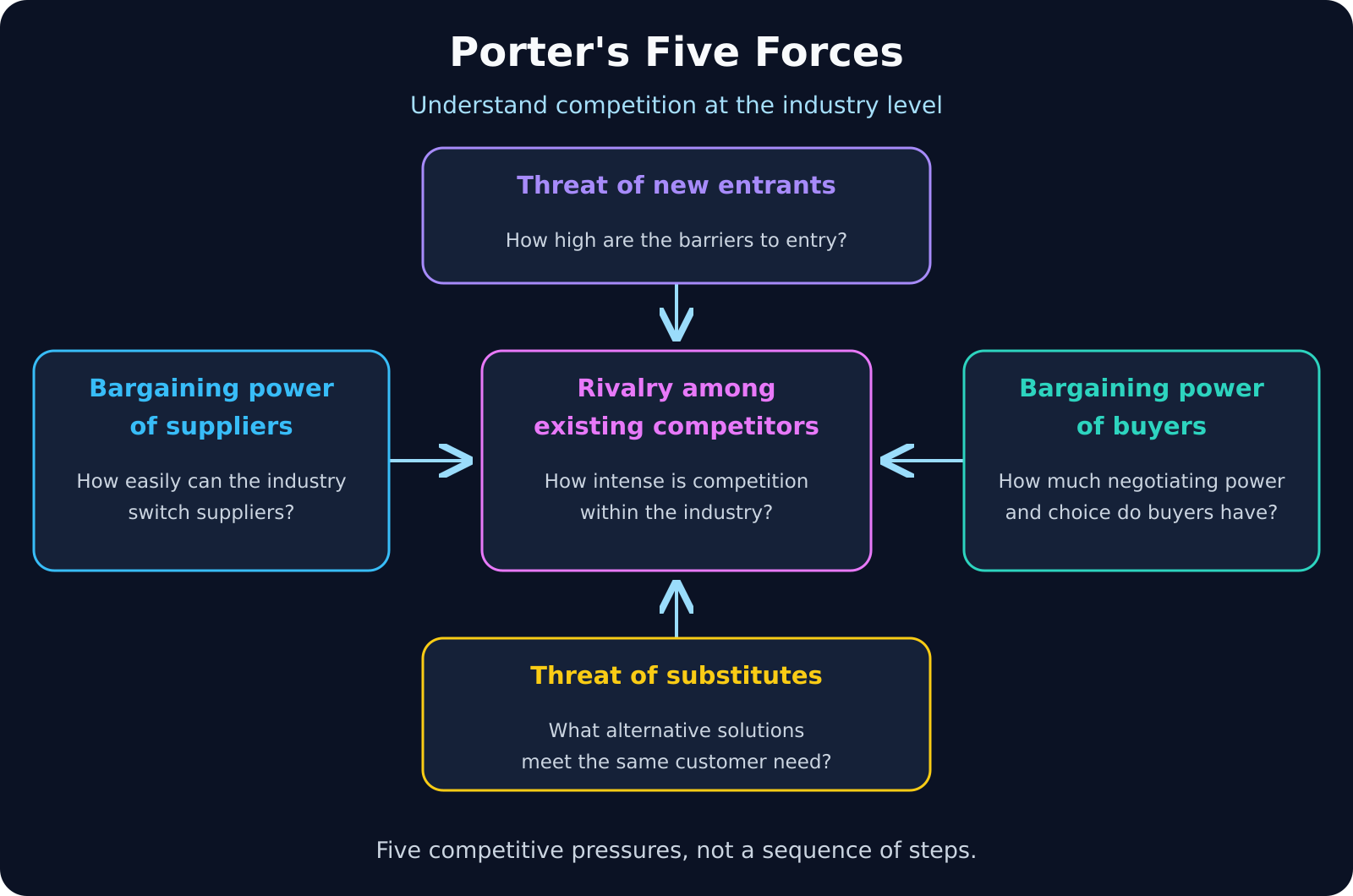
Original Five Forces diagram: arrows represent competitive pressures within the industry, not sequential steps or a ranking of importance.
Understand the five forces
Rivalry among existing competitors
Rivalry concerns competition among organizations already serving the defined industry. The introductory course asks whether competition is intense and whether competitors follow each other's prices. Those questions are a useful starting point because a crowded advertising environment is not the same thing as evidence of commercially damaging rivalry. A team needs to understand how businesses actually compete and what that competition does to the economics of serving customers. See the introductory course, page 63.
Begin by describing the offer customers compare. Do they mainly compare a unit price, a bundle of services, the reliability of delivery, or the amount of work required after purchase? Then examine the terms under which business is won. A lower headline price may conceal a smaller service package. A higher price may include support that is costly to deliver. Comparisons become useful only when the underlying scope is reasonably consistent.
For marketing, the practical consequence may be a need for sharper positioning and stronger evidence of value. If every provider promises the same broad benefits, another slogan is unlikely to change the buying conversation. Investigate whether a segment has an underserved requirement the organization can meet reliably. The result might be a different offer or service process, rather than simply a different advertisement. Avoid presenting differentiation as a guaranteed escape from competitive pressure.
Threat of new entrants
New entrants are organizations that could begin competing within the defined industry. The course highlights investment requirements and the presence of a dominant competitor as questions to investigate. The task is to determine how feasible entry would be for a plausible entrant, rather than assume that an industry is protected because no unfamiliar brand has appeared recently. An established business moving from another location may face different obstacles from a small startup.
Separate the ability to announce an offer from the ability to deliver it consistently. Creating a website may be straightforward, while establishing dependable operations, securing suitable inputs, earning customer confidence, and supporting repeated purchases may take much more work. Ask which of those requirements matters in the actual buying decision. A barrier that exists on an analyst's diagram but has little practical effect on entrants deserves reconsideration.
Marketing can help investigate the credibility and reach of potential entrants, but it should not confuse follower counts with competitive readiness. Review observable distribution access, offer design, customer references where available, and the resources needed to fulfil promises. Keep uncertainty visible. A possible entrant is a scenario to assess, not a reason to announce that market share will inevitably decline or to increase spending without a commercial explanation.
Threat of substitutes
Substitutes meet the same underlying need through a different approach. This is different from another supplier selling a comparable offer within the industry. Harvard's explanation makes this distinction explicit. The practical question is what customers might do instead of buying from any company in your category, and whether that alternative is acceptable given its total cost, effort, performance, and the practical difficulty of switching. Harvard Business School: The Five Forces.
Describe the customer's problem before listing substitutes. A hospitality manager may want a workable way to serve takeaway food, rather than a particular container material. A business buyer may want reliable coordination, rather than a particular software subscription. Once the need is clear, investigate alternatives with customers. Do not assume that an option is a credible substitute merely because it can be described as one in a brainstorming session.
The strategy course connects substitute pressure with the importance of a unique selling proposition. A useful proposition should make a relevant distinction that the business can demonstrate. It might explain an operational benefit, a reduction in administrative effort, or a service capability that matters to a particular buyer. It should not make unsupported superiority claims. If the substitute serves customers better for the situation in question, the response may require changing the offer or choosing a different segment.
Bargaining power of buyers
Buyer power concerns the ability of purchasers to influence prices, terms, or the work a supplier must provide. The introductory course asks whether buyers can impose their preferred price or have few alternatives. Start by identifying the actual purchasing unit. The person who uses a service, the person who selects providers, and the organization that pays may be different parties with different priorities. Combining them under one customer label can obscure the negotiation.
Compare buyer groups rather than assigning one universal rating. A large purchasing group may request tailored reporting and standardized terms, while an individual customer may mainly choose between visible offers. Investigate what each group can realistically change and what happens when it walks away. A demanding buyer is not automatically powerful; the relevant issue is whether the buyer has practical leverage over the transaction.
For marketing, buyer power affects segmentation, value communication, and the design of the sales process. A presentation that stresses broad awareness may be unhelpful when procurement needs evidence about the full service package. Conversely, a technically complete proposal may fail to answer the end user's practical questions. Collect feedback from the distinct participants, explain the offer clearly, and ensure that additional commitments have been costed before they become part of a persuasive sales promise.
Bargaining power of suppliers
Suppliers provide the resources needed to deliver the industry's offer. These may include materials, specialist services, infrastructure, distribution, and other essential inputs. The course asks a concrete question: if a supplier raises its price tomorrow, is there an alternative? A useful answer considers whether that alternative is workable, not merely whether another supplier appears in a search result. See the strategy course, page 30, and introductory course, page 63.
Investigate what changing suppliers would involve. A nominally equivalent input may require testing, adjustments to operations, retraining, or a different customer promise. A cheaper service may omit support that the organization currently relies on. Compare the complete change rather than only the quoted price. Make a clear distinction between evidence from existing agreements and assumptions about what a future supplier might accept.
Supplier pressure can affect marketing even when purchasing sits in another department. A campaign may promise availability, turnaround, or customization that depends on a fragile input arrangement. Before promoting those benefits, confirm the business can support them. Sometimes the most useful marketing contribution is to clarify which promises are conditional, which can be made consistently, and which should wait until operating constraints are resolved.
Treat the Internet as a changing condition, not a universal verdict
The strategy course's page 30 summarizes ways the Internet can affect all five forces: greater buyer visibility, easier supplier search, more substitute possibilities, lower barriers for some entrants, and stronger rivalry. These are useful mechanisms to investigate. They should not be repeated as claims that digital technology always changes every industry in the same direction. A teaching summary is the beginning of an analysis, not its conclusion.
Consider supplier discovery. Online search might reveal several alternative vendors, yet the business could still depend on a particular system or integration. In that situation, the number of visible options overstates the number of practical options. Conversely, a standardized input that is easy to replace might genuinely become easier to source. The same technology can have different consequences because the operating arrangements differ.
Apply the same discipline to entry and rivalry. A digital storefront may reduce one setup task while leaving fulfilment and customer acquisition unresolved. Price visibility may make comparisons easier, but customers still need to understand differences in what is included. Ask what changed, which force it affects, who gains negotiating room, and what evidence supports the conclusion. Avoid treating digitization as a sixth force or as an automatic prescription to advertise more.
Build an analysis that can support a decision
Begin with a short decision statement. For example, specify that the team is assessing a limited entry into a defined customer segment over the next twelve months. State the boundaries, the buyer, the offer, and the alternatives under consideration. This prevents a general market overview from expanding until it no longer answers the original question. It also gives reviewers a way to challenge an assumption without discarding the entire analysis.
Next, collect evidence for each force. Useful material may include consistently defined offer comparisons, purchasing interviews, supplier quotations, public descriptions of competing services, and relevant operating information the organization is authorized to use. Record the source, date, scope, and limitations. A customer's comment can identify a question worth investigating, but one comment should not become a market-wide conclusion without further support.
Separate observations from interpretations. An observation might be that several reviewed offers include the same administrative service. The interpretation might be that this feature is becoming less useful for differentiation. A further hypothesis might be that buyers will resist paying extra for it. These statements have different levels of support. Preserving that distinction helps the team choose what to verify before committing money or making public claims.
Then explain the business mechanism. Do not stop at a rating such as high buyer power. Describe what buyers could request, why the supplier might accept, and how that would affect revenue, delivery cost, or the ability to retain customers. Use low, medium, or high labels only as summaries of the reasoning. There is no need to create a precise numerical score when the evidence does not support one.
Look across the forces before choosing a response. An offer designed to appeal to a powerful buyer could increase dependence on a particular supplier. Entering a narrow segment might reduce direct comparison while increasing reliance on a small number of accounts. These are strategic trade-offs to examine, not reasons to avoid making a choice. Record the expected benefit, the new exposure, and the evidence needed to decide whether the trade-off is acceptable.
Finish with a decision, an owner, and a review trigger. A conclusion might be to test a smaller package, investigate an alternative input, postpone entry, or proceed only with specified operating conditions. Assign responsibility for unresolved questions. Revisit the analysis when a significant assumption changes, such as a supplier arrangement, customer purchasing process, or credible new offer. Routine review dates are useful, but a material change should not wait for the calendar.
Hypothetical application one: a diagnostic service's employer booking package
Consider a wholly fictional independent outpatient diagnostic service assessing an employer-funded administrative booking package over twelve months. The package would help participating employers coordinate practical booking information for employees. This example concerns business arrangements and administration only. It does not recommend tests, treatments, clinical pathways, or changes to individual care, and it makes no claim about current healthcare rules in any jurisdiction.
The team first defines the proposed offer and who buys it. Employers would purchase the administrative arrangement, while employees would interact with the booking process. The analysis must therefore distinguish the buyer's requirements from the user's experience. It must also keep the wider diagnostic service separate from the narrower coordination package where necessary. An alternative to the package is not automatically an alternative to the underlying healthcare service.
For rivalry, the team would compare other providers' employer-facing administrative packages, focusing on verifiable inclusions such as inquiry handling, booking instructions, and account support. It would avoid comparing clinical quality through unsupported marketing claims. If offers appear similar, interviews could explore which administrative problems are still unresolved. The response might be clearer service boundaries and a more dependable support process, rather than a blanket price reduction.
For entrants, the team would investigate who could credibly introduce a competing coordination offer within the planning horizon. An existing provider might be able to extend its administration more readily than a new organization could build the entire service. The analysis would distinguish those entry routes. Actual operating and jurisdiction-specific requirements would need appropriate verification before any launch; the fictional case does not assume that an online booking page establishes readiness to provide diagnostic services.
For substitutes, employers might continue arranging administrative information internally or allow employees to use providers' existing booking routes. These are alternative ways of handling coordination, not recommendations to replace diagnostic care. The team would ask how much administrative work employers actually want to outsource and what employees find usable. If the proposed package solves little additional friction, a polished sales presentation would not establish its value.
Buyer power would depend partly on how employers purchase the package and which terms they can negotiate. One employer seeking extensive reporting and custom support could create a different commercial situation from several smaller buyers using a standard package. The team would cost the requested work before offering it. It would not assume that employer payment permits access to employees' personal health information; any real information flow would require appropriate authorization and review.
Supplier analysis would examine the dependencies behind the offer, including booking infrastructure and the broader service's equipment and qualified staffing arrangements. The fictional team would ask which dependencies constrain administrative promises and what a change would entail. It would avoid implying that personnel or equipment can be replaced casually. Procurement, operations, and appropriate professional reviewers would establish what is feasible before marketing promises an expanded service.
A sensible outcome could be a limited pilot with clear inclusions, a verified support process, and no unsupported availability guarantees. Measures might include aggregate administrative response times, repeated clarification requests, support effort per employer, and whether the package covers its own delivery costs. No medical records are needed merely to illustrate those measures. The decision to expand would depend on the pilot's evidence and operating review, not on the mere completion of a Five Forces diagram.
Hypothetical application two: reusable packaging in a second city
Now consider a wholly fictional supplier of reusable food-service packaging evaluating entry into a second city's hospitality market over twelve months. Its proposed customers include independent cafés and restaurant groups. The offer includes packaging and a defined return or collection arrangement. No real city, legislation, market size, environmental saving, or commercial result is asserted. The purpose is to show how the same framework changes with the industry and buying decision.
The supplier starts by defining the operational area it could actually serve and the customer needs it intends to address. It would compare full arrangements rather than isolated container prices. Storage, handling, collection, replacement, and staff effort could matter to a buyer's decision. Those topics become research questions. They are not treated as established local preferences before the supplier has spoken to potential customers and tested the operating assumptions.
Rivalry research would examine incumbent reusable-packaging arrangements and how their offers are packaged. If providers compete on comprehensive service, a new entrant offering only containers may be addressing a different buying problem. The team would compare what is included, what customers must do themselves, and what evidence supports each promise. It would also avoid assuming that the most visible brand has the strongest economics or the highest retention.
Entry analysis would consider both new specialists and existing suppliers expanding into the city. A supplier with nearby operations might have an easier route to serving customers than a business starting from scratch. The team would investigate the resources needed for its own entry without assuming that its difficulties protect it from everyone else. Marketing reach, dependable service coverage, and customer onboarding would be examined together.
Substitutes could include disposable packaging arrangements or a hospitality business managing its own reusable system. Their relevance would depend on the customer's needs and circumstances. The comparison would include operational effort and the complete service arrangement, not an unsupported claim that reuse is always cheaper or environmentally superior. Any real environmental claim would require evidence appropriate to the actual product and operating system before appearing in promotional material.
Buyer power could differ between independent cafés and restaurant groups negotiating for multiple locations. The supplier would examine whether a group's proposed volume comes with costly customization, demanding collection conditions, or concentration risk. Serving a large account could be attractive, but headline volume is not enough to establish that. A segment decision should account for the work required and the resilience of the resulting customer mix.
Supplier power would involve the inputs and services needed to fulfil the proposed arrangement. Standardized packaging might offer different replacement options from a bespoke design, while collection arrangements could introduce another dependency. The team would test whether alternatives are actually compatible with its process. It would not announce reliable citywide collection simply because a possible logistics provider has expressed interest.
The combined analysis could lead to a geographically limited pilot using a clearly defined offer. The team would track delivery effort, replacement requirements, customer support workload, and the economics of repeat service. It would compare those observations with the assumptions that justified entry. Expansion, redesign, a narrower segment, or postponement could all be reasonable outcomes. The framework helps structure the choice; it does not predetermine that entering the city is the right answer.
Connect the findings to marketing strategy
Five Forces becomes useful when it changes a choice about whom to serve, what to offer, what to promise, or where to invest. Use the analysis to write a focused strategic brief. State the commercial pressure, the evidence behind it, the audience affected, the proposed response, and the conditions needed for that response to work. Then check that the organization can deliver what the brief asks marketing to communicate.
Use other frameworks for questions they handle better. PESTLE examines broader external conditions; Five Forces investigates their possible implications for industry competition. SWOT can combine relevant external findings with internal strengths and weaknesses. Detailed competitor analysis can then examine selected organizations. Moving between these levels is useful as long as evidence and assumptions remain visible and the team does not mistake one framework for a complete strategy.
The discipline is straightforward: define the industry, investigate all five forces, explain the economic consequences, and choose a response that fits the evidence. Keep the difference between buyers and users clear, distinguish substitutes from direct competitors, and revisit assumptions when conditions change. A well-supported analysis may justify a campaign, an operational improvement, a narrower offer, or a decision to wait. Its value lies in improving the decision rather than decorating the plan.
Related models and sources
This article is based on the explanatory Arabic course PDFs “شرح_استراتيجية_التسويق_الرقمي.pdf,” pages 29–30, and “شرح_مقدمة_التسويق_الرقمي.pdf,” page 63. These pages establish the five forces, practical questions about buyers and suppliers, the relationship with competitor analysis, and proposed Internet effects. The expanded research workflow and both fictional applications are original explanatory material. Internet effects are treated as context-dependent possibilities rather than universal claims.
The model's industry-structure and profitability scope, and the distinction between substitutes and direct competitors, were independently checked against Harvard Business School's Institute for Strategy and Competitiveness: The Five Forces, reviewed on 12 October 2026. No course illustration is presented as a current market fact.
For the wider macro environment, see PESTLE analysis. Connect the important external findings to your capabilities with SWOT analysis.
Comments
No published comments yet.