A marketing strategy depends on conditions the organization cannot fully control. Customers may reconsider spending, a new technology may change how they search, or a public policy decision may alter access to a market. A team can execute its campaigns well and still struggle if the assumptions behind those campaigns no longer fit the outside world. PESTLE analysis gives that external environment a clear place in planning.
The framework examines six groups of macro-environmental influences: Political, Economic, Social, Technological, Legal, and Environmental. Its practical value comes from connecting researched changes to a specific decision. A useful analysis explains what is happening, whom it affects, how it could change the organization's choices, and what deserves further investigation. This article develops that approach through a research workflow and two hypothetical applications.
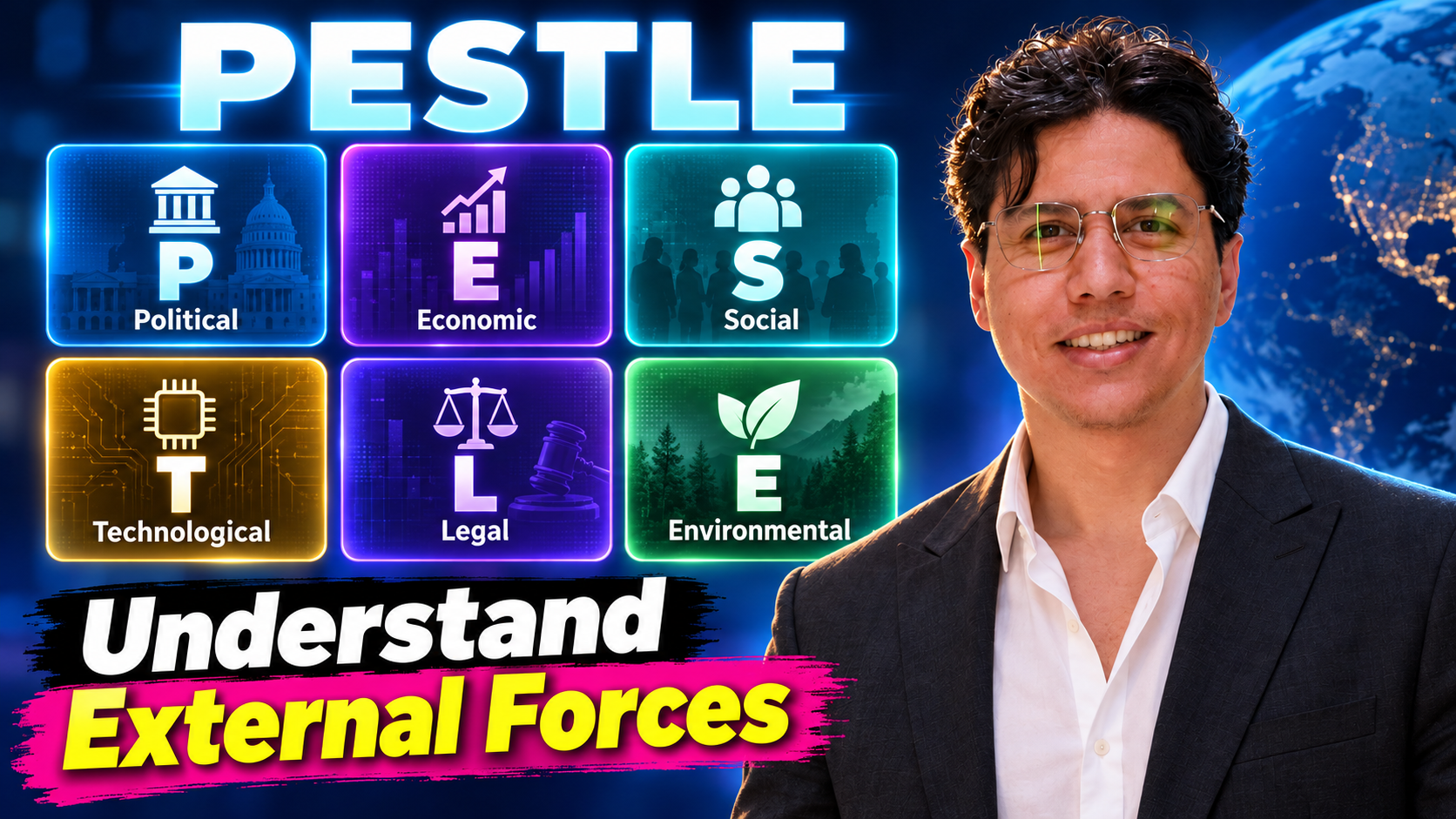
What PESTLE analysis covers
The digital marketing strategy course describes PESTLE as a strategic planning tool for identifying current and emerging external influences. It emphasizes that findings need research and critical analysis of their effect on the organization. The six headings organize questions; they do not establish that a particular change is happening or prove that it matters to every business. Those judgments require evidence. See the strategy course, page 26, and the introductory course, page 49.
The word macro is important. PESTLE looks at broader conditions such as population patterns, economic pressures, technology adoption, and public policy. An individual competitor's new advertisement is usually better examined through competitor analysis. A widespread change in how customers discover services could belong in PESTLE. A shortage of skills inside your own marketing team is an internal issue, although a wider labor-market shortage might help explain it.
PEST is the shorter, four-category variant: Political, Economic, Social, and Technological. PESTLE makes Legal and Environmental influences explicit. A team using PEST should still consider relevant legal and environmental questions rather than assume they disappear because the acronym has fewer letters. State which version you are using and keep the category definitions consistent. The choice of label matters less than whether the analysis covers the external conditions that could materially change the decision.
PESTLE also complements SWOT. SWOT brings together internal strengths and weaknesses with external opportunities and threats; PESTLE provides a more structured investigation of the wider external environment. The introductory course pairs the frameworks on page 45. Its shorthand emphasis on SWOT's internal perspective should not be read as making opportunities and threats internal. After researching a PESTLE finding, decide whether it creates a relevant opportunity, threat, both, or neither for the organization in question.
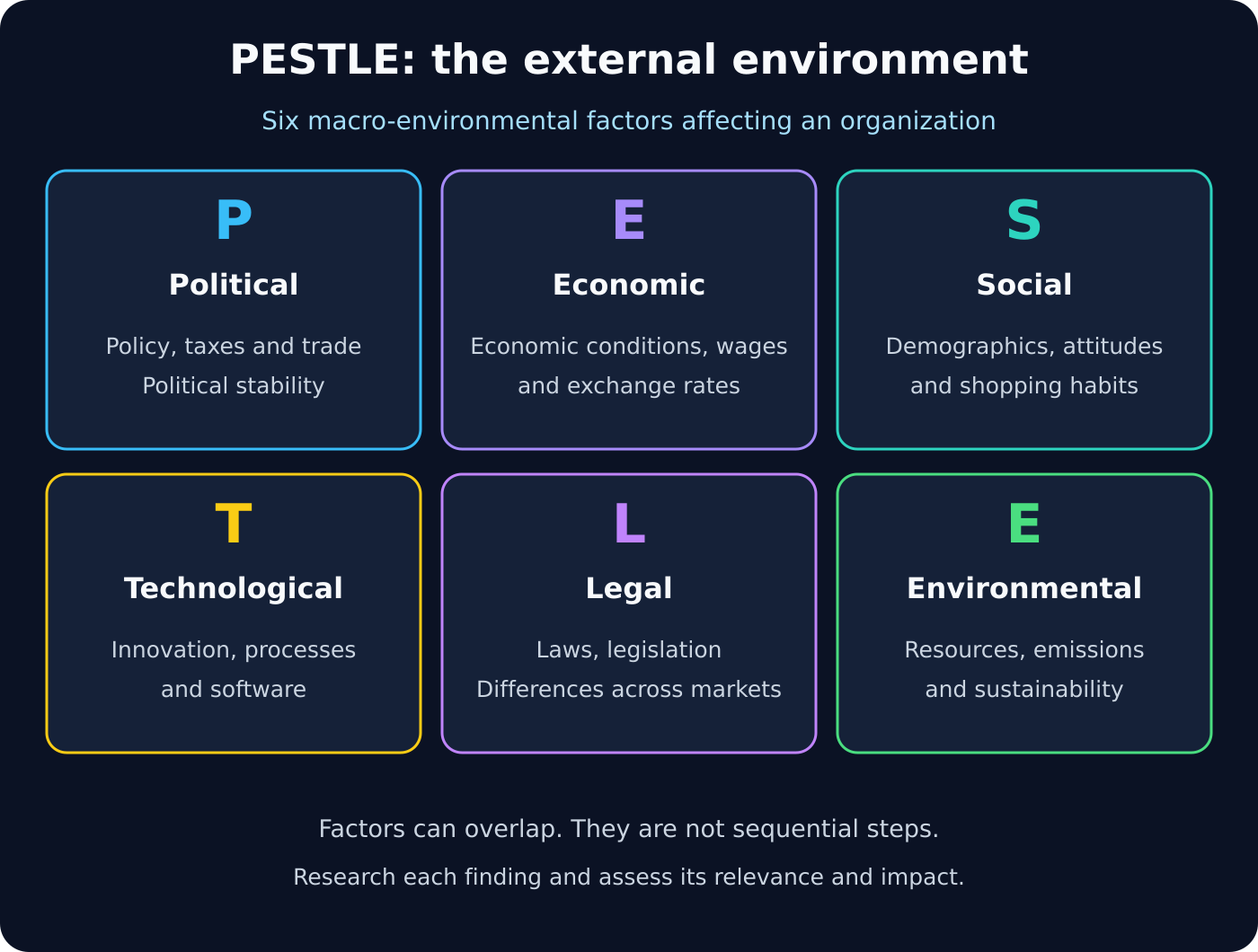
Original diagram of Political, Economic, Social, Technological, Legal and Environmental factors: external influences that may overlap, not sequential steps.
The six PESTLE factors in marketing strategy
Political factors
Political analysis considers how public priorities, government decisions, institutional stability, and relationships between countries might affect the planning context. The course includes taxation, trade agreements, and fiscal policy among its examples. For marketing, the consequence may appear through distribution costs, public funding, market access, or the suitability of a message. The useful question is which specific decision could affect your audience or the conditions under which you serve it.
Distinguish a proposal from an adopted policy and implementation from an announcement. A possible change may deserve monitoring without justifying an immediate campaign overhaul. Record the jurisdiction and expected timing, then describe the mechanism of impact. For example, a proposed transport initiative might change access to a service location if it proceeds. That is an assumption to investigate, rather than evidence that demand will automatically grow.
Economic factors
Economic analysis examines conditions affecting customers' ability and willingness to spend, alongside the costs of delivering the offer. Relevant topics can include income patterns, employment, price changes, borrowing conditions, exchange rates, and business confidence. Their importance depends on the audience and buying decision. A business selling imported equipment faces different exposures from a local service whose main costs are staffing and premises.
Avoid moving directly from a national headline to a sales forecast. An overall expansion in a market can coexist with pressure in a particular segment. Ask how a change affects the customer's budget, purchase timing, alternatives, and evaluation of value. Then examine your own cost exposure separately. Customers may become more price sensitive while your costs rise, creating a trade-off between affordability, service quality, and margin that marketing alone cannot resolve.
Social factors
Social analysis considers demographic patterns, attitudes, habits, expectations, and cultural context. It can help explain changes in how people seek information, what they consider convenient, and whose recommendations they trust. The course highlights demographic change, consumer attitudes, and shopping habits. Translate those broad topics into questions about the actual audience rather than stereotypes about an age group or community.
A preference for digital convenience, for example, does not establish that every customer wants a fully self-service journey. Some may need assistance, accessible information, or another way to ask questions. Research should examine those differences without collecting unnecessary personal information. Social findings can influence language, content formats, service explanations, and channel choice. They should also challenge assumptions about who is being overlooked by the current approach.
Technological factors
Technological analysis examines external developments in tools, infrastructure, processes, materials, and patterns of adoption. The course includes new software and generative artificial intelligence. For marketing, a development may affect discovery, customer expectations, measurement, production costs, or the experience of using a service. Its strategic relevance depends on whether the intended audience or operating environment is actually changing.
Separate external availability from internal readiness. A booking technology becoming common in a market is an external development; your team's inability to maintain a booking system is an internal constraint. Both matter, but they answer different questions. Before adopting a tool, examine reliability, accessibility, integration, staff workload, and the consequences of failure. A pilot should test whether the technology improves the relevant task, not merely whether staff can launch it.
Legal factors
Legal analysis identifies requirements and changes that may affect the organization's activities in the jurisdictions where it operates. The course stresses that rules can differ between countries. In marketing, research topics may include advertising claims, customer communications, use of personal information, contracts, and transaction processes. These are areas to verify with appropriate authoritative sources and qualified reviewers; this framework does not establish what a particular business is legally allowed to do.
Record the applicable location, source, effective date, and scope of any requirement that informs a decision. Check whether a document describes an existing rule, proposed change, regulator guidance, or someone else's interpretation. Where specialist advice is needed, make that a dependency before launch. A marketing team can identify the question and preserve evidence without presenting its own reading as a definitive legal conclusion.
Environmental factors
Environmental analysis considers natural conditions, resources, pollution, waste, emissions, and sustainability-related pressures. These can affect supply continuity, operating costs, customer expectations, and the credibility of marketing claims. The course discusses environmental impact and resource use, then highlights overlap with social and legal influences in the introductory material, page 59. An environmental finding should explain a real exposure or opportunity rather than simply label sustainability a trend.
For a physical product, examine the relevant parts of sourcing, production, use, delivery, and end-of-life handling. For a service, consider access and operational dependencies where they affect the decision. Be precise about evidence: recyclable, reusable, and lower-impact describe different properties. A packaging change cannot support a broad environmental claim without an appropriate basis for comparison and an understanding of how the product is actually used.
Build the analysis around one decision
Start with a decision statement. “Understand the market” is usually too broad to direct research. “Decide whether to enter a second city within twelve months” identifies a choice, geography, and horizon. Add the intended audience, offer, and major assumptions. This makes it easier to decide which findings belong in the analysis and which interesting developments have little bearing on the current work.
Set boundaries before collecting information. A local service may need neighborhood access information alongside regional economic evidence. An international seller may need separate views for different markets rather than a single global average. Note the date of the analysis and the period each source describes. The publication date and the data period can differ substantially, and a recently published summary may still rely on old observations.
Build a small evidence record for each material finding. Include the external change, its category, source, date, geographic coverage, affected audience, possible business effect, confidence, and an unresolved question. Then add a decision implication. For instance, evidence about uneven digital access may suggest testing an assisted booking route alongside self-service. The implication remains a proposed response until the organization checks feasibility and observes what happens.
Use sources suited to the claim. Official publications can establish the text or status of a policy. Statistical releases may describe an economic or demographic pattern. Direct research with an appropriately selected audience can explore how that pattern affects a particular purchase decision. Supplier information may reveal commercial constraints but should be assessed in light of the supplier's interests. No single source type answers every question.
Check what the evidence can actually support. A survey of current customers cannot fully describe people who considered the offer and left. A platform's advertising audience estimate is not a count of customers ready to buy. Market revenue does not establish your obtainable share. The introductory course uses dated charts to illustrate research-led planning on pages 50–57; those teaching examples should be treated as historical illustrations, not reused as current market facts.
Connect factors without counting the same risk repeatedly
Real developments cross category boundaries. A public policy decision can affect costs, while a social preference can influence environmental expectations. Classify each finding where it is easiest to understand, then describe the connections. The objective is a coherent explanation of exposure. Filling six equal-sized boxes is unnecessary when a particular decision is dominated by a few well-supported influences.
Consider a hypothetical resource shortage. Its physical cause may belong under Environmental, its cost effect under Economic, and any new requirements under Legal. These are connected parts of one situation. If you count all three as independent risks and add their scores together, the analysis can exaggerate exposure. Preserve a shared reference and explain which part of the decision each connection affects.
Prioritize according to potential impact, timing, uncertainty, and relevance to the choice. A high-impact development that could occur soon may require a contingency plan. A distant, poorly evidenced possibility may need only a monitoring question. Simple high, medium, and low judgments can support discussion, provided their meanings are explained. Avoid presenting subjective scores as if they were measured probabilities or precise forecasts.
End the review with choices. Decide what to change now, what to test on a limited basis, what to prepare for, and what to monitor. Give important unresolved questions an owner and a useful review trigger. A trigger might be an official implementation notice, confirmed supplier terms, or evidence that the audience is abandoning a particular process. The resulting plan should show how the research changes action.
Hypothetical application one: an outpatient health centre
Imagine an outpatient health centre reviewing its administrative booking access over the next six months. This is a fictional example, with no claims about an actual provider, jurisdiction, or outcome. The decision concerns information and appointment administration only. Clinical assessment, treatment decisions, and medical advice remain outside the example's scope.
The centre begins with a narrow question: should it introduce a simpler online inquiry route while retaining assisted booking? Its team wants people to understand how to request an appointment and receive accurate administrative information. It cannot infer unmet need from website visits alone, and it should avoid treating more inquiries as success if staff cannot respond reliably. Capacity, accessibility, and suitable demand all matter.
For Political factors, the centre investigates whether any announced local transport or public-service changes could affect access to its location. It distinguishes confirmed arrangements from proposals. Under Economic factors, it explores whether administrative inquiries increasingly concern prices or payment arrangements, using aggregated information rather than exposing individuals' financial or health details. A question about cost is evidence of an information need; it does not establish the reason someone delayed a visit.
The Social investigation examines how people prefer to ask practical questions and what information is difficult to understand. Some may value self-service, while others need a staff-assisted route or clearer language. The Technological investigation examines the availability and reliability of suitable booking tools, including whether they work on common devices and support accessible use. The centre then checks its own staff capacity separately before promising faster responses.
For Legal factors, the centre identifies which proposed form fields, messages, and promotional statements require review in its actual jurisdiction. It does not assume that general contact details, health information, and marketing permissions can be handled identically. Before any launch, appropriate reviewers would confirm the relevant requirements. The Environmental review considers whether seasonal conditions or transport disruption could affect arrival information and appointment administration, without speculating about clinical consequences.
The findings suggest a limited pilot with plain administrative information, a minimal inquiry form, and a visible assisted-booking alternative. No diagnosis or treatment information is requested merely to improve marketing reporting. Staff confirm what the form promises and what happens when the service is unavailable. The content explains verified booking steps and avoids guarantees about access, waiting time, or outcomes that the centre cannot substantiate.
Before the pilot, the team establishes consistent definitions for completed inquiries, administrative response time, booking completion, and requests that require assistance. It records service interruptions and changes in available appointments so that later comparisons have context. These measures help identify friction; they do not prove that a particular campaign caused a change. The team would also check whether aggregate reporting masks difficulties experienced by people using the assisted route.
At review, the centre might retain both routes, simplify the form further, or resolve staffing and system problems before expanding promotion. Its PESTLE analysis has connected external access, affordability questions, audience preferences, technology, legal review, and operating conditions to a practical decision. The appropriate result is a better-supported administrative approach, not a claim that the framework has improved medical care or guaranteed commercial growth.
Hypothetical application two: a reusable packaging supplier
Consider a fictional supplier of reusable hospitality packaging exploring entry into a second city over twelve months. Its customers would be cafés and other small hospitality businesses. The offer depends on a workable return and handling process, so the marketing decision cannot be separated from operational feasibility. No city, legislation, market estimate, or performance figure in this example is presented as a real-world fact.
The supplier defines the decision as whether to run a limited commercial pilot before committing to wider expansion. Political research examines relevant public priorities and any proposed support for reuse systems, while distinguishing policy interest from confirmed funding or purchasing commitments. Economic research examines customers' capacity to absorb total operating costs and the supplier's exposure to transport, energy, and replacement costs. A low unit price would be incomplete if collection and handling made the overall arrangement expensive.
Social research asks how staff and end customers would understand and participate in the return process. Interest in reducing waste may not translate into consistent participation when instructions are confusing or returns are inconvenient. The team investigates likely points of friction using clearly labeled research questions. It avoids assuming that environmental awareness alone will make the service easy to sell or operate.
Technological research considers available tracking methods and whether they can work reliably in busy hospitality settings. The supplier separates tool capability from the practical burden of training, support, and exception handling. Legal research identifies the local requirements and proposed commercial claims that need qualified review before a pilot. It does not copy assumptions from the original city or treat a competitor's advertising as evidence of permission.
Environmental research examines material use, expected useful life, collection patterns, handling requirements, and the destination of damaged items. Any comparison with an alternative would require a defined boundary and credible evidence. Calling the packaging reusable describes an intended characteristic; it does not by itself establish that the full system has a lower environmental impact. This distinction directly affects what the supplier can responsibly communicate.
The analysis reveals a connected uncertainty: demand may exist, but return participation and collection practicality determine whether the offer can be delivered consistently. The supplier therefore proposes a small pilot in a manageable area, with clear participation instructions and verified terms. Marketing materials explain the service process and its limitations. Broader claims about savings or environmental performance remain dependent on suitable evidence.
The pilot measures participation, successful collections, loss or damage, support requests, and actual servicing cost. The team records why businesses decline or withdraw where that information is voluntarily provided. It then checks whether the findings apply beyond the pilot area. Results from a compact route with enthusiastic early participants may not transfer to a dispersed customer base with different operating conditions.
A sensible decision could be to expand gradually, redesign the collection process, adjust the target segment, or postpone entry. Each option follows from a combination of external findings and internal feasibility. PESTLE has helped the team investigate the conditions around the opportunity before treating a market-entry campaign as the answer. The commercial decision remains accountable to evidence gathered during the pilot.
Use AI to extend questions and verify sources yourself
The strategy course, page 27, and introductory course, page 60, demonstrate using AI as a starting point for PESTLE research. Both warn that the underlying information may be outdated and must be checked. This is especially important when generated answers mix a genuine trend, an old statistic, and an unsupported prediction into a confident paragraph.
A useful research prompt gives the decision, geography, audience, and horizon, then asks for questions, possible influences, and sources to inspect. Ask the system to separate provided facts from hypotheses and identify where current verification is necessary. Read the underlying source before adopting a claim. A plausible citation, company name, or numerical detail should not be accepted simply because it appears in a structured answer.
Keep confidential business information and personal data out of tools that are not approved for that use. Challenge generic suggestions by asking what evidence would make them relevant to this organization. Human reviewers remain responsible for applicability, interpretation, and the final decision. AI can help organize the work, but a completed six-part answer is not proof that the environment has been adequately researched.
Keep PESTLE connected to action
A PESTLE analysis becomes useful when it changes a decision, exposes an assumption, or identifies a condition worth watching. Preserve the reasoning behind the chosen response and the evidence that could change it. When the environment shifts, update the affected finding rather than rewriting the whole framework for appearance. Review the analysis at moments that matter to the decision, including before a launch, a major commitment, or expansion after a pilot.
The discipline is straightforward: define the choice, research the relevant external influences, explain their effects, and decide how to respond. Keep uncertainty visible and connect the findings to the organization's actual capabilities. That approach turns Political, Economic, Social, Technological, Legal, and Environmental analysis into a practical contribution to marketing strategy.
Related models and sources
Use the relevant external findings with SWOT analysis, then review existing activity, limitations and leverage with SWOTELL.
Based on the Arabic explanatory course PDFs “شرح_استراتيجية_التسويق_الرقمي.pdf,” pages 26–27, and “شرح_مقدمة_التسويق_الرقمي.pdf,” page 45 and pages 49–61. The six factors and emphasis on research appear on strategy page 26 and introduction page 49; factor overlap appears on introduction page 59; AI verification cautions appear on strategy page 27 and introduction page 60; introduction page 61 asks learners to use SWOT and PESTLE to identify priorities. The PEST comparison, expanded research workflow, and two fictional applications are original explanatory material. Dated statistical illustrations and historical legal forecasts in the course have not been presented as current facts. No originator, invention date, or guaranteed outcome is claimed.
The four-category PEST definition is independently supported by AHRQ’s PEST analysis guide, reviewed on 11 October 2026.
Comments
No published comments yet.