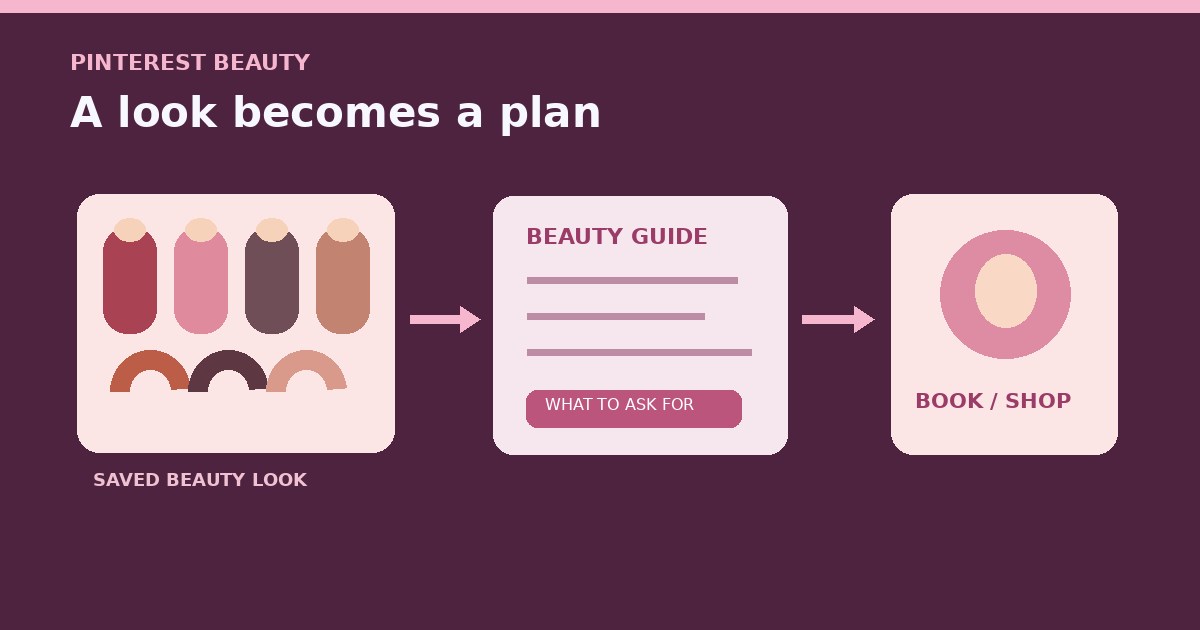
Pinterest's first Beauty Trend Report, published on 6 October 2026, is more useful to marketers as a map of specific intent than as a list of fashionable colors. Its examples show searches moving from broad categories such as “hair color” or “nails” toward precise combinations of finish, shape, mood, and occasion. Pinterest also announced a Sephora collaboration around expressive makeup and described Beauty Guides, a feature that can turn a saved hair or nail image into a practical brief and shoppable product suggestions. For a beauty retailer or salon, the commercial question is how to translate discovery into a suitable product or appointment without treating every rising query as proven local demand. Pinterest's report, 6 October 2026.
What the reported signals mean
Pinterest says 85% of its weekly users surveyed discovered new beauty ideas on the platform before seeing them elsewhere, and 64% considered it better for finding up-to-date beauty trends. The newsroom page presents these as survey findings but does not disclose enough sampling detail in the visible report to treat them as a Saudi population estimate. The distinction matters: a platform can be an early inspiration source for its regular users without being the dominant discovery channel for every customer segment. A marketer should use the findings to frame a test, then validate demand with local search, store questions, consultation requests, and sales. Pinterest, 6 October 2026.
The search examples illustrate specificity. Pinterest reports “cluster lashes ideas” up 646%, “pink hair stripe” up 463%, “frosted makeup” up 286%, and “mocha balayage hair” up 949% in the report's trend comparisons. It also lists large increases for specialized nail terms, including “polka dot cat eye nails” up 1,585%. These are growth rates for particular queries in Pinterest's data, not market share, sales growth, or evidence that the underlying service is safe or profitable. A term can grow sharply from a small base. The page does not provide complete denominators, geographic breakdowns, or a universally comparable date window next to each figure. Use the percentages as clues for creative development, not forecasts. Pinterest trend examples, 6 October 2026.
Why narrow searches can be commercially valuable
A query such as “dark red cat eye nails design” reveals more than interest in manicures. It describes color, effect, and format. The person may be collecting ideas, comparing salons, or deciding which products to buy. A brand can answer each stage with a different asset: a visual guide explaining the finish, a product page listing the required items, or a booking page that clarifies time, maintenance, and price range. When the asset matches the exact concern, the customer does less work to translate inspiration into action.
This is also a warning about taxonomy. Many retailers organize catalogs by internal merchandising categories, while customers describe looks in natural language. If a catalog calls an item “shade 418” but users ask for “cherry-cola brunette,” product discovery will be harder. The response is not to rename every item after a trend. It is to add accurate descriptive tags, examples of the result, application guidance, and links from look pages to the relevant products. For services, a consultation page should explain what can be achieved and what depends on hair history, skin characteristics, or professional assessment.
Beauty Guides change the handoff
Pinterest says Beauty Guides let an eligible user open a hair or nail Pin, tap “Get the Guide,” and see a breakdown of the look, what to ask for in a salon, similar inspiration, and shoppable products. The report states availability is currently for iOS users in the United States, with wider rollout planned in following weeks. A Gulf salon should not promise its clients the feature today without checking availability on their devices and market. Still, the product design is instructive: the saved visual becomes a structured brief. It shortens the gap between “I like this” and “what exactly should I request or purchase?” Pinterest, 6 October 2026.
Salons can build the same handoff even without platform access. A booking flow can invite a customer to attach a reference image, select the aspect they like, describe current hair or nail condition, and receive a transparent consultation pathway. The staff should distinguish inspiration from a guaranteed result. A look that appears simple in a photograph may require previous color removal, multiple visits, or maintenance that the customer did not expect. A transparent explanation builds trust and prevents disappointment.
A merchandising and content workflow
Start with the report's themes, then filter them through the business's actual products, services, capabilities, and local customer language. Choose a limited set of looks for which the brand can demonstrate a credible result. Photograph or illustrate those looks with clear licensing and honest labels. Add a short explanation of the technique, tools or products needed, maintenance, and who should seek professional advice. Write descriptive English and natural Arabic terms where both audiences matter. Avoid mechanically translating trend slang if customers use a different phrase in Arabic.
Next, connect each look to inventory and booking. A product pin should resolve to a page where the item is available in the customer's region, where shade and finish are clear, and where returns or hygiene exclusions are stated. A service pin should resolve to the correct branch, appointment type, expected consultation, and realistic next step. A marketer must not send a trend-inspired visitor to a broad homepage and assume the person will search again. Broken availability and ambiguous shade naming waste the intent that the creative captured.
Build a measurement view that separates inspiration from conversion. Track saves, outbound clicks, product detail visits, add-to-cart actions, booked consultations, attended appointments, and repeat purchase. A pin can be valuable even when a purchase happens days later, but reported assisted conversions need careful attribution. Compare themed creative against evergreen creative with similar offers and delivery conditions. If a rising trend earns many saves but few qualified actions, investigate whether the look lacks local supply, the page is unclear, or the audience was collecting ideas without near-term intent.
A four-week test for a Gulf business
In week one, ask store, salon, and customer-service staff which visual references customers already bring. Compare those answers with Pinterest trends and the site's own search terms. Pick one hair theme and one nail or makeup theme supported by existing stock and staff skill. Record baseline impressions, clicks, consultation requests, attendance, average order value, and refunds or complaints where relevant.
In week two, create several distinct visuals for each theme: close-up of finish, practical process, and product or appointment outcome. A truthful original illustration can explain a technique, but it must not masquerade as a real client's result. For a clinic or medical aesthetics provider, before-and-after presentation and outcome claims need particular care and local approval. Write descriptions that explain the intended look and the next step rather than merely repeating the trend name.
In week three, publish eligible Pins and matching pages, check mobile speed and availability, and monitor feedback. Note which precise descriptions lead to meaningful product views or completed bookings. In week four, assess whether the campaign brought new customers or only shifted existing demand from another page. Calculate contribution after creative production, stock, and service delivery costs. If evidence is sparse, continue observation rather than scaling from a dramatic search-growth headline.
Limits and Karim's strategic angle
Pinterest's percentages describe activity on its platform and a survey of its users. They do not tell Karim how many Saudi shoppers want a given look, what they will pay, or whether a local clinic can deliver it safely. Search growth can reverse, and products must meet quality and advertising standards regardless of popularity. The Sephora collaboration illustrates how a retailer can pair inspiration with products, but it does not prove a return for other brands.
Karim's best opportunity is to offer beauty brands a “trend-to-service” system: identify a specific intent signal, verify it with local customer evidence, prepare accurate bilingual visual explanations, connect each asset to real stock or appointment capacity, and measure commercial outcomes. The strategic edge is precision and trust. A useful result is a customer who knows what to ask for and receives a fitting service, not merely a campaign that repeats the newest aesthetic label.
Translating discovery into durable search value
A trend page should survive after the initial spike. Include a plain description of the finish or technique, who it suits, what maintenance involves, and alternatives for customers who cannot use the featured product. Use internal links from broad category pages to the more specific guide and back to the appropriate booking or product page. Update availability rather than deleting an article when stock changes; visitors and search engines still need a truthful answer. Ask frontline staff whether the language on the page matches the words customers use. If the local audience describes a look differently from Pinterest's English query, maintain the concept but adapt the terms. This creates a more lasting asset than a caption that borrows a popular phrase for a week.
A useful way to brief the creative team
Give designers the exact customer question, not a list of search terms alone. Specify the finish or technique, the real product or service, the level of maintenance, and the part of the look that must remain legible on a small card. Ask for a visual that explains the result without implying that a generated face or hand is a documented client outcome. Pair it with a caption that answers what the viewer can do next and who should consult a professional. Review the finished asset with store or salon staff, because they know which visual details customers misinterpret. This makes a trend test a source of practical customer education rather than a collection of attractive but ambiguous pictures.
Comments
No published comments yet.