Effective change: October 30, 2026. Editorial review: November 2, 2026. This article examines an already effective campaign-setting change, not a launch announced today.
What the official documentation establishes
OpenAI says creative enhancements became automatic for new and existing ChatGPT Ads campaigns from October 30, while existing opt-outs remain. Campaign choices override account defaults. Enhancements can adapt copy, translate text, resize images and change destination selection using existing ads and landing pages. Individual variants need not receive approval before delivery, and not every variation is previewable. Settings remain adjustable in Ads Manager. The documentation explicitly cautions that overall reporting trends do not isolate enhancement effects. Official source.
Those are the verified platform facts. The remainder is our editorial analysis and a proposed operating approach, not additional product documentation or evidence of advertiser results.
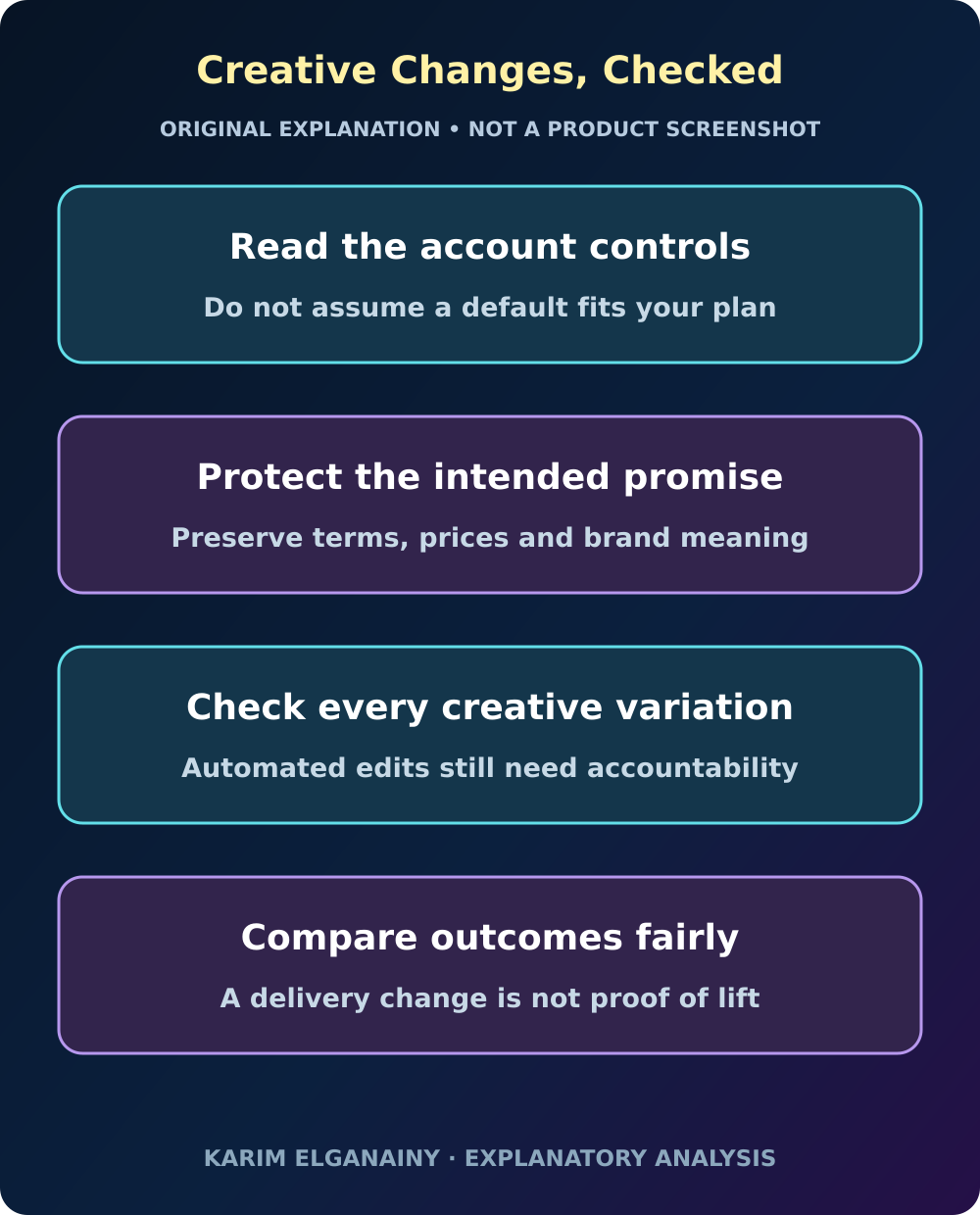
Original editorial framework; not a product screenshot or proof of campaign results.
A default is a distribution decision
An account default looks like a technical preference until it changes who can modify a promise made to a customer. For an advertiser, the important question is not whether generated copy sounds polished. It is whether the organisation can still explain what it offered, where that offer appeared, and which page supported the customer's next step. That question becomes harder when preparation and delivery no longer share a mandatory human checkpoint.
Consider a hypothetical home-services advertiser. Its approved headline promotes an assessment, while its landing page contains separate sections about installation, maintenance and financing. The business might be comfortable allowing variations that explain the assessment differently, but uncomfortable implying that the assessment includes installation. Both messages can be assembled from genuine information on the same website. Only one describes the actual transaction being advertised. Content accuracy and offer accuracy are related, but they are not interchangeable.
The immediate marketing task is therefore to define the permitted promise before debating whether automation should be embraced or rejected. A team that cannot articulate that promise in one paragraph will struggle to review either a human-written advertisement or a machine-assisted variation. Automation exposes an existing briefing weakness; it does not remove the need for a brief.
Start with the offer, not the creative asset
A useful offer specification contains the product or service, eligible customer, included benefit, material exclusion and acceptable next action. For a subscription, distinguish the trial from the paid plan. For a retailer, distinguish a category promotion from a discount on every item. For a professional service, distinguish booking a consultation from buying a guaranteed outcome. These distinctions belong in the working brief even when space prevents every detail from appearing in a headline.
Next, inspect whether the landing page tells a consistent story. A page can contain a current hero promotion and an outdated question-and-answer section. It can show an available product beside an archived seasonal bundle. It can describe delivery in a general footer while a specific product has different fulfilment conditions. A creative workflow that treats the page as reference material makes such contradictions operationally relevant, not merely untidy website maintenance.
This does not require rewriting the entire site. Begin with the pages receiving paid traffic and the offers that are currently live. Give each page an owner who can answer a simple question: if a customer takes this page literally today, what are we prepared to honour? The answer should agree with checkout, sales scripts and customer support. Otherwise the advertiser is buying attention to an unresolved commercial disagreement.
Separate adaptation from reinterpretation
Teams often classify changes by size: a small headline edit receives light review; a large visual change receives more scrutiny. A more useful distinction is whether a change preserves or reinterprets the offer. Replacing a long phrase with a shorter equivalent may preserve the promise. Turning a qualified benefit into a universal claim may reinterpret it, even if only a few characters change.
Create a short list of invariants for each campaign. Examples include the named product, the duration of a promotion, the required eligibility condition and the actual action after a click. An invariant is not a list of preferred adjectives. It is something that cannot change without changing the commercial meaning. Keep this list brief enough that account managers, copywriters and sales staff can use the same version.
Then identify desirable flexibility. A travel advertiser may welcome different explanations for business and leisure needs without changing availability or cancellation conditions. An education provider may adapt the language used to describe a course while keeping prerequisites and certification claims fixed. This framing avoids a false choice between freezing every word and accepting unrestricted reinterpretation.
Treat destination consistency as part of creative quality
A persuasive message can still fail if the next page does not deliver what the user reasonably expects. That is why destination review should sit beside copy review rather than being delegated entirely to a technical checklist. The relevant question is not simply whether a page loads. It is whether the next screen preserves the product, price context, language and action that made the advertisement relevant.
For a hypothetical retailer, a category page might be useful when someone is exploring alternatives but frustrating when the advertisement appears to promise a particular item. For a service business, a general contact page may lose the connection between an urgent need and the specialist appointment being offered. Neither destination is inherently wrong. The mismatch is relational: it arises between message, expectation and next step.
Before increasing investment, walk through several realistic customer journeys. Include someone unfamiliar with the brand, someone comparing prices and someone returning after seeing a promotion elsewhere. Record where each person would expect to land and what evidence would reassure them. These exercises are not a substitute for performance data. They help identify preventable experience failures that aggregate conversion reports may not explain.
Translation needs commercial ownership
Multilingual advertising is not simply an English approval process with extra words attached. A translated offer can preserve grammar while changing tone, certainty or the relationship between a headline and its conditions. Local teams need authority to flag a commercial ambiguity, not merely correct spelling after a campaign has started.
For Arabic-language work, a practical review should examine whether the expression for a benefit implies certainty, whether the advertised service matches the terminology used by the local sales team, and whether the page and form are coherent in the same language. This is an editorial recommendation, not a claim about how any particular platform translation behaves. It matters whenever a company moves from one source language to multiple customer-facing versions.
The owner of the local offer should also check whether the business can actually fulfil the experience in that market. Language coverage does not establish service coverage. A fluent message can attract enquiries that the company cannot handle, leaving the campaign apparently successful at generating interest while creating a poor customer experience downstream.
Build a comparison that answers a decision
The easiest measurement mistake is to compare results before and after a setting changed and call the difference an effect. A seasonal promotion, changing stock availability, different spend or a revised landing page can all move the same metrics. A useful evaluation starts with the decision the team intends to make: retain the setting, narrow its use, or keep a particular campaign under tighter creative control.
Where the account's available controls and experiment design permit, compare reasonably similar activity under stable offer conditions. Do not assume that a particular testing feature exists. Document the method actually available, including allocation, timing, audience differences and any operational changes during the observation period. If the design cannot support a causal conclusion, label the result descriptive rather than trying to compensate with confident wording.
Choose a downstream quality measure alongside a delivery measure. A lower cost per enquiry is not automatically useful if more enquiries concern an unavailable service. A higher click rate can be commercially unhelpful when it comes from a broader interpretation of the offer. Pair advertising outcomes with information the business already uses to judge whether demand is suitable and fulfilment is working.
Preserve evidence without collecting unnecessary customer detail
When a concern arises, the team needs enough evidence to understand the incident: campaign identity, date, offer version, relevant page and the observed mismatch. It generally does not need a dossier about the person who noticed it. Design the internal issue record around the advertisement and commercial promise rather than around personal information.
This is especially useful when several teams share responsibility. A copywriter may see an issue in wording, a media buyer may see a change in delivery, and customer support may hear the first complaint. A common incident format allows them to describe the same problem without sending ambiguous screenshots around multiple channels. The point is faster diagnosis, not an elaborate bureaucracy.
Agree in advance who can pause affected activity, who can correct the underlying page, and who confirms that the offer is coherent again. These are organisational responsibilities, not assumptions about specific platform controls. The people making those decisions should know the financial and customer-service consequences of leaving a questionable message in circulation.
Use reversibility to set the pace
Some campaigns are easier to test than others because mistakes are easier to detect and unwind. A stable product with a simple offer and a well-maintained destination creates a different operating environment from a time-limited promotion with regional restrictions and several fulfilment partners. This is a reason to sequence experimentation, not to declare one category permanently suitable or unsuitable.
Start where the team can observe outcomes and respond quickly. Avoid changing the offer, destination structure, audience strategy and creative approach simultaneously if the goal is to learn about one decision. A restrained first comparison can produce more actionable knowledge than a broad rollout whose results cannot be interpreted.
For campaign reviews after October 30, the most valuable conversation is therefore concrete: what promise is allowed to vary, what must remain fixed, which destination supports it, and what evidence would make us change course? The default setting makes that conversation more urgent. It does not answer it on the advertiser's behalf.
Editorial conclusion
Creative automation should be evaluated as part of the offer-delivery system, not as an isolated copywriting shortcut. Its usefulness depends on the quality of the source offer, the coherence of the destination and the organisation's ability to distinguish suitable demand from superficial engagement. The best next move is not an automatic yes or no. It is an explicit, reviewable decision about where flexibility helps the customer without changing what the business has actually promised.
Comments
No published comments yet.