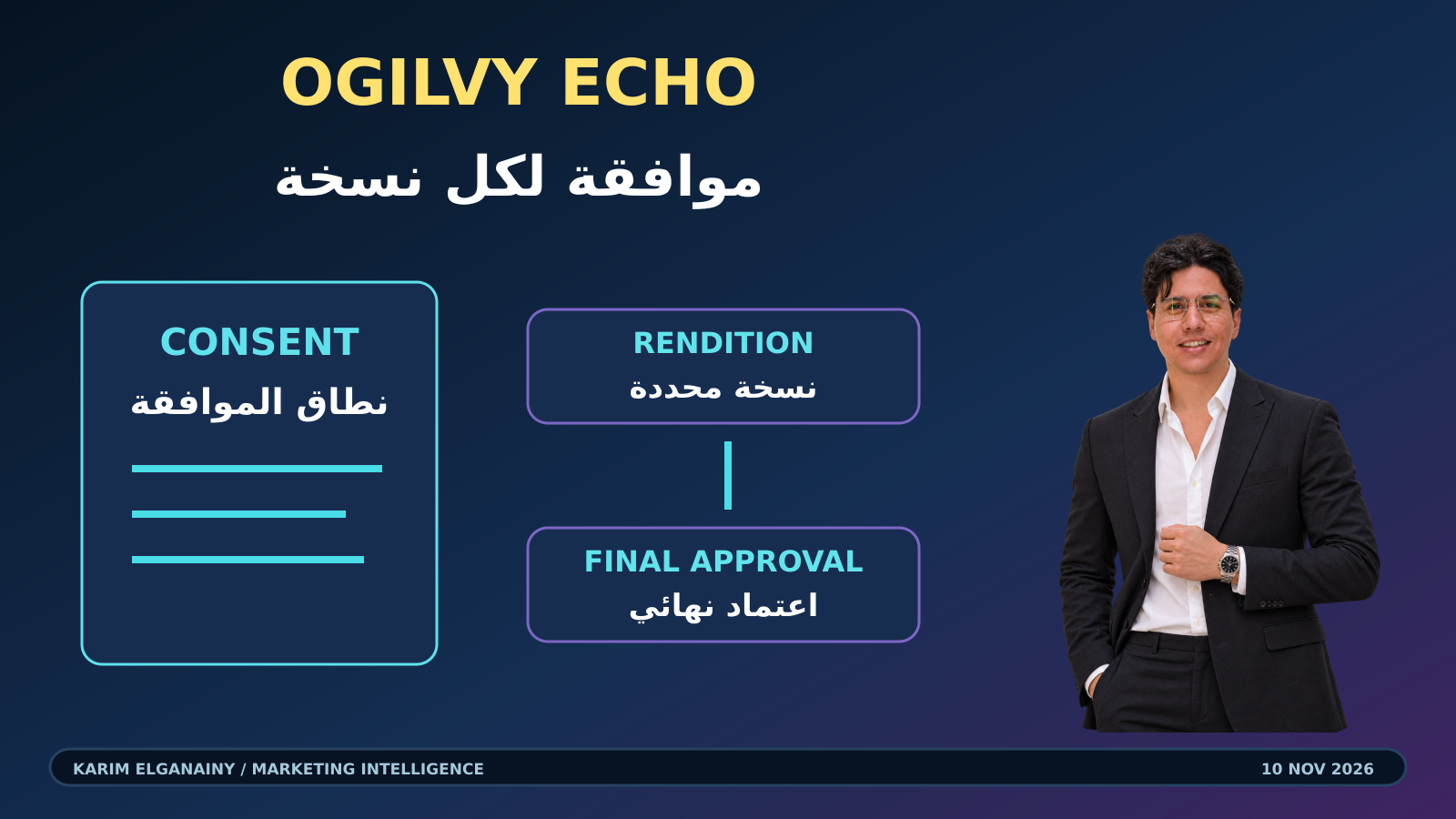
An AI-generated advertising image can look complete before the permissions behind it are complete. Ogilvy’s launch of ECHO brings that gap into focus by connecting creative generation with verified talent material and approval before release. For marketing teams, the important question is how consent stays attached to the exact version that eventually reaches an audience.
The announcement offers a specific example of an industry approach, not a universal answer to licensing or audience trust. The factual digest below is followed by independent operational analysis. The proposed procedures and hypothetical examples are recommendations for evaluating a workflow, not undisclosed ECHO features or accounts of an actual client campaign.
What the ECHO announcement establishes
Ogilvy announced ECHO on November 9, 2026. The platform connects creative generation with verified talent scans in CAA Vault through a WPP–CAA partnership. Ogilvy describes machine-readable usage terms, automated checks and final talent or agent approval before each asset can be released. Cleared public assets carry a visible disclosure watermark indicating that the AI use is talent-approved.
The announcement says ECHO integrates with WPP Open and standard post-production tools, and is commercially available across WPP from November 2026. That is not the same as a public self-service product or a general license to use a represented person’s likeness. The release does not give a public price or broad licensing permission.
Ogilvy also cites proprietary research involving more than 1,200 respondents in the United States, United Kingdom and India. Its geographic scope matters: those findings cannot establish how Saudi or UAE audiences will respond. Projected cost-per-asset reductions should likewise be treated as company projections, not guaranteed savings or independently validated outcomes. Source: Ogilvy’s ECHO announcement.
Define the intended use before making variants
Begin with a use description that production staff can understand and the responsible legal or rights specialist can review. Identify the person represented, the material involved, the proposed brand association, the markets, channels and period of use. Record whether the planned work changes an existing image or generates a new rendition. Do not infer the scope of permission from the mere availability of a scan.
If a brief includes a voice, text attributed to the person or an implied endorsement, assess those permissions separately rather than assuming image approval covers them. This is a planning recommendation, not a statement about the platform’s supported formats. The relevant contract and professional review should determine what is permitted in the particular engagement.
Keep uncertainties visible. A team can prepare an unresolved-rights list without deciding the legal answer itself. Label an unapproved use as awaiting a decision, and prevent it from becoming an assumed permission as the brief passes between teams. An explicit question early in production is usually more useful than an ambiguous approval note beside a finished file.
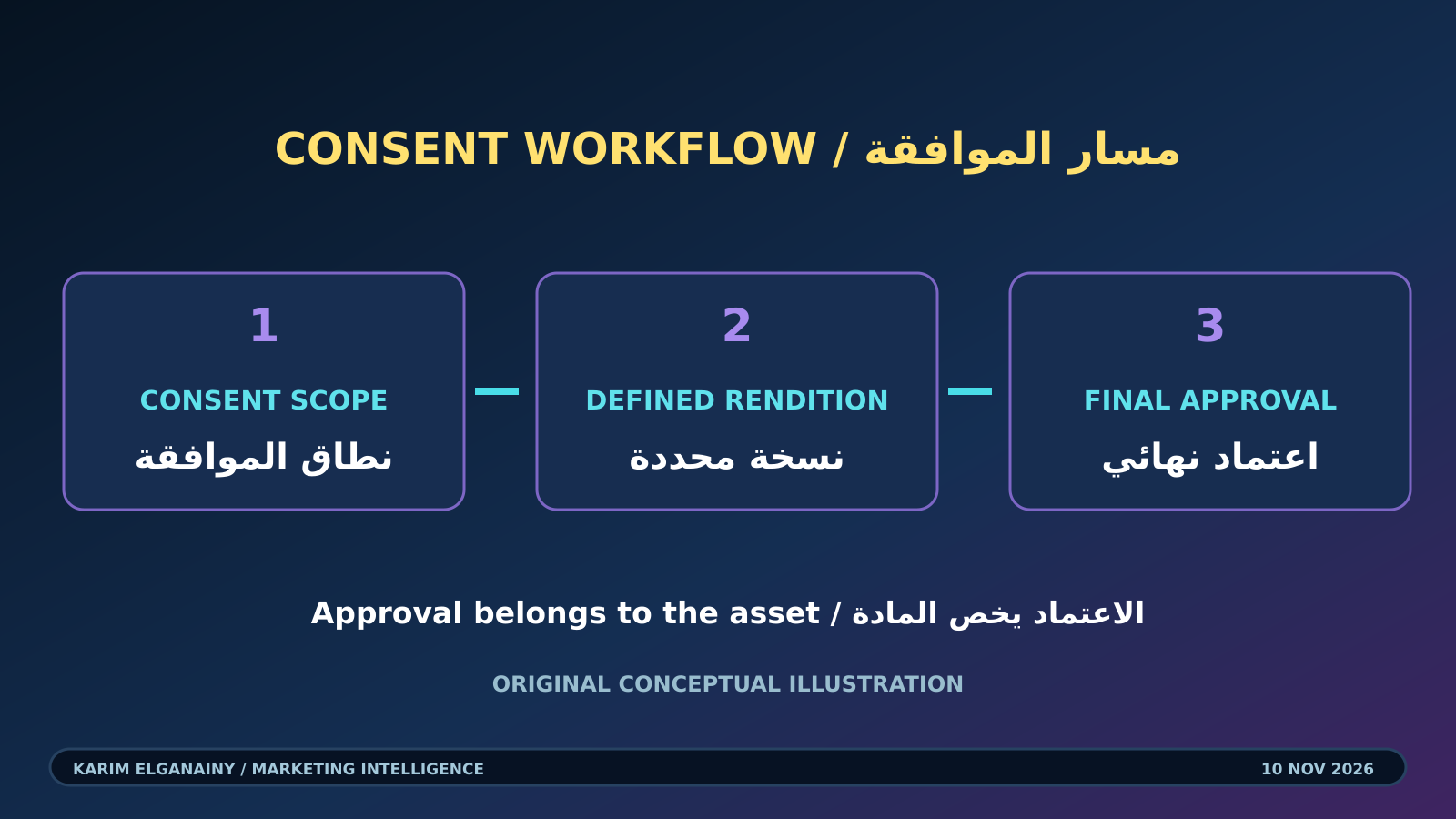
Original explanatory diagram proposed for this article, not an ECHO interface or an official platform workflow: consent scope → defined rendition → final asset approval. It distinguishes operational decisions rather than claiming to reproduce the product’s technical controls. Announcement context: Ogilvy.
Separate a concept decision from release approval
Creative teams often discuss a campaign through storyboards, rough images and sample copy before a final asset exists. Approval of that direction should be recorded for what it is. It does not by itself establish that every later image, edit, caption or placement is approved. In a proposed workflow, a concept decision gives production a defined direction; release approval refers to an identifiable final asset and its intended use.
Consider a hypothetical product campaign in which a performer appears beside a package. The initial concept may be acceptable, while a later generated gesture appears to endorse a specific product claim that was never part of the brief. That change should return to the appropriate reviewers rather than inherit the concept’s approval automatically.
Describe what changes trigger a new decision. A new market, revised spoken or written claim, altered depiction or different publication context may require review under the relevant agreement. The exact requirements depend on that agreement. The practical objective is to make substantive changes visible instead of allowing the word “approved” to travel unchanged through a chain of different materials.
Build a record around each version
Give each candidate an identifier that remains understandable after export and handover. Link it to the approved brief, source material, relevant permission record, edits and review status. The record should allow someone who did not create the work to answer a basic question: why is this exact version cleared for this exact use?
Avoid relying on filenames such as “final,” “final-new” and “final-approved” to carry the decision history. Keep the accepted asset distinct from rejected or superseded alternatives. If editing continues after approval, mark the new version for the appropriate review instead of silently replacing the file associated with an earlier decision.
This record need not expose confidential contractual detail to every collaborator. Give each role the information needed to perform its job, while keeping access to restricted material appropriate. The aim is traceable permission and reliable handover, not indiscriminate distribution of scans, contracts or personal data. These are proposed management practices; the announcement does not specify the full record design used inside ECHO.
Allocate creative, rights and release decisions
Several judgments can sit behind one public asset. Creative reviewers assess whether the work serves the brief. Rights reviewers check that the intended use fits the relevant permissions. The represented person or their authorized agent has the approval role described in the announcement. The publishing team then needs to know which version and placement have been cleared.
Document the responsibilities without assuming that one sign-off replaces all the others. A talent approval should not be treated as confirmation that a product claim is accurate. Equally, a marketer’s approval of brand presentation does not establish the person’s consent to the depiction. Specialist claims may require additional qualified review.
Create an escalation route for disagreement or uncertainty. Name who pauses release, who resolves a rights question and who records the resulting decision. Production deadlines should not turn a missing response into an inferred approval. This separation can feel slower at first, but it makes the status of the work clearer and identifies the decision that is actually blocking publication.
Treat localization as a substantive change
A translated campaign may retain the same image while changing the meaning around it. Headline, caption, call to action and placement can alter what an audience believes the represented person is saying or endorsing. Review the complete localized asset, not just whether the translation reads smoothly or the original image remains intact.
For example, a hypothetical English line about exploring a product range could become a stronger recommendation when adapted into another language. The translation might sound natural yet exceed the approved message. Ask a qualified local reviewer to compare the intended meaning, assess cultural context and flag claims that require renewed approval.
Do not use Ogilvy’s three-country research as a shortcut for Gulf-market judgment. A Saudi or UAE campaign needs evidence relevant to its own audience and use case. That may include a limited comprehension test of the actual creative and disclosure, with findings described narrowly. Neither a translated slogan nor a global platform relationship demonstrates local suitability or compliance.
Test whether the disclosure is understood
A visible talent-approved AI watermark is part of the announced public-asset approach. Its presence provides information, but it does not establish that every viewer notices it, understands it or trusts the advertisement. Teams should distinguish the existence of a disclosure from its effectiveness in the intended context.
In a proposed test, show the actual asset in a realistic placement and ask viewers what they believe was generated, what the label tells them and whether it changes their interpretation of the person’s participation. Use neutral questions rather than explaining the desired answer first. Check smaller screens, compressed versions and placements where surrounding interface elements could compete for attention.
Do not confuse a positive answer about the label with approval of the product claim or the campaign as a whole. The disclosure, accuracy of the message, clarity of the relationship and suitability of the depiction all matter. Local advertising requirements may impose additional obligations, so the team should obtain the relevant professional review rather than treat a watermark as a blanket compliance certificate.
Measure the economics of usable work
A high volume of generated variants is not a complete business result. Measure how many materials reach approval, how many are actually deployed, how long approvals take and why candidates are rejected. Record editing and review effort alongside generation activity. The useful denominator is the accepted or deployed asset, depending on the decision being made, not simply the exported file.
Include rights administration, talent-related arrangements where applicable, creative production, review, post-production and version management in the cost view. Separate initial setup from recurring work and explain which costs are included. A faster generation step can coexist with a slower approval process; both effects belong in the assessment.
The announcement’s projected savings do not substitute for this calculation. Begin with the organization’s own baseline and compare similar briefs under consistent acceptance requirements. If an experiment improves creative flexibility but does not lower total cost, report that result accurately. It may still have value, but the investment case should describe the observed benefit rather than borrow a promise from a launch statement.
Plan for expiry and changes in permission
Permissions have a life after the first publication. A practical asset record should help the team identify where material is running, who owns each placement and what conditions govern continued use. An expiry date is useful only if it reaches the people who can stop or replace the material when required.
Prepare a response for an amended agreement, an expiring license or a request affecting consent. The appropriate action depends on the contract and applicable requirements; do not assume every situation has the same remedy. Identify who reviews the issue, who authorizes the response and who checks that changes have reached the relevant placements and partners.
Keep superseded versions out of routine reuse while preserving records according to appropriate retention requirements. A campaign team should not discover an old approved file and assume it is approved forever. The announcement’s approval mechanism is a useful starting point for discussion, but the organization still needs a clear operating plan for the full period during which it uses an asset.
Pilot the approval process before increasing output
Start with a contained assignment whose permissions and audience are clear. Walk one candidate through the full process, including a deliberate revision after review, before asking the system to generate a large batch. This tests whether the team can identify the approved version, understand why a change needs attention and deliver the correct file to publication.
Agree on expansion conditions in advance: dependable permission records, understandable disclosures, workable review capacity and a demonstrable benefit for the chosen task. Set pause conditions for unclear consent, repeated depiction problems or missing release ownership. Thresholds should reflect the organization’s risk and workload; the announcement provides no universal production target.
ECHO’s launch makes consent a practical production question rather than a general statement of intent. The strongest takeaway for marketers is to connect permission scope, the actual rendition and final release approval. That connection can support more accountable creative experimentation, while leaving legal interpretation, specialist review and the represented person’s decision in the hands of the people authorized to make them.
Comments
No published comments yet.