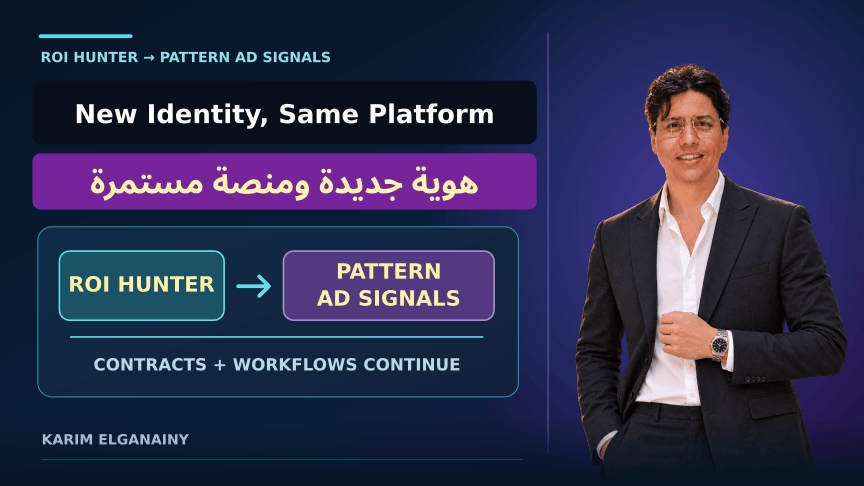
On October 26, 2026, ROI Hunter announced its new name, Pattern Ad Signals. The company explicitly describes a branding change, not a new product or platform migration. It says existing commercial terms, access, features, integrations, workflows and contacts remain unchanged, while the visual transition continues through Q2 2027. Primary announcement.
Published October 27, this analysis examines what a rename asks of marketing and customer-facing teams. The event should not be confused with the earlier acquisition, announced in December 2025. Original acquisition release. The practical framework below is independent editorial analysis, not a description of Pattern's internal transition plan or a forecast of product performance.
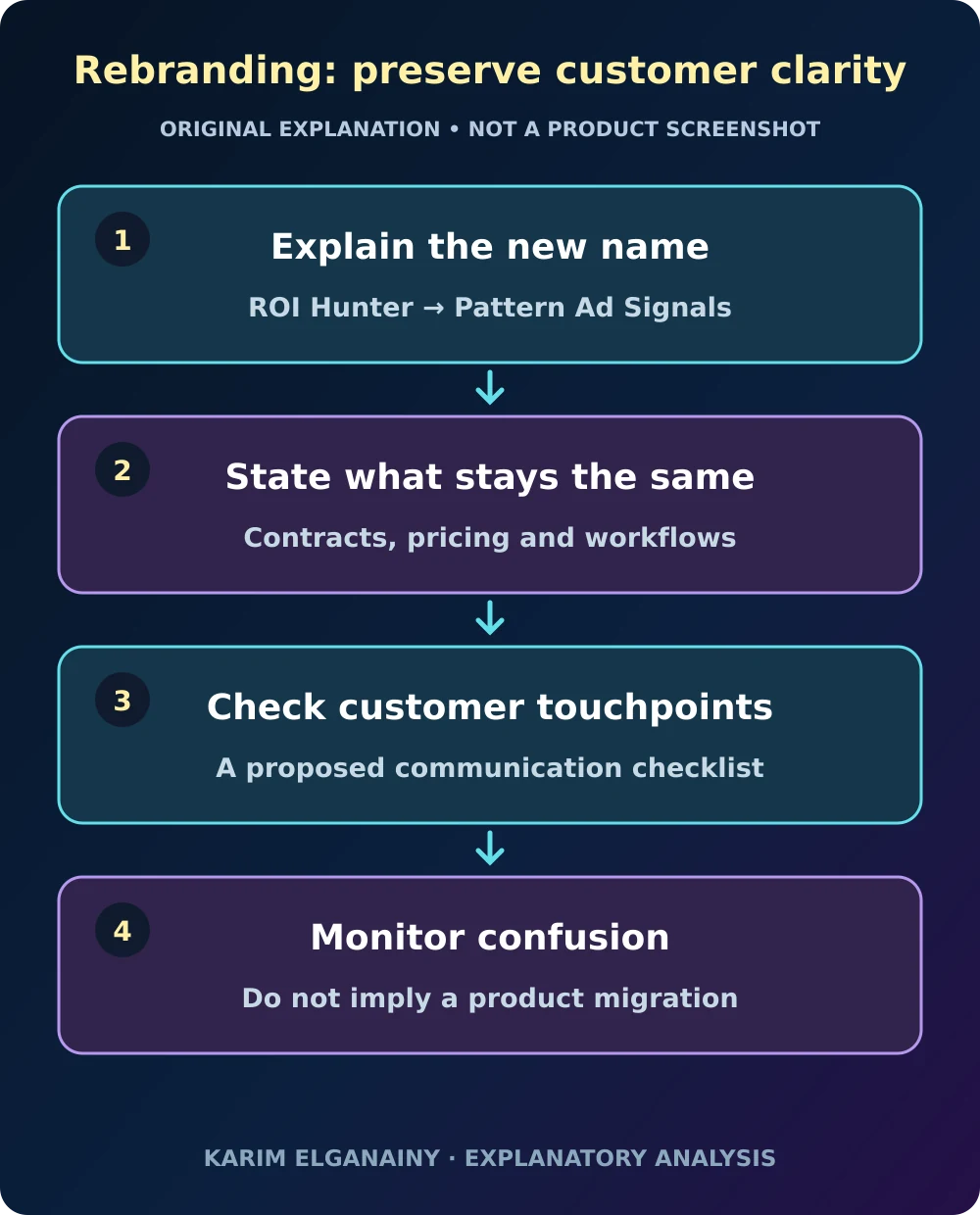
Original explanatory illustration by Karim Elganainy: a proposed communication framework, not a product screenshot or company process diagram. Announcement context: ROI Hunter becomes Pattern Ad Signals.
A rename is a customer-understanding project
A company can change its logo in a day while leaving customers uncertain for months. People encounter the business through saved links, invoices, proposals, support messages, training material and colleagues' recommendations. If those touchpoints tell different stories, a visually consistent launch can still produce an inconsistent experience. The customer may not know whether a familiar service has disappeared, whether an account needs action, or whether an unexpected message is authentic.
Treat the transition as a set of questions to resolve rather than a list of assets to recolor. Ask what an existing customer needs to recognize, what a prospective buyer needs to understand, and what an internal employee needs to explain accurately. These groups may share a headline, but they do not necessarily need the same detail or the same next step.
A useful first deliverable is a plain-language continuity statement. It should distinguish what changes now, what stays the same and what remains undecided. Do not fill an information gap with optimistic language about transformation. If an operational change has not been announced or approved, the communication should not encourage the reader to infer it from the new name.
Separate identity, ownership and capability
Brand discussions often collapse three different subjects into one story: what the product is called, who owns the business and what the product can do. For customer communication, keep them separate. A new identity may help explain a corporate relationship without establishing a new feature, a new integration or a better commercial result.
Build a simple message table with one row for each subject. For every row, record the verified statement, its source, the audience that needs it and the action required. If no action is required, say so clearly rather than creating an unnecessary migration checklist. This discipline prevents a sales presentation from accidentally turning a brand event into an unsupported product announcement.
The table also helps reviewers identify misleading combinations. A new logo placed beside an old performance claim can imply that the claim belongs to a newly launched capability. A broad description of the parent organization can be mistaken for functionality available in every account. Review the complete impression of the communication, not just whether each isolated sentence is technically defensible.
Map the moments where recognition can fail
Before replacing assets, inventory the customer journey. Include discovery pages, product documentation, saved login links, account emails, invoices, contracts, partner directories, webinar recordings and onboarding checklists. Rank them by the harm caused if a customer becomes confused. A payment-related message and an archived social post do not deserve identical urgency simply because both display an old name.
For each high-priority touchpoint, identify its owner, current wording, proposed wording, review requirement and update dependency. Some changes may need coordination with legal, finance, information security or a distribution partner. A shared transition list makes those dependencies visible before a public launch creates expectations that teams cannot yet fulfill.
Do not assume that the website is the whole brand. A customer's most frequent contact may be a recurring report or a support conversation. Ask the service team which documents people actually use. The best transition sequence is the one that preserves recognition at important moments, not necessarily the one that produces the largest number of updated files first.
Use a bridge message with an expiry decision
During a rename, a transitional phrase such as “new name, formerly known as…” can connect familiarity with the future identity. Its role is to reduce ambiguity, not become a permanent second brand by accident. Decide where that bridge is useful, who owns it and what evidence will support retiring it.
Avoid an arbitrary universal removal date. Different audiences may recognize the new identity at different speeds, and different assets have different replacement cycles. A current proposal template can change quickly; a recorded training session may need a contextual note rather than an expensive remake. Explain the relationship clearly without implying that every historical appearance of the old name is an error.
Measure confusion directly where possible. Support questions, search terms within help content and feedback from account teams can reveal whether customers still need the bridge. These are diagnostic signals, not a scientific brand-awareness study. Use them alongside a deliberate review of the customer experience rather than claiming that silence proves everyone understands the change.
Protect trust in access and communications
A rename can make unfamiliar messages look plausible. That is a reason to coordinate communication with security owners, not to improvise new login instructions. Direct customers toward established, verified channels and make any required action precise. If a communication says no action is necessary, avoid surrounding it with buttons that suggest the opposite.
Prepare support teams for practical questions: Is this message genuine? Where should I sign in? Has my account changed? Who can confirm a payment request? The answer should come from an approved reference, not an employee's interpretation of the branding announcement. Keep sensitive account verification inside the organization's normal process.
For a hypothetical software provider, a safe rehearsal would follow the customer path from an announcement email to a trusted help page and then to the existing access route. Review links, sender recognition and the clarity of the action. This is a proposed quality-control exercise, not a statement that the companies in this story have changed authentication or encountered a security incident.
Give sales teams an evidence-based narrative
A brand transition often creates pressure to tell a bigger story. Sales teams may want to connect the new identity with a broader portfolio or future ambition. That can be useful if the narrative distinguishes present availability from aspiration and leaves room for account-specific qualification.
Create an approved claims sheet. Mark each statement as current capability, commercial condition, announced direction or independent interpretation. Include the date and source of verification. A buyer should not need to guess whether a feature is available today, under development, separately priced or merely part of a broader corporate vision.
Train through realistic objections rather than only a launch presentation. Ask a representative to explain the change to an existing customer who is worried about disruption and to a prospect comparing alternatives. Review whether the explanation answers the actual question. Good messaging reduces uncertainty; it does not simply repeat the new name more confidently.
Keep measurement definitions stable
Renaming a product can create avoidable reporting noise if teams also change labels, campaign conventions and business definitions without documentation. Establish which naming changes are cosmetic and which alter the meaning of a metric. Preserve a mapping between old and new labels so analysts can compare periods without accidentally treating one service as two different entities.
Record the transition date in relevant reporting, but do not attribute every subsequent movement to the rebrand. Changes in demand, sales activity, product availability or advertising can coincide with the launch. The analysis should distinguish observation from explanation and avoid assigning causality simply because two events share a calendar window.
A useful transition scorecard might track recognition-related support queries, errors in public listings, completion of high-risk updates and unresolved customer questions. Commercial measures can be reviewed separately with an appropriate comparison and limitations. The first scorecard evaluates execution quality; it does not establish that the new identity caused revenue growth.
Do not redesign customer workflows by implication
An identity project can become an unplanned operational transformation when every team adds its own preferred change. A new template leads to a new approval process, which leads to different data collection, which creates additional work for customers. Each change may seem reasonable in isolation, but their combined effect can contradict a message of continuity.
Keep a clear scope boundary. Separate necessary brand updates from optional workflow improvements and from changes that require fresh customer communication. If a process improvement deserves implementation, evaluate it on its own merits rather than hiding it inside the rename. Customers should know when they are being asked to do something different and why.
This separation also protects delivery teams. A defined transition can be completed and reviewed; an unlimited collection of related improvements cannot. Maintain a backlog for later opportunities, with owners and evidence requirements. Finishing the agreed identity work should not depend on solving every historical problem in the product or commercial organization.
Plan localization as a recognition problem
For Arabic and English audiences, consistent recognition matters more than literal word-for-word symmetry. Decide how the product name appears in each language, how the former name is referenced and which descriptive terms explain its role. Keep a shared terminology reference so different teams do not invent competing Arabic labels for the same offering.
Test the wording with the actual task. Can an Arabic-speaking customer connect a support message to the product they already use? Can a buyer identify which name belongs on an internal request? Can a colleague explain the relationship without translating a slogan awkwardly? These practical questions reveal problems that a visual review alone may miss.
For healthcare organizations adapting the same principles, identity continuity can affect appointment instructions, referral communication and service information. Do not infer that a renamed service has different clinical capabilities or approvals. Any such claim needs its own verification and relevant professional review. The transferable lesson is clarity about identity and continuity, not a reason to make unverified health claims.
Build a transition register that people will use
A useful register does not need to be elaborate. It needs a touchpoint, an accountable owner, the current state, the intended state, dependencies, verification evidence and a decision date. Include a place for exceptions so incomplete third-party updates do not disappear into informal conversations.
Review high-risk exceptions regularly with the people who can resolve them. A partner listing that still uses an older name may only need a bridge description, while a misleading sales document may need immediate correction. Prioritize by customer impact and accuracy rather than by how visible the item is to the launch team.
When an item is marked complete, record what was actually checked. “Updated” might mean a file was edited, a page was published or a customer-facing journey was tested; these are different states. Clear evidence avoids the familiar situation in which every department believes its work is finished while the customer still encounters contradictory information.
The strategic takeaway: preserve understanding while changing identity
The strongest question for a marketing leader is not whether the new name looks more modern. It is whether the transition makes the business easier to understand without disrupting the trust attached to the old identity. That requires disciplined claims, coordinated operations and a willingness to say plainly what has not changed.
For the next planning meeting, bring a continuity statement, a touchpoint map, an approved claims sheet, an ownership register and a modest measurement plan. Ask which customer questions remain unanswered and which teams need to act before the next communication goes live. These are concrete deliverables that can be reviewed, corrected and completed.
This announcement is meaningful as a current brand-architecture and customer-transition development. It should not be inflated into evidence of a new technology release or improved advertising results. The editorial lesson is more practical: a rename earns credibility when people can connect the new identity to a familiar, accurately explained experience.
Comments
No published comments yet.